




With its remarkably thin body, the flounder fish truly lives up to the name of flatfish. Lying almost motionless along the sandy ocean or seafloor, the flounder fish waits patiently for a tasty meal to come by so it can feed. Its entire lifestyle and physical appearance are oriented around the bottom-dwelling habitat. This is an incredible display of evolutionary ingenuity. But due to its popularity as a cuisine, some species of flounder are in danger of population depletion.
5 Incredible Flounder Fish Facts
- The technical term for the type of bottom-dwelling marine animal is a demersal fish.
- Some species of flounders are nicknamed the chameleons of the sea due to their ability to change colors as a means of blending in with the environment.
- The flounder fish resembles a typical fish upon birth. A few weeks into its life, it undergoes a profound metamorphosis to transform into a flatfish.
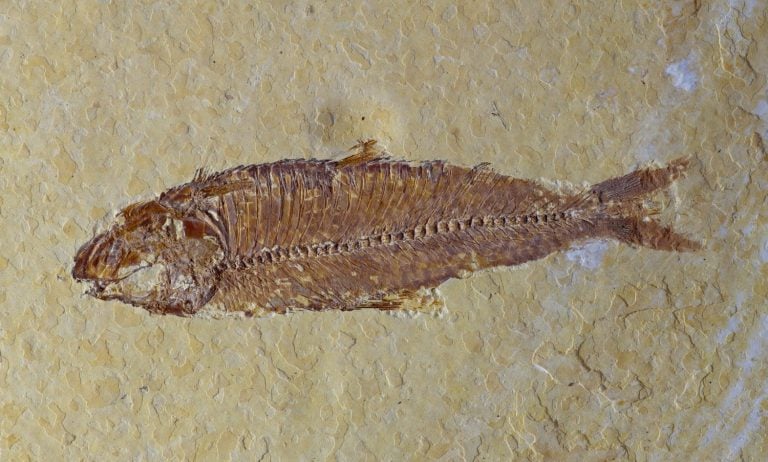
- The flounder fish probably evolved more than 50 million years ago. One fossil from that period demonstrates that some species of flatfish had already evolved an eye on the top of the head.
- As cuisine, flounder fish is commonly broiled or grilled.
Classification and Scientific Name
The term flounder fish does not refer to only one species. This has often inspired quite a lot of confusion among people. Instead, it refers to many different species of flatfish that are part of four distinct families: Achiropsettidae, Pleuronectidae, Paralichthyidae, and Bothidae. All of these families are classified within the order Pleuronectiformes. However, not every member of this order is a flounder fish, because it also includes the dabs, brills, soles, and others. Together, these creatures belong to the class of ray-finned fish known as the Actinopterygii.
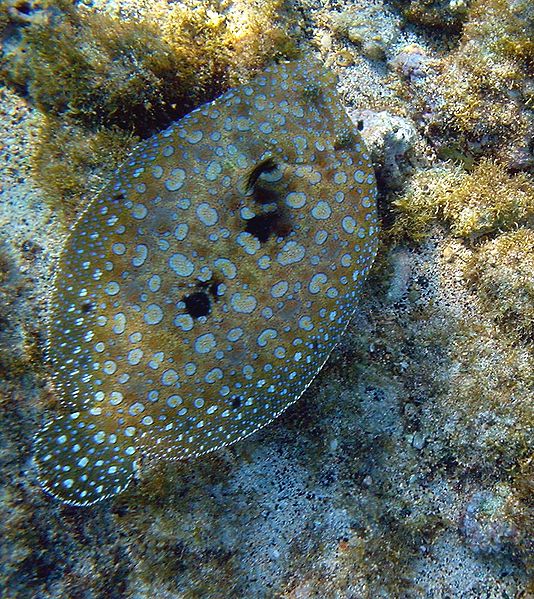
There are hundreds of species of flatfish, with flounder generally divided into right-eyed and left-eyed families.
©Moondigger, CC BY-SA 2.5, via Wikimedia Commons – Original / License
Species
The flounder fish is generally divided into right-eyed and left-eyed families. The right-eyed family of Pleuronectidae contains some 100 different species. The left-eyed families of Bothidae and Paralichthyidae contain approximately 240 species. The fourth family, Achiropsettidae, has only a few species in it. Here are just a few examples of common flounder species:
- European Flounder Fish (Platichtys flesus): This species occupies a large stretch of territory between the coasts of North Africa in the west, the Black Sea in the east, and the Baltic Sea in the north. The body is olive green or pale brown and has an almost diamond shape, with the fins included.
- Summer Flounder fish (Paralichthys dentatus): This species occupies the Atlantic coast of the United States and Canada. It has a dark gray or brown color and rounded fins.
- Dusky Flounder fish (Syacium papillosum): Measuring up to 12 inches, this species has a very long appearance and features tan or brown scales. It resides in a stretch of water between the Gulf of Mexico and the Yucatan Peninsula.
- Winter Flounder fish (Pseudopleuronectes americanus): Also known as black back, this flounder is a right-eyed flatfish native to the coastal waters of the western North Atlantic coast, from Labrador, Canada, to Georgia, United States.
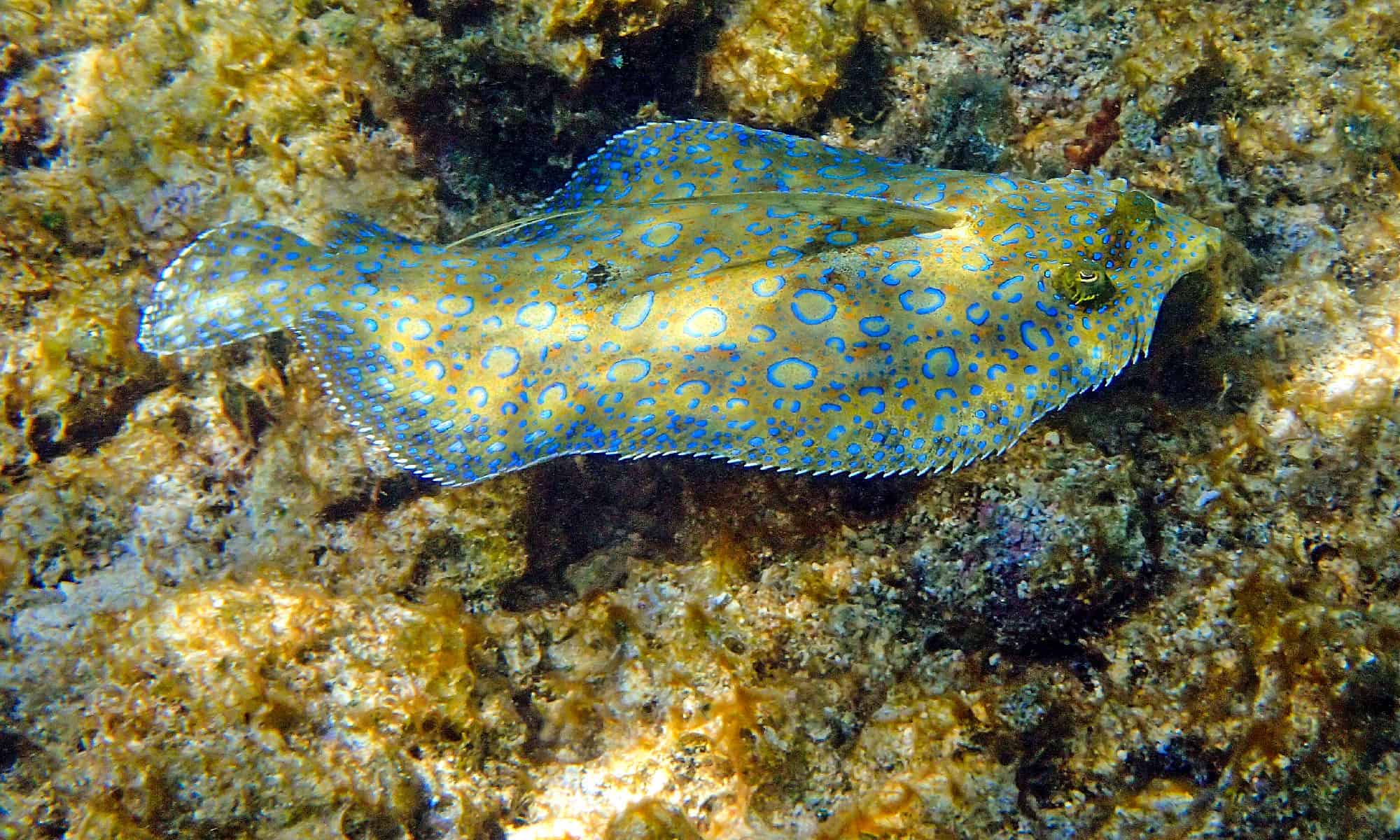
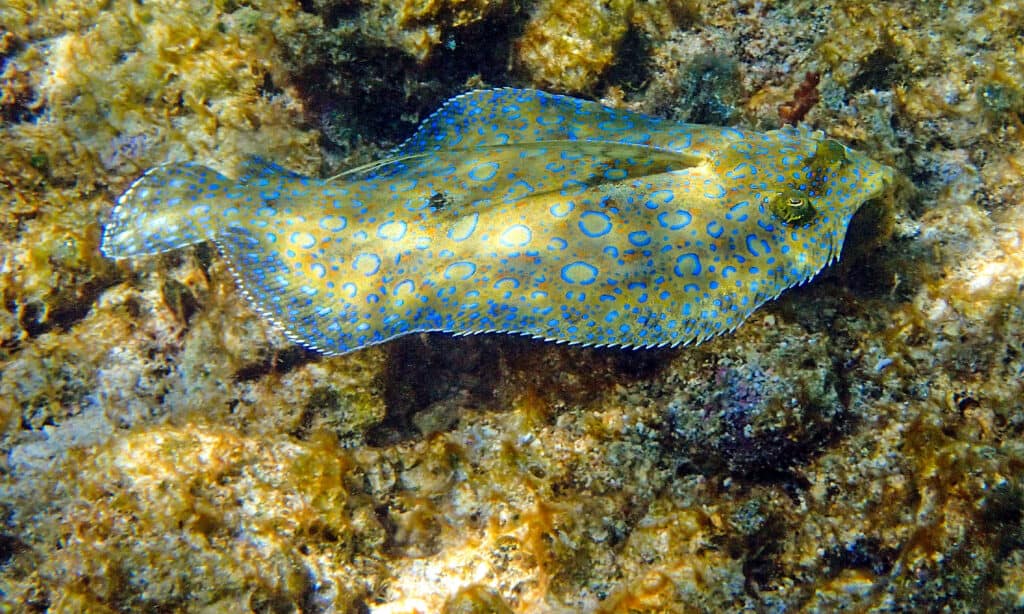
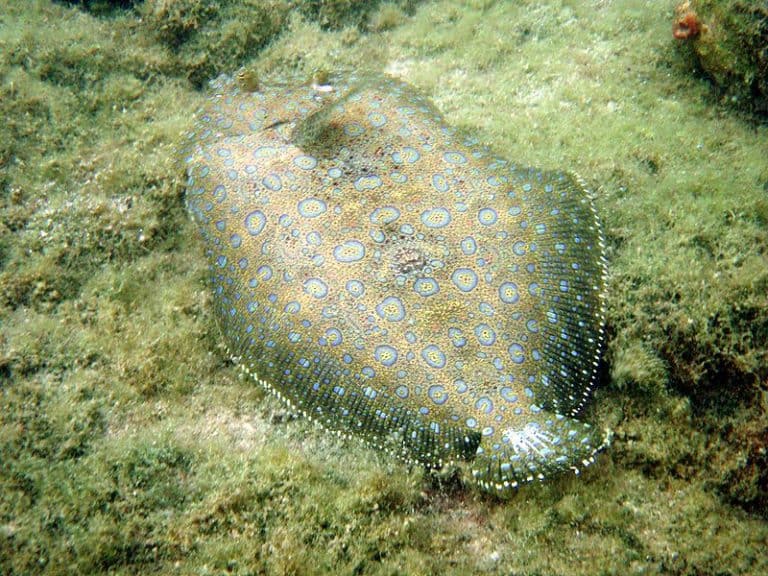
- Peacock Flounder fish (Bothus mancus): Also known as the flowery flounder, this flounder is blue, pink, and yellow like the sands of the shallow waters of the Indo-Pacific where it resides.
- European Plaice (Pleuronectes platessa): This right-eyed flat fish is known for its sweet and mild flavor with a firm yet juicy texture. It inhabits the muddy bottoms of the European shelf from the Barents Sea to the Iberian Peninsula and around Iceland.
- Arrowtooth Flounder fish (Atheresthes stomias): This is the most common fish in the Gulf of Alaska and can be caught as far south as Santa Rosa Island, California. It is named for its menacing set of sharp, arrow-like teeth.
- Olive Flounder fish (Paralichthys olivaceus): This rare flounder is also called Korean halibut, Korean flatfish, or Japanese flatfish. It is a large-tooth flounder native to the North-western Pacific Ocean and has been popularized by the game, “Animal Crossing.”
- Atlantic Halibut (Hippoglossus hippoglossus): These flatfish are now endangered due to overfishing. They live on sand, gravel, or clay ocean bottoms at depths of between 50 and 2,000 miles. They are found all around the North Atlantic, including around Greenland and the waters off southern New England in the west, and Iceland and Europe in the east.
- Starry Flounder fish (Platichthys stellatus): Also known as the grindstone, emery wheel, and long-nosed flounder, this common fish is found around the North Pacific.
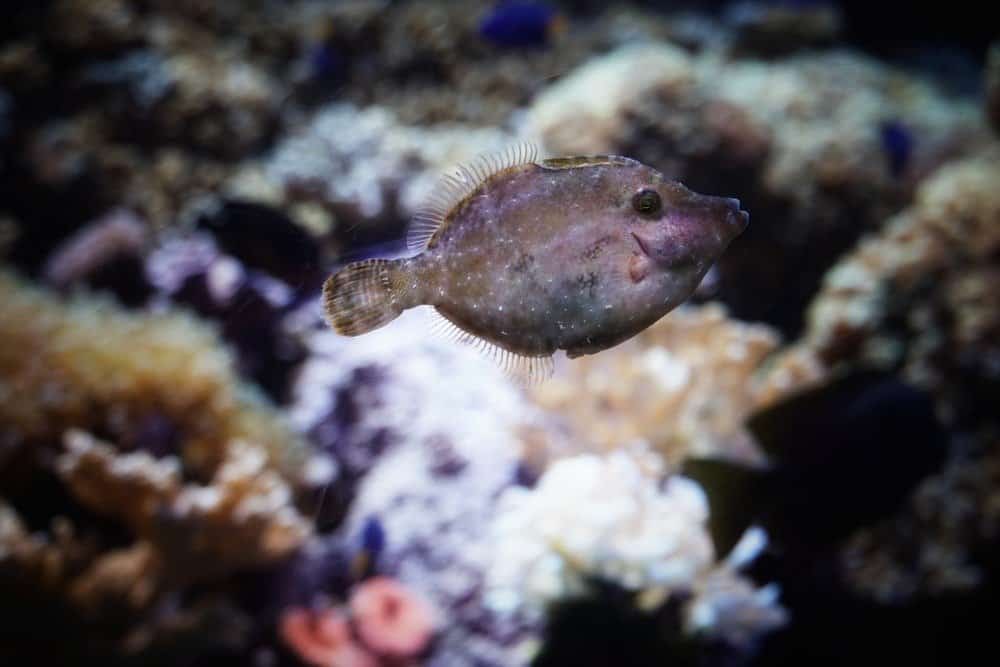
Just as flounders started as regular fish about 50 million years ago, before they evolved, they start life the same way today.
©Gaurav Ruke/Shutterstock.com
Evolution
Flatfish in the flounder family are the most asymmetric animals on the planet — and, believe it or not, they weren’t born that way. They start their lives as normal little fish with swim bladders and eyes on either side of their head before they transform into their strange Picasso fish adult form. In a snapshot of evolution, their eyes shift to the top, their swim bladders shrink, and their fins become almost useless in a matter of weeks. They begin life as lively little fish before they sink to the bottom to “flounder around” on the bottom of the ocean floor.
All of this strange morphology started about 50 million years ago, and within three million years, their evolution was largely complete. Three million years, in evolutionary time, is a blink of an eye. Flatfish species are so dissimilar that it was almost impossible for scientists to track the degree of integration between different regions of the skull across the 65-million-year history of flatfishes and their relatives without the creation of complex mathematical models. They found that in flatfishes, the evolution of asymmetry involved changes all across the skull. As the eye migrated, other changes occurred, and it became additive.
There is still no explanation for why flatfishes like flounders changed so rapidly and drastically, almost violently, and fish like stingrays just gradually went flat. Sometimes the weirdness of nature is the most amazing thing about it.
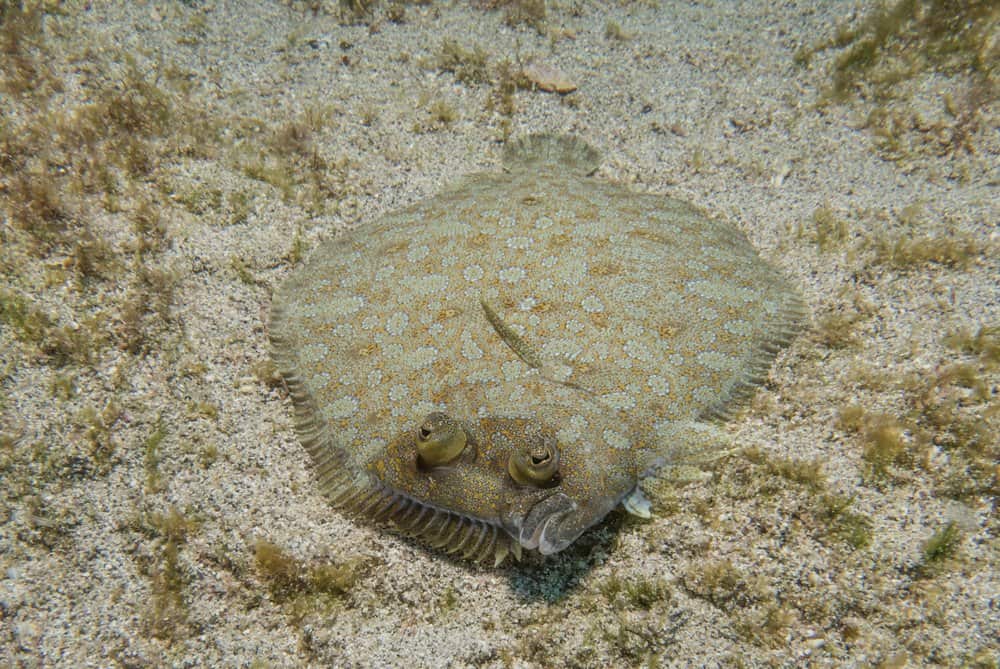
Flounders are flat with two big eyes located on the same side of the head
©Becky Gill/Shutterstock.com
Appearance
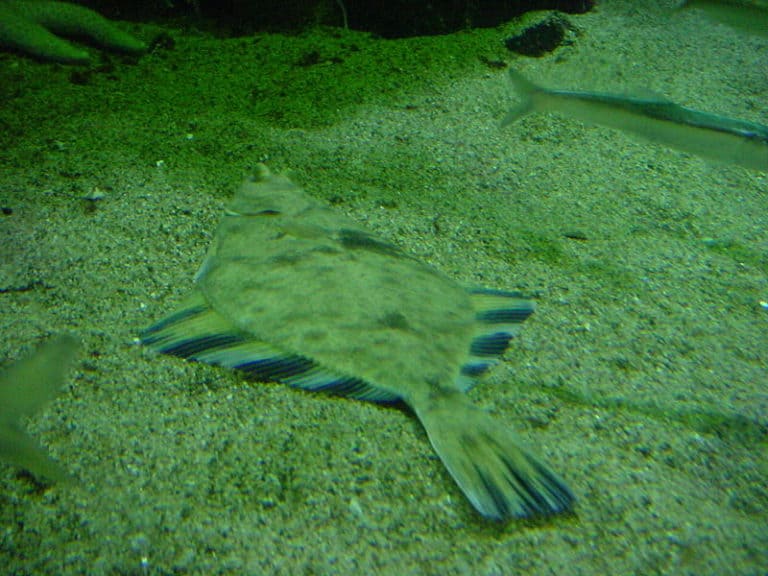
The flounder has an unusually flat appearance that’s well-suited for its bottom-dwelling lifestyle. To see everything above it, the flounder has two big, round eyes located on the same side of the head. These eyes can also move independently of each other.
The typical flounder specimen measures somewhere between five and 25 inches in length (the largest ever recorded was some 37 inches) and up to 22 pounds in weight. This doesn’t quite capture its true size, however, since the flounder has a massive surface area thanks to its round or oval body.
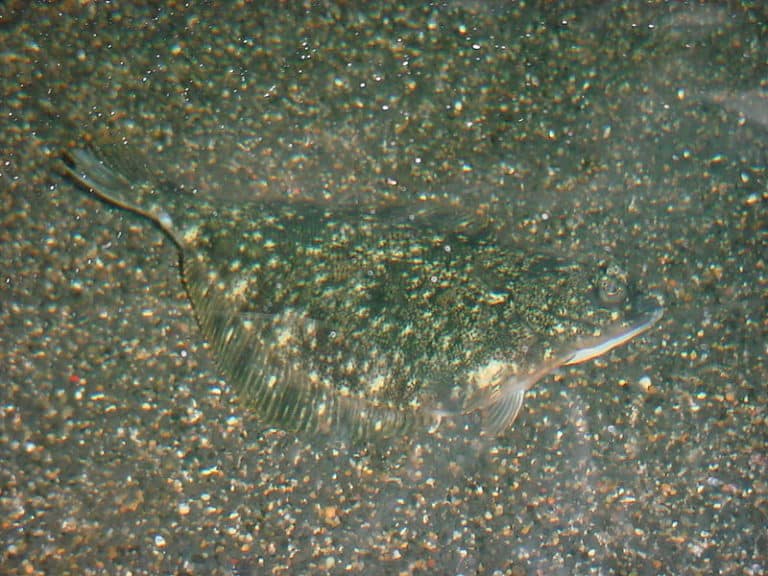
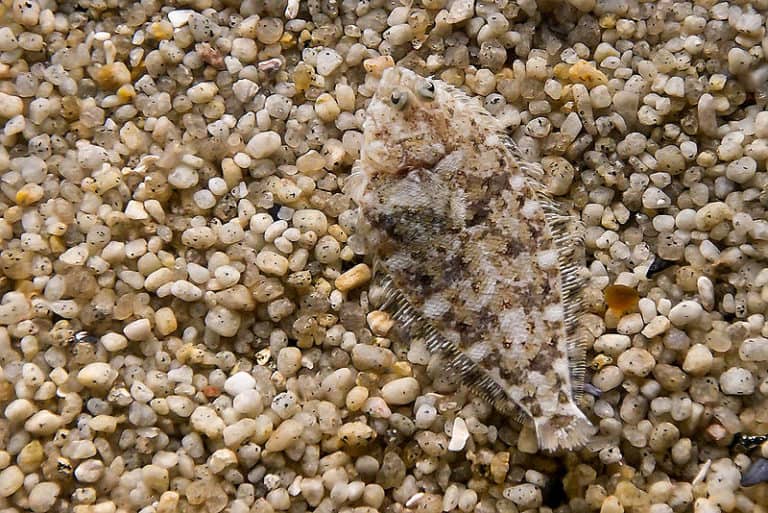
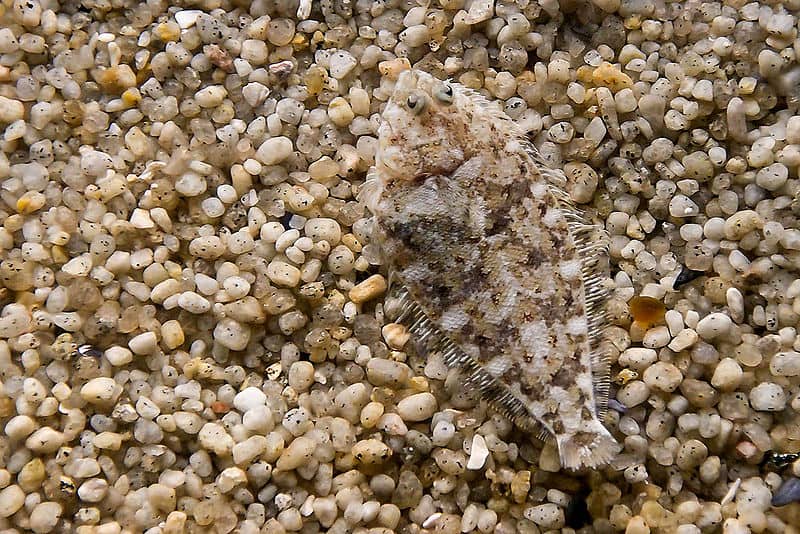
The flounder’s scales act as camouflage, which makes it difficult for both predators and prey to detect it against the muddy or sandy ocean bottom. Some species can actively change their color to blend in with the seabed. This has the dual purpose of signaling the emotional state of the fish. For instance, a pale color may be a sign that the creature feels threatened.
The flounder comes in a huge range of different colors and patterns, depending on the composition of the sediment in which it resides. The slate of orange, brown, green, white, or tan colors is normal.
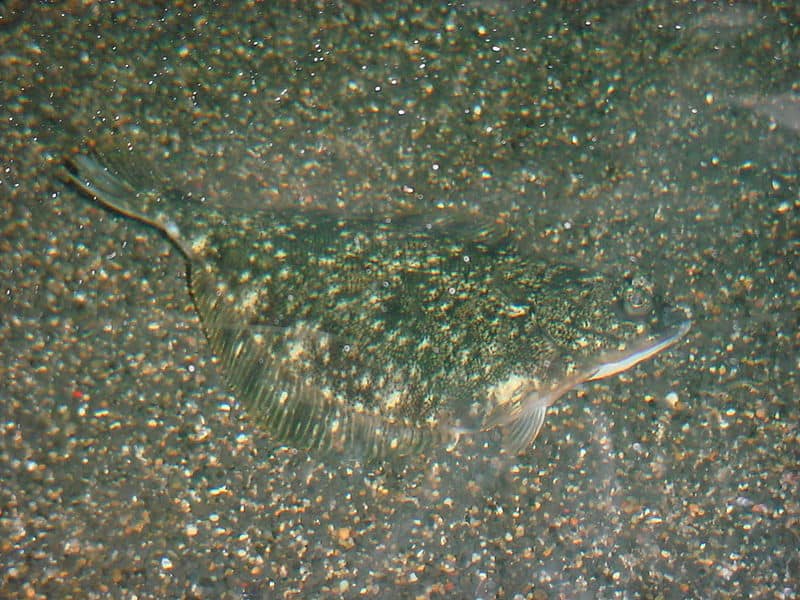
Flounders can perfectly camouflage themselves on the seafloor.
©Dark jedi requiem – Public Domain
Distribution, Population, and Habitat
The flounder dwells at the bottom of oceans and seas near docks, bridges, and coral reefs. Its main areas of occupancy include the tropical and temperate waters along the coasts of Europe, North America, Africa, and Asia. Some species also reside much farther north near the Arctic.
It is estimated that some 30 million flounders are still alive across the entire world’s oceans, but pollution, habitat change, and overfishing in the 20th and 21st centuries have depleted some stocks. For many species of flounder, there is not enough data to fully estimate their conservation status. But when data is known, the vast majority of species appear to be in good health.
The conservation tracker, IUCN Red List, believes that most of them are of least concern. However, the continued depletion of fish stocks may threaten many species in the future.
In the United States, the National Oceanic and Atmospheric Administration is the main governmental body in charge of carefully managing flounder numbers. The administration uses scientific data to determine how much of the flounder population can be harvested for the following year, and then it allocates resources accordingly between commercial and recreational catches to ensure that enough stocks are present to repopulate the waters.
Predators and Prey
The flounder fish is primarily a nocturnal carnivore that thrives on a diet of shrimp, crabs, and other fish. Smaller species may consume worms and plankton as well. The exact composition of the diet varies quite a bit by location and species. The flounder is an ambush predator that lies motionless on the ocean or sea floor, blending in with the environmental surroundings, and then quickly snaps up the unsuspecting prey with its sharp teeth.
Because of its relatively large size, the flounder has only a few natural predators, such as sharks, eels, and humans. Camouflage offers the best means of protection. When exposed, however, it is very vulnerable to larger predators due to the lack of other natural defenses.
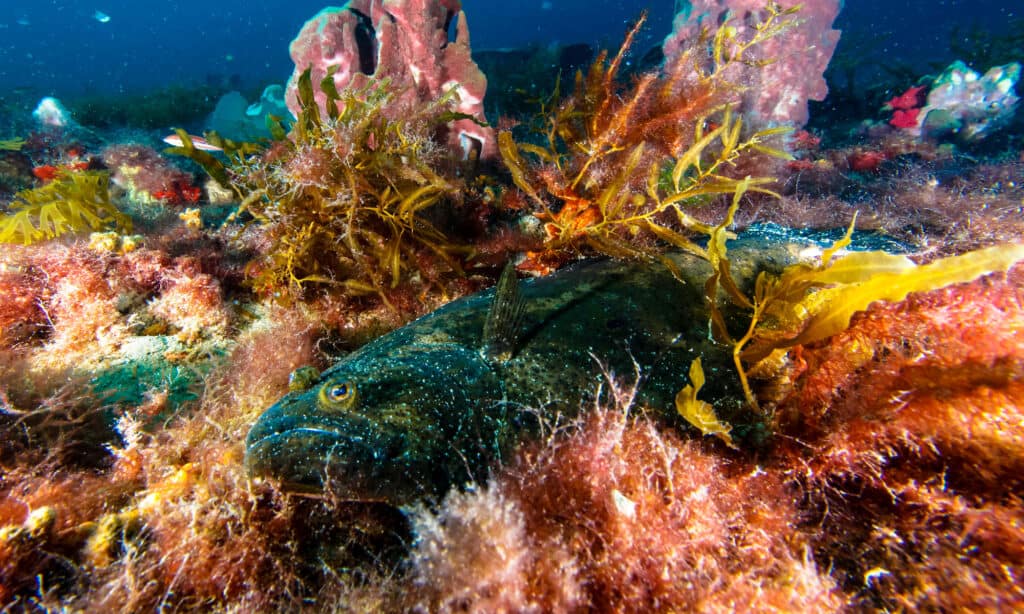
Flounders breed during the warmer months when food is plentiful.
©Porco_Rosso/Shutterstock.com
Reproduction and Lifespan
The flounder’s breeding season usually takes place during the warmer months. The female will release more than 100,000 (and sometimes millions of) eggs from her body, and the male will release his sperm to fertilize them. After a few weeks, the young fry will hatch from the eggs. The spawning is usually timed perfectly with the most productive and bountiful season of the year for food.
At birth, the flounder fish looks like a typical fish. It is born with a standard symmetrical appearance with eyes located on both sides of its head, and also swims around the ocean like a fish.
After a few days of this, the flounder undergoes significant physical changes in which the body begins to flatten out, the swimming bladder (which provides buoyancy) reduces in size, and one eye begins to migrate to the other side of the fish. Once it has fully developed, the flounder tends to live some three to 10 years in the wild.
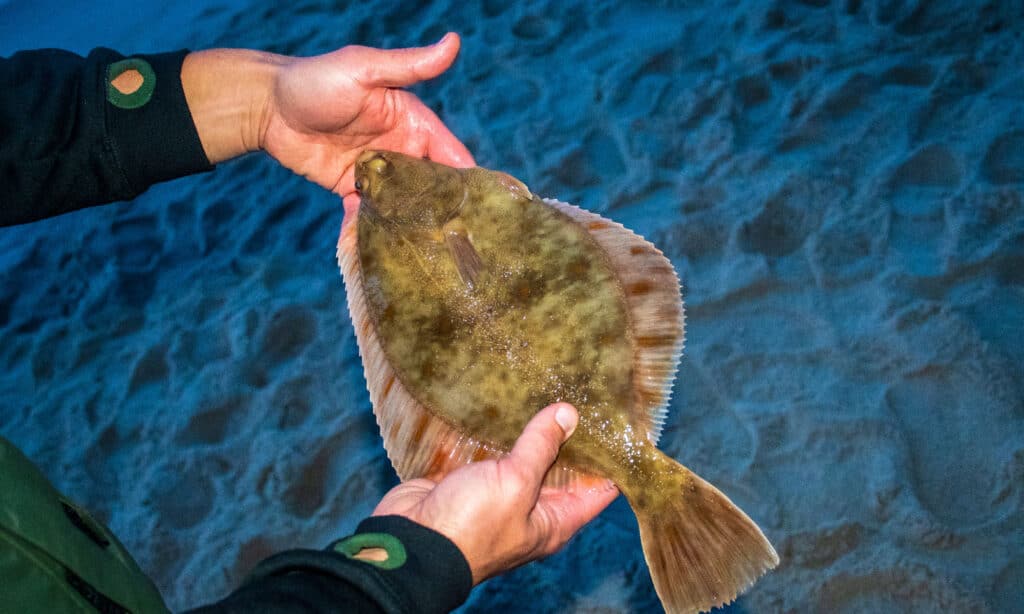
Flounder is caught, cooked, and enjoyed in delicious dishes all over the world.
©Michele Ursi/Shutterstock.com
Fishing and Cooking
Captured for both recreational and commercial purposes, the flounder is one of the most popular deep-sea fish to eat around the world. It is commonly fried, broiled, or grilled, but it is cooked in so many different ways and served with so many different foods that the variety is truly staggering. The mild taste goes well with all kinds of sauces, herbs, spices, vegetables, and cheeses.
Flounder Pictures
View all of our Flounder pictures in the gallery.

CT Johnson/Shutterstock.com
Sources
- David Burnie, Dorling Kindersley Animal, The Definitive Visual Guide To The World's Wildlife / Accessed January 4, 2010
- Tom Jackson, Lorenz Books The World Encyclopedia Of Animals / Accessed January 4, 2010
- David Burnie, Kingfisher The Kingfisher Animal Encyclopedia / Accessed January 4, 2010
- Richard Mackay, University of California Press The Atlas Of Endangered Species / Accessed January 4, 2010
- David Burnie, Dorling Kindersley Illustrated Encyclopedia Of Animals / Accessed January 4, 2010
- Dorling Kindersley Dorling Kindersley Encyclopedia Of Animals / Accessed January 4, 2010
- Britannica / Accessed November 19, 2020
- Soft Schools / Accessed November 19, 2020
- Fishing Booker / Accessed November 19, 2020