

S
Species Profile

Sumatran Tiger

Panthera tigris sumatrae

Sumatra's last Sunda-island tiger
Wilfried Berns / Creative Commons

Sumatran Tiger Distribution

Click a location to explore more animals from that region

Endemic Species
Loading map...

Found in 1 country

Size Comparison

Human 5'8"
Sumatran Tiger 2 ft 4 in

Sumatran Tiger stands at 41% of average human height.

Sumatran Tiger standing on grass

At a Glance

Wild Species
Also Known As Tiger, Harimau, Striped cat, Striped big cat, Big cat
Diet Carnivore
Activity Crepuscular+
Lifespan 12 years
Weight 140 lbs
Did You Know?

Smallest extant tiger form: adult males commonly ~100-140 kg; adult females ~75-110 kg (Nowell & Jackson, 1996; Sunquist & Sunquist, 2002).

Scientific Classification

The Sumatran tiger is the only surviving wild tiger population in the Sunda Islands, adapted to Sumatra’s forests and wetlands. It is the smallest extant tiger form and is noted for dense striping and a pronounced ruff in males.

Kingdom
Animalia
Phylum
Chordata
Class
Mammalia
Order
Carnivora
Family
Felidae
Genus
Panthera
Species
Panthera tigris

Distinguishing Features

  • Generally smaller body size than mainland tiger subspecies
  • Dense, narrow striping; often more numerous stripes
  • Males frequently show a more developed neck ruff
  • Island/endemic distribution: Sumatra only

Physical Measurements

Males and females differ in size

Height
2 ft 3 in (1 ft 12 in – 2 ft 6 in)
2 ft 2 in (1 ft 12 in – 2 ft 6 in)
Length
1 in (1 in – 1 in)
7 ft 7 in (7 ft 1 in – 8 ft)
Weight
265 lbs (220 lbs – 309 lbs)
198 lbs (165 lbs – 243 lbs)
Tail Length
2 ft 7 in (2 ft 1 in – 3 ft 2 in)
2 ft 7 in (2 ft 6 in – 2 ft 9 in)
Top Speed
40 mph
running

Appearance

Primary Colors
Secondary Colors
Skin Type Fur (dense short-to-medium pelage with underfur; facial whiskers prominent).
Distinctive Features
  • Smallest extant tiger subspecies; adult male about 100-140 kg, female about 75-110 kg (Nowell & Jackson, 1996; Mazak, 1981).
  • Head-body length typically male about 220-255 cm total, female about 215-230 cm total; tail about 80-100 cm (Nowell & Jackson, 1996).
  • Shorter limbs and compact build relative to mainland tigers, suited to dense forest/peat-swamp cover.
  • Dense, narrow striping with many stripes extending onto legs and underparts; strong camouflage in rainforest shadows.
  • Male has a pronounced neck/cheek ruff ("mane-like" facial ruff) that is reduced in females.
  • Distinct white ocelli ("eye-spots") on ear backs bordered by black, used in intraspecific signaling.
  • Large forepaws with retractile claws; heavily muscled shoulders for grappling prey in closed habitats.
  • Wild longevity commonly ~10-15 years; captive individuals can reach ~20-26 years (species-level husbandry records; e.g., AZA/ISIS summaries; Sunquist & Sunquist, 2002).
  • Typical behavior: solitary and territorial; scent-marking (urine spray/scrapes) and mainly crepuscular-nocturnal activity (Sunquist & Sunquist, 2002).
  • Dark, deep orange coat with relatively narrow, closely spaced black stripes; males often show a noticeable mane-like neck ruff and beard compared with many mainland tigers.

Sexual Dimorphism

Males are substantially heavier and more robust, with broader heads and thicker necks. Males also show a conspicuous cheek-and-neck ruff, while females are smaller and more lightly built with reduced ruffing.

  • Typically larger mass and more robust torso (commonly ~100-140 kg).
  • Broader skull and thicker neck musculature.
  • Pronounced cheek/neck ruff; facial hair longer and fuller.
  • Larger forepaws and overall heavier limb bone proportions.
  • Typically smaller mass and lighter build (commonly ~75-110 kg).
  • Narrower head and less massive neck/shoulders.
  • Ruff minimal or absent; facial hair shorter.
  • Overall more gracile proportions, aiding maneuverability in dense cover.

Did You Know?

Smallest extant tiger form: adult males commonly ~100-140 kg; adult females ~75-110 kg (Nowell & Jackson, 1996; Sunquist & Sunquist, 2002).

Distinctive coat: narrower, denser striping than many mainland tigers and (in males) a noticeable neck ruff/beard-features frequently noted in museum/zoo morphology descriptions (Mazák, 1981; Sunquist & Sunquist, 2002).

Forest-and-wetland specialist: occurs in lowland rainforest, hill/montane forest, and peat-swamp mosaics; it can move through dense understory where larger-bodied tigers are less maneuverable (IUCN Red List-Sunda tiger).

Radio-telemetry in Bukit Barisan Selatan NP recorded female home ranges of 27 km² and 45 km² and a male home range around 100 km² (Franklin et al., late-1990s field studies).

Diet in Sumatra includes wild boar (Sus scrofa), sambar deer (Rusa unicolor), muntjac (Muntiacus spp.), and occasionally Malayan tapir (Tapirus indicus) where ranges overlap (Sunquist & Sunquist, 2002; Sumatra field reports).

Conservation reality: the primary threats are habitat loss/fragmentation (including conversion and infrastructure) and poaching for illegal trade (IUCN Red List-Sunda tiger; TRAFFIC/WWF syntheses).

Unique Adaptations

  • Compact body plan relative to other tiger lineages: smaller average mass (males ~100-140 kg; females ~75-110 kg) likely improves movement efficiency in dense rainforest/peat-swamp vegetation compared with larger mainland forms (Nowell & Jackson, 1996; Sunquist & Sunquist, 2002).
  • Dense, narrow striping: provides disruptive camouflage in high-contrast rainforest light (sunflecks and shadow bands) and reed/fern edges common in Sumatra's forest-wetland ecotones (morphology/natural history descriptions: Mazák, 1981; Sunquist & Sunquist, 2002).
  • Male neck ruff ("mane-like" fur): more pronounced than in many other tiger populations; may aid in intraspecific display and protection during fights (noted in subspecies descriptions: Mazák, 1981).
  • Broad paws with retractile claws and rough tongue papillae: classic tiger adaptations enabling silent footing on soft forest soils, powerful traction on muddy banks, and efficient meat-scraping from bone (Panthera tigris functional anatomy).
  • Sunda-island lineage isolation: long-term separation from mainland populations contributed to distinctive genetic/morphological identity within the Sunda group (basis for the P. t. sondaica grouping; Cat Specialist Group taxonomy update, 2017).

Interesting Behaviors

  • Solitary, territorial adults: both sexes maintain exclusive core areas and advertise ownership with scent marks (urine spraying) and scrapes; boundaries are reinforced by vocalizations (roars) and tree-scratching (Sunquist & Sunquist, 2002).
  • Home-range overlap pattern: males typically encompass the ranges of multiple females; the Sumatra telemetry estimates (27-45 km² females; ~100 km² male) illustrate this spacing system in rainforest landscapes (Franklin et al.).
  • Ambush hunting in closed-canopy forest: relies on short stalks and sudden rushes using cover (buttress roots, rattan thickets, stream edges); kills are commonly throat/neck bites typical of Panthera tigris (Sunquist & Sunquist, 2002).
  • Strong affinity for waterways: like other tigers, it readily swims and uses river/stream corridors as travel routes in swamp-forest mosaics-useful in peatlands and seasonally flooded areas (IUCN habitat notes; tiger natural history).
  • Caching and revisiting kills: large prey are often dragged into cover and fed on over multiple bouts, with vigilance behaviors increasing where human disturbance is high (tiger field ecology syntheses).
  • Cub rearing: females raise litters alone; cubs remain dependent for roughly 18-24 months (general tiger life history; applied to Sunda/Sumatran populations in IUCN accounts).

Cultural Significance

The Sumatran tiger (Panthera tigris sumatrae) is seen as a forest ruler, moral guide, and ancestor spirit in Minangkabau and other Sumatran traditions. This view shapes taboos, stories, and rituals about entering tiger habitat and proper behavior.

Myths & Legends

Minangkabau "grandparent tiger" honorific: in West Sumatra, tigers are sometimes addressed with respectful kinship titles meaning "grandparent" or "elder," reflecting beliefs that a tiger may be an ancestral guardian rather than a mere beast.

Were-tiger traditions: Sumatran and wider Malay folklore includes accounts of humans who can become tigers-often linked to inheritance, secret knowledge, or transgression-appearing at night to punish wrongdoing or settle feuds.

Elder-spirit tiger guardians of the forest: in several Sumatran storytelling traditions, a venerable spirit-like tiger protects certain groves, springs, or mountain slopes; harming it or breaking taboos invites misfortune.

Stories of the Sumatran Tiger (Panthera tigris sumatrae) show it acting as a judge: it faces thieves, oath-breakers, and proud hunters, sparing respectful people but punishing those who break forest custom.

People say you must speak politely about the Sumatran tiger (Panthera tigris sumatrae). Boastful or careless talk can draw its attention, so people use polite titles and roundabout words to avoid offense.

Conservation Status

CR Critically Endangered

Facing an extremely high risk of extinction in the wild.

Population Decreasing

Protected Under

  • CITES Appendix I (commercial international trade prohibited)
  • Indonesia Law No. 5/1990 on Conservation of Living Resources and Their Ecosystems
  • Indonesia Government Regulation No. 7/1999 (protected species provisions)
  • Indonesia Ministry of Environment and Forestry Regulation P.106/2018 (Protected Plant and Animal Species)

Life Cycle

Birth 2 cubs
Lifespan 12 years

Lifespan

In the Wild
8–20 years
In Captivity
16–26 years

Reproduction

Mating System Polygynandry
Social Structure Solitary
Breeding Pattern Transient
Fertilization Internal Fertilization
Birth Type Internal_fertilization

Adults are solitary; male home ranges overlap multiple females, and females may mate with more than one male during a 3-6 day estrus. Pairing is brief (days-weeks). Internal fertilization; gestation ~93-112 days; females rear litters (typically 2-3) alone.

Behavior & Ecology

Social Streak Group: 1
Activity Crepuscular, Nocturnal, Cathemeral
Diet Carnivore Medium-to-large ungulates-especially sambar deer (Rusa unicolor) and wild boar (Sus scrofa vittatus)-where locally abundant (e.g., Kerinci Seblat landscape studies: Linkie et al.).

Temperament

Strongly territorial and solitary; overlap is limited and often time-shared, especially by males.
Primarily ambush predator; uses dense forest cover and short-distance rushes typical of Panthera tigris hunting.
Avoids humans when possible; defensive aggression most likely when cornered or with cubs.
Maternal behavior is highly protective; cub dependency typically ~18-24 months (Sunquist & Sunquist, 2002).
Reproductive grouping is brief; adult associations outside mating and mother-offspring are uncommon.

Communication

roar Long-distance advertisement, spacing, and reproductive context
chuff/prusten Friendly, close-range greeting; often between mother and cubs
growl Agonistic warning at close range
hiss Defensive threat at very close range
moan/low call Contact or mild agitation
caterwaul/mating call Estrus advertisement
urine spraying on vegetation to deposit scent and signal occupancy
ground scraping with hind feet to leave visual and scent cues Often with urine
fecal deposition at conspicuous sites as territorial markers
cheek/neck rubbing on objects to deposit facial gland scents
claw raking/scratch marks on trees as persistent visual signals
body postures and facial expressions (ear position, tail movement) for close-range signaling

Habitat

Biomes:
Tropical Rainforest Wetland Freshwater
Terrain:
Mountainous Hilly Plains Valley Coastal Island Riverine Muddy Volcanic +3
Elevation: Up to 10498 ft 8 in

Ecological Role

Apex predator of Sumatra's forest and wetland ecosystems (lowland rainforest, peat-swamp, and montane forest), structuring prey communities and trophic dynamics.

Top-down regulation of ungulates and suids (e.g., sambar, muntjac, wild boar), which can reduce overbrowsing/seedling suppression and help maintain forest regeneration dynamics. Stabilizes community structure by suppressing potential mesopredator release and altering prey behavior ("landscape of fear"), affecting habitat use and foraging patterns. Carrion provisioning: partially consumed kills support scavengers and decomposer food webs (e.g., civets, monitor lizards, birds). Umbrella/indicator function: conserving tiger habitat and prey base protects large contiguous forest blocks and associated biodiversity.

Diet Details

Main Prey:
Sambar deer Red muntjac Wild boar Greater mouse-deer Lesser mouse-deer Sumatran serow Malayan tapir Porcupine Primates Livestock +4

Human Interaction

Domestication Status

Wild

Danger Level

High
  • severe injury or fatality from predatory attack (rare but possible, especially in edge habitats with reduced prey)
  • defensive attacks when surprised, cornered, or when a female has cubs
  • high-risk scenarios during capture/translocation, snare removal, or illegal keeping/handling
  • zoonotic and bite-wound infections (secondary risk associated with attacks or handling)
  • property/livelihood impacts that elevate human risk: livestock depredation leading to close-range encounters or retaliation attempts

As a Pet

Not Suitable as Pet

Legality: Sumatran Tiger (Panthera tigris sumatrae) is not a legal pet in most places. CITES Appendix I bans trade; Indonesia and many countries forbid private ownership. In the US, ESA limits ownership to zoos, sanctuaries, or licensed holders.

Care Level: Expert Only

Purchase Cost: Up to $20,000
Lifetime Cost: $250,000 - $1,500,000

Economic Value

Uses:
Ecotourism / wildlife viewing value (flagship species) Conservation funding leverage (flagship/umbrella role) Zoo and education value (ex situ display and outreach) Scientific research value (ecology, genetics, disease surveillance) Negative economic impacts (livestock depredation, human safety costs) Illegal wildlife trade value (high black-market incentive)
Products:
  • tourism revenue linked to protected areas and wildlife experiences
  • zoo admissions and conservation-donation fundraising
  • research outputs (population monitoring, camera-trap datasets, genetic samples)
  • conflict-related costs (livestock losses, compensation/mitigation spending)
  • illegal products: skins/pelts, teeth and claws (ornaments), bones (traditional-medicine trade), other parts sold as curios

Relationships

Ecological Equivalents 4

Animals that fill a similar ecological role in their ecosystem

Sunda clouded leopard Neofelis diardi Co-occurs with Sumatran tigers in Sumatra's Sundaic forests; both are felid predators that share prey (primates, ungulates) and inhabit lowland to montane forests, but Sunda clouded leopards are more arboreal and take smaller prey.
Dhole
Dhole Cuon alpinus Forest-dwelling hypercarnivore that overlaps spatially with tigers in Sumatra and targets similar ungulate prey (e.g., deer, pigs). Both occupy a similar niche as predators of medium-to-large ungulates, but the dhole hunts socially in packs whereas the Sumatran tiger is solitary and uses ambush-based hunting.
Saltwater crocodile Crocodylus porosus Co-occurs along wetland and riverine edges in parts of Sumatra; occupies an apex-predator niche at aquatic interfaces and can compete for or scavenge large prey carcasses. Also poses a credible predation risk at water crossings, especially for juveniles.
Sun bear
Sun bear Helarctos malayanus Sympatric large-bodied carnivore/omnivore in Sumatran forests. Both are wide-ranging, forest-dependent predators/scavengers that use dense cover and can interact via carcass competition, although the sun bear's diet is much more omnivorous (fruits and invertebrates) compared with the tiger's primarily ungulate-based diet.

Last of the Sunda Island Tigers


Majestic but increasingly vulnerable, Sumatran tigers are on the verge of extinction. A century ago, they roamed the Sunda islands in western Indonesia. Today, only a small number on Sumatra Island remains. Conservationists are diligently working to preserve the species, but their efforts aren’t outpacing the deadly habitation destruction and poaching. Researchers predict that if things don’t quickly take a turn for the better, Sumatran tigers will be the first large cat to go extinct in the 21st century.
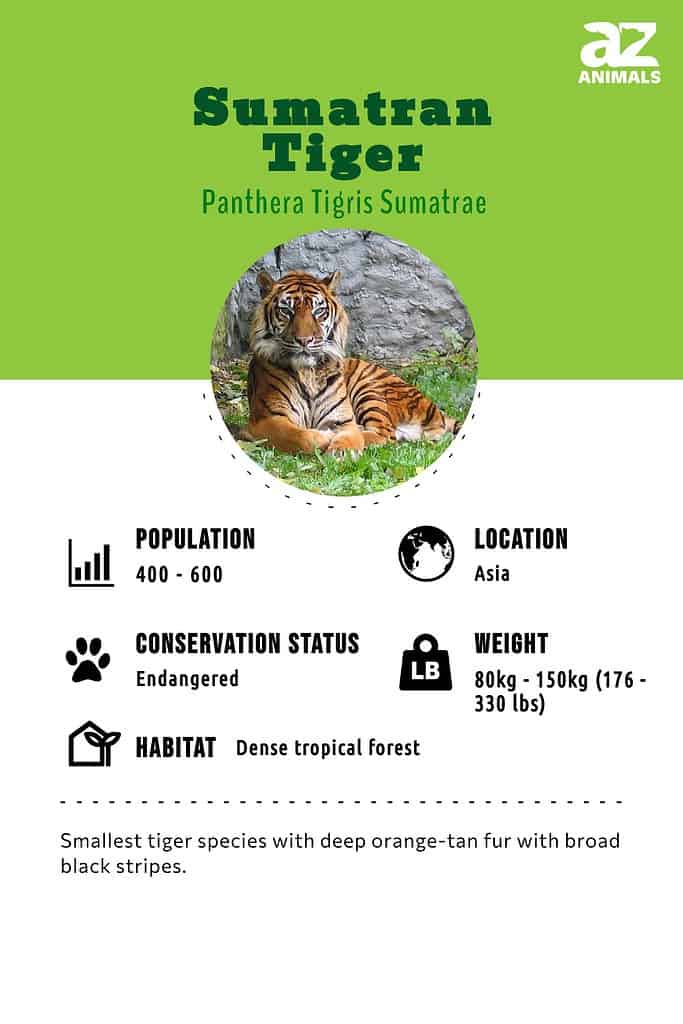


Seven Fascinating Facts About Sumatran Tigers

  • Between 12,000 and 6,000 years ago, after the sea level significantly rose, Sumatran tigers became isolated from mainland tigers.
  • Sumatran tigers have deeper orange-tan fur and broader stripes than other tiger species.
  • Nearly 50 percent of tiger cubs don’t live past two years old.
  • About 250 Sumatran tigers live in captivity at reputable conservation-focused zoos around the world.
  • Seventeenth-century aristocrats kept tigers in their castles as symbols of their status and power.
  • In a global 2004 Animal Planet survey, people worldwide chose tigers as their favorite animal, narrowly beating out the dog.
  • Sumatra Island is the planet’s real-life Jungle Book; it’s the only place where tigers, rhinos, orangutans, and elephants live together in the wild.

Sumatra Island is the planet’s real-life Jungle Book; it’s the only place where tigers, rhinos, orangutans, and elephants live together in the wild.

Scientific Name

The scientific name for the Sumatran tiger is Panthera tigris sondaica. Panthera derives from the classical Latin word “panthēra” and the Ancient Greek “pánthēr.” Linguists surmise the word is a portmanteau of “pâs,” which means “all” in Ancient Greek, and “thḗra,” which means “that which is hunted.”

Sometimes, you may see the scientific name listed as Panthera tigris sumatrae, but recent genetic research triggered a taxonomic change to Panthera tigris sondaica.
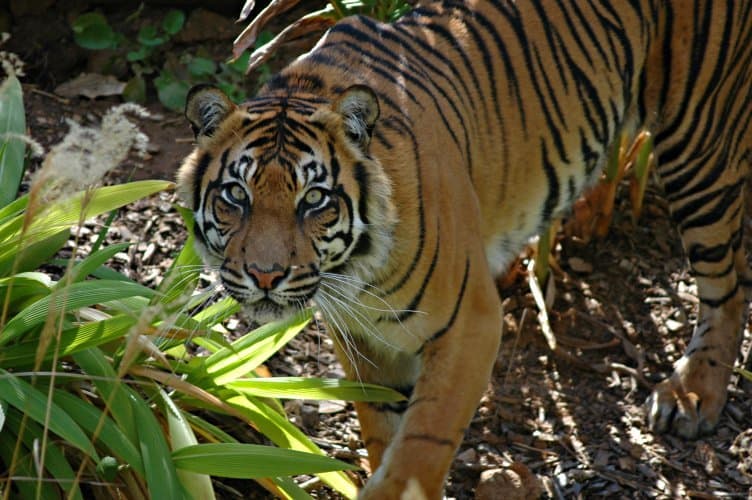
Sumatran Tiger under trees

Like all tigers, Sumatran tigers are closely related to snow leopards.

Evolution

The earliest fossil record of a tiger was found in China and is believed to have lived two million years ago during the Pleistocene era. This evidence suggests that tigers originated in what is now China with Panthera zdanskyi, the Longdan tiger, being the most primitive tiger species. By the end of the Pleistocene, tigers had spread to the north of Asia, India, the bridge of Beringia, the island of Sakhalin, and Japan.

The genus, Panthera, made up of tigers, lions, leopards, and jaguars are all closely related to each other. In 2010, it was discovered that tigers are more closely related to the snow leopard – and that they diverged from the rest of the group 3.2 million years ago.

Appearance and Behavior
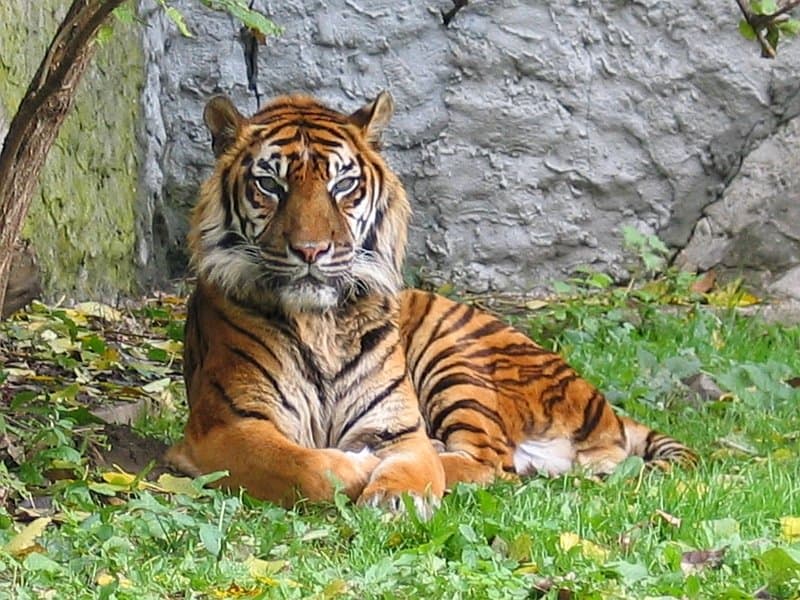
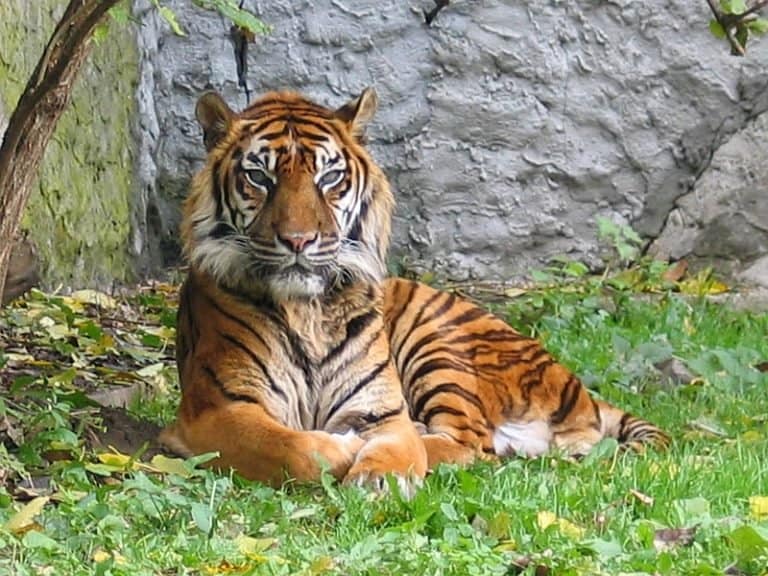
Sumatran Tiger lying on grass

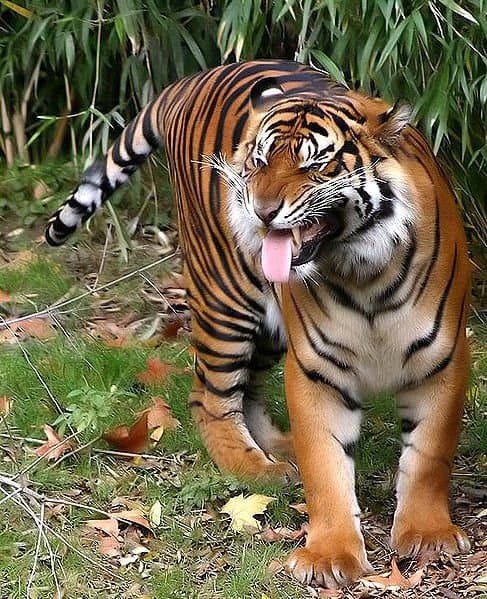
Sumatran tiger’s fur is a deeper orange than other tiger species.

Appearance

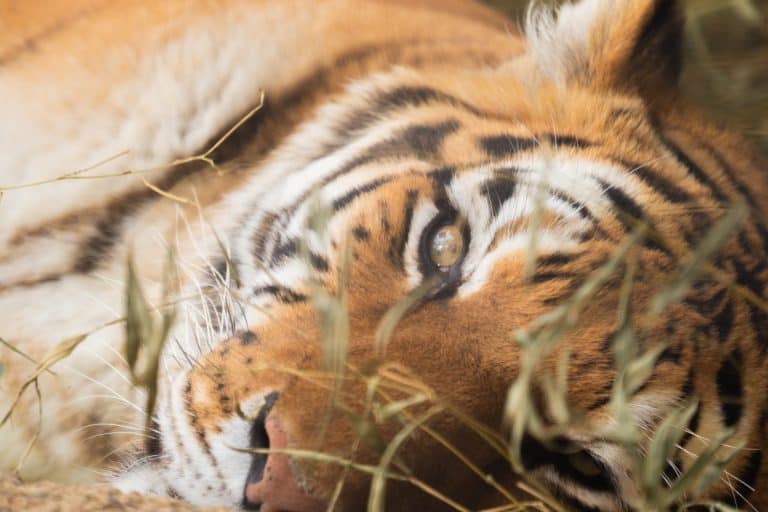
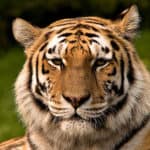
Sumatran tigers sport beautiful tawny-orange fur with bold black stripes. If you get close — which is by no means recommended — you’d notice their stripes taper into spots, and the hind legs also have tiny dotted lines between the solid ones. Just as every zebra’s stripe pattern is unique, so is every tiger’s. Moreover, their coat patterns are skin-deep and visible when fully shaven. Compared to other species, Sumatran tigers have more stripes.

Sumatran tigers don mane-like hair growth around their necks, and the males’ ruffs are larger than other tiger species. Their whiskers are long and strong, and their ears are small and round. Sumatran tigers have yellow irises, and their tails are about half the size of their bodies.

The smallest tiger species, Sumatran males weigh about 100 to 140 kilograms (220 to 310 pounds); females are a bit lighter at 75 to 110 kilograms (165 to 243 pounds). In terms of length, the gents fall between 2.2 and 2.5 meters (87 to 100 inches), and the ladies between 2.15 and 2.3 meters (85 to 91 inches). You’ll likely encounter the phrase “peg to peg” when learning about tiger lengths, but what does it mean? The phrase references the distance from nose to backside, not including the tail and not accounting for any length-adding curvatures.

Because of their smaller statures, Sumatran tigers are more agile than other tiger species. In terms of speed, they can sprint up to 65 kilometers per hour (40 miles per hour) in short bursts.
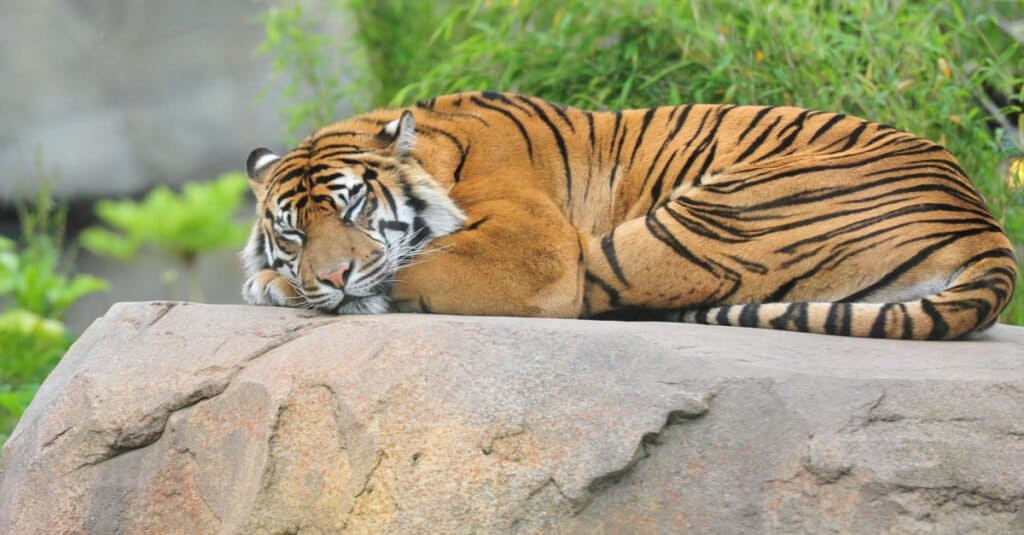
Sleepiest Animals – Tiger

Sumatran tigers sleep 18 – 20 hours a day.

Behavior

Sumatran tigers believe in conserving energy and sleeping 18 to 20 hours a day! If they live in a place also occupied by people, they normally hunt at night. But hidden cameras reveal that when humans aren’t around, day hunts are the norm.

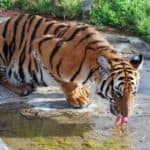
Being island-dwellers, Sumatran tigers are like the Michael Phelpses of the big cat world. They’re powerful swimmers! They love the water and even have paw webbing to navigate the ponds, rivers, and lakes in which they spend a lot of time.

Generally, tigers are solitary animals, but that doesn’t tell the entire story. In times of famine, they will amicably share food, even with cats from different “families.”

When Sumatran tigers are ready to break out on their own, both males and females establish a “home territory.” Females usually pick spots close to their mothers and visit often in the beginning. Males, however, venture further and don’t come home nearly as much, if ever.

Tigers establish their territories by spraying urine and gland secretions, creating scat trails, and clawing trees with unique markings. Not only do these activities serve as border warnings, but they also provide vital information to other tigers, like the sex and reproductive status of the individual.

Sumatran tigers sometimes fight for territory, and these battles end in death about 35 percent of the time. Tigers who don’t want to lose their lives for a patch of land roll over on their backs to surrender. When this happens, the dominant tiger may permit the supplicant to remain on the land with the understanding of its inferiority.


Roaring, chuffing, grunting, snarling, hissing, growling, and even meowing are all vocalizations used by Sumatran tigers to communicate. Their roars, which indicate aggressiveness, can be heard up to 3 kilometers (1.9 miles) away. Chuffing, a low-frequency snort signals contentment and happiness.
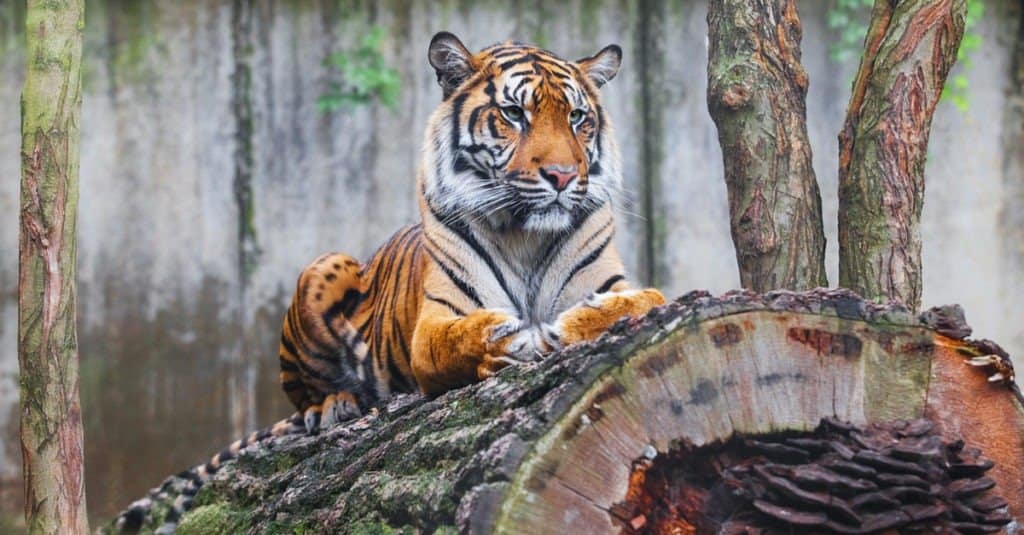
Beautiful rare Sumatran Tiger

Sumatran tigers are only found in Sumatra, one of the Indonesian Sundra Islands.

Tiger Habitat

Wild Sumatran tigers are native to one place and one place only: Sumatra, one of the Indonesian Sunda Islands. Due to their dwindling numbers, they live in fragmented subpopulations, in both coastal lowlands and uncultivated mountain forests.

At this point, since palm oil, acacia, and rubber plantations are encroaching on their natural habitats, the majority live in protected national parks, like the Bukit Barisan Selatan National Park and the Gunung Leuser National Park. Researchers believe that Kerinci Seblat National Park is home to the largest subpopulation.

Sumatran tigers need lots of room to live, and they prefer to reside deep in the forest to avoid human contact. Currently, and not ideally, up to three tigers can occupy the same 39-square-mile area.

Tiger Diet
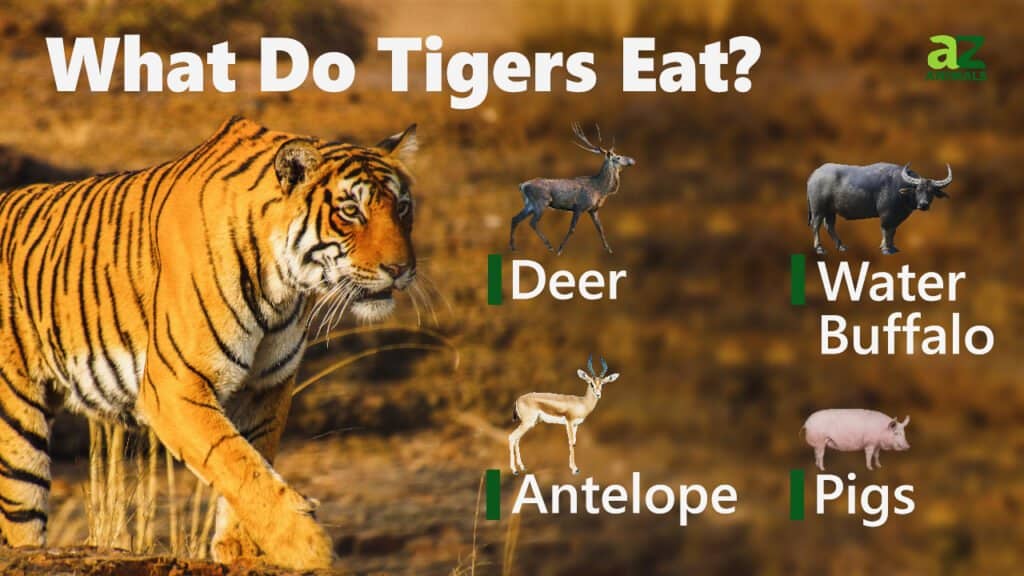
What Do Tigers Eat image
Tigers eat deer, water buffalo, antelope, and pigs.

Sumatran tigers are obligate carnivores, meaning they’re biologically dependent on a meat diet. On Sumatra, their menu consists of monkeys, birds, tapir, boar, deer, porcupines, fish, and, much to the torment and chagrin of human residents, livestock.

Despite their size and power, only 10 percent of tiger hunts are successful. Sumatran tigers typically enjoy a large meal once a week. When they catch an animal, tigers use their powerful jaws to latch onto the prey’s throat and tackle them to the ground with their forelimbs. Ultimately, the tiger suffocates the target to death.

Predators and Threats
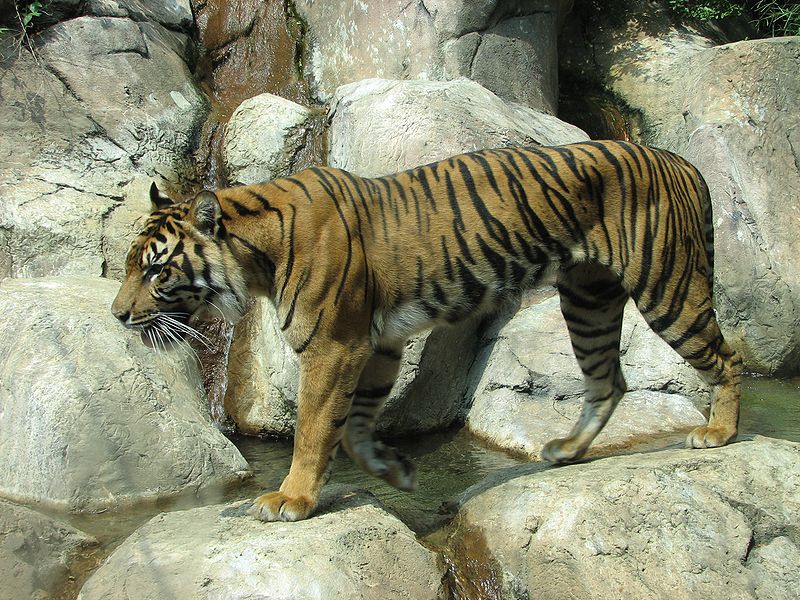
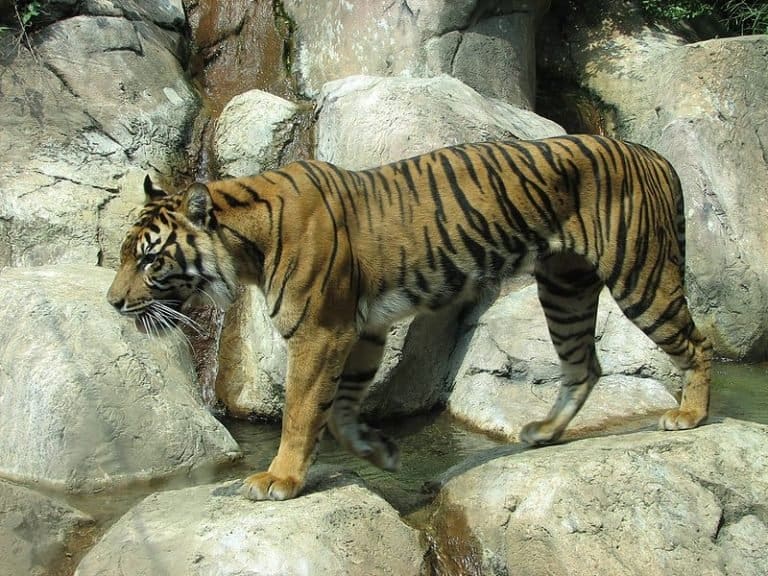
Sumatran Tiger walking on rocks

Human poaching is the biggest threat to Sumatran tigers.

Sumatran tigers don’t have natural predators, but human activity is a huge threat. An increase in deforestation to make way for rubber, acacia, and palm oil farming — which feeds the cosmetics, candy, and “clean-burning” fuel industries — has devastated the island’s tiger population. The plantations come in, which pushes the animals out, forcing them into places with less prey and more human contact, a deadly combination. The illegal timber trade also contributes to the problem.

Poaching is another giant problem. Sumatran tigers are prized for their skins, teeth, bones, whiskers, and even private parts. Although poaching is illegal and punishable by jail and massive fines, locals take the risk because the black market for tiger parts is lucrative. One tiger kill can support a local family for a year.

Wild Sumatran tigers aren’t fond of humans. They prefer to avoid people, but that’s getting harder to do as humans increasingly encroach on their lands. In Sumatra, hungry and agitated tigers attack humans and have even started to eat them.

Dr. John Goodrich, the chief scientist for a big cat conservation organization called Panthera, explained that forests are “the lungs of our planet.” To further the analogy, the rapid rate of deforestation in Indonesia is the equivalent of the planet having a two-pack-a-day smoking habit. Over the past 30 years, 30 million acres (12 million hectares) of forest have been lost to deforestation and timber felling.

Reproduction: Mating, Babies, and Lifespan
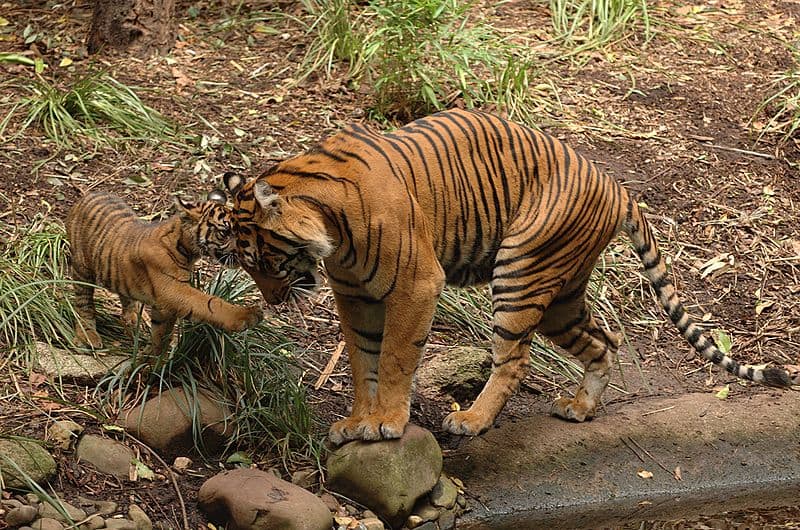
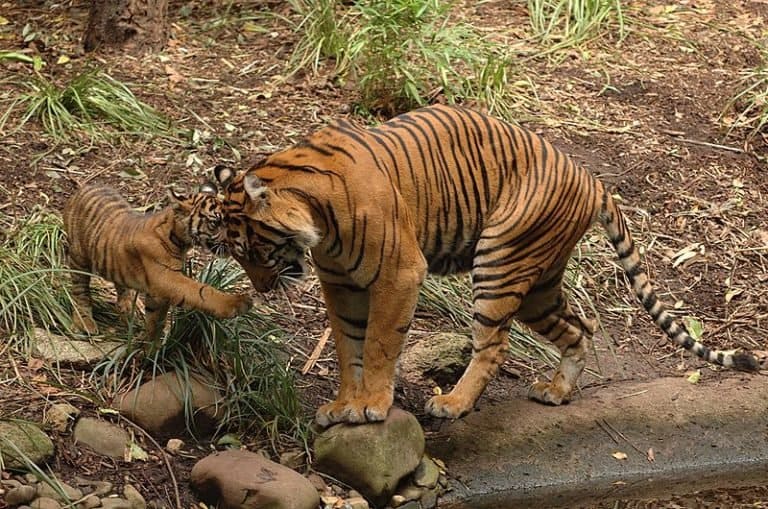
Sumatran Tiger, adult with cub

Sumatran tigers breed year-round but don’t reproduce easily in captivity.

Mating

Like humans, Sumatran tigers breed year-round, but most births happen between March and June, with another spurt in September. When a female is ready and willing, she’ll excrete certain scents and dial-up vocalizations to let nearby males know.

Females gestate for about three to four months or 93 to 114 days, and birth litters of three to five cubs. For the most part, Sumatran tiger moms will raise their cubs — aka baby tigers — by themselves. In rare circumstances, males will help.

Mother tigers give birth in sheltered places, including tall grasslands, thickets, caves, and rocky crevices. To ensure the best protection for their offspring, mothers also create hidden dens to care for their newborns.

Breeding in captivity can prove challenging — even deadly. In 2019, a 7-year-old stud loan named Asim, from a Denmark safari zoo, was brought to the London Zoo to mate with a 10-year-old female named Melati. Zoologists believed the pair to be “perfect mates” whose offspring would yield much-needed genetic diversity in the dwindling population. But things didn’t go as planned. After several weeks of measured introductions, the two tigers were placed in the same enclosure. They immediately fought, and Asim killed Melati.
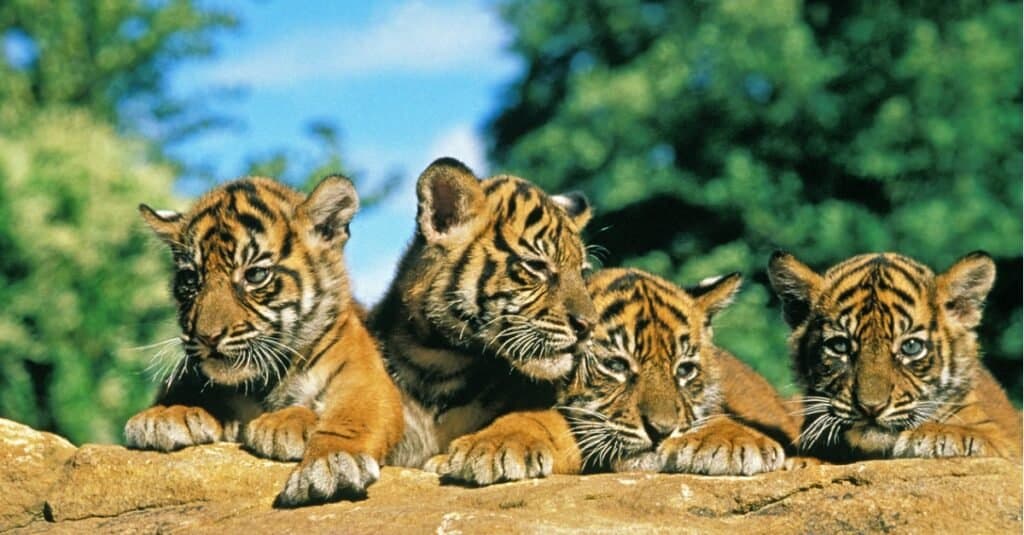
 

Sumatran tiger cubs stay under their mother’s care for 18 months.

Babies

Baby Sumatran tigers are born blind and weigh about 1 kilogram (2 pounds). A week or two after entering the world, they open their eyes for the first time.

Babies feed on their mother’s milk for two months, at which point they’re introduced to meat. For the first 11 to 18 months of life, they stick with their moms and learn how to hunt, shelter, and groom. Although cubs leave their mothers after two years, they keep growing until they’re about five years old.

In every litter, a dominant cub emerges. This confident cub leads the playtime and is the one who leaves home the earliest. Life for baby Sumatran tigers is precarious. Threats, like starvation and male adult tiger dominance killings, are ever-present. In fact, 50 percent of cubs don’t make it past two years.
 

Lifespan

Sumatran tigers live between 18 and 25 years. The oldest tiger ever recorded lived to 26.

Tiger Population
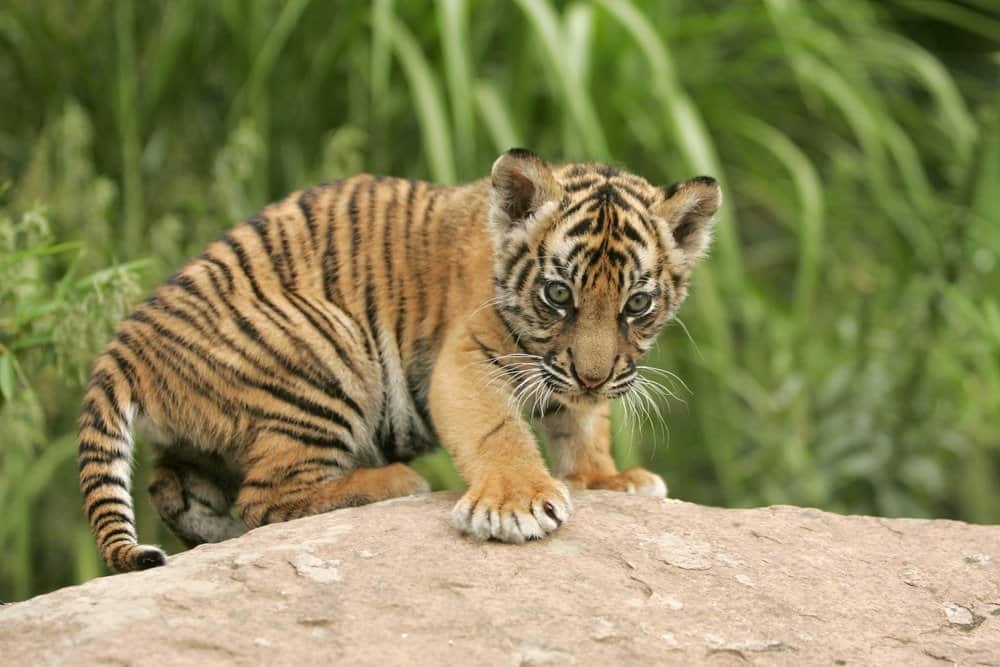
Sumatran tigers are dangerously close to becoming extinct in the wild.

The tigers are not all right.

Listed as Critically Endangered on the International Union for the Conservation of Nature (IUCN) Red List, Sumatran tigers are dangerously close to becoming extinct in the wild.

A century ago, about 100,000 tigers roamed free. Things have dramatically diminished since then. In 1970, over 1,000 Sumatran Tigers lived in Indonesia. Today, as few as 400 remain, and some analysts believe the number is closer to 250. None of the subpopulations have more than 50 individuals, and their habitat is rapidly disappearing.

Sumatran tigers are the only remaining tiger species on the Sunda Islands. Two others, the Bali tiger and the Javan tiger, went extinct in the 1950s and 1970s, respectively.

Dozens, if not hundreds, of conservation groups, are working to prevent extinction. Additionally, Sumatran tigers are listed on several endangered and protected species lists, including:

  • The Convention of International Trade in Endangered Species of Wild Fauna and Flora (CITES)
  • Act of the Republic of Indonesia No. 5 Concerning Conservation of Living Resources and their Ecosystems
  • International Union for the Conservation of Nature Red List
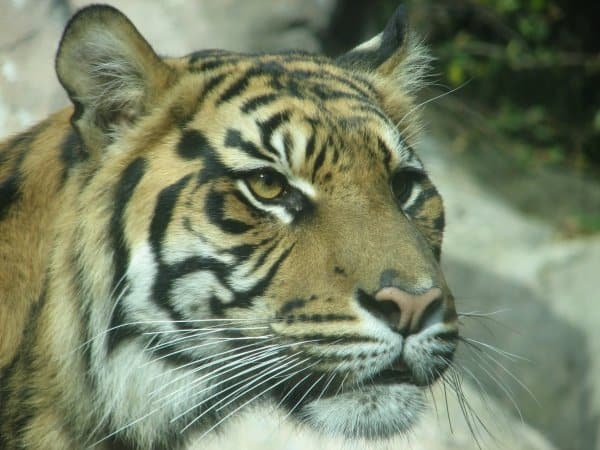
Sumatran Tiger close-up

Many conservation groups are working to save the magnificent Sumatran tiger.


Groups and government agencies dedicated to saving Sumatran tigers include:

  • Sumatran Tiger Project
  • Indonesian Forest Ministry in partnership with the Australian Zoo
  • Taman Safari Park
  • Global Tiger Recovery Plan
  • Batu Nanggar Sanctuary for the Sumatran Tiger
  • Tambling Wildlife Nature Conservation


The above list isn’t exhaustive. If you know of an accredited Sumatran tiger conservation group — not private, profit-seeking zoos and rescue sanctuaries — please message us. If, after some due diligence, we determine its credibility, we’ll add it to the list.

View all 390 animals that start with S
How to say Sumatran Tiger in ...
Czech
Tygr sumaterský
German
Sumatratiger
English
Sumatran Tiger
Spanish
Tigre de Sumatra
French
Tigre de Sumatra
Croatian
Sumatranski tigar
Italian
Tigre di Sumatra
Dutch
Sumatraanse tijger
English
Sumatratiger
Polish
Tygrys sumatrzański
Portuguese
Tigre de Sumatra
English
Tigru de Sumatra
Swedish
Sumatratiger
Turkish
Sumatra kaplanı

Sources

  1. David Burnie, Dorling Kindersley (2011) Animal, The Definitive Visual Guide To The World's Wildlife / Accessed May 27, 2010
  2. Tom Jackson, Lorenz Books (2007) The World Encyclopedia Of Animals / Accessed May 27, 2010
  3. David Burnie, Kingfisher (2011) The Kingfisher Animal Encyclopedia / Accessed May 27, 2010
  4. Richard Mackay, University of California Press (2009) The Atlas Of Endangered Species / Accessed May 27, 2010
  5. David Burnie, Dorling Kindersley (2008) Illustrated Encyclopedia Of Animals / Accessed May 27, 2010
  6. Dorling Kindersley (2006) Dorling Kindersley Encyclopedia Of Animals / Accessed May 27, 2010
  7. David W. Macdonald, Oxford University Press (2010) The Encyclopedia Of Mammals / Accessed May 27, 2010
Lisha Pace

About the Author

Lisha Pace

After a career of working to provide opportunities for local communities to experience and create art, I am enjoying having time to write about two of my favorite things - nature and animals. Half of my life is spent outdoors, usually with my husband and sweet little fourteen year old dog. We love to take walks by the lake and take photos of the animals we meet including: otters, ospreys, Canadian geese, ducks and nesting bald eagles. I also enjoy reading, discovering books to add to my library, collecting and playing vinyl, and listening to my son's music.

Thank you for reading! Have some feedback for us?


Sumatran Tiger FAQs (Frequently Asked Questions)

Sumatran tigers, just like house cats, are obligate carnivores, meaning they need meat to survive.