S
Species Profile

Snow Leopard

Panthera uncia

Built for cliffs. Made for cold.
abzerit/Shutterstock.com

Snow Leopard Distribution

Click a location to explore more animals from that region

Loading map...

Size Comparison

Human 5'8"
Snow Leopard 1 ft 12 in

Snow Leopard stands at 35% of average human height.

Snow Leopard

At a Glance

Wild Species
Also Known As Irbis, Ounce, Snow cat, Ghost of the Mountains
Diet Carnivore
Activity Crepuscular+
Lifespan 10 years
Weight 55 lbs
Status Vulnerable
Did You Know?

Size: head-body length 90-115 cm; tail 80-105 cm (tail can be ~70-90% of body length).

Scientific Classification

The snow leopard is a large, solitary felid native to the high mountains of Central and South Asia, specialized for cold, rugged alpine environments.

Kingdom
Animalia
Phylum
Chordata
Class
Mammalia
Order
Carnivora
Family
Felidae
Genus
Panthera
Species
Panthera uncia

Distinguishing Features

  • Thick smoky-gray coat with dark rosettes/spots for camouflage on rock and snow
  • Very long, thick tail used for balance and warmth
  • Broad, furred paws that act like “snowshoes” for traveling on snow
  • Powerful hind limbs enabling exceptional leaping in steep terrain
  • Adaptations to cold and thin air (dense fur, enlarged nasal cavities)

Physical Measurements

Males and females differ in size

Height
2 ft 2 in (1 ft 12 in – 2 ft 4 in)
1 ft 10 in (1 ft 9 in – 1 ft 11 in)
Length
6 ft 9 in (5 ft 11 in – 7 ft 9 in)
6 ft 1 in (5 ft 5 in – 6 ft 9 in)
Weight
110 lbs (99 lbs – 121 lbs)
71 lbs (49 lbs – 93 lbs)
Tail Length
3 ft (2 ft 7 in – 3 ft 5 in)
2 ft 11 in (2 ft 7 in – 3 ft 3 in)
Top Speed
40 mph
running

Appearance

Primary Colors
Secondary Colors
Skin Type Dense, long, double-layer fur; heavily furred paws/footpads for insulation and traction
Distinctive Features
  • Adult head-body length typically 86-125 cm; tail 80-105 cm (very long for balance/insulation).
  • Adult mass: males commonly ~45-55 kg; females ~22-42 kg (sex-dependent ranges reported across studies).
  • Small, rounded ears reduce heat loss; broad forehead and short muzzle give a compact head profile.
  • Very thick winter coat; long guard hairs and dense underfur suited to high-altitude cold.
  • Large, furred paws act like snowshoes and improve grip on scree and snow.
  • Long, thick tail used for balance on cliffs and can wrap around body for warmth when resting.
  • Enlarged nasal cavities aid warming/humidifying cold, thin mountain air.
  • Primarily solitary and crepuscular; frequent scent-marking (scrapes/sprays) along ridgelines and travel routes.
  • High-mountain specialist across Central and South Asian ranges (e.g., Himalaya, Karakoram, Pamirs, Tien Shan, Altai).
  • Diet centers on mountain ungulates where present (notably blue sheep and ibex); also takes marmots, pikas, and other small prey.
  • IUCN Red List status: Vulnerable (global assessment); major threat is retaliatory killing linked to livestock depredation-mitigation includes predator-proof corrals, herder incentives/insurance, and wild prey recovery.

Sexual Dimorphism

Sexual dimorphism is moderate: males are typically heavier and more robust, with broader heads and necks. Females are smaller and lighter-bodied; both sexes share the same rosetted pelage and cold-adapted features.

  • Greater average body mass and more muscular build.
  • Broader head/neck; larger overall frame.
  • Canine teeth and skull dimensions typically larger on average.
  • Lower average body mass with a more slender frame.
  • Slightly narrower head/neck proportions.
  • Same coat patterning; differences are mainly size and robustness.

Did You Know?

Size: head-body length 90-115 cm; tail 80-105 cm (tail can be ~70-90% of body length).

Mass: typically 22-55 kg (males larger than females).

Altitude use: commonly 3,000-4,500 m; records extend from ~540 m up to ~5,500 m in parts of its range.

Reproduction: gestation 93-110 days; litters of 1-5 (most often 2-3).

Longevity: ~10-12 years typical in the wild; up to ~20-21 years in captivity.

It can't roar like a lion or tiger; instead it uses sounds such as mews, growls, and a friendly "chuff."

Leaping specialist: reported horizontal jumps up to ~15 m, helping it cross gaps on steep, rocky slopes.

Unique Adaptations

  • Thermal insulation: extremely dense, long fur (often cited at ~5 cm on the back and up to ~12 cm on the belly) reduces heat loss on snow and rock.
  • Snow travel "snowshoes": broad paws with fur between pads increase surface area and grip, improving traction on snow/ice and cold rock.
  • Balance and agility: the very long tail acts as a counterbalance on steep ledges and during leaps; it's also used as a warm "scarf" during rest.
  • Cold-air conditioning: enlarged nasal cavity and sinuses help warm and humidify frigid, dry mountain air before it reaches the lungs.
  • Steep-terrain power: long hind limbs and strong back/shoulder muscles support climbing and high, controlled leaps in broken alpine cliffs.
  • Camouflage tuned to rock and snow: pale gray coat with dark rosettes breaks up the outline against talus, scree, and patchy snowfields.

Interesting Behaviors

  • Solitary ranging: adults usually travel and hunt alone, meeting mainly to mate; individuals maintain overlapping territories marked with scent.
  • Scent-marking and sign-posting: uses scrapes, urine spray, and cheek rubbing on rocks to communicate presence and reproductive status across rugged terrain.
  • Crepuscular hunting: often most active at dawn/dusk, stalking prey along ridgelines, cliff bases, and game trails before a short, explosive chase.
  • Caching and revisiting kills: may drag prey to a sheltered spot (under rock overhangs or into gullies) and feed over multiple days, returning cautiously.
  • Tail-assisted resting: commonly wraps its 80-105 cm tail around the body/face while resting to reduce heat loss and block wind.
  • Livestock depredation patterns: when wild prey is scarce or herds are poorly protected, it may enter corrals and kill multiple animals in a single event, intensifying human-wildlife conflict.

Cultural Significance

Snow leopard (Panthera uncia) lives in high mountains in Central and South Asia and is used as an important national symbol. It sometimes eats goats and sheep, so communities use corrals, better herding, insurance, and protect wild prey. Listed Vulnerable (IUCN) ~4,000–6,500.

Myths & Legends

In Kyrgyz tradition, the snow leopard is revered as a noble and formidable mountain animal and is often treated as a symbol of strength and courage associated with life in the high mountains.

In parts of Central Asia, the snow leopard (Panthera uncia) is a cultural symbol. Stories call it a careful ruler of the high peaks, avoiding people and showing sacred, off-limits mountain land.

In Himalayan and Tibetan highlands, snow leopards (Panthera uncia) are seen as mountain spirits or guardians of remote passes; meeting one is a rare omen of the mountains' power.

Historic Altai-Sayan "animal-style" art (Scythian/Saka-era traditions) includes powerful feline motifs interpreted locally as big cats of the mountains; these images fed later cultural associations of highland leopards with protection, sovereignty, and wild strength.

Conservation Status

VU Vulnerable

Facing a high risk of extinction in the wild.

Population Decreasing

Protected Under

  • CITES Appendix I
  • Convention on Migratory Species (CMS) Appendix I (listed species)
  • National legal protection in multiple range states (e.g., India: Wildlife (Protection) Act, 1972 - Schedule I)

Life Cycle

Birth 2 cubs
Lifespan 10 years

Lifespan

In the Wild
8–12 years
In Captivity
15–22 years

Reproduction

Mating System Polygyny
Social Structure Solitary
Breeding Pattern Transient
Fertilization Internal Fertilization
Birth Type Internal_fertilization

Solitary adults form brief pairs in late winter; males follow receptive females and may mate with more than one female. Internal fertilization; gestation 90-105 days; litters typically 2-3 cubs, raised by the female alone.

Behavior & Ecology

Social Solitary Group: 1
Activity Crepuscular, Cathemeral
Diet Carnivore Blue sheep / bharal (Pseudois nayaur) (commonly reported as the dominant wild ungulate prey across much of the species' range where available).

Temperament

Elusive and conflict-avoidant; typically retreats from humans rather than confronting.
Strongly territorial in marking behavior; core areas defended more than peripheral overlap.
Solitary hunter with flexible daily activity; often crepuscular, shifting activity with prey availability and human disturbance.
Reproduction: estrus and mating peak late winter; births commonly after ~90-105 days gestation.
Parental care: litters usually 2-3 cubs (range 1-5); independence commonly around 18-22 months.
Space use (precise field estimates vary by site): e.g., Nepal study reported mean home ranges ~12-39 km² (females) and ~37-65 km² (males) (Johansson et al.).
Longevity: commonly ~15-18 years in the wild; up to ~25 years reported in captivity.

Communication

chuffing/prusten-like friendly exhalation
mewing and call notes between mother and cubs
wailing/yowling during estrus
growling
hissing
urine spray and scent-marking on rocks/vegetation
scrapes (hind-foot scraping) along travel routes
fecal marking (latrines) on prominent sites
cheek rubbing and body scent deposition
claw marks on substrates
visual signaling via posture and tail/ear positions

Habitat

Mountain Cliff/Rocky Outcrop Alpine Meadow Shrubland Steppe Grassland Coniferous Forest Desert Cave +3
Biomes:
Alpine Tundra Desert Cold Temperate Grassland Temperate Forest
Terrain:
Mountainous Plateau Valley Hilly Rocky
Elevation: 1771 ft 8 in – 18044 ft 8 in

Ecological Role

Apex/mesopredator of high-mountain ecosystems, exerting top-down control on wild ungulates and medium-sized mammals and influencing prey behavior and distribution; can also subsidize scavenger communities via carcasses.

Regulates herbivore populations (e.g., ibex, blue sheep), helping reduce overgrazing pressure on alpine vegetation Maintains trophic balance and supports biodiversity through predation on abundant prey Provides carrion resources for scavengers (corvids, vultures, foxes, wolves where present) via partially consumed kills Functions as an indicator/umbrella species for conservation of large, intact alpine landscapes

Diet Details

Main Prey:
Blue sheep Siberian ibex Markhor Argali Himalayan tahr Himalayan marmot Pika Hares Game birds Domestic livestock +4

Human Interaction

Domestication Status

Wild

Snow leopard (Panthera uncia) is a wild big cat with no history of domestication. People keep it only in zoos or rescues with managed breeding. Snow leopards sometimes kill livestock, causing conflict, and people sometimes kill them in return. Threats include poaching for skins, habitat loss, and small populations. Listed Vulnerable (IUCN) and on CITES Appendix I.

Danger Level

Moderate
  • Physical injury if a snow leopard is cornered, handled, or trapped (defensive biting/scratching typical of large felids)
  • Occupational risk to herders/rangers/veterinarians during conflict response, capture, transport, or medical procedures
  • Indirect risk during livestock depredation events (people entering confined spaces like corrals where an animal may be present)
  • Zoonotic/parasite exposure is possible when handling carcasses/scat (general wildlife handling risk), though direct disease transmission to the public is uncommon

As a Pet

Not Suitable as Pet

Legality: Snow leopard (Panthera uncia) is not legal as a pet in most places. CITES Appendix I bans commercial trade. Laws usually bar private ownership or allow only zoos and sanctuaries with strict permits, secure housing, inspections, insurance.

Care Level: Expert Only

Purchase Cost:
Lifetime Cost: $300,000 - $1,500,000

Economic Value

Uses:
Ecotourism and community-based conservation revenue (wildlife viewing/trekking economies in high-mountain regions) Ecosystem services/value (apex predator role; trophic regulation and biodiversity conservation benefits) Cultural and symbolic value (national/regional iconography; educational value) Costs from human-wildlife conflict (livestock losses; corrals/guarding/insurance programs) Conservation employment and funding flows (rangers, monitoring teams, NGO/government programs) Illegal wildlife trade pressures (negative economic and conservation impacts)
Products:
  • Non-consumptive tourism services (guided treks, wildlife tracking, homestays)
  • Conservation program outputs (community insurance/compensation schemes, predator-proof corral construction, monitoring data products)
  • Educational/visitor experiences in accredited zoos (non-commercial transfer only under permits)

Relationships

Predators 4

Ecological Equivalents 6

Animals that fill a similar ecological role in their ecosystem

Eurasian lynx
Eurasian lynx Lynx lynx A solitary predator, mostly active at dawn, dusk, and night, that overlaps the snow leopard's mountain range in Central Asia; it uses rocky and forest-edge cover to hunt medium-sized hoofed animals and rabbits, maintains large, low-density home ranges, and relies on stealth.
Gray wolf
Gray wolf Canis lupus They compete with snow leopards for wild sheep and goats. Wolves hunt in packs and can steal kills from solitary snow leopards. Both are top predators that shape ungulate behavior in alpine and steppe-montane habitats.
Himalayan wolf Canis himalayensis High-elevation canid ecotype occupying cold, open alpine habitats where snow leopards occur; overlaps in prey base (bharal, ibex, and smaller mammals) and can exert interspecific pressure through kleptoparasitism and occasional predation on juveniles.
Himalayan brown bear Ursus arctos isabellinus Shares rugged high‑mountain environments and may appropriate kills or scavenge snow leopard prey. Although more omnivorous, it can act as a dominant competitor and an occasional predator of cubs in overlapping alpine valleys.
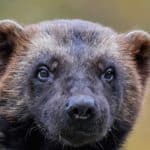
Wolverine
Wolverine Gulo gulo A cold-adapted, wide-ranging carnivore and scavenger in alpine and subalpine ecosystems that can compete through scavenging and carcass usurpation. Ecological similarity is strongest where both rely on sparse prey distributions and rugged terrain for foraging opportunities.
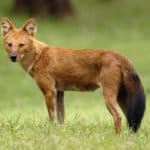
Dhole
Dhole Cuon alpinus In parts of the Himalaya, a pack-hunting carnivore that targets similar classes of ungulate prey. It represents a contrasting predation mode — cursorial cooperative hunting — but overlaps in trophic role and can contribute to intraguild competition where ranges meet.

The Snow Leopard is the elusive cat of the Himalayas

This beautiful and endangered cat, listed as vulnerable under the IUCN Red List, is well-adapted for life in the cold atmosphere of the Central Asian mountains, including the Himalayas. It has a thick coat whose beauty attracts poachers and huge paws that serve the same purpose as snowshoes, allowing it to walk over snow with ease. Besides its lustrous fur, its small ears allow it to hold on to heat, and its long, strong hind legs allow it to jump from cliff to cliff.
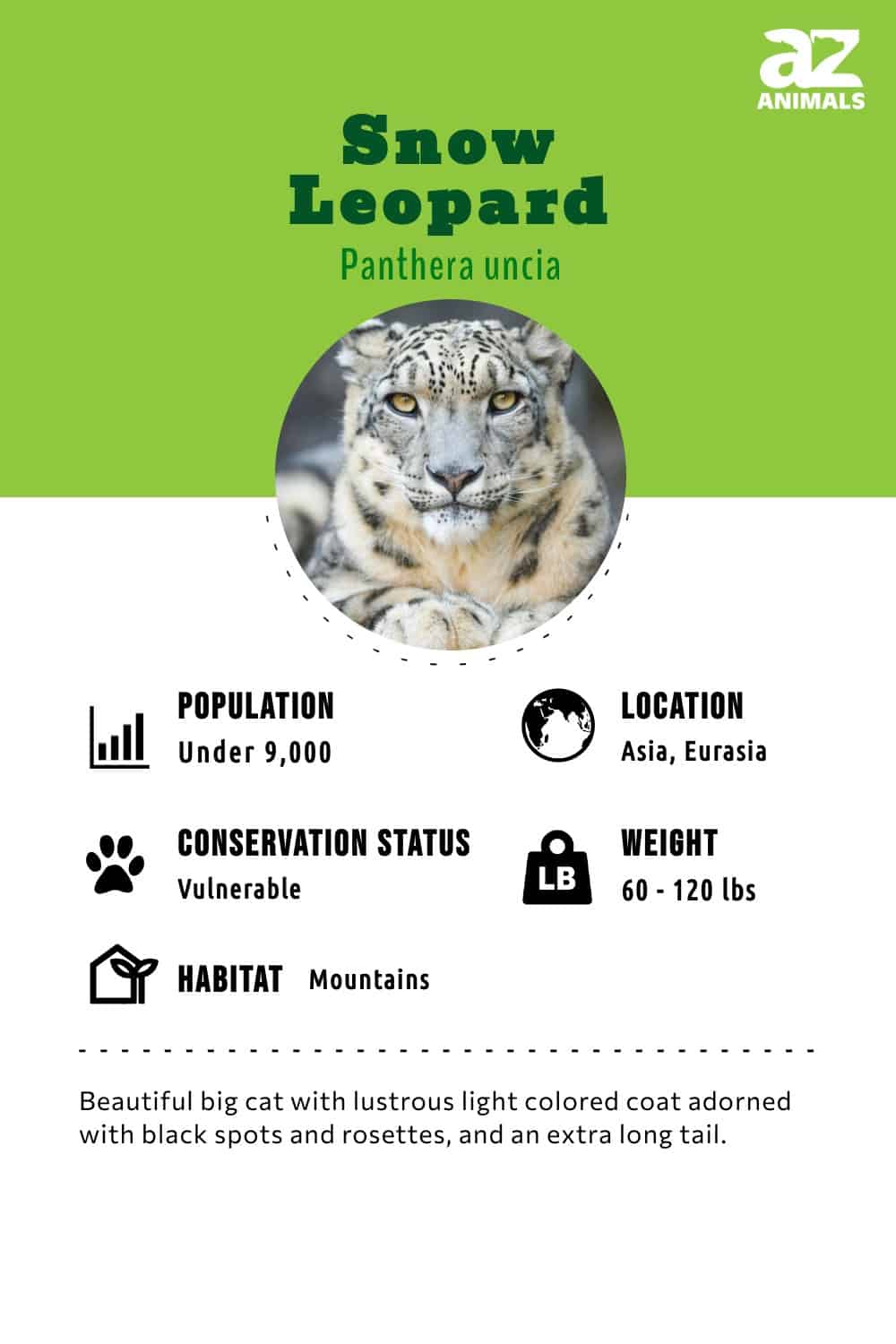
5 Incredible Snow Leopard Facts!

Some facts about snow leopards include:

  • Females give birth every other year.
  • The sexes are about the same size, or the males are just slightly bigger.
  • Their tails are very long compared to other big cats. It aids in balance as the cat leaps over boulders and cliffs.
  • The snow leopard is more closely related to the tiger than to the leopard.
  • The snow leopard is Pakistan’s national animal.
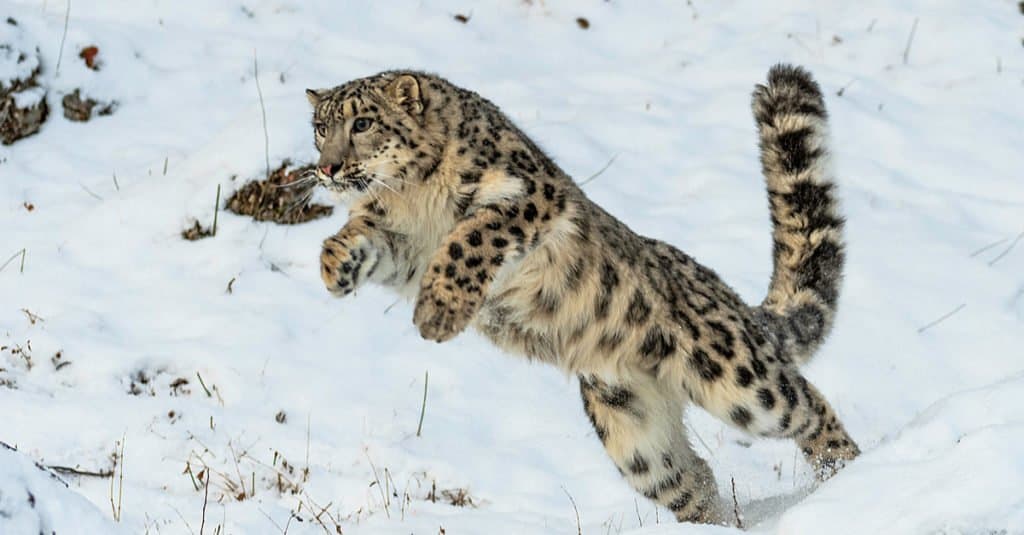
Snow Leopard hunting for prey.

Snow leopards are more closely related to tigers than leopards.

Scientific Name

The snow leopard’s scientific name is Panthera uncia. The word “Panthera” comes from the Latin for panther, but uncia has an interesting history. It seems to come from an old French word that was used for the lynx. That word was actually lonce, but somebody thought this word was actually l’once. This would mean the name of the animal in question was actually once, and once was Latinized into uncia. Some biologists classify the snow leopard as Uncia uncia, and the animal is still called the once.

Species

There are three snow leopard subspecies that share traits but appear in different regions. They are:

  • P. u. uncia, Western group,(Tian Shan, Pamir, transHimalya region)
  • P. u. irbis, Northern group, (Altai region)
  • P. u. uncioides, Central group, (Himalya and Tibetan Plateau region)

Appearance
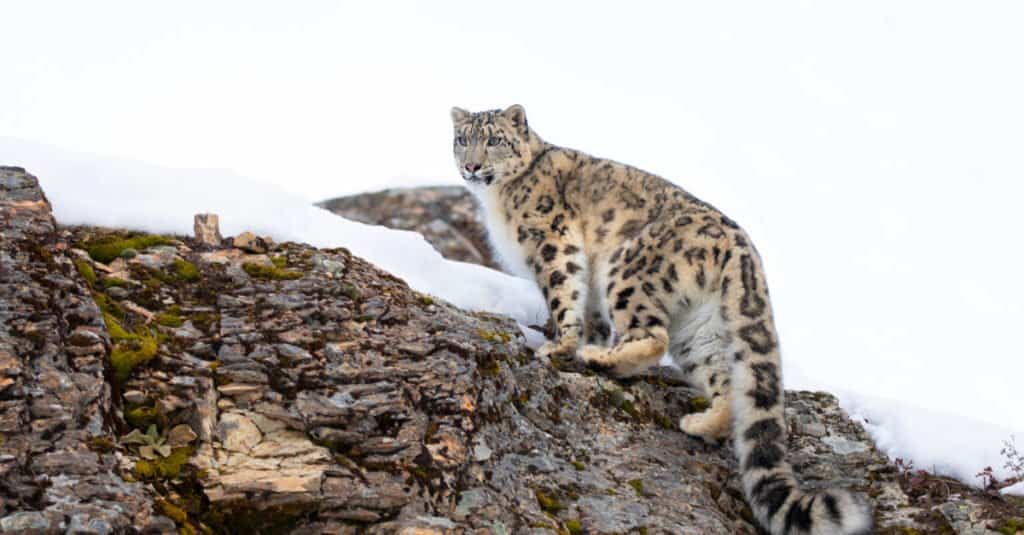
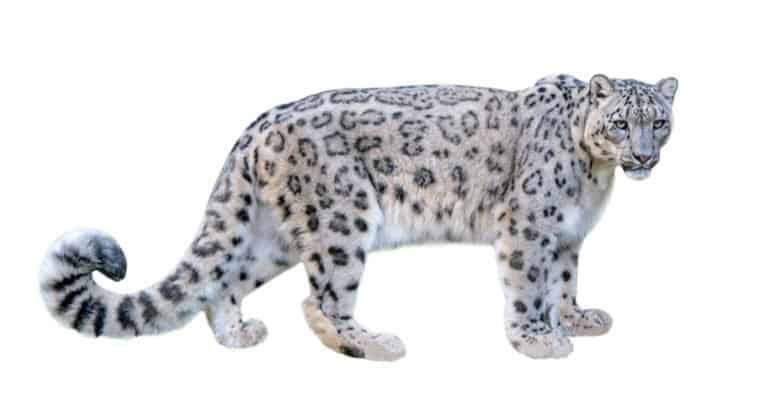
Alert Snow Leopard looking for prey.

Snow leopards have longer tails than other big cats.

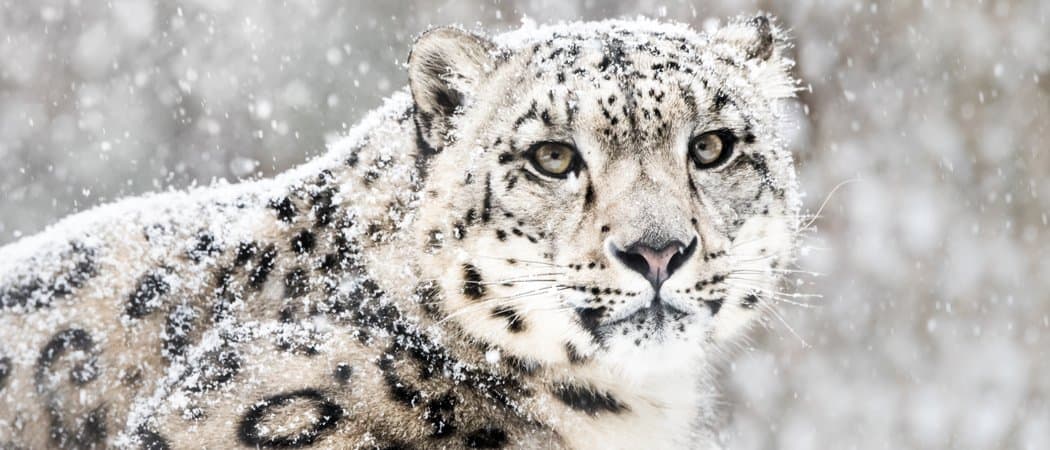
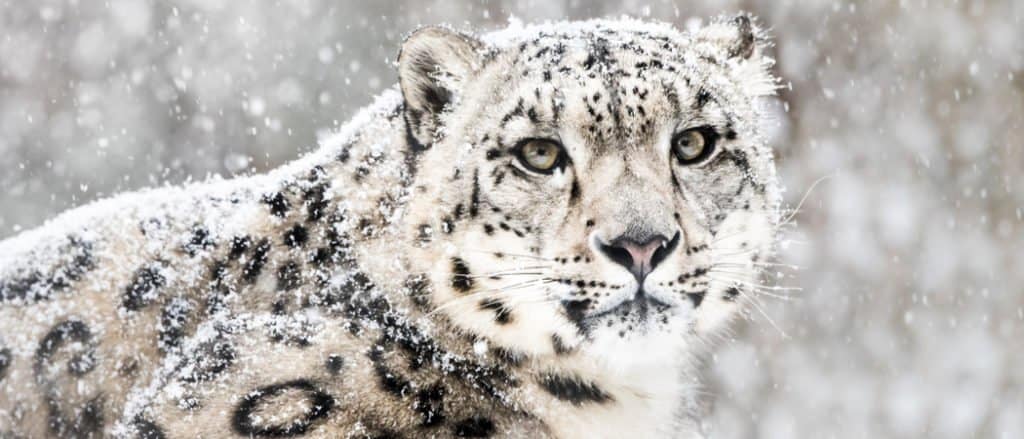
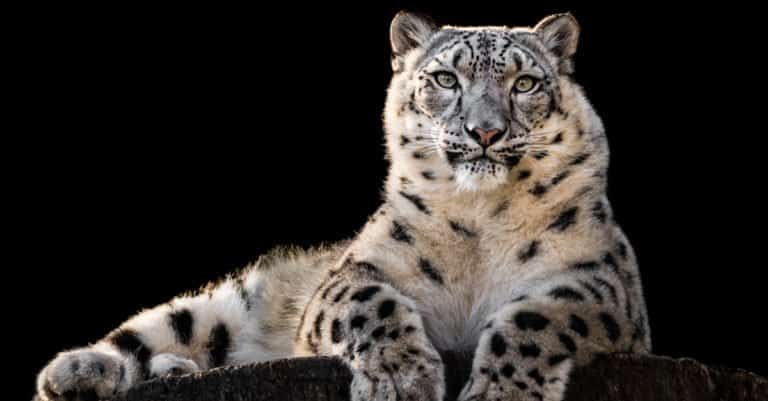
The appearance of the snow leopard is striking. Its thick fur is gray or shades of white or cream, adorned with rosettes and spots. The rosettes, which are spots that surround other spots, are on the animal’s sides, back, and tail, while single spots are found on its neck and head. It has green or gray eyes and a small head in relation to the body.

Other facts about the snow leopard: Its nasal cavities are larger than those of other big cats to allow it to take in more air and make the inhaled air warm and humid. The tail can be nearly as long as the animal’s body. It is not only unusually long but thick, for it is used to store fat. When the animal sleeps, it often drapes its tail over its face for warmth.

Evolution

Even though its name is “leopard” the snow leopard is closely related to the tiger and forms a sister group with the animal. These sister animals diverged from other cats around 4.62 to 1.82 million years ago – originating in northern Central Asia.

The snow leopard and the tiger diverged between 3.7 and 2.7 million years ago. Both animals have evolved to suit their habitats with snow leopards developing extra thick, light-colored fur, big snowshoe feet, and a long bushy tail for life in cold mountain climates.

Behavior

Snow leopards are solitary and elusive. The appearance of a snow leopard in the wild is an uncommon event, and they only come together to mate. Snow leopard cubs stay with their mother for less than two years before they strike out on their own.
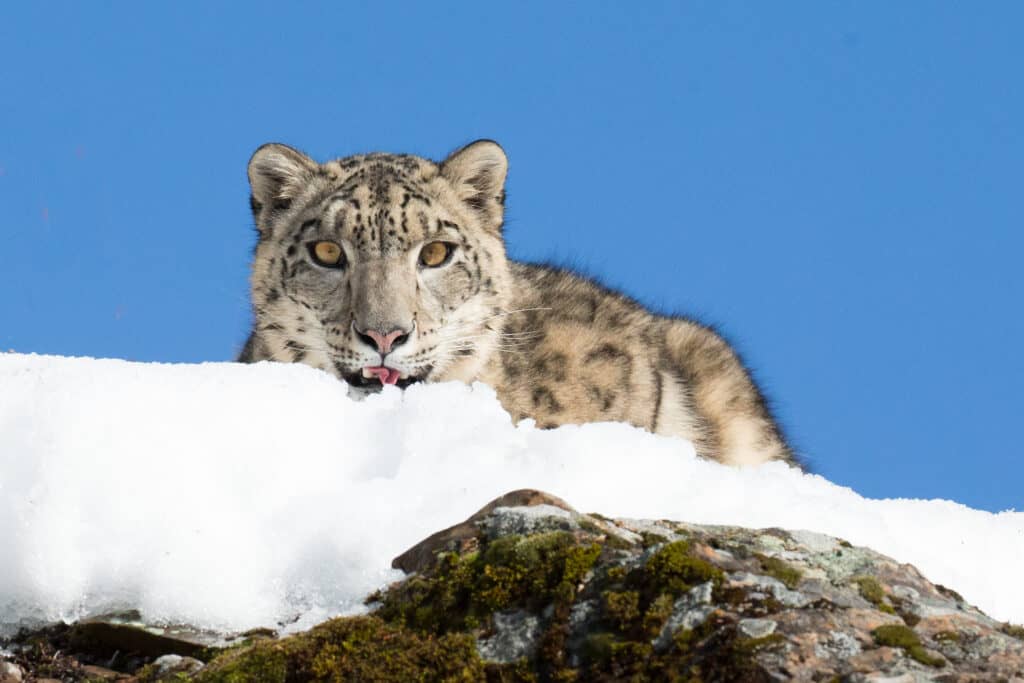
snow leopard

Snow leopards are adapted for life in cold habitats

The animal is most active at dusk and just before dawn and moves restlessly from one part of their territory to another during the day. They tend to stay in one corner of their territory for a few weeks before moving to another. They are comfortable being at least 1.24 miles away from the nearest snow leopard, and males don’t tolerate other males encroaching on their territory. Snow leopards mark their territory with scat, urine, and scrapings. This gives snow leopards much information about each other, including their sex and whether they are ready to mate. They are adept at climbing as well as jumping and like to rest on high structures that allow them to see the terrain and potential prey.

These leopards don’t roar, but they have an impressive array of vocalizations, including purring. They also meow, moan, yowl, and chuff, which is also called prusten. Females yowl when they’re in heat, and chuffing might be a way to simply greet another snow leopard. They also use their bodies to communicate. Like housecats, the way a snow leopard moves its tail indicates its mood. They also rub their heads and necks. They bare their teeth when they’re defensive but open their mouths without bearing their teeth when something simply catches their attention.

These leopards leave their scent on trees, on the ground, and on other surfaces along the paths they travel. This tells other snow leopards to stay away.
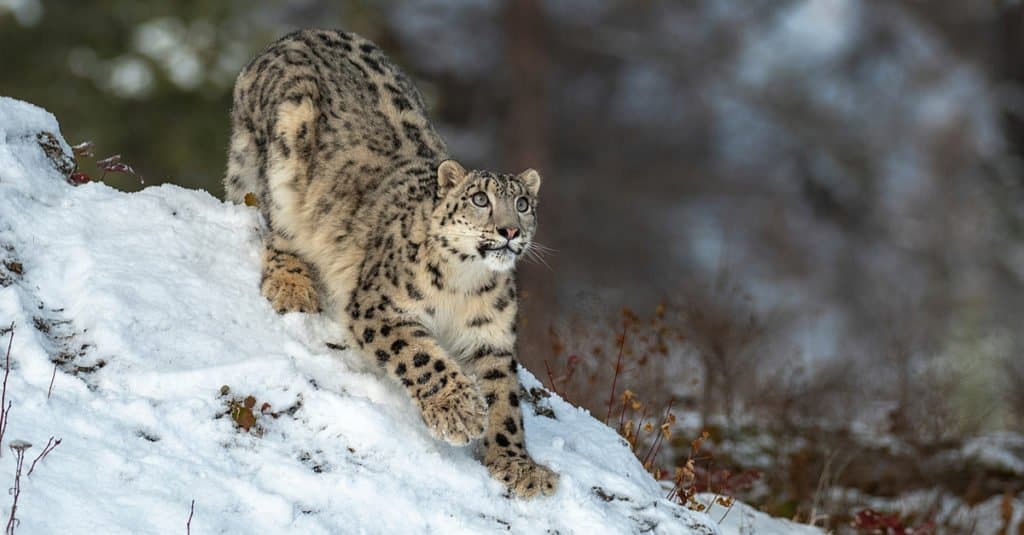
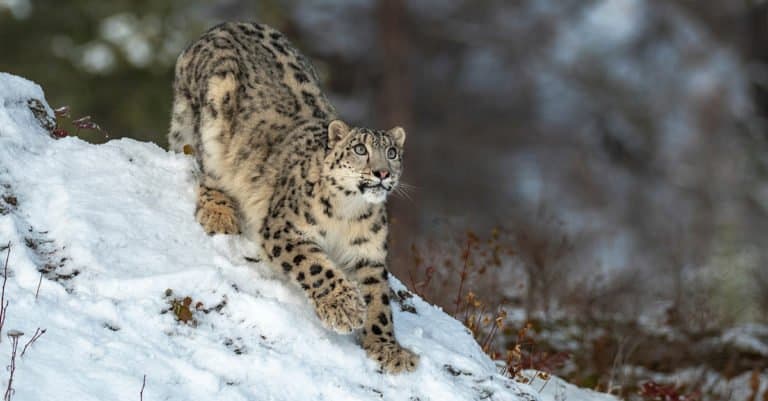
Alert Snow Leopard looking for prey.

Snow leopards are most active at dusk and dawn and are mostly solitary.

Habitat

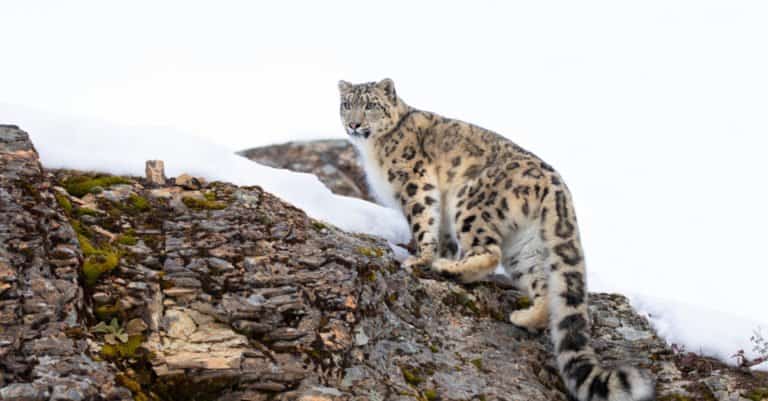
These leopards are found in rugged and rocky terrain in the mountains of Central Asia, including Siberia, Nepal, China, and Bhutan. Because the cat hasn’t evolved to live in areas where oxygen is very scarce, it lives in elevations that range between 9843 and 14,764 feet above sea level, and during the winter it comes down to elevations of 2953 feet as it follows its prey. Snow leopards avoid pastures, fields, and dense forests.

Diet
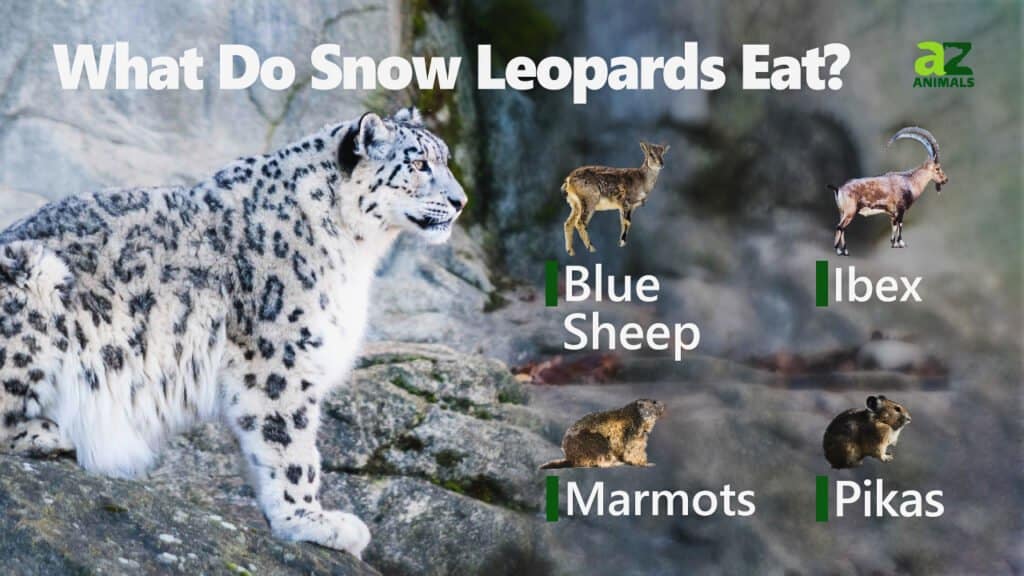
What Do Snow Leopards Eat

The snow leopard is a meat-eater and a hunter and its diet is varied as long as it’s animal protein. Its preferred prey is the blue sheep. It also takes markhor, ibex, tahrs, musk deer, wild boar, wild donkeys and yaks, Tibetan antelope, and Tibetan gazelles. If it must, it will eat voles, birds, marmots, and even mice and has even been seen to eat vegetation. Because its natural prey has been depleted in some areas, the snow leopard might take livestock.

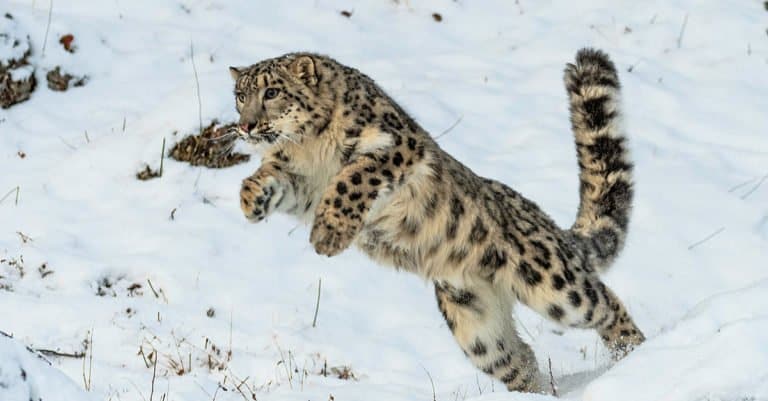
The leopard ambushes its prey by leaping on it from an elevated hiding place or chasing it down. After it applies the killing bite, it will drag the animal to a secluded place to eat it in peace.

Predators and Threats
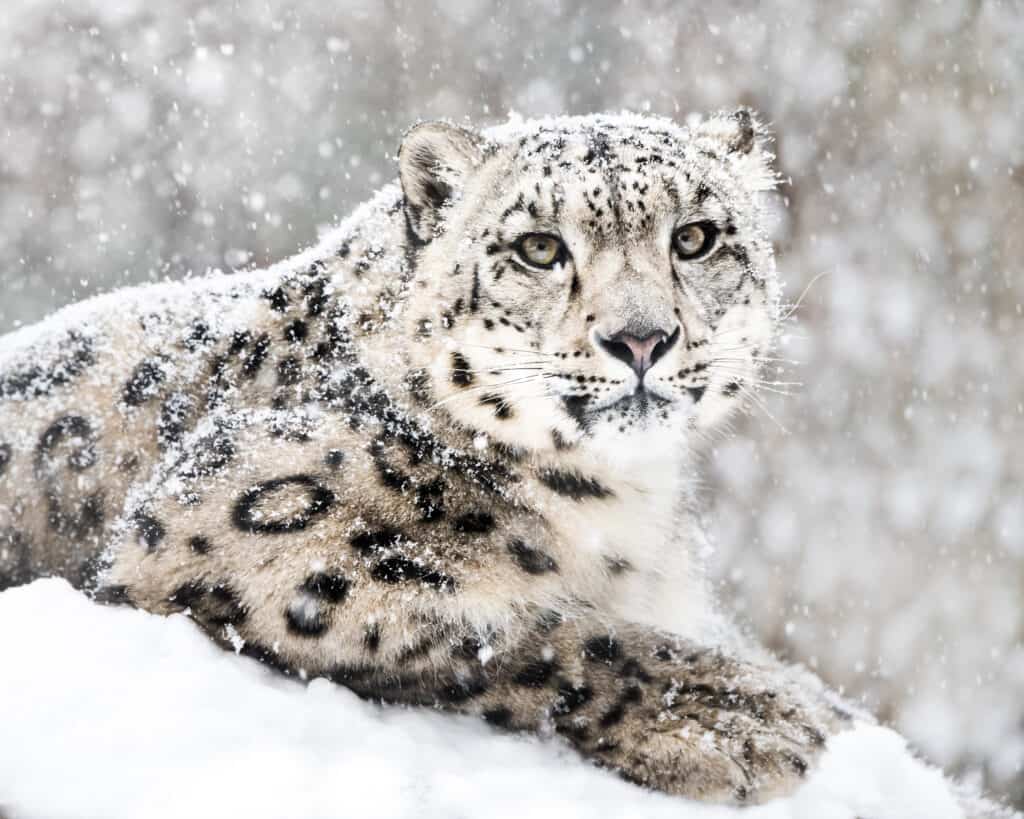
snow leopard

Snow leopards are poached for their beautiful fur.

These leopards are apex predators and few other animals save humans hunt them. Snow leopards and leopards who live in the same area may fight to the death over resources, and snow leopards can prey on cubs.

Humans poach these leopards for their beautiful fur and even for their bones. Their natural prey has also been overhunted, and much of their habitat has been fragmented or lost. Climate change has allowed forests to grow higher and higher into the mountains. This means that the snow leopard has to compete with other carnivores such as leopards and tigers, who usually avoid the treeless cliffs and ridges inhabited by their cousin. Farmers also shoot snow leopards who, deprived of their usual prey, eat their livestock.

Though these leopards are solitary, a mating couple might team up to hunt.

Reproduction and Life Cycle
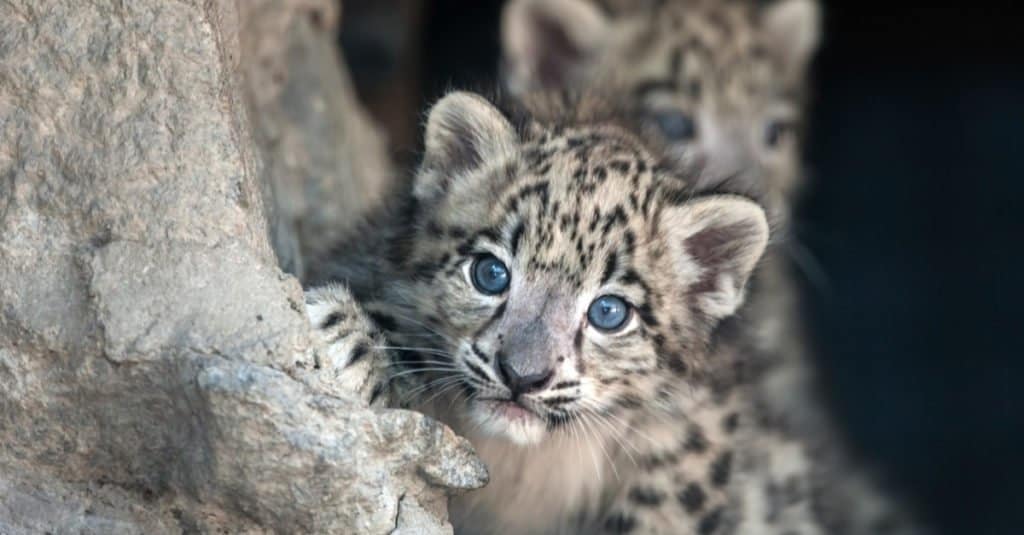
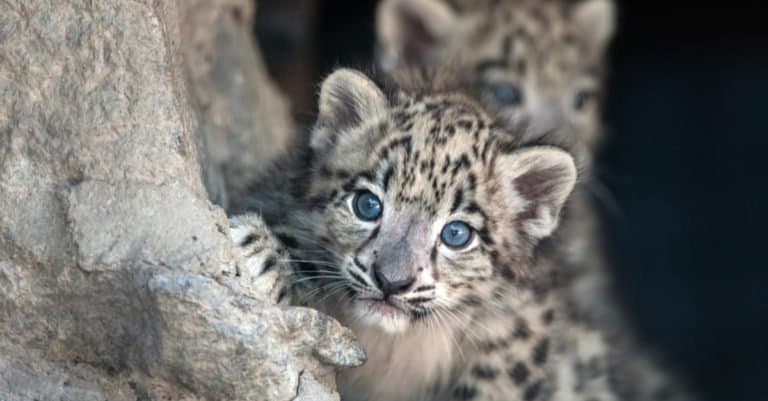
Snow Leopard cub looking out of the den.

Snow Leopard cubs are born in dens lined with their mother’s soft fur.

These leopards breed in late winter, and as with housecats, a female who’s in heat yowls to attract a male. She’ll also chuff and approach the male with her tail raised to let him know she’s available. The female’s estrus cycle lasts about a week, so males usually only have a chance to mate with one female at a time. Once the male is accepted, the couple mates as much as 36 times a day.

After this, the female is pregnant for about 90 to 100 days, so her babies are born in the spring in a den she lines with her own fur. The name for a snow leopard baby is a cub. The female will usually have two or three but can have as many as seven cubs. A baby weighs from 11 to 20 ounces at birth. Though it already has fur, it is blind and completely dependent on its mother. After seven days, the eyes open, and after a few weeks, it can walk. The baby is weaned when it’s about two and a half months old, then ventures out of the den with its mother and siblings around the same time. Here is a baby snow leopard.

These leopards live about 15 to 18 years in the wild, though captive leopards live much longer. The oldest one in captivity, Shynghyz, was 27 years old at this writing. It lives at the Tama zoo in Japan. These leopards are subject to several parasites, including toxoplasma, coccidia, and giardia, and the diseases they bring.

Population
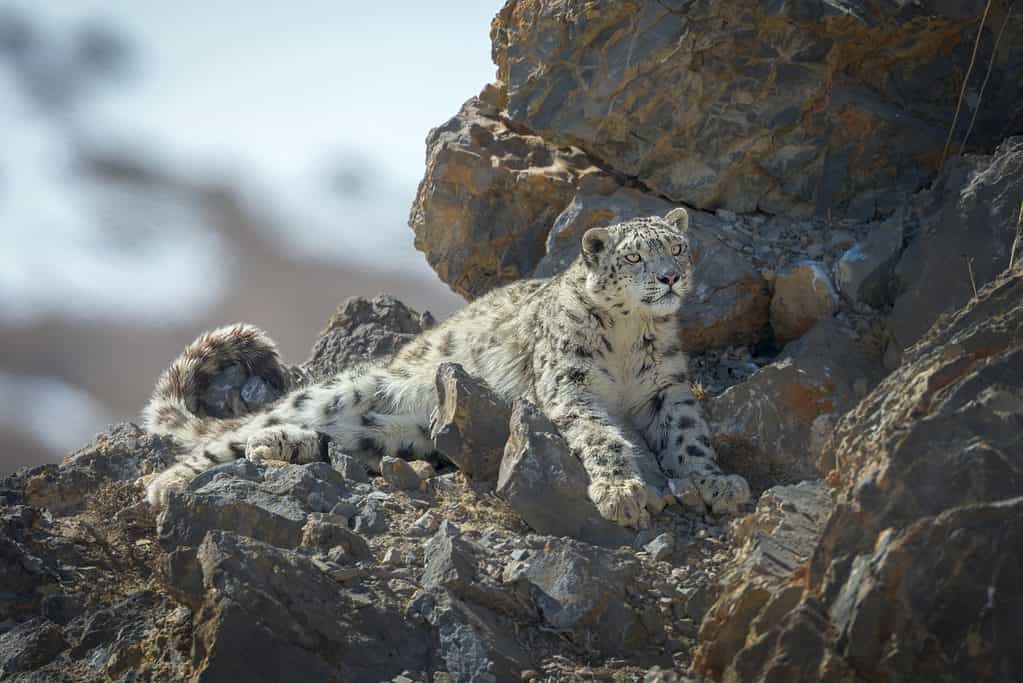
Snow leopard rests against rocks, slightly camouflaged

There are under 9,000 snow leopards in the wild.

A best there are over 8000 of these leopards in the wild, and this number is declining due to poaching, overhunting of their usual prey, and climate change that is turning their mountain habitat into forests. Fortunately, the animal is attractive and is considered a flagship species, and there is much effort going into protecting it. There are now a good number of areas where the leopard is protected, including:

View all 391 animals that start with S

Sources

  1. Wikipedia / Accessed May 12, 2021
  2. Animal Diversity Web / Accessed May 12, 2021
  3. Time / Accessed May 12, 2021
  4. WWF / Accessed May 12, 2021
  5. National Geographic / Accessed May 12, 2021
  6. WWF / Accessed May 12, 2021
  7. Britannica / Accessed May 12, 2021
Lisha Pace

About the Author

Lisha Pace

After a career of working to provide opportunities for local communities to experience and create art, I am enjoying having time to write about two of my favorite things - nature and animals. Half of my life is spent outdoors, usually with my husband and sweet little fourteen year old dog. We love to take walks by the lake and take photos of the animals we meet including: otters, ospreys, Canadian geese, ducks and nesting bald eagles. I also enjoy reading, discovering books to add to my library, collecting and playing vinyl, and listening to my son's music.

Thank you for reading! Have some feedback for us?


Snow Leopard FAQs (Frequently Asked Questions)

While both species are types of big cats, snow leopards are much larger than clouded leopards. In addition, they live in different habitats with clouded leopards hunting in dense forests while snow leopards hunt in higher elevations.