A
Species Profile

Armenian Gampr

Canis lupus familiaris

Highland guardian, steady and bold
Ninell Creative/Shutterstock.com

Armenian Gampr Distribution

Click a location to explore more animals from that region

Origin Location

This map shows the native origin of the Armenian Gampr. As a domesticated species, they are now found worldwide.

Loading map...

Found in 1 country

Size Comparison

Human 5'8"
Armenian Gampr 2 ft 4 in

Armenian Gampr stands at 41% of average human height.

Armenian Gampr

At a Glance

Domesticated
Also Known As Gampr, Gampr dog, Armenian Ovcharka, Armenian shepherd, Armenian village dog
Diet Omnivore
Activity Cathemeral+
Lifespan 11 years
Weight 70 lbs
Status Not Evaluated
Did You Know?

"Gampr" is an Armenian term used for a powerful, large guardian dog; the type is often treated as a landrace rather than a tightly standardized modern breed.

Scientific Classification

The Armenian Gampr is an ancient Armenian livestock-guardian dog type (often treated as a landrace rather than a tightly standardized modern breed), developed for guarding flocks and homesteads and adapted to local conditions.

Kingdom
Animalia
Phylum
Chordata
Class
Mammalia
Order
Carnivora
Family
Canidae
Genus
Canis
Species
Canis lupus

Distinguishing Features

  • Large, powerful livestock-guardian build adapted for endurance and protection work
  • Typically thick double coat suited to variable/mountain climates (coat length can vary)
  • Strong guarding instinct, territoriality, and independence typical of LGDs
  • Regional/landrace variability in appearance compared with highly standardized show breeds

Physical Measurements

Males and females differ in size

Height
♂ 2 ft 4 in (2 ft 2 in – 2 ft 7 in)
♀ 2 ft 2 in (2 ft – 2 ft 4 in)
Length
♂ 5 ft 1 in (4 ft 7 in – 5 ft 9 in)
♀ 4 ft 2 in (3 ft 9 in – 4 ft 7 in)
Weight
♂ 143 lbs (110 lbs – 176 lbs)
♀ 104 lbs (88 lbs – 121 lbs)
Tail Length
♂ 1 ft 5 in (1 ft 2 in – 1 ft 8 in)
♀ 1 ft 4 in (1 ft 2 in – 1 ft 6 in)
Top Speed
28 mph

Appearance

Primary Colors
Secondary Colors
Skin Type Armenian Gampr has a protective double coat, shedding seasonally. Coat length and density vary by local line and climate, often long outer coat with dense undercoat in highlands. Skin is tough; routine parasite control needed.
Distinctive Features
  • Breed/species context: A domestic dog landrace from the Armenian Highlands-selected for livestock and property guarding; not a separate wild species.
  • Compared with the base species context (wolf/dog lineage): typically more human-directed social flexibility than wild canids, yet retains strong territorial/guardian instincts; built for endurance and independent decision-making around stock.
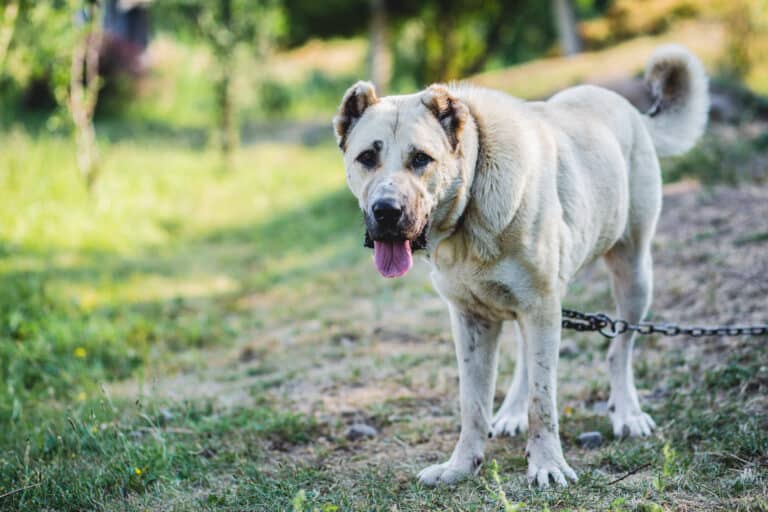
  • Large, powerful, functional build with substantial bone; broad chest; strong neck/shoulders suited to confronting predators rather than sprint hunting.
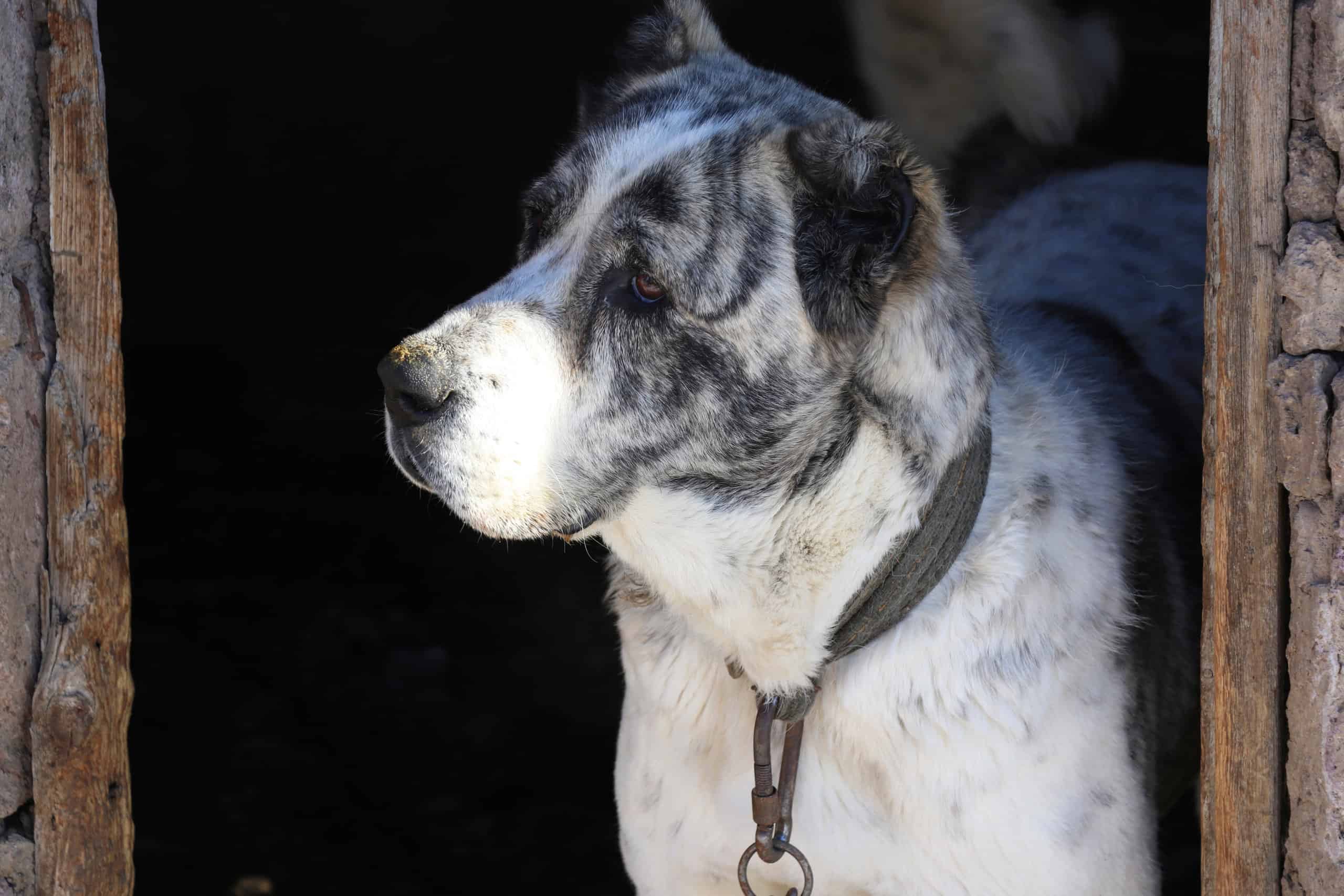
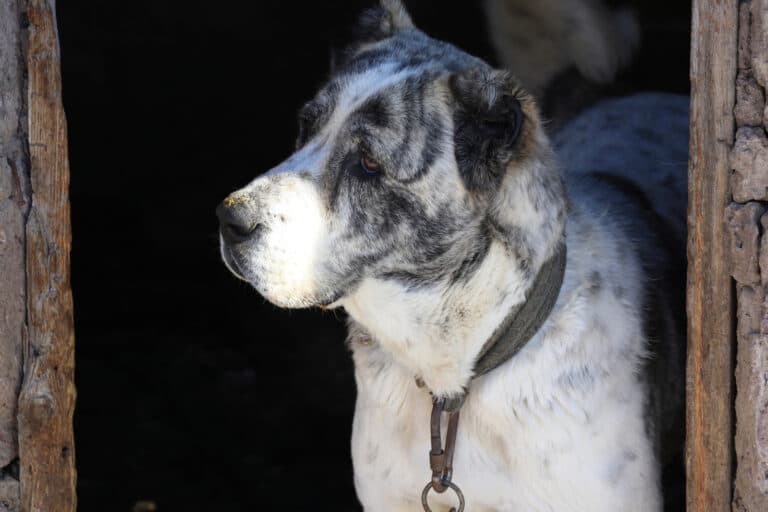
  • Head is typically broad with strong muzzle; expression often calm/assessing; ears may be natural (drop/semi-erect) depending on lineage and local practice.
  • Thick neck ruff/'mane' can be present (especially in heavier-coated males), enhancing protection in confrontations.
  • Tail is thick and carried low at rest; may curl upward when alert; carriage varies by individual.
  • Temperament/working trait: steady, confident, and territorial; tends to be reserved with strangers, strongly bonded to household/flock; requires early socialization to ensure reliable judgment and controllability.
  • Care requirement: needs secure fencing and clear boundaries; thrives with a job/role (guardian duties or structured property routines) and consistent, experienced handling.
  • Exercise requirement: moderate daily activity with ample space; more about patrol/roaming and mental engagement than high-intensity repetitive exercise.
  • Coat care: regular brushing (more frequent during seasonal shedding); check for burrs, mats (in longer-coated dogs), and skin parasites due to outdoor work.
  • Health considerations common to large working dogs: risk of hip/elbow dysplasia; monitor weight and growth rate during puppyhood; avoid excessive forced exercise on young joints.
  • Other potential concerns: bloat/GDV risk in deep-chested large dogs (feed management, avoid vigorous activity around meals); working-life wear such as pad injuries and tick-borne disease exposure-routine checks recommended.
  • Landrace variability: size, coat length, and coloration can vary notably between lines; functional soundness and stable guardian temperament are typically prioritized over uniform appearance.

Sexual Dimorphism

Sexual dimorphism is typically evident: males are generally larger and heavier-headed with more pronounced neck/shoulder mass; females tend to be slightly lighter and more streamlined while retaining guardian strength.

♂
  • Broader head and thicker muzzle; more pronounced stop/cheek musculature in many lines.
  • Heavier neck and forequarter muscling; more visible ruff/'mane' in longer-coated males.
  • Overall larger frame and bone; more imposing silhouette.
♀
  • Slightly smaller, more refined head and lighter forequarter mass while remaining robust.
  • Often shows greater agility and efficiency of movement; still territorial and capable as a guardian.
  • Coat and markings are equally variable; no consistent sex-linked color differences.

Did You Know?

"Gampr" is an Armenian term used for a powerful, large guardian dog; the type is often treated as a landrace rather than a tightly standardized modern breed.

Unlike many herding dogs, Gamprs are primarily livestock guardians: they live with flocks and deter predators through presence, patrol, and confrontation if needed.

They're adapted to the Armenian Highlands' climate swings; many have a dense double coat that insulates in cold and sheds heavily seasonally.

Functional selection matters more than uniform looks-size, coat length, and coloration can vary widely while working ability stays central.

A well-bred Gampr typically shows low reactivity without cause: calm around routine farm life, intense when a boundary is tested.

Their guarding style often includes "silent assessment" first-watching and positioning-before escalating to barking or pursuit.

As domestic dogs, Gamprs share ancestry with wolves, but are bred for stable coexistence with people and livestock, not wild hunting.

Unique Adaptations

  • Climate resilience: insulating coats (often double-coated) and robust bodies suited to cold winters, hot summers, and high-elevation exposure in the Armenian Highlands.
  • Functional variability: as a landrace, traits are maintained by real-world performance (guarding, stability, endurance) rather than show-ring uniformity.
  • Territorial mapping: strong spatial memory for boundaries, paths, and "pressure points" where predators tend to probe.
  • Energy efficiency: capable of long hours outdoors with bursts of intensity; many conserve movement until action is necessary.
  • Guardian temperament suite: steady nerves, low prey drive toward stock, and readiness to confront threats-distinct from herding-driven chase behaviors.
  • Dense skin/neck protection in many lines (common in livestock guardians) that can reduce injury risk in predator confrontations.
  • Weather-ready feet and gait: strong, balanced movement for rough, rocky terrain common in mountainous pastoral regions.

Interesting Behaviors

  • Perimeter patrolling and "checking" routines: repeated circuits of fences, ridgelines, and flock edges, especially at dawn/dusk.
  • Strategic positioning: choosing elevated vantage points to watch approach routes rather than staying in constant motion.
  • Selective barking: many livestock guardians conserve energy-barking intensifies when an intruder closes distance or crosses a perceived boundary.
  • Livestock bonding: affiliative behavior with sheep/goats (lying near them, moving to the flock when it shifts), while remaining wary of unfamiliar canids.
  • Independent decision-making: less handler-focused than many pet breeds; they may pause, evaluate, and choose actions without cues.
  • Night vigilance: increased alertness after dark, when predators are more active; they may rotate between rest and patrol.
  • Threat display before contact: body blocking, standing tall, deep barking, and advancing in measured steps-often enough to deter predators without a fight.

Cultural Significance

The Armenian Gampr is tied to herding life in Armenia and the Highlands. Flock-guarding dogs that grew as a working landrace, they stand for rural independence, home protection, and keeping shepherd ways—and efforts to save native working-dog traditions.

Myths & Legends

In Armenian tradition, dog-like guardian spirits are said to descend to lick the wounds of fallen heroes, healing them-a mythic reflection of the dog as a protector and restorer.

A famous legend tells of Ara the Beautiful: after he is slain, Queen Semiramis prays that these dog-like spirits will bring him back by licking his wounds, linking canine imagery with hope of renewal.

Armenian highland folklore often treats the guardian dog as a liminal watchman-an animal believed to sense approaching danger before humans do and to "hold the line" at the threshold of home and pasture.

Historical anecdotes in regional tradition describe formidable Armenian shepherd dogs guarding caravans and remote homesteads, their reputation traveling with merchants and pastoralists across mountain routes.

Local names and village stories stress the Gampr's strength and loyalty, calling it a strong guard dog and praising it as the one that never leaves its post.

Conservation Status

NE Not Evaluated

Has not yet been evaluated against the criteria.

Population Stable

Life Cycle

Birth 6 pups
Lifespan 11 years

Lifespan

In the Wild
10–12 years
In Captivity
9–14 years

Reproduction

Mating System Polygynandry
Social Structure Managed Domestic
Breeding Pattern Serial
Fertilization Managed Selective
Birth Type Managed_selective

Armenian Gampr (Canis lupus familiaris) breeding is often polygynandry: both sexes may mate with multiple partners. Mostly managed_domestic and managed_selective — humans choose mates; pairings change each heat and helpers rarely raise pups.

Behavior & Ecology

Social Pack Group: 2
Activity Cathemeral, Crepuscular, Diurnal
Diet Omnivore Meat-forward meals (ruminant meats/offal) with edible bones or cartilage for chewing; in working settings often a hearty meat-and-starch ration.

Temperament

Livestock-guardian landrace/type: calm, self-possessed, and highly territorial; distinguishes from the base species by being selectively bred for defensive guarding (deterrence, boundary enforcement) rather than cooperative hunting and prey acquisition.
Independent and discerning: tends to assess situations before acting; can be aloof with strangers and is often less biddable than many modern companion breeds-best with experienced handlers and clear, consistent boundaries.
Strong protective instincts and low tolerance for perceived intrusion; requires early, extensive socialization (people, animals, environments) to reduce inappropriate suspicion and to ensure controllable, context-appropriate guarding.
Generally steady with family and well-integrated livestock when raised with them; may show same-sex or inter-dog friction if introduced poorly-structured introductions and adequate space reduce conflict.
Care requirements (behavioral): needs a defined territory, daily patrolling opportunities, and meaningful work; confinement without outlets can increase barking, fence-running, and reactivity.
Care requirements (physical): large, rugged dog adapted to outdoor living; needs secure fencing, weather-appropriate shelter, and moderate daily exercise (endurance over sprinting).
Health concerns (breed-typical for large guardians): risk of hip/elbow dysplasia, osteoarthritis with age, gastric dilatation-volvulus (bloat), and injuries from predator/stock interactions; maintain lean body condition, consider slow-growth feeding for puppies, and use preventive veterinary screening.

Communication

Deep, rhythmic alarm barking used for deterrence and boundary signaling; may escalate with proximity of threat.
Growls and low rumbling vocalizations as close-range warnings; typically used to control approach without immediate contact.
Whines/soft vocalizations toward familiar humans/livestock Greeting, attention, social cohesion
Territorial scent marking (urine/feces) and habitual patrol routes; strong reliance on boundary memory.
Posture-based warnings: forward stance, raised hackles, blocking/escorting behavior to move intruders away rather than chase to kill Defensive vs predatory pattern
Visual monitoring from elevated points and strategic positioning between flock/home and perceived threat.
Mouthy but controlled contact may occur in high arousal (grabbing clothing/limbs) if poorly trained; management focuses on early impulse control and clear stop/recall cues.
Most individuals show strong night and edge-of-day vigilance, high situational awareness, and selective affiliative bonds; intensity of stranger wariness and roaming or patrolling range varies with upbringing, fencing, workload, and local predator pressure.

Habitat

Biomes:
Alpine Temperate Grassland Temperate Forest Mediterranean Boreal Forest (Taiga) Tundra Desert Hot Desert Cold Wetland Freshwater +4
Terrain:
Mountainous Hilly Plateau Valley Plains Rocky
Elevation: Up to 16404 ft 3 in

Ecological Role

Domestic livestock-guardian (landrace) functioning as a human-managed mesopredator deterrent and territorial sentinel rather than an apex predator.

deterrence of wild predators (e.g., wolves, jackals, bears) from livestock through presence and defensive behavior reduction of livestock losses and associated retaliatory killing of wildlife (human-carnivore conflict mitigation) local pest control by opportunistic removal of rodents around farms support of pastoral systems by enabling grazing in predator-rich landscapes

Diet Details

Main Prey:
Other Foods:
Berries Grasses and herbs Roots and tubers Grains and starches

Human Interaction

Domestication Status

Domesticated

Armenian Gampr is an ancient Armenian livestock guardian dog (landrace) of Canis lupus familiaris. Bred for guarding, not looks, it is large, powerful, hardy in mountains, and less eager to follow orders. Used for shepherding, property guarding, and rural companionship. Needs early socialization. Watch for hip/elbow problems, bloat, and a 10–13 year lifespan.

Danger Level

Moderate
  • Defensive aggression toward perceived intruders, especially on its territory (yard/farm) if poorly socialized or mishandled
  • High bite severity potential due to large size and strong jaws
  • Increased incident risk in dense urban/high-traffic environments (frequent strangers, confined spaces)
  • Dog-dog aggression or conflict with unfamiliar animals can indirectly endanger people trying to intervene
  • Roaming/containment failures may lead to confrontations with neighbors or visitors

As a Pet

Suitable as Pet

Legality: Generally legal as a domestic dog where dogs are permitted. May be subject to local large-dog, dangerous-dog, nuisance-barking, leash/containment, or HOA restrictions; some jurisdictions restrict guardian-type dogs after incidents. Import/export and rabies/vaccination rules apply for international movement.

Care Level: Expert Only

Purchase Cost: $800 - $2,500
Lifetime Cost: $15,000 - $40,000

Economic Value

Uses:
Livestock protection (predator deterrence) Property and perimeter security Breeding and sale of working dogs Cultural heritage/landrace preservation Rural household utility (guardian/watchdog)
Products:
  • Livestock-guardian services (reduced predation losses)
  • Puppies/adult working dogs for placement
  • Security/watchdog utility

Relationships

Ecological Equivalents 6

Animals that fill a similar ecological role in their ecosystem

Quick Take

  • Achieving a 15-year lifespan requires strict adherence to specific growth rate limitations during development.
  • Maintaining large-breed puppy food for 18 months prevents permanent musculoskeletal pressure on fragile skeletal systems.
  • Frequent bathing is counterintuitive because it strips natural oils essential for resisting dirt and debris.
  • A 3-year maturation process is necessary for gigantic dogs to fully develop their protective instincts safely.

The Armenian Gampr is classified as a large-breed dog; however, they are more than just large; they are gigantic! These gigantic dogs were bred thousands of years ago in the Armenian Highlands to guard livestock.

While Armenian Gamprs are gentle with both livestock and people, they are not very playful dogs and are more serious and aloof. In addition, they have other fantastic traits like intelligence, courage, and calm natures. However, they do not get along with other animals if they are not socialized from a young age.

These gigantic dogs have a relatively long lifespan for such a big breed because they don’t have many health issues.

Infographic about the Armenian Gampr dog featuring an illustration of a large dog guarding sheep in a mountainous landscape and detailed health statistics.
Defying the short lifespans typical of giant breeds takes more than luck—it requires a strict developmental regime to protect their fragile frames. © A-Z Animals

Three Pros and Cons of Owning an Armenian Gampr

The Armenian Gampr has many redeeming qualities; however, they also have a few off-putting traits that dog lovers should know about before purchasing one.

ProsCons
Excellent guard dogDoes not get along with other animals
IndependentArmenian Gamprs are hard to train because of their independent and stubborn nature
Their calm nature is excellent for families with childrenNot suited for apartment living

The Best Dog Food for an Armenian Gampr

Because of their massive size, Armenian Gamprs require high-quality dog food specifically formulated for large breeds, or better yet, giant breeds.

Size and Weight

Armenian Gampr males are slightly larger than females. They stand at 23 to 26 inches tall and can weigh between 100 and 135 pounds when fully grown!

Common Health Issues

The Armenian Gampr is a relatively healthy dog and not prone to many genetic health issues. However, because of their massive size, they may develop musculoskeletal problems later in their lives.

These problems are due to their growing too fast, putting pressure on their fragile bones before they are fully grown. So, as prevention, ensure your Armenian Gampr does not grow too fast by feeding them specifically formulated large-breed puppy food for about 18 months, or once they reach 80% of their maximum height. Next, switch to large-breed dog food.

But, if cared for properly, these gigantic dogs can live a healthy and long life, between 12 and 15 years, which is rare for a breed this size.

Temperament

The Armenian Gampr is a gentle giant with an excellent temperament for families with small children. However, they make great guard dogs and will defend their home and owners if necessary. Unfortunately, they are not very playful and prefer to laze around the house during their downtime.

In addition, they are aloof with strangers, and it may take them some time to get used to visitors. Finally, they have a high guard drive against predators, so they are the perfect dog for protecting livestock.

Because of their huge size and temperament, they are not recommended for first-time dog owners.
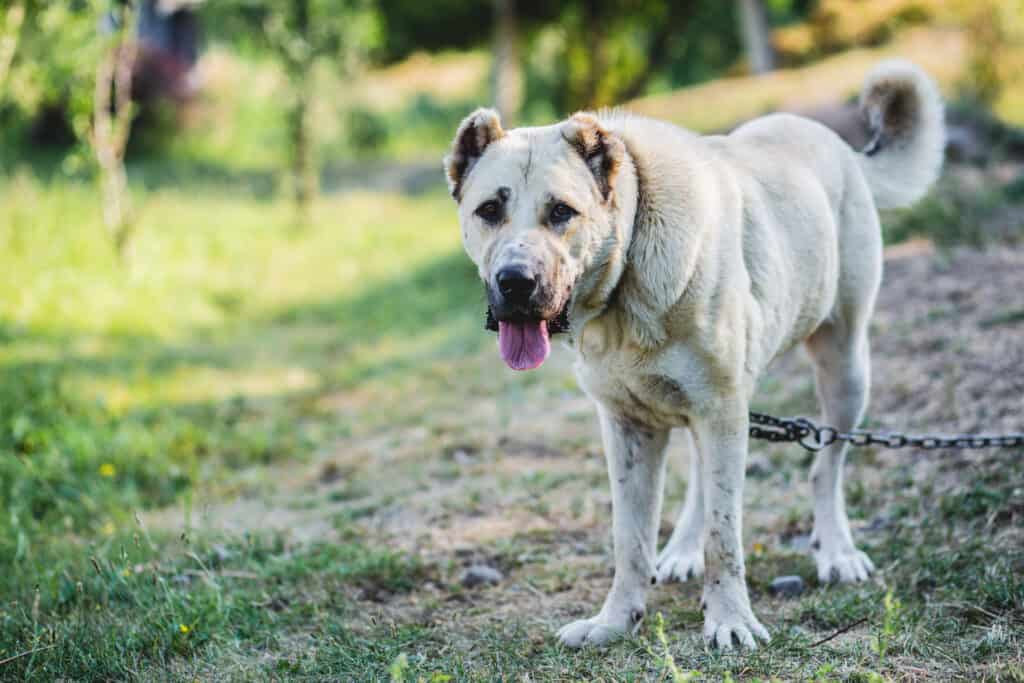
Armenian Gampr

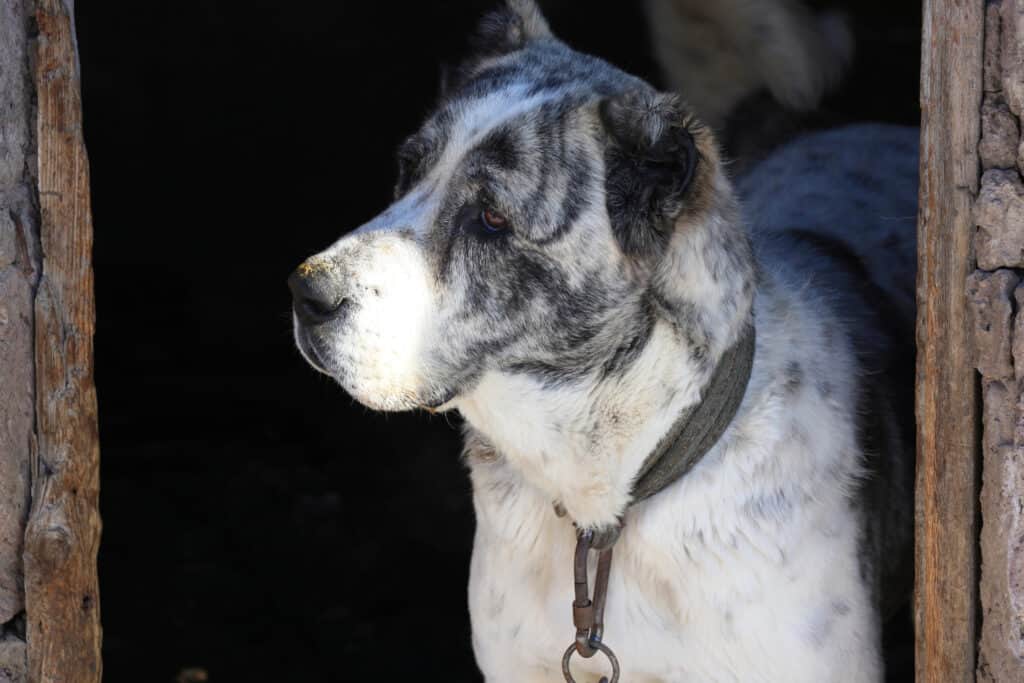
The Armenian Gampr is a gentle giant with an excellent temperament for families with small children.

How to Take Care of an Armenian Gampr

Taking care of a breed this size might be daunting at first, but it’s not as complicated as you might think.

Grooming

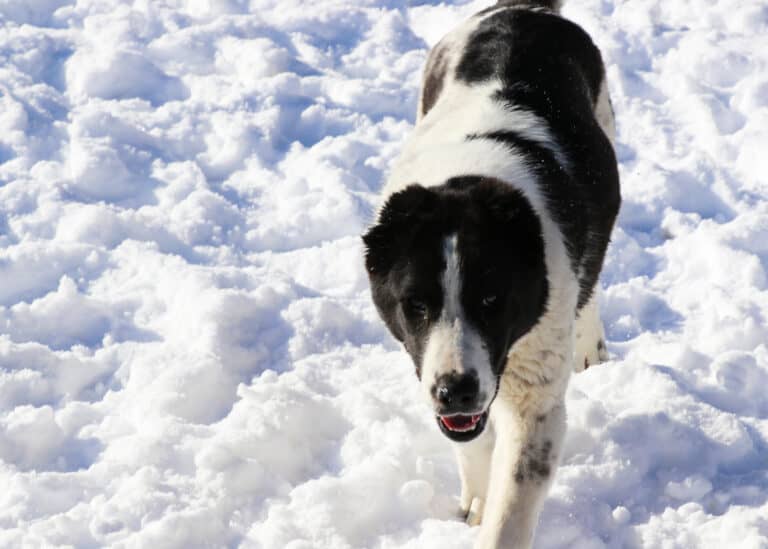
Armenian Gamprs have a double-layered coat to protect them against freezing temperatures and predators. In addition, they have natural oils that aid in shedding dirt and debris and protecting the skin.

That’s why they shouldn’t be bathed too much; in fact, they only need to bathe a couple of times a year when absolutely necessary.

Old school owners brush their coats with a rake once or twice a week, preventing major matting. However, brushing with a heavy-duty brush every day will completely prevent mats from forming.

Because of the amount of fur they have, they are heavy shedders, and during the change of season, they lose even more hair, so be sure to brush them more frequently when this happens.

To avoid struggling with this giant breed, they should have a grooming routine from a young age, including nail clipping every few months and brushing their teeth weekly.

Training

The Armenian Gampr might be hard to train because of its independent and aloof nature, which is why it is not recommended for first-time dog owners. Instead, they need a persistent and firm training routine overseen by a dominant trainer.

Even if they are trained well, their protective instincts will always kick in and can only be controlled to a certain point. Therefore, they need early socialization and training to try to curb these behaviors.

Exercise

While they are working dogs with incredible stamina, they are not overly energetic. One long walk a day should suffice, along with some outdoor fun in a fenced yard.

Puppies

Female Armenian Gamprs generally have litters of 6 to 8 pups. Unfortunately, these puppies are slow growers, and it can take them 3 years to fully mature. However, even after 3 years, they still fill out for several more years.

While they are not dog aggressive, they don’t enjoy spending time with other dogs and prefer the company of humans.

Because the Armenian Gampr is so rare, they fetch a pretty penny. You could expect to pay between $1,000 to $1,500 in the USA, but it could be more depending on the breeder and what sex you are buying.

Armenian Gampr and Children

The Armenian Gampr has the perfect temperament for families with small children. They are calm, patient, and protective. In addition, they rarely bark or show aggression. However, their size might be a problem; they accidentally knock children over when running past.

Dogs similar to the Armenian Gampr

There are several breeds similar to the Armenian Gampr in size and behavior; they include:

Anatolian Shepherd Dog

These dogs are fast becoming the go-to breed used for protecting flocks of sheep from cheetahs and leopards in Southern Africa. Anatolian Shepherds are an ancient breed that hails from Turkey, but today they can be found all around the world.

Along with their big, bulky bodies, the Anatolians are very intelligent and need a lot of physical and mental stimulation to thrive. Training these dogs might be challenging because of their independent natures, and they will need plenty of positive reinforcement.

Kangal Shepherd Dog

Another giant breed originating from Turkey is the Kangal Shepherd Dog. Also used to protect livestock, this breed makes fantastic guard dogs. However, they require early socialization and training if you want them to get along with other dogs.

Unlike many breeds that protect livestock, the Kangal Shepherd is more people-oriented and loves children. In addition, they are very intelligent and amazing escape artists, so having a secure backyard is essential. They can be dog aggressive and may even be aggressive towards strangers who enter your home.

Bucovina Shepherd

The Bucovina Shepherd is one of the tallest dog breeds in the world. They originate from the Carpathian Mountains in Romania, but their impressive guardian skills have taken them all over the world.

They are fearless and powerful dogs; definitely not a breed you want to run into when doing something wrong! However, they make fantastic companions because of their surprisingly gentle nature. While they might be loyal to their owners, the Bocvina Shepherd has a strong defensive instinct and will act aggressively when threatened. In addition, they let out a deep and loud bark when they sense danger is near, which can be heard from long distances.

View all 328 animals that start with A

Sources

  1. Dog Breed Info / Accessed October 1, 2022
  2. Wag Walking / Accessed October 1, 2022
  3. Pet Guide / Accessed October 1, 2022
Chanel Coetzee

About the Author

Chanel Coetzee

Chanel Coetzee is a writer at A-Z Animals, primarily focusing on big cats, dogs, and travel. Chanel has been writing and researching about animals for over 10 years. She has also worked closely with big cats like lions, cheetahs, leopards, and tigers at a rescue and rehabilitation center in South Africa since 2009. As a resident of Cape Town, South Africa, Chanel enjoys beach walks with her Stafford bull terrier and traveling off the beaten path.
Connect:

Thank you for reading! Have some feedback for us?


Armenian Gampr FAQs (Frequently Asked Questions)

Because the Armenian Gampr is so rare, they fetch a pretty penny. You could expect to pay between $1000 to $1500 in the USA, but it could be more depending on the breeder and what sex you are buying.