
Quick Take
- Not all birds in a species migrate, and which individuals stay behind reveals a surprising social hierarchy most people never consider. Who stays behind →
- One North American flyway funnels a staggering proportion of the continent's migratory birds through a single corridor, and the number is genuinely hard to believe. Explore the four flyways →
- Irruptive migration looks random, but it is set off by a very specific double trigger that only occurs in certain years. See the double trigger →
- Some birds never follow a fixed migration route at all. Their strategy is pure chaos, and it's more effective than it sounds. How nomadic wandering works →
Birds typically migrate to move from areas with few resources to areas with abundant resources. The primary resources sought are food and nesting sites. Migratory patterns include different strategies, from standard directional routes, such as latitudinal (north-south) and longitudinal (east-west) movements, to vertical altitudinal shifts down mountain slopes. Some bird species also use tactics such as partial migration (in which only some individuals leave), sudden irruptive surges driven by food scarcity, and unpredictable, irregular, or nomadic wandering. Continue reading to learn more about these types of migration.

Birds that breed in the Northern Hemisphere typically fly north in the springtime to reap the benefits of the abundance of nesting sites, expanding insect populations, and blossoming plants. The birds then migrate south as winter draws near and the number of insects and other food sources decreases.
©eurotravel/Shutterstock.com
Latitudinal Migration
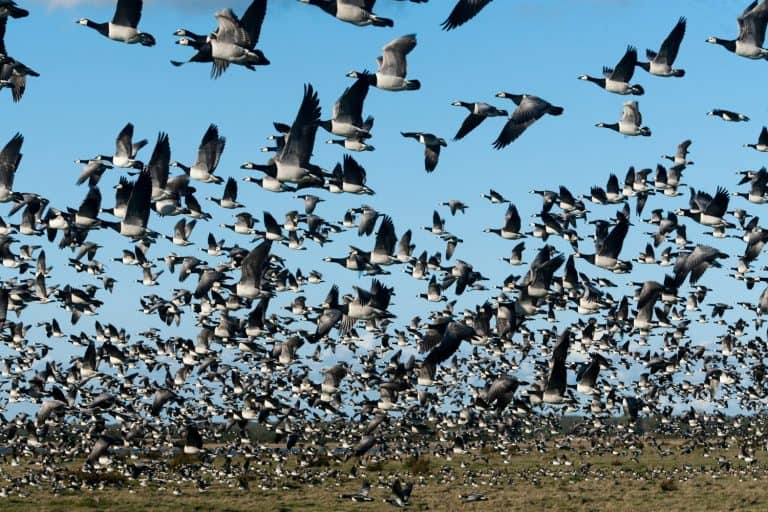
Latitudinal migration is the seasonal movement of birds traveling north and south between their breeding and wintering grounds. In spring, these birds fly north to exploit abundant food and nesting sites. They return south in autumn to escape harsh winter weather.

Common latitudinal migrants include Canada geese (pictured), Arctic terns, ruby-throated hummingbirds, and barn swallows.
©Michael Tatman/Shutterstock.com
To accomplish these massive journeys, millions of birds rely on four major north-south flyways across North America, which act as aerial superhighways following distinct geographical boundaries. Along the East Coast, the Atlantic Flyway guides waterfowl and shorebirds toward Florida and the Caribbean.

The rufa red knot migrates annually along the Atlantic Flyway, making one of the longest annual journeys in the animal kingdom by traveling up to 9,300 miles each way between the southern tip of South America and the Canadian Arctic.
©Buvana Bala/Shutterstock.com
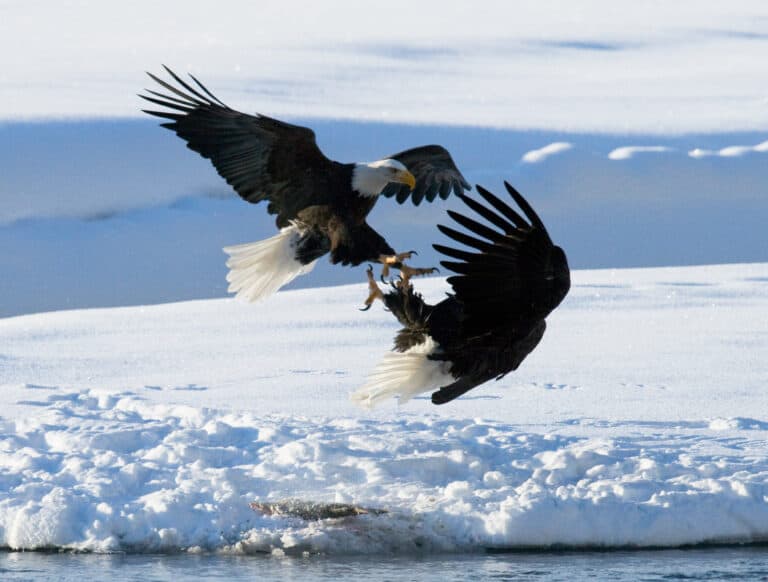
The Mississippi Flyway follows the massive Mississippi River Valley to funnel an estimated 40-60% of North America’s migratory birds straight through the midsection of the United States.
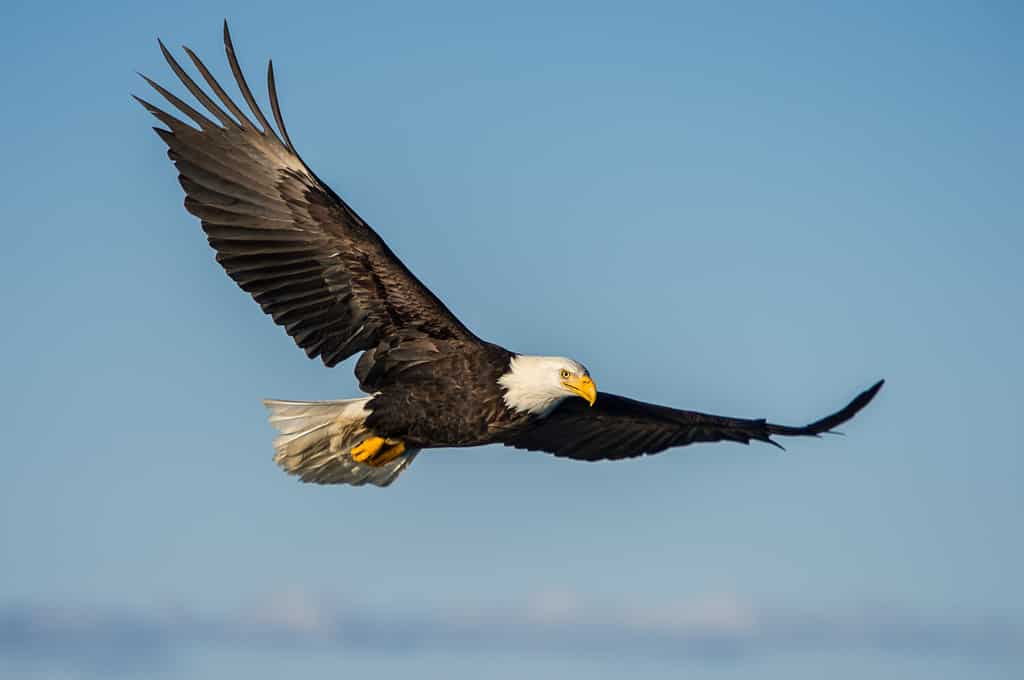
Bald eagles use the Mississippi Flyway to migrate from their breeding grounds in Canada and the Great Lakes to ice-free waters farther south, and back again.
©FloridaStock/Shutterstock.com
Farther west, the Central Flyway spans the Great Plains from Central Canada down to Texas and Mexico, bordered by the Rocky Mountains.
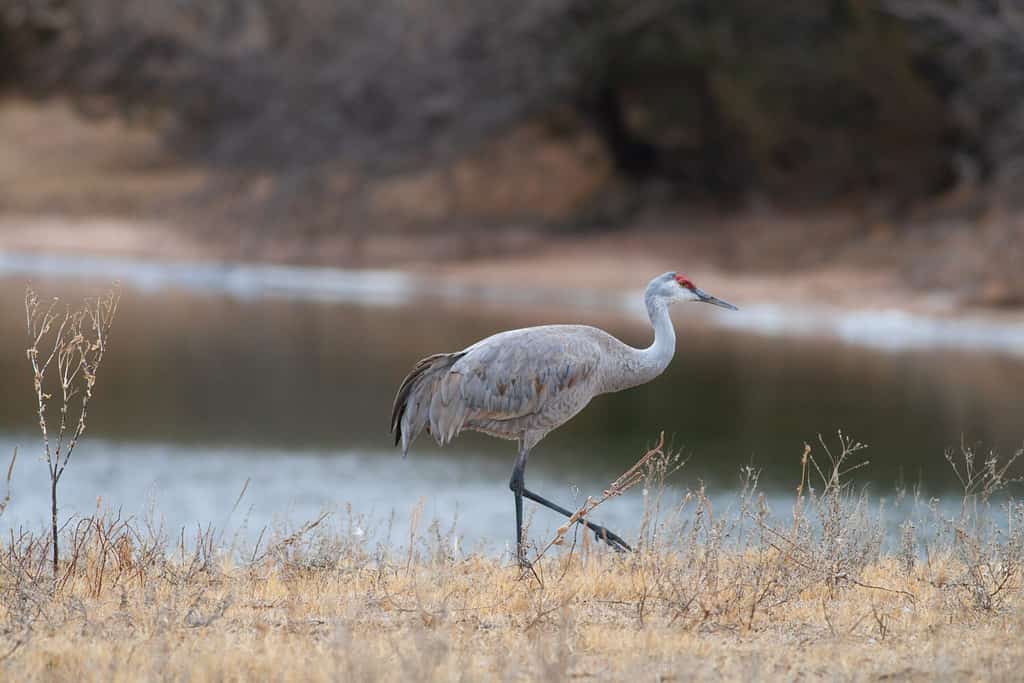
Sandhill cranes are among the bird species that rely on the Central Flyway for migration.
©Benjamin Tillotson/Shutterstock.com
The Pacific Flyway stretches between the Pacific Ocean and the Rockies, supporting western species traveling all the way from Alaska down into Central and South America.
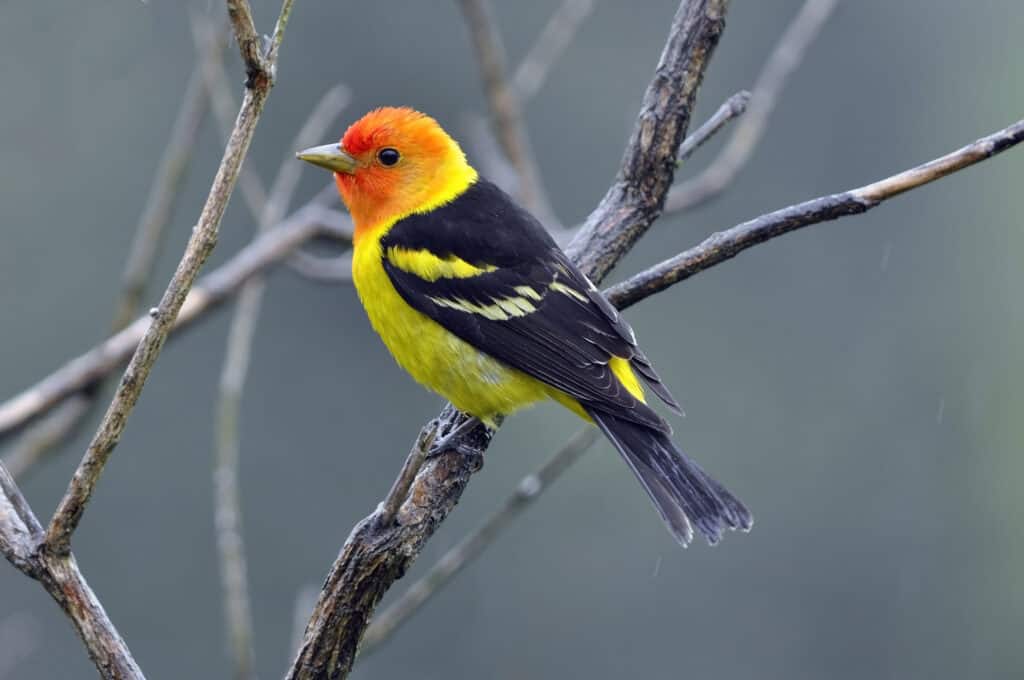
The Western tanager uses the Pacific Flyway to migrate between its wintering grounds in Mexico and Central America and its breeding grounds in the forests of Western North America.
©Laura Mountainspring/Shutterstock.com
Longitudinal Migration
Longitudinal migration is the seasonal movement of birds traveling east to west (or vice versa) across a continent. A less common strategy than north-south travel, longitudinal migration allows species to transition between distinct coastal and continental climates or water sources. In North America, true longitudinal paths rarely exist as separate geographic corridors.
Birds may use horizontal paths as connections or shortcuts between the major north-south flyways to make dramatic east-west adjustments before or after their main journeys, but the majority of migratory birds in North America rely on the major flyways at some point during their journey.
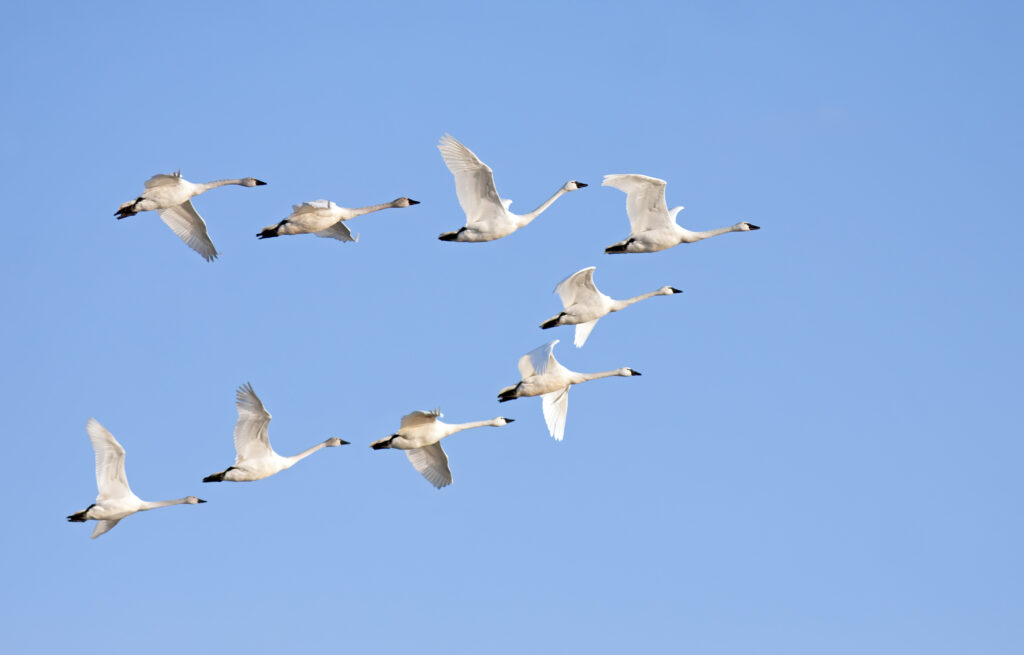
Tundra swans migrate from west to east across the Northern United States each autumn.
©Delmas Lehman/Shutterstock.com
True longitudinal migration paths exist primarily over open water. Highly specialized marine flyways exist in the Atlantic, Pacific, and Indian Oceans, where pelagic seabirds follow global wind currents and ocean surface temperatures in sprawling, east-west looping patterns rather than rigid continental lines.
Altitudinal Migration
Altitudinal migration is the seasonal movement of birds up and down mountain slopes rather than across geographic latitudes. Birds breed at high elevations during the summer to exploit abundant food and nesting sites, then descend to lower valleys or foothills in winter to escape harsh mountain weather and heavy snow cover.
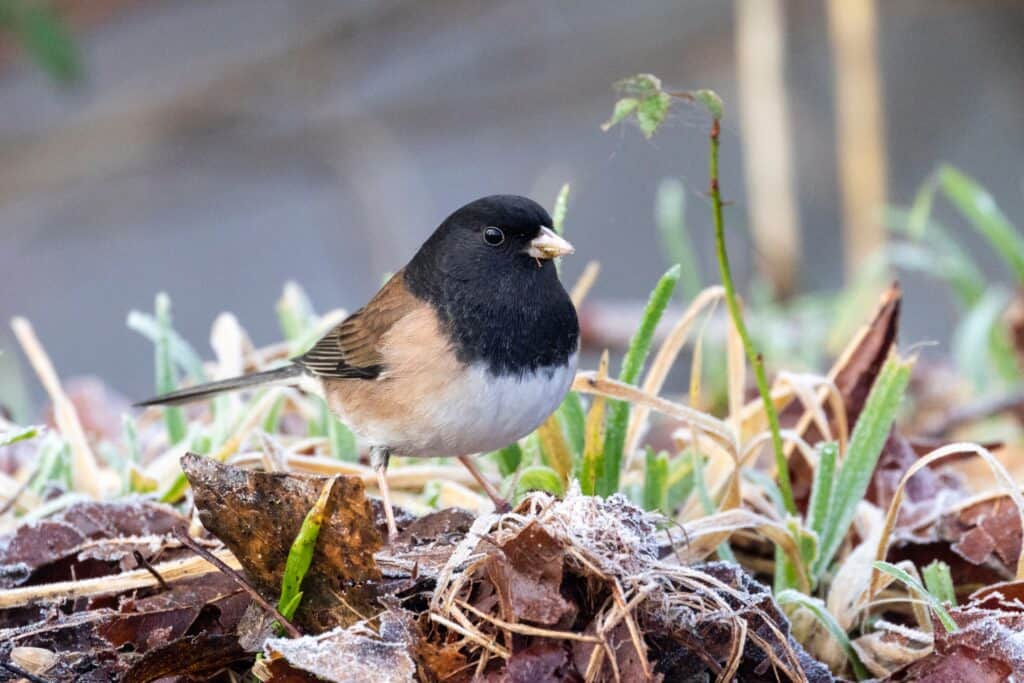
Dark-eyed juncos are altitudinal migratory birds.
©Feng Yu/Shutterstock.com
Nomadic Migration
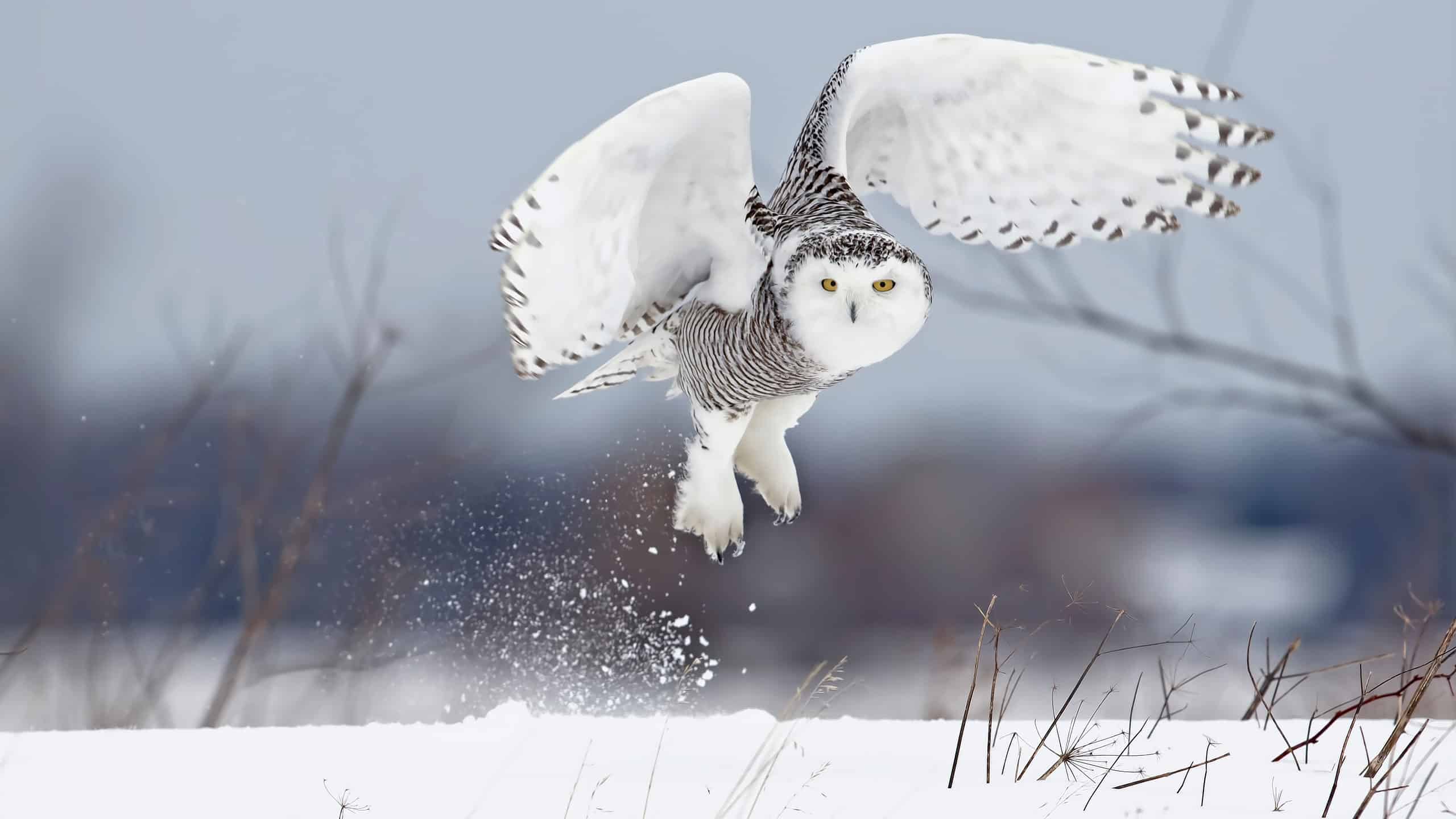
Nomadic bird migration is an unpredictable, wandering pattern in which birds continuously travel from place to place without a fixed seasonal destination or home range.
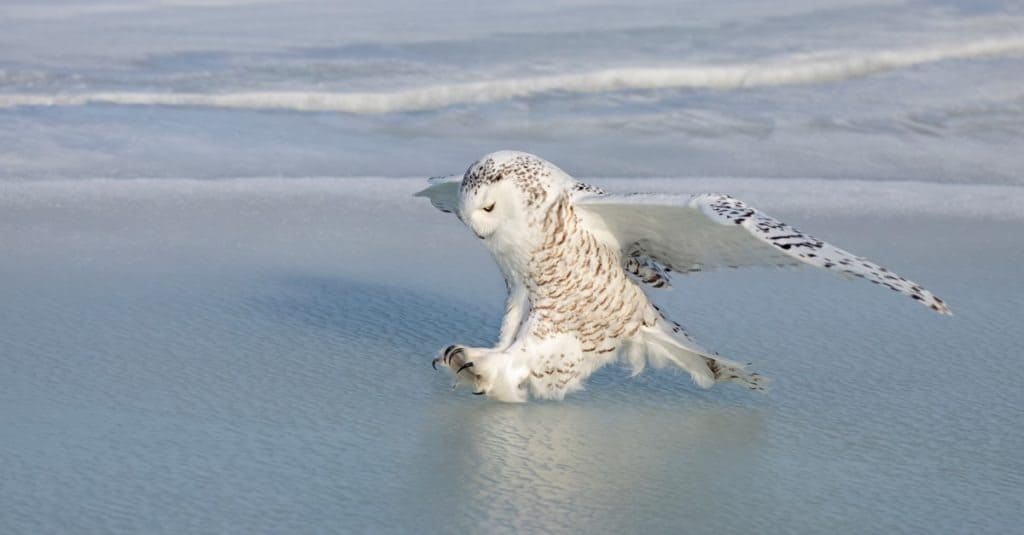
Snowy owls are nomadic, medium-to-long-distance migrants whose journeys are often driven by food availability.
©Jim Cumming/Shutterstock.com
Driven entirely by the erratic availability of environmental resources like rainfall, seed crops, or insect swarms, these birds quickly abandon drying or depleted areas to seek out newly abundant habitats.

Cedar waxwings are considered nomadic migratory birds because they have no set seasonal destinations and will quickly abandon a region as soon as the local berry supply is depleted.
©Paul Tymon/Shutterstock.com
Irruptive Migration
Irruptive migration is a sudden, crisis-driven mass departure of birds. Unlike predictable seasonal migrations driven by weather, irruptions are triggered by a severe collapse of local food supplies, such as a failure of seed cones or berry crops, often coupled with a high bird population following a successful breeding season.

Evening grosbeaks’ movements are driven entirely by winter food shortages and forest insect outbreaks.
©Danita Delimont/Shutterstock.com
Irruptive migrants are usually non-migratory or short-distance migrants with stable year-round territories. They only leave their home areas in large numbers during occasional years when severe food shortages or population booms force them to move.
Partial Migration
Partial migration is a pattern in which only a portion of a flock migrates, while the remaining individuals stay behind as year-round residents. This phenomenon is driven by a trade-off between the survival risks of a long journey and the competition for scarce winter resources at home.

The American robin is a partial migratory bird.
©Thomas G. Barnes, USFWS / CC0 Via Wikimedia Commons – Original / License
The decision to migrate or remain can be fixed, but it is often conditional and depends on individual factors such as sex, age, or physical dominance.