B
Species Profile

Black Marlin

Istiompax indica

Rigid fins. Big power. Black marlin.
kelldallfall/Shutterstock.com

Black Marlin Ocean Range

Marine Species

Black marlin (Istiompax indica) is a tropical–subtropical Indo‑Pacific pelagic billfish found across the Indian Ocean and much of the Pacific, including the Coral Sea and Tasman Sea. It moves seasonally into warm‑temperate waters (e.g., Sea of Japan), spawns in warm offshore currents, and is seen near productive offshore fronts and island/reef oceanic waters.

Loading ocean map...

Ocean Regions 8

indian_ocean north_pacific south_pacific coral_sea south_china_sea sea_of_japan tasman_sea red_sea
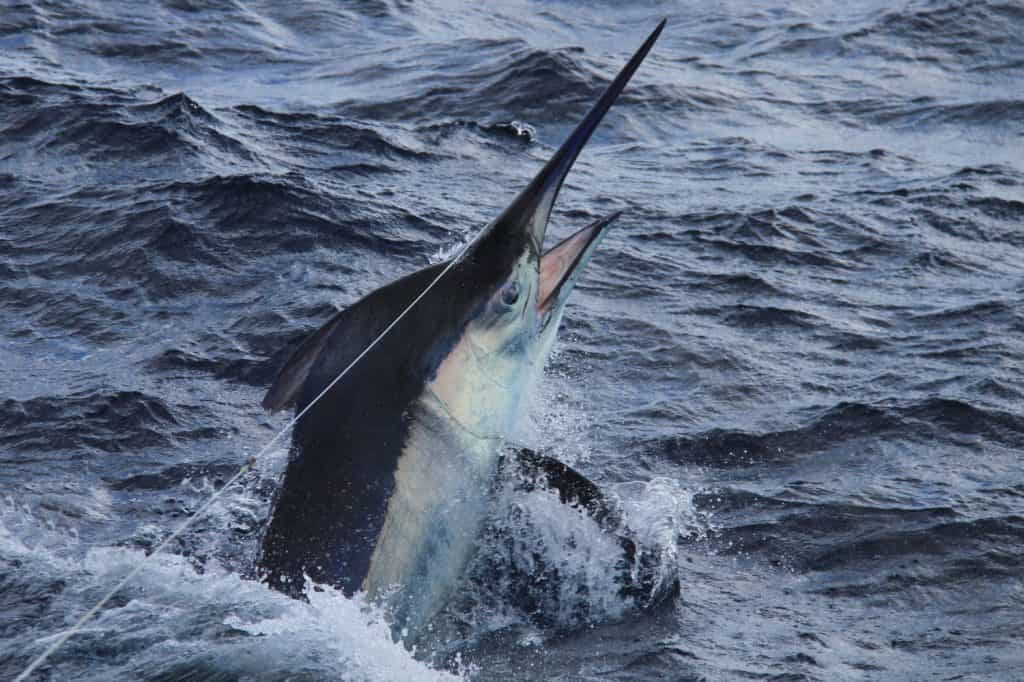
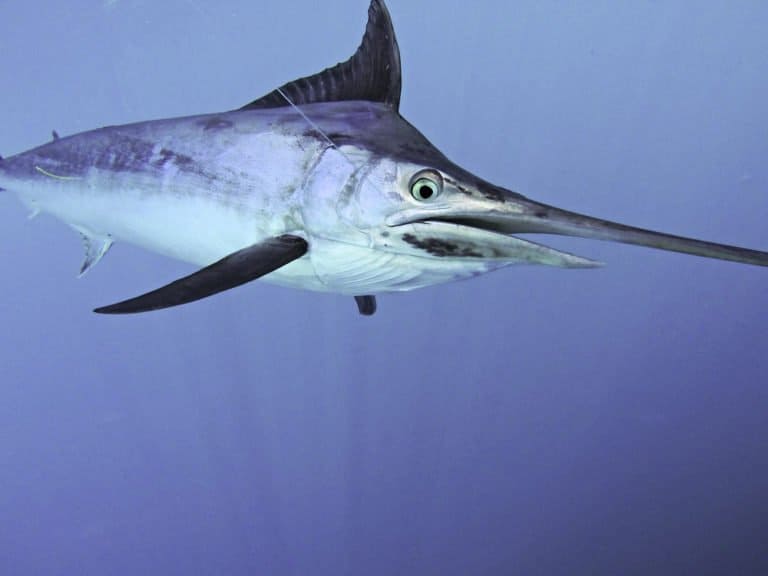
Black marlin close up

At a Glance

Ocean Species
Diet Piscivore
Activity Diurnal+
Lifespan 9 years
Weight 750 lbs
Did You Know?

Maximum recorded size is about 4.65 m lower-jaw fork length (FAO billfish catalogue: Nakamura, 1985).

Scientific Classification

The black marlin is a large, fast pelagic billfish found in tropical and subtropical oceans, prized in sport fishing and known for its powerful body and rigid pectoral fins.

Kingdom
Animalia
Phylum
Chordata
Class
Actinopterygii
Order
Istiophoriformes
Family
Istiophoridae
Genus
Istiompax
Species
Istiompax indica

Distinguishing Features

  • Robust, thick-bodied marlin; typically heavier-set than blue marlins
  • Pectoral fins are relatively rigid and cannot be folded flat against the body (a common field mark)
  • Long spear-like bill; dark bluish-black dorsally with silvery flanks
  • Large size; among the largest billfishes

Physical Measurements

Males and females differ in size

Length
♂ 7 ft 3 in (4 ft 7 in – 9 ft 10 in)
♀ 10 ft 6 in (6 ft 7 in – 15 ft 3 in)
Weight
♂ 220 lbs (55 lbs – 441 lbs)
♀ 441 lbs (88 lbs – 1,653 lbs)
Top Speed
22 mph
No proven speed - ~36 km/h

Appearance

Primary Colors
Secondary Colors
Skin Type Tough, leathery skin with small, embedded billfish scales that can give a rough, sandpaper-like feel; streamlined epipelagic body surface adapted for high-speed swimming (general istiophorid morphology; FishBase species account notes typical billfish scaling/skin texture).
Distinctive Features
  • Large, robust Indo-Pacific marlin (pelagic billfish) with a powerful, thick body and short-to-moderate, stout bill (rostrum).
  • Key identifier: rigid, non-folding pectoral fins (cannot be pressed flat against the body), a classic field mark separating black marlin from Atlantic blue marlin (Makaira nigricans), which can depress/fold pectorals.
  • First dorsal fin relatively low compared with sailfish; paired pelvic fins present; deeply forked (lunate) caudal fin with strong caudal keels for sustained high-speed swimming.
  • Maximum recorded size in sport-fishing record data: IGFA all-tackle record 707.61 kg (International Game Fish Association record listings for black marlin).
  • Maximum reported length commonly cited at 465 cm (lower jaw-fork length) in global databases (FishBase: Istiompax indica, accessed 2026-01).
  • Warm-water, tropical/subtropical Indo-Pacific distribution (including Indian Ocean and western/central Pacific) consistent with epipelagic habitat use and seasonal movements; appearance often described from blue-water sport-fisheries.
  • Behavioral appearance context: typically solitary or in loose association, fast, powerful burst swimmer; coloration can intensify (darker dorsum, more evident bars) during feeding strikes or capture (reported by fishery observations; common for istiophorids).
  • Otolith-based age estimates for black marlin in the Indo-Pacific show maximum observed ages around 10 to 12 years; females reach larger, older sizes than males. Values vary by region and method.

Sexual Dimorphism

Primarily size dimorphism: females grow substantially larger and heavier than males, a common pattern in istiophorid billfishes; very large trophy-class individuals are overwhelmingly female (supported by fisheries biological sampling and age/growth studies).

♂
  • Generally smaller maximum body size and mass than females; mature males typically occur in lower size classes in fishery samples.
  • Same overall coloration and rigid pectoral-fin structure as females (no strong color-morph sex differences documented).
♀
  • Attain the largest sizes (including record-class individuals); deeper-bodied appearance in very large adults due to overall mass and girth.
  • Often dominate older age classes in regional age/growth datasets, consistent with larger ultimate size and longer realized lifespan in samples.

Did You Know?

Maximum recorded size is about 4.65 m lower-jaw fork length (FAO billfish catalogue: Nakamura, 1985).

Reported maximum mass is ~750 kg, and the all-tackle IGFA world record is 707.61 kg caught off Cabo Blanco, Peru (IGFA record listings).

Unlike most marlins, its pectoral fins are rigid and cannot be folded flat against the body-one of the quickest field ID traits.

It is primarily Indo-Pacific (Red Sea/East Africa to Japan, Australia and the central Pacific), but it also occurs in parts of the eastern Pacific (e.g., Mexico-Peru).

Billfishes (including black marlin) have a specialized "heater organ" that warms the eyes/brain for sharper vision in cold/deep water layers (e.g., Carey, 1982; Fritsches et al., 2005).

Longevity is commonly reported up to ~11 years in compiled life-history databases (FishBase: Froese & Pauly, accessed 2025), with females generally reaching larger sizes than males.

Unique Adaptations

  • Rigid, non-depressible pectoral fins: a distinctive anatomical trait among marlins, aiding identification and reflecting a body built for stability at speed and in turns.
  • Streamlined, muscular body with a stiff crescent tail (lunate caudal fin) optimized for efficient thrust in open ocean pursuits.
  • Bill (rostrum) plus reinforced skull and neck musculature: enables forceful strikes and rapid direction changes during prey capture.
  • Cranial endothermy ("heater tissue"): vascular heat-exchange and heater organ can elevate eye/brain temperature above ambient water, supporting visual performance during dives (Carey, 1982; Fritsches et al., 2005).
  • Countershading (dark dorsum, pale belly): camouflage from above and below in clear pelagic water.

Interesting Behaviors

  • Epipelagic hunter: typically patrols the surface and upper water column (roughly 0-200 m), especially along warm currents, shelf edges, reefs and seamounts (FAO: Nakamura, 1985).
  • High-energy pursuit feeding: attacks schooling fish (e.g., tunas, mackerels) and squid, using rapid acceleration and the bill/body to disable prey.
  • Seasonal movements: concentrations form where warm water, bait and structure intersect (classic examples include the Great Barrier Reef shelf edge and Indo-Pacific current systems), producing predictable sport-fishing "runs."
  • Powerful fight strategy: strong sustained swimming and repeated deep, heavy runs are typical; large individuals can tow line and angle sharply under load, a key reason they're prized in big-game fishing.
  • Spawning in warm tropical/subtropical waters: like other istiophorids, produces pelagic eggs/larvae and likely spawns in batches when temperatures are high (FAO: Nakamura, 1985).

Cultural Significance

Black marlin (Istiompax indica) is a well-known Indo-Pacific sport fish that helps tourism and tournaments, especially around Australia's Great Barrier Reef/Cairns. Its 707.61 kg Cabo Blanco record (IGFA) made it a top heavy-tackle offshore fishing icon.

Myths & Legends

Polynesian stories say demigod Maui used a magic fishhook to pull land from the sea; an island was called a great fish. Today people sometimes picture that fish as a black marlin.

Ernest Hemingway's marlin in The Old Man and the Sea made the marlin a world symbol of endurance and respect between fisher and fish, a link many sport anglers extend to giant black marlin.

Among big-game anglers, the Cabo Blanco giant is treated as a near-mythic benchmark-retold as a legendary fish and place where marlins reached almost unbelievable size, shaping offshore fishing lore for generations.

Conservation Status

DD Data Deficient

Not enough data to assess extinction risk.

Population Unknown

Life Cycle

Birth 4000000 frys
Lifespan 9 years

Lifespan

In the Wild
4–13 years

Reproduction

Mating System Promiscuity
Social Structure Aggregation Group
Breeding Pattern Transient
Fertilization Broadcast Spawning
Birth Type Broadcast_spawning

Black marlin (Istiompax indica) have separate sexes (gonochoristic) and are pelagic billfish. They spawn in groups by broadcast spawning in warm surface waters. Females release buoyant eggs, males release sperm; no nests or parental care.

Behavior & Ecology

Social Shoal Group: 1
Activity Diurnal, Crepuscular
Diet Piscivore Small tunas and mackerels (Scombridae)
Seasonal Migratory 746 mi

Temperament

Apex epipelagic predator; opportunistic and highly responsive to prey density rather than maintaining stable social groups (behavioral generalization consistent with FAO billfish accounts: Nakamura, 1985).
Wary/avoidant of nearby large objects (including vessels) outside feeding contexts; when hooked, exhibits powerful burst swimming and sustained runs (widely documented in capture/fishery performance records; not a sign of social aggression).
Black marlin (Istiompax indica) are usually solitary cruisers, but when there is lots of bait many may feed together without clearly working together; grouping size depends on fronts, eddies, reef drop-offs, and prey.

Communication

Vision-based cues at close range Body orientation, approach/avoidance trajectories, rapid turns) typical of fast pelagic predators; no confirmed species-specific visual 'display' system has been formally described for I. indica in primary catalogues (Nakamura, 1985
Mechanosensory detection via the lateral line of prey movement and nearby large animals; likely important during feeding aggregations where individuals respond to prey-school dynamics and turbulence.
Chemical cues (olfaction) for detecting prey and possibly reproductive cues, as in many large pelagic teleosts; specific pheromonal communication has not been demonstrated for black marlin.
Hydrodynamic/acoustic byproducts (water displacement, tail-beat pressure waves) may incidentally signal presence during close-range interactions, but deliberate sound production is not documented for this species.

Habitat

Open Ocean Coastal Coral Reef
Biomes:
Elevation: Up to 328 ft 1 in

Ecological Role

High-trophic-level pelagic predator (upper-level consumer) in tropical/subtropical open-ocean and shelf-edge ecosystems

Regulates abundance/behavior of schooling pelagic forage fishes and oceanic squids through predation Provides trophic connectivity between open-ocean pelagic food webs and productive shelf-edge/reef-associated prey aggregations Cultural/provisioning value via recreational fisheries, with cascading incentives for pelagic ecosystem monitoring and conservation

Diet Details

Main Prey:
Schooling pelagic fishes Clupeiform fishes Flying fish Scads and jacks Sauries Cephalopods

Human Interaction

Domestication Status

Wild

Black marlin (Istiompax indica) is a wild oceanic billfish with no history of taming, farming, or pet keeping. Its migratory life and huge size (about 465 cm, ~750 kg; IGFA record 707.6 kg) make captivity impractical. Fast and powerful with rigid pectoral fins, it faces anglers, longline bycatch, and international conservation.

Danger Level

Moderate
  • Severe puncture/laceration trauma from the bill during capture/handling (thrashing fish on deck or alongside vessel)
  • Injury during gaffing, leadering, or bringing fish aboard due to sudden bursts of force
  • Boating/gear accidents during high-speed runs (line burns, falls, entanglement)
  • Rare but serious incidents if a marlin strikes a person in the water (generally associated with spearing/boating interactions)

As a Pet

Not Suitable as Pet

Legality: Black marlin (Istiompax indica) are not kept as pets. No legal pet trade exists; capture and holding need fisheries laws, transport, animal welfare, and facility permits, so private keeping is usually not allowed.

Care Level: Expert Only

Purchase Cost:
Lifetime Cost:

Economic Value

Uses:
Recreational sport fishing (trophy/charter fisheries) Commercial fisheries landings (limited; more often bycatch in longline fisheries) Seafood/meat utilization from landed fish Tournament and coastal tourism economy tied to billfishing destinations Scientific research (tagging, movement ecology, stock assessment sampling)
Products:
  • Charter/guide services and tournament entry revenue
  • Meat sold fresh/frozen where landed legally
  • Taxidermy mounts/replicas and media value from trophy catches
  • Tag-and-release programs (data products)

Relationships

Related Species 6

Atlantic blue marlin Makaira nigricans Shared Family
Indo-Pacific blue marlin Makaira mazara Shared Family
Striped marlin Kajikia audax Shared Family
Indo-Pacific sailfish Istiophorus platypterus Shared Family
Longbill spearfish Tetrapturus pfluegeri Shared Family
Swordfish
Swordfish Xiphias gladius Shared Order

Ecological Equivalents 4

Animals that fill a similar ecological role in their ecosystem

Indo-Pacific blue marlin Makaira mazara Overlaps strongly in tropical and subtropical epipelagic habitats and serves as a large, fast pursuit predator of schooling fishes and squid; commonly co-occurs around current edges, seamounts, and bait concentrations targeted by pelagic fisheries.
Swordfish
Swordfish Xiphias gladius Occupies a similar high-trophic-level pelagic niche and uses a bill to subdue prey. Differs by more frequent deep diel vertical movements, but overlaps with black marlin in foraging on squid and pelagic fishes along thermal fronts.
Yellowfin tuna
Yellowfin tuna Thunnus albacares Shares a warm-water pelagic distribution and prey base (small tunas, mackerels, flying fish, cephalopods), and commonly associates with the same bait schools and oceanographic features; black marlin often targets similar forage at comparable spatial scales.
Common dolphinfish Coryphaena hippurus A fast, epipelagic predator that concentrates around floating objects and oceanic convergence zones where black marlin also hunt. Both species feed heavily on schooling fish (e.g., flyingfish, small scombrids) and squid in warm waters.

Quick Take

Usually found in the Indian and the Pacific oceans, the black marlin is a fish that comfortably exists in the tropical and subtropical areas and can swim at burst speeds of around 36 kilometers per hour, though popular claims of up to 80 miles per hour have been disputed by scientific evidence. It is a species of marlin and has a maximum length of 15.3 feet. These marine creatures can reach a maximum weight of around 1,650 pounds, and they belong to the family Istiophoridae, which also includes sailfish. The sailfish is considered the fastest fish in the world.

An educational infographic about the Black Marlin, featuring a large central illustration of the fish, a global habitat map, and a size comparison to a 6-foot human.
From 40 million eggs to 1,600 pounds of raw power, discover how the Black Marlin dominates the deep with a lethal bill and a 13-year survival streak. © A-Z Animals

5 Incredible Black Marlin Facts

  • Pointed dorsal fins: These marine creatures have anteriorly pointed dorsal fins.
  • Hatched from eggs: They hatch from eggs as small fish. They grow rapidly year by year, eventually exceeding the size of most fish.
  • Largest bony fish: These are known to be one of the largest bony fish in the world.
  • Granders: The black marlins that weigh above 1,000 pounds are called granders.
  • Warm, tropical habitat: These marine creatures can be found in the warm waters of the Indian Ocean and the Pacific Ocean.

Classification and Scientific Name

Black marlins go by the scientific name Istiompax indica and belong to the family Istiophoridae, and are closely related to sailfish. They come from the class Actinopterygii and order Istiophoriformes. The genus is Istiompax. Meanwhile, the kingdom is Animalia, and the phylum is Chordata.

With a close relation to the swordfish, the black marlin is one of several different types of marlins. The word “indica” in their scientific name is Latin for “of India.”

Appearance

Black marlins are marine animals that have a shorter bill. Their dorsal fins are lower, and they also have a lower, more rounded dorsal tip. These fish can be easily differentiated from other marlin species since they have rigid pectoral fins, which become noticeably fixed especially in fish weighing around 150 pounds.

Their pectoral fins lie flat against their bodies, and they have between 39 and 50 dorsal rays. They are usually about 183 inches long and weigh around 1,653 pounds.
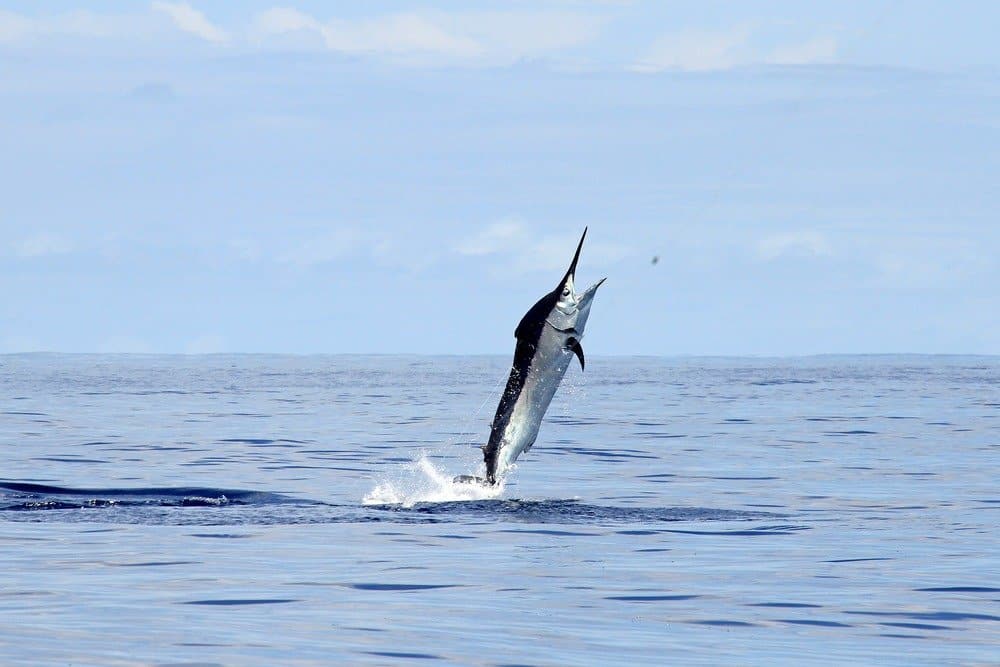
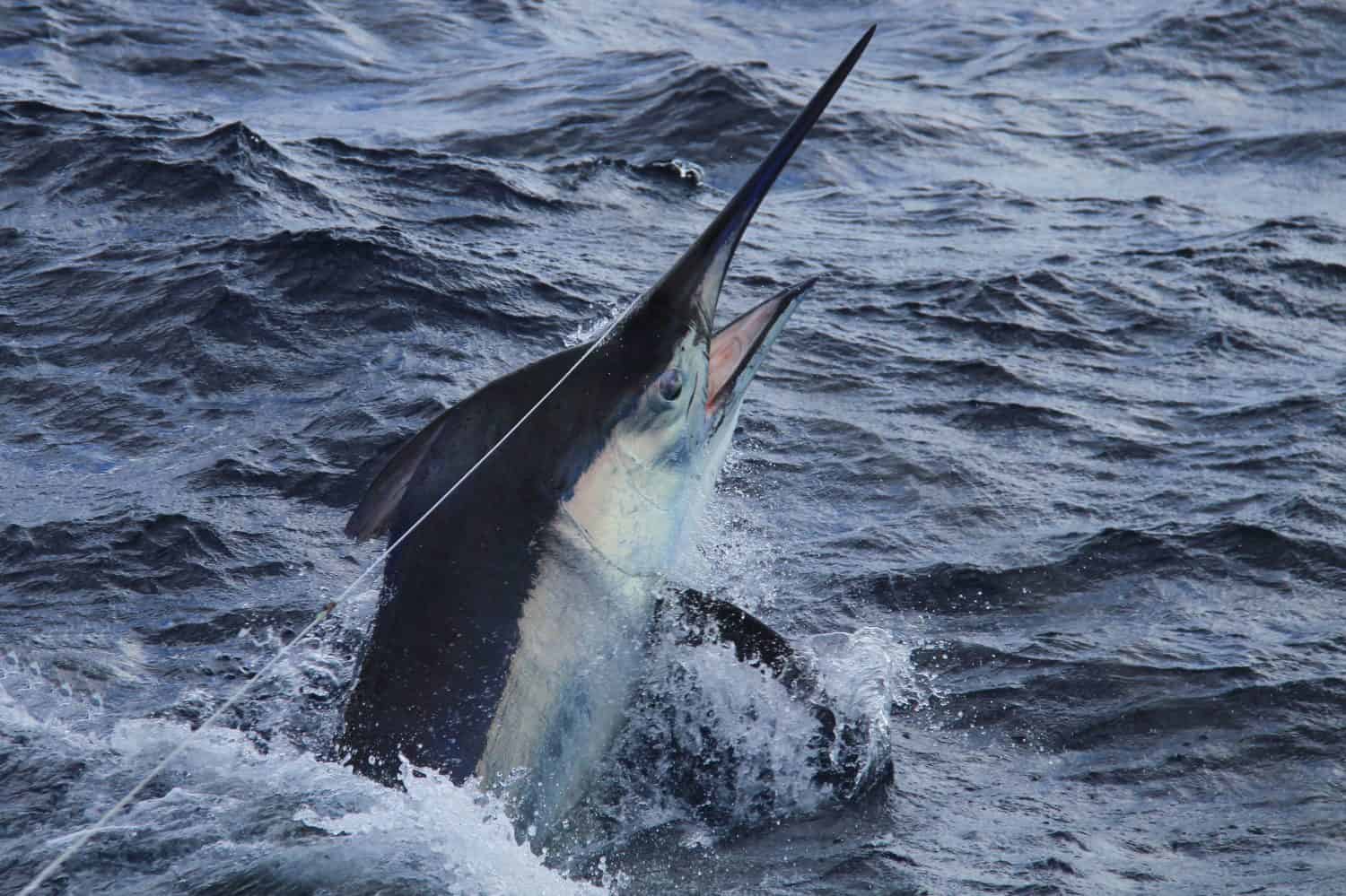
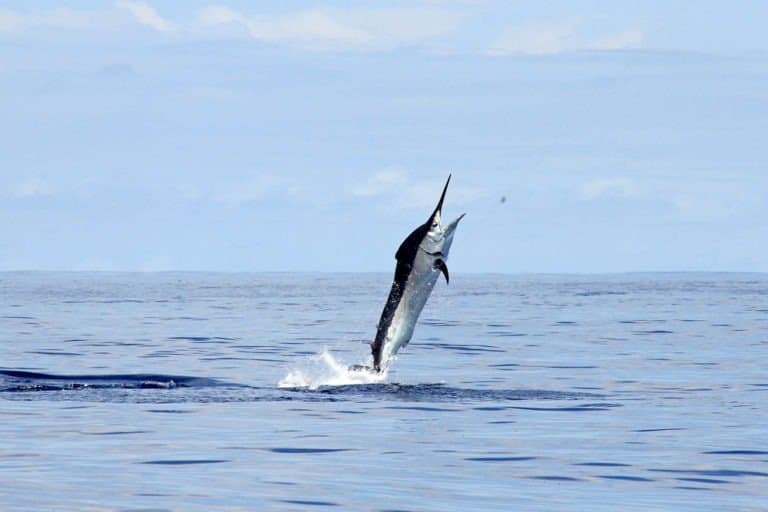
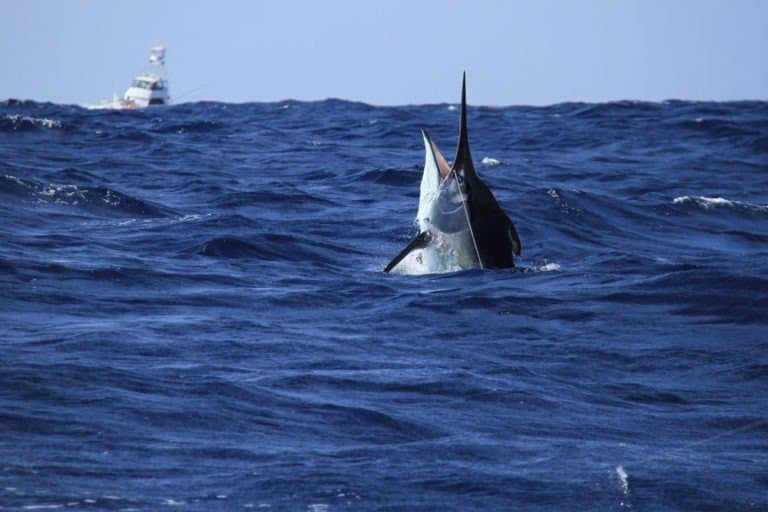
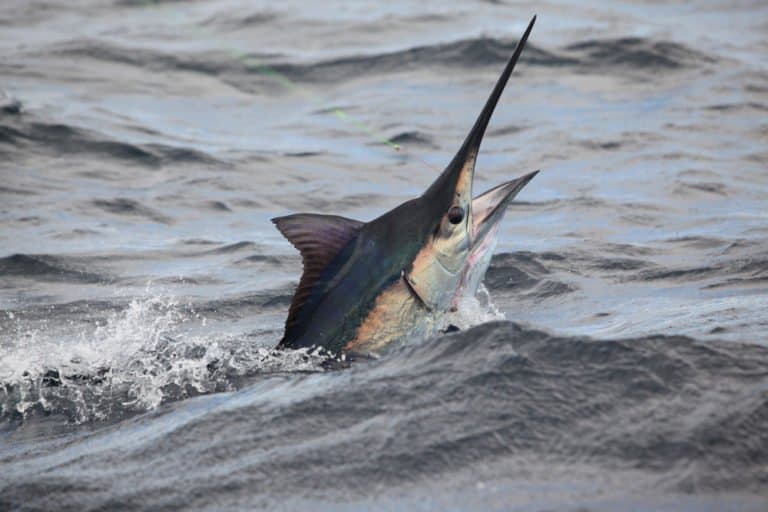
Black marlin jumping out of the water

The size of the black marlin is evident as it jumps out of the water.

Distribution, Population, and Habitat

Black marlins are usually found in shallow waters. They exist close to continents, coral reefs, and islands, and swim around depths of zero to 500 meters. However, most of them rarely go below 30 meters. They are found in both tropical and subtropical waters of the Indian Ocean as well as the Pacific Ocean, and can occasionally also enter temperate waters.

Although the exact population is unknown, black marlins have not yet been declared threatened or endangered.

Predators and Prey

Black marlins usually feed on squid, cuttlefish, octopods, fish, and large crustaceans. As these fish go after their prey, some research suggests they attack with a fast slash of their bill, similar to the hunting technique of the swordfish. The only time that these fish go after tuna is when the waters that they are in have them in abundance.

The only significant threat to these fish is humans, who hunt them for sale or as trophies. Even though they tend to have high mercury levels, they are still fished for food.

Reproduction and Lifespan

Black marlins reproduce by external spawning. They release eggs into warm waters; the eggs later hatch into juvenile fish that grow rapidly. A female can carry up to 40 million eggs, which hatch after a short incubation period.

Females are known to live up to 13 years, while males live only about 7 years. This difference in lifespan is attributed to sex-specific mortality rates in this species.

Black Marlin in Fishing and Cooking

This fish can be caught and cooked. However, despite being edible, it has been banned in some parts of the world because its flesh contains high levels of selenium and mercury. In fact, many chefs recommend against consuming this fish, and it is considered one of the top fish to avoid consuming.

View all 453 animals that start with B

Sources

  1. Wikipedia / Accessed November 28, 2020
  2. Marlin / Accessed November 28, 2020
  3. MarineBio / Accessed November 28, 2020
  4. Ocean Adventures / Accessed November 28, 2020
  5. Pelagic / Accessed November 28, 2020
  6. Science Direct / Accessed November 28, 2020
  7. Fish Index / Accessed November 28, 2020
  8. The Healthy / Accessed November 28, 2020
Ashley Haugen

About the Author

Ashley Haugen

Ashley Haugen is the editor of A-Z Animals. She's a lifelong animal lover with an affinity for dogs, cows and chickens. When she's not immersed in A-Z-Animals.com (her favorite editorial job of her 25-year career), she can be found on the hiking trails of Middle Tennessee or hanging out with her family, both human and furry.
Connect:

Thank you for reading! Have some feedback for us?


Black Marlin FAQs (Frequently Asked Questions)

The primary difference between marlins and swordfish is that they belong to different families. Marlins live longer than swordfish, while swordfish are migratory.