Quick Take
- One gender is more likely to wander, but the other joins in under one specific condition.
- Planning a second cane corso? Pairing the wrong sexes could turn your home into a battleground.
- Both sexes are protective, but each has a different trigger for aggression.
- The smaller sex has a surprising edge in energy, and there's a logical reason why.
The cane corso is an ancient Italian mastiff originally bred as a Roman war dog and later used as a hunting dog and a guard dog. Cane corsos have a large, broad head and a deep chest. Their short, stiff coat can be black, gray, fawn, red, or brindle, often paired with a black or gray facial mask. Cane corsos are assertive, loyal, and naturally protective toward their family while remaining aloof toward strangers.
Size and Weight
In many dog breeds, males tend to be larger and heavier than females. This is also generally true for the cane corso. Adult male cane corsos typically weigh between 100 and 120 pounds and stand around 25 to 27.5 inches tall at the shoulder.

Mature cane corsos can weigh up to 120 pounds, with males generally being larger than females.
Adult female cane corso dogs are slightly smaller on average, weighing between 80 and 100 pounds and standing around 23.5 to 26 inches tall.
Temperament
Both male and female cane corsos are known for their protective and loyal nature. However, there can be differences in temperament between the genders.

Cane corsos are known to be empathetic and loyal regardless of gender.
©BoJack/Shutterstock.com
Male cane corso dogs tend to be more assertive and dominant, especially around other dogs of the same sex. Females may exhibit territorial behavior, especially if not spayed, and can be more protective of their home and family.
Males are more likely to wander, although females will also roam when they are in heat.
Aggression
Although cane corso dogs are generally not aggressive without reason, they are naturally protective dogs.
Male cane corsos, especially intact (unneutered) males, may be more prone to territorial disputes and dominant displays, leading to aggression if not properly trained and socialized. Female cane corsos are especially likely to become aggressive if they feel their pups are threatened.

A female cane corso may become aggressive if she feels her pups are in danger.
©Mavicpro_LV/Shutterstock.com
Cane corsos are prone to same-sex aggression, so if you plan to own more than one, it is best to pair a male with a female. Generally, these dogs are more protective than aggressive. Therefore, working on socialization and training from an early age is important.
Training and Socialization
Both male and female cane corsos require proper training and socialization from a young age. Early training and exposure to various people, animals, and environments are crucial for a well-adjusted adult dog. There is perhaps nothing more important than socialization for this breed.
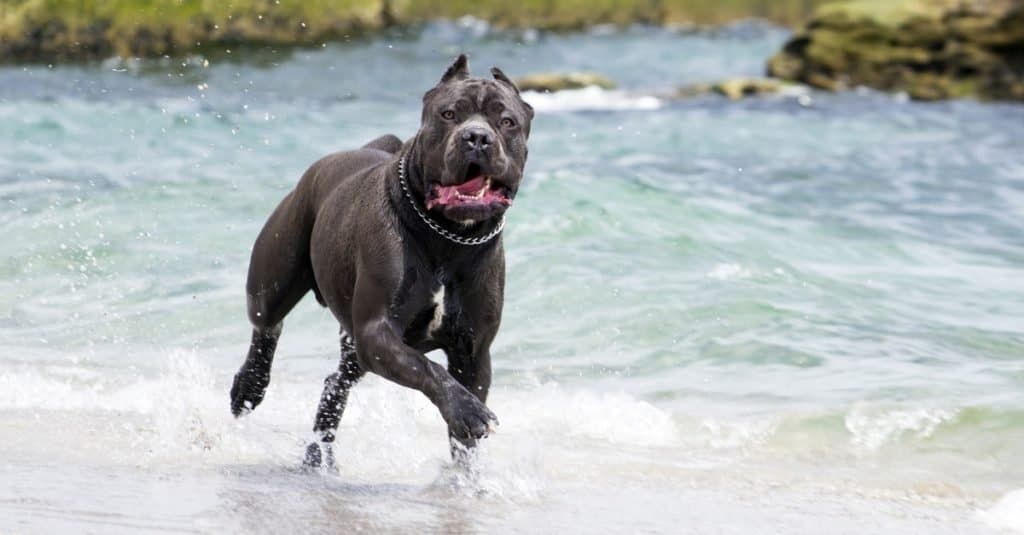
Cane corso dogs need proper training and socialization regardless of their gender.
©Sbolotova/Shutterstock.com
Males may require slightly firmer handling due to potential dominance tendencies, while females need careful training to manage protective behaviors. However, their training needs are quite similar.
Stamina
Energy levels can vary among individual dogs, but females generally have slightly more energy than males. This is because they are smaller, and smaller dogs tend to be more energetic than larger dogs.
However, this difference is not significant and can easily be managed with proper exercise and mental stimulation.

Despite being large, these dogs have moderate activity levels, especially as puppies.
©Eudyptula/Shutterstock.com