Quick Take
- One white chicken breed carries a lethal gene so dangerous that owning it means accepting a built-in mortality rate before chicks even hatch.
- A royal obsession with one fluffy white breed once triggered a full-blown economic bubble, and the crash that followed reshaped poultry keeping forever.
- The breed named after one country was almost certainly invented in a completely different one, and the real origin story is stranger than the name suggests.
- Some of these snow-white birds number fewer than 1,000 worldwide, and a few are so rare that no breeder anywhere offers chicks for sale.
There is something special about snow-white chickens. Breeders have developed white varieties of most types of chickens all over the world. From tall and lanky to short and round, these birds make a bright addition to any backyard flock. Take a look at these breeds with white chicken varieties, which are just a small selection of all the different domestic chicken breeds recognized across the world today. Maybe you’ll find just the right white chicken breed to add to your own flock.
Ameraucana Chicken
The Ameraucana chicken originated in the United States in the 1970s. It might be thought of as the new and improved version of the Araucana chicken, from which it was bred. The Ameraucana chicken produces the highly desirable blue eggs that originated with its predecessor, but breeders successfully eliminated lethal genes that also produced ear tufts and rumplessness (lacking a tailbone and the final few vertebrae) in Araucanas.
The American Poultry Association (APA) added the Ameraucana chicken to the Standard of Perfection in 1984, and currently recognizes nine colors including white. Ameraucana chickens have muffs and beards, along with relatively short, curved tails. Roosters generally reach 6.5 to 7.5 pounds, while hens weigh 5.5 to 6.5 pounds.

Ameraucana chickens have beards and muffs, rather than the ear tufts common to their predecessor.
©Vampyre Zen/Shutterstock.com
Araucana Chicken
The Araucana chicken, named for the Araucania region in Chile, hails from South America. The breed is well known for its beautiful blue eggs, a trait seldom seen in other breeds. The few other breeds that do produce blue eggs all trace back to the Araucana. Although researchers have investigated the trait, currently, no one knows for sure how the blue eggs came about. Roosters can weigh up to 5 pounds, while hens weigh up to 4 pounds.
Araucana chickens are also known for having a lethal autosomal dominant gene linked to their prominent ear tufts. Chicks that receive two copies of this gene either die before hatching or shortly after. Chicks with only one copy also face a higher risk of early death than those without the gene. These rumpless chickens also have no tailbones. Although up to 20 colors are recognized in Europe, the APA recognizes only five varieties in both bantam and large sizes, including white.

The genes that cause ear tufts and rumplessness in Araucana chickens can be lethal.
Aseel Chicken
The Aseel chicken, also known as the Asil chicken, is an ancient breed from India. Records show the birds have existed since at least 1,000 B.C., and the modern variety has changed very little from its ancestors. Aseel chickens, perhaps the epitome of game fowl, are fierce fighters. Roosters of game breeds typically fight one another, but even the hens of this breed eagerly battle. If an Aseel chicken looks as though it has seen a thing or two, it probably has.
These chickens, though on the smaller side, produce high-quality meat. Males weigh up to 5.5 pounds and females weigh up to 4 pounds. However, they are among the lowest egg producers, laying as few as 6 to 40 eggs per year. The APA recognizes Aseel chickens in five colors, including white. The Livestock Conservancy lists the breed as critical, with fewer than 1,000 birds remaining worldwide.

Aseel chickens, sometimes spelled Asil chickens, are highly aggressive birds that hail from India.
©Ammad Ali Zahid/iStock via Getty Images
Booted Bantam Chicken
The Booted Bantam chicken, also known as the Sabelpoot throughout much of Europe, was first recognized in the Netherlands. This tiny chicken with heavily feathered feet is a true bantam breed that likely developed on its own from ancient bantams in Asia. The long feathers on the breed’s feet, reaching up to six inches in length, give the Booted Bantam chicken its name.
This breed never exceeds two pounds, with roosters weighing in at about 1.6 pounds and hens reaching only 1.4 pounds. They make excellent show birds, but they require extra care to protect their feathers. The APA recognizes five colors of Booted Bantam chickens, including the white and nearly white porcelain varieties. The Livestock Conservancy includes the breed on its critical list, meaning fewer than 1,000 birds remain worldwide.

Booted Bantam chickens, also known as Sabelpoots, have heavily feathered feet.
Chantecler Chicken
The Chantecler chicken, a Canadian breed, was developed with cold hardiness in mind. Historians credit a monk, Brother Chatelain, with creating the breed after noticing that the flock at an abbey in Quebec had no Canadian chickens. He set about crossing large, hardy breeds, including Cornish, White Leghorn, Rhode Island Red, and white Wyandotte chickens, along with a final cross with white Plymouth Rocks.
The APA recognized this pure white Chantecler chicken in 1921 and later recognized the partridge variety in 1935. Chantecler chickens have full feathers, very small, cushion combs, and practically no wattles. These features help them resist frostbite and thrive in cold climates. They are recognized in partridge (golden-brown or reddish-brown base) and white varieties. Males weigh 8–9 pounds and females weigh 6.5–7.5 pounds.

Chantecler chickens, a Canadian breed, were designed specifically for cold climates.
©Pat Stornebrink/Shutterstock.com
Cochin Chicken
The huge and fluffy Cochin chicken resembles a heart-shaped ball with feathers all the way down its feet. This breed sparked the phenomenon known as hen fever when Queen Victoria fell in love with them after receiving a small flock as a gift. She built a special aviary for her prized chickens, and of course, everyone who was anyone rushed to follow her influence.
The price of Cochin chickens, which originated in China, soared until eventually, the bubble burst. Today, Cochin chickens remain popular as exhibition birds, but they lack commercial success. The APA recognizes these hardy birds in 17 colors in bantam sizes and nine colors in large sizes. Standard cochin males weigh 11-12 pounds, while females weigh 6.5 to 8.5 pounds. The white Cochin chicken is the most popular color among breeders.
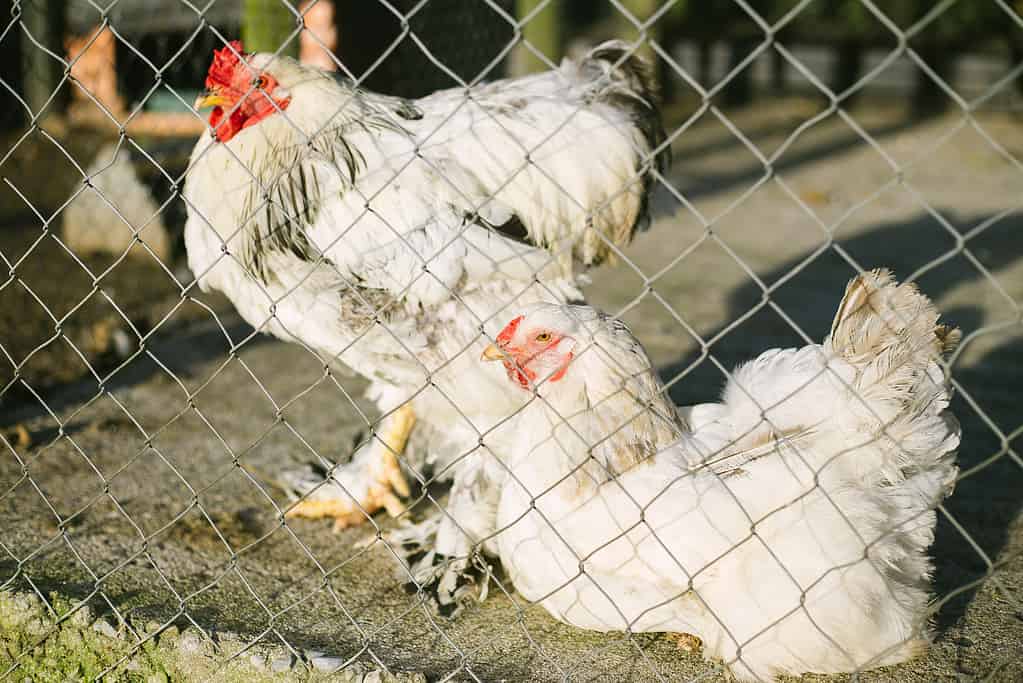
Cochin chickens are large, fluffy birds with feathers down the outsides of their feet.
©Albina Kosenko/iStock via Getty Images
Dorking Chicken
The Dorking chicken is an ancient breed that may have originally been brought to Britain during the Roman conquest. Breeders developed this five-toed fowl in southern England, where they dubbed it after the Surrey town of Dorking. Historians believe the white Dorking chicken is the oldest color variation. Males can weigh up to 9 pounds, and females can weigh up to 7 pounds.
By the mid-1800s, this breed had established a strong presence in the United States, and by the turn of the 20th century, the Dorking’s popularity exceeded all other chickens in England. Enthusiasm for the breed rapidly declined with the development of the commercial poultry industry, and today the Livestock Conservancy lists the Dorking chicken as threatened, with fewer than 5,000 birds worldwide. The APA recognizes five colors, including the white variety.

The white Dorking chicken is the oldest color of this ancient breed.
Faverolles Chicken
The Faverolles chicken, named after the village of Faverolles in France, is a product of extensive cross-breeding. Breeders spent many years crossing at least half a dozen different types of chickens before coming to a consistent stock around 1886. The medium-sized birds had round, fluffy bodies and full, feathered beards. Roosters weigh up to 8 pounds while hens can weigh up to 6.5 pounds.
Exporters introduced them in England in 1894, and they were brought to the United States in 1901 or 1902, where they found favor for their year-round egg production. The APA recognized the salmon variety in 1914 but did not recognize the white Faverolles chicken until 1981. They are unusually docile, curious, and adaptable, making them an excellent family breed and a good choice for first-time chicken owners.

Faverolles chickens have a unique look featuring full, feathery beards.
©JZHunt/iStock via Getty Images
Hamburg Chicken
The penciled (dark concentric lines on their plumage resembling pencil marks) versions of the Hamburg chicken, a small fowl with disputed origins, had established their place in the Netherlands by the end of the Middle Ages. By the end of the 18th century, the breed made its way to England, where in 1800, historians say two Hamburg roosters faced off in the first chicken show in the country. English breeders soon developed black, spangled, and white varieties of the breed, but the white variety only really took off when Hamburgs reached the United States.
This small fowl reaches only about 5 pounds at most, but the hens can lay up to 225 relatively small eggs per year. Sadly, interest in Hamburg chickens waned with the development of Leghorns, which laid more and larger eggs. The Livestock Conservancy currently lists the breed as threatened.

Hamburg chickens are known for their long, thin legs and small, rose combs.
©Whiteaster/Shutterstock.com
Houdan Chicken
The Houdan chicken originated in France. Bred from ancient birds, owners eventually crossed Houdan chickens with other breeds to improve their size and growth rate. Roosters can generally reach 8 pounds while hens weigh up to 6.5 pounds. These large birds became known for the quality of their meat, deemed to be among the most succulent and tasty in France.
The mottled Houdan chicken was introduced in America in 1865, but the white variety was developed in the United States. The APA recognized the white Houdan chicken in 1914, nearly half a century after the mottled variety. Though they nearly went extinct before the turn of the 21st century, the Livestock Conservancy now lists them as threatened.

Houdan chickens are known for their impressive crests and tasty meat.
Japanese Bantam Chicken
The Japanese bantam chicken is a true bantam with no large counterpart. That means it has always been small, and it was not selectively bred for its diminutive size. Females weigh 0.9-1.1 pounds, while males weigh 1.1-1.3 pounds. Japanese bantam chickens have a gene that causes 25 percent of their offspring to die before hatching. Another 25 percent hatch with undesirable long legs, and these chickens are not bred. The remaining 50 percent have the desirable short legs and large tails that are the trademark of the Japanese bantam chicken.
The APA recognizes this breed in nine colors, including white. The Livestock Conservancy currently lists the breed as threatened, with fewer than 5,000 birds worldwide. Although some hens can be good layers of small, cream-colored eggs, these birds are often kept as ornamental or showmanship birds rather than for their eggs or meat.
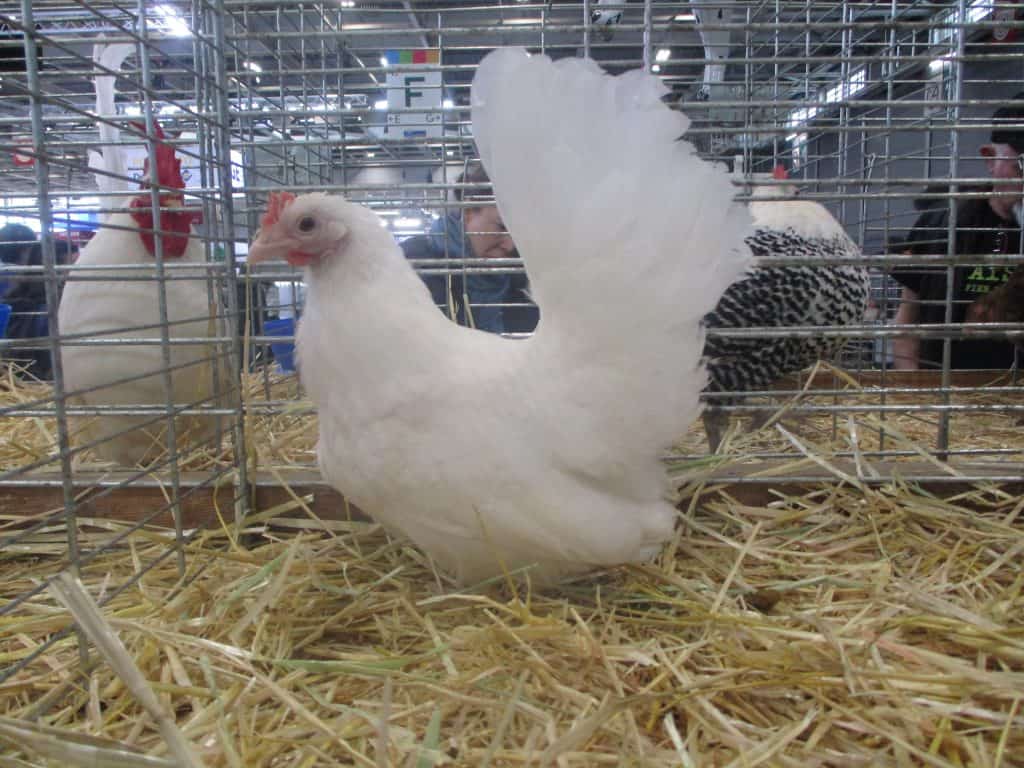
Japanese bantams are very small, weighing only around 0.9-1.3 pounds.
Jersey Giant Chicken
The Jersey Giant chicken was developed with just one thing in mind: size. These huge birds are the largest domestic chicken breed in the world. They were first developed between 1870 and 1890 by John and Thomas Black of New Jersey. They combined several large chicken breeds such as Black Javans and Black Lanshans to create Jersey Giants.
Jersey Giant chickens live up to their name, as the roosters weigh between 13 and 15 pounds, and hens weigh 10 to 11 pounds. The hens outweigh the roosters of most other breeds. The APA recognizes black, white, and blue varieties. They are widely known to be “gentle giants,” as they are docile and calm, making them easy to manage despite their size.

Jersey Giants are the largest domestic chicken breed in the world.
Langshan Chicken
The Langshan chicken originated in the Langshan area of China and was first exported to England in 1872 by an English officer. The breed became popular across Europe and then Australia, and it made its way to the United States in 1878. Today, these birds are typically exhibition fowl because their tall, narrow bodies and long legs make them unsuitable as meat birds by modern standards.
The APA recognizes only three colors of Langshan chickens, including black, white, and blue. There are both bantam and large varieties. Standard roosters reach about 9.5 pounds and hens weigh about 7.5 pounds. The Livestock Conservancy currently lists the Langshan chicken as threatened with fewer than 5,000 birds worldwide.

Langshan chickens originated in China.
Leghorn Chicken
The Leghorn chicken originated in the Tuscany region in Italy. When most people think of Leghorn chickens, the white commercial variety comes to mind. However, the APA currently recognizes many colors of non-industrial Leghorn chickens, including white. They list six colors of Leghorn chickens in the large variety and 11 different colors in the bantam variety. Standard males can weigh 5.5-7.5 pounds, while females reach 4-5.5 pounds.
Although they are a smaller breed, they can produce up to 320 white eggs per year, which are the kind you typically see in the grocery store. The industrial-type Leghorn is the backbone of the commercial egg industry in the United States. The Livestock Conservancy currently lists the non-industrial Leghorn as a recovering breed.

Leghorn chickens are a Mediterranean variety that originated in the Tuscany region of Italy.
©slowmotiongli/Shutterstock.com
Malay Chicken
The Malay chicken originated in India or southeast Asia long ago. Breeders imported Malay chickens to Europe by the early 1800s and showed them officially in England in 1845. By 1846, the breed made it to the United States. Malay chickens were once used for gamefowl fighting, but they have also served as predecessors to many modern breeds, including the Rhode Island Red.
There are both standard and bantam sizes. Standard Malay chickens are among the tallest in the world, reaching up to 36 inches in height. Roosters can weigh up to 9 pounds and hens can weigh up to 7 pounds. The APA added Malay chickens to their Standard of Perfection in 1883, eventually recognizing six colors, including white. The Livestock Conservancy currently lists the Malay chicken as critical, with just a few flocks and no availability of chicks from breeders.

The Malay chicken, among the world’s tallest, reaches heights of up to 3 feet.
Marans Chicken
The Marans chicken originated near the town of Marans in France. Marans chickens lay some of the darkest, richest brown eggs in the poultry world. The eggs of the Marans chicken gained fame in From Russia with Love, as the eggs James Bond preferred. Hens weigh 6.5 to 7 pounds, while roosters weigh about 7.5 to 8.5 pounds.
The breed was first shown in France in 1914, but the American Poultry Association did not recognize Marans chickens until they accepted the black copper variety nearly a century later, in 2011. The white, wheaten, and black varieties gained acceptance to the APA Standard of Perfection in 2021. The chickens are typically in demand and high-quality stock is hard to find.

Marans chickens originated in France and are known for their deep, chocolate brown eggs.
©sorsillo/iStock via Getty Images
Minorca Chicken
The Minorca chicken has mysterious origins, but once had a large population on the Island of Minorca off the coast of Spain. This breed made its way to England by the late 18th century, and made it to the United States close to a century later, in 1884.
Roosters weigh 9 pounds and hens weigh up to 7.5 pounds. These large, hardy birds are good layers of extra-large white eggs and also provide ample meat. The APA recognizes straight comb varieties in white, black, and buff, and rose comb varieties in white and black.

The Minorca chicken was named for the Island of Minorca, where it once lived in large numbers.
Modern Game Chicken
The Modern Game chicken was introduced in Great Britain in 1849 as an exhibition bird in response to a law banning cockfighting. These tall, lean birds reach around 22 inches tall and bear a strong resemblance to lanky teenagers in skinny jeans, or as some insist, ballerinas. The breed came from crosses between Old English Game chickens and Malay chickens.
The APA recognizes Modern Game chickens in 14 different color variations for bantam-sized birds, and nine colors for large fowl. Males weigh around 6 pounds, while females weigh 4.5 pounds. The Livestock Conservancy lists this breed as threatened, with fewer than 5,000 birds remaining worldwide.

Modern Game chickens are tall with long, lanky legs.
Naked Neck Chicken
The Naked Neck chicken, named for its bare, featherless neck, likely originated in Asia. Also known as the Transylvanian Naked Neck, it grew in popularity after its introduction to Romania in the late 1800s. This odd-looking bird, sometimes called a Turken, is said to resemble a cross between a chicken and a turkey, but it is all chicken.
Aside from their naked necks, these birds have sparse feathers all over and cannot fly. A single gene causes their odd feathering, and the trait can be introduced to other breeds. The APA recognizes four colors of Naked Neck chickens, including white. Standard Naked Neck chickens weigh about 8.5 pounds for roosters and 6.5 pounds for hens.

Naked Neck chickens, sometimes called Turkens, look like a cross between a chicken and a turkey.
Old English Game Chicken
The Old English Game chicken originated as a fighting bird in England. Its popularity declined after cockfighting was banned in 1849, but thanks to the breed’s beautiful plumage, it persisted as a show bird. Old English Game chickens are among the most colorful fowl in the world. Roosters generally weigh up to 5 pounds, while hens reach up to 4 pounds.
The APA currently recognizes a whopping 28 different color variations in the bantam size, and 14 in the large variety. These birds exhibit aggressive tendencies, and the roosters cannot be kept together because they may fight to the death. The Livestock Conservancy includes this breed on the watch list, with fewer than 5,000 birds in the United States.
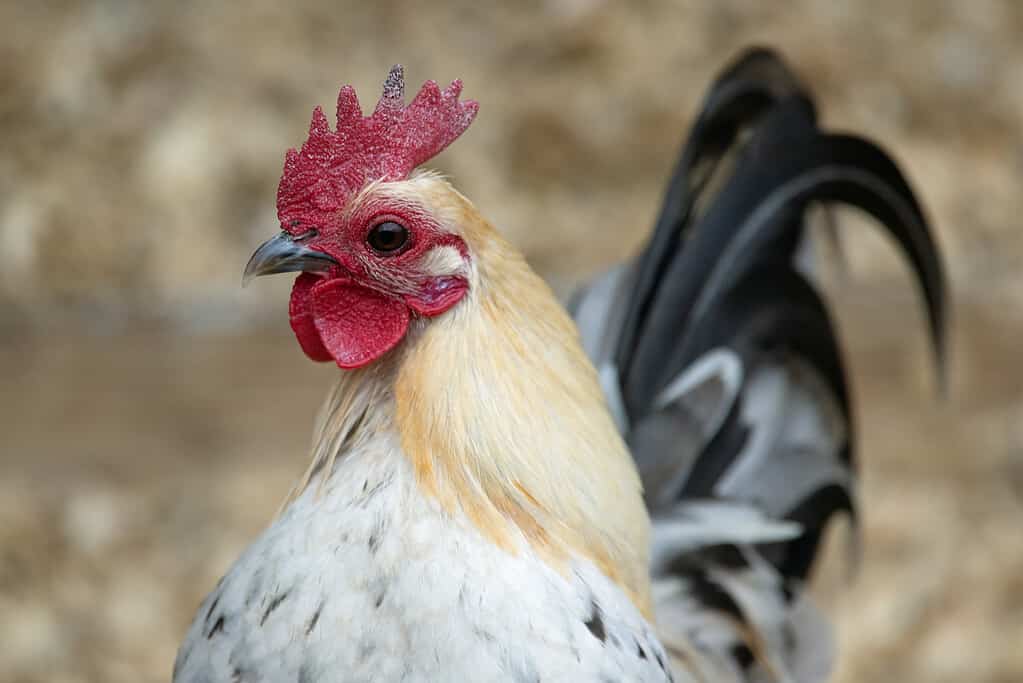
Multiple varieties of Old English Game chickens, besides the all-white type, have white feathers.
©JZHunt/iStock via Getty Images
Orpington Chicken
The Orpington chicken originated in the town of Orpington in England in 1886. These extremely fluffy birds came from crosses between Plymouth Rock chickens from the United States, Langshan chickens from Asia, and Minorcas chickens from Spain. The APA recognizes four colors in both large and bantam sizes, including white, black, blue, and buff, the most popular variety. A standard cock can weigh up to 10 pounds, while a hen can weigh up to 8 pounds.
Orpington chickens gained popularity both as meat birds and layers. They once ranked among the world’s best egg producers, with hens sometimes laying up to 340 eggs per year. However, they now average fewer than 200, as many owners bred the birds to show quality over production.
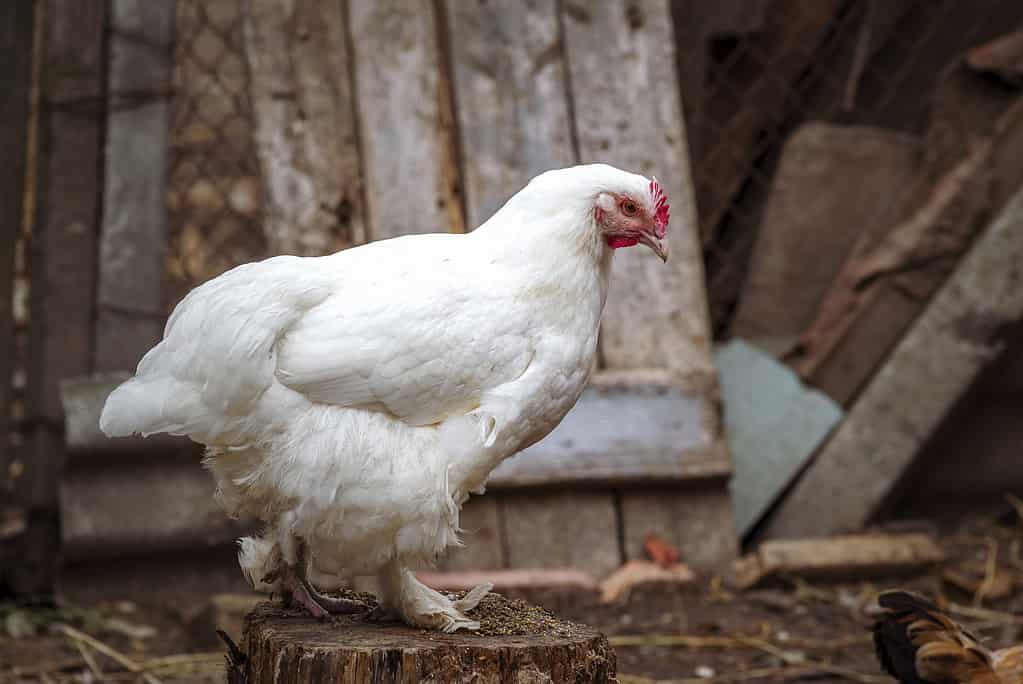
Orpington chickens are considered a good, general-use bird.
©Victoria Moloman/iStock via Getty Images
Plymouth Rock Chicken
The Plymouth Rock chicken was developed in the U.S. in the mid to latter part of the 19th century and officially appeared at a poultry show in Massachusetts in 1849. They are now considered good farm birds and are used for both meat and eggs. Males can weigh up to 9.5 pounds, while females can weigh up to 7.5 pounds.
The APA recognizes seven different colors in the standard variety, including white, and eight colors in the bantam variety. The barred variation, often called the Barred Rock, is by far the most popular of all the colors. Barred Plymouth Rock chickens appear to be covered head to tail in feathers with narrow black and white bars.

Although the barred variety is the most popular, white Plymouth Rock chickens are also striking.
Polish Chicken
The modern version of the Polish chicken is believed to have originated in the Netherlands, not Poland. They were most likely named after the Dutch word, Pol, which means big head. These chickens have large, round crests supported by an oddly shaped skull that features a rounded protrusion shaped like a ping pong ball, which causes their brain to form in a peanut shape. Some Polish chickens have beards and muffs in addition to their elaborate crests. This limits their vision, and they can be easily scared.
The APA currently recognizes 11 different color variations of Polish chickens, including both bearded white and non-bearded white. They are strictly ornamental birds. The standard Polish chickens are small-to-medium-sized fowl, with roosters weighing up to 6 pounds and hens weighing up to 4.5 pounds.

Polish chickens have enormous, rounded crests, sometimes paired with muffs and beards.
©JZHunt/iStock via Getty Images
Rhode Island White Chicken
The Rhode Island White chicken was developed in Rhode Island around the turn of the 20th century. Breeders combined Cochin chickens, white Wyandotte chickens, and white Leghorns to create the Rhode Island White. This breed is not simply a white variation of the Rhode Island Red chicken, although they share the same place of origin and have a similar overall shape. They have separate lineages and are not as closely related as their names might suggest.
The APA added the breed to its Standard of Perfection in 1922. The Livestock Conservancy currently lists Rhode Island White chickens in their watch category, with fewer than 5,000 birds left in the United States. They are a moderately-sized bird, with males weighing up to 8.5 pounds and females weighing up to 6.5 pounds.
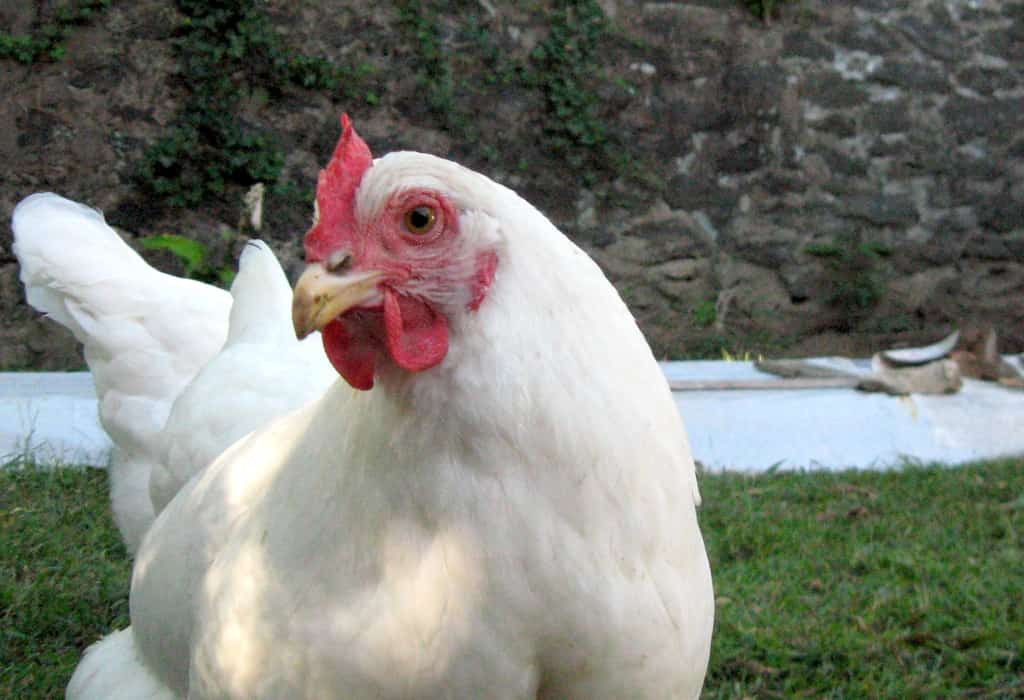
Despite the name, the Rhode Island White chicken is not closely related to the Rhode Island Red.
©Steven Johnson from Philadelphia / CC BY 2.0 – Original / License
Silkie Chicken
The Silkie chicken is an ancient bantam-sized, Asian breed named for its unusual silky feathers. The barbs on a Silkie chicken’s feathers lack a feature known as barbicels, which hook together and keep feathers neat and tidy. Instead, Silkie chickens have barbs that float about freely, giving them a fluffy, airy quality much like a luxurious powder puff. Without barbicels to help their feathers hold air, these chickens lack the ability to fly.
The Silkie chicken breed has other features that set it apart, including black skin, bright turquoise earlobes, mulberry-colored combs and wattles, a puffy crest, and five toes on each foot. The APA recognizes eight colors, including white. Hens weigh about 1.5 to 2 pounds, while roosters weigh about 2 to 3 pounds.
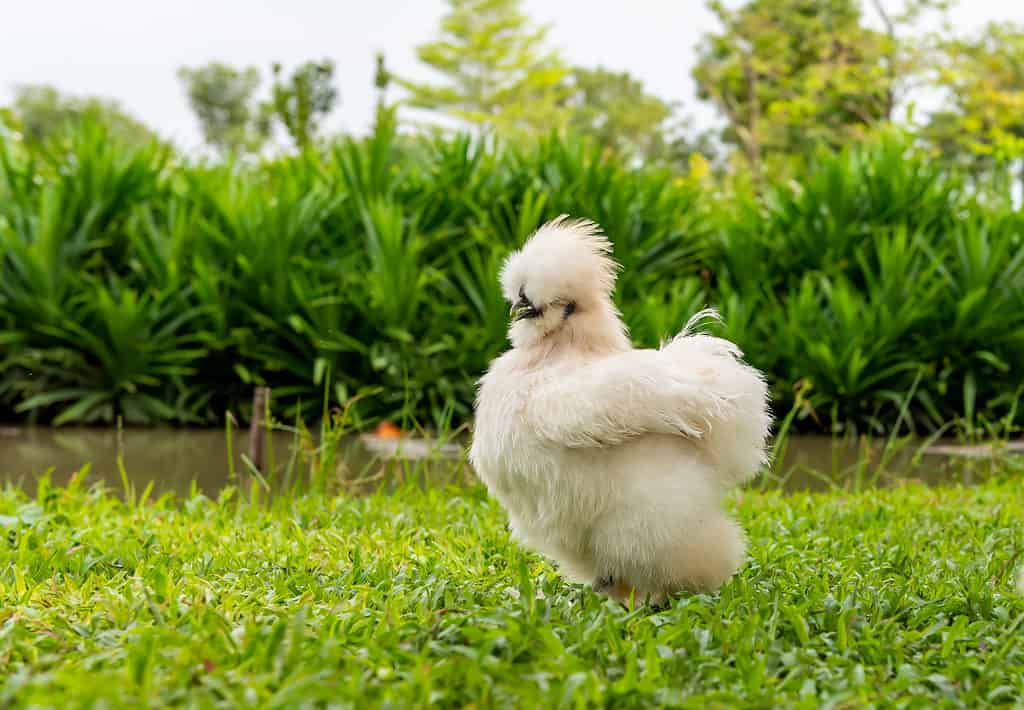
Silkie Chickens are known for their unusual feathers.
©MR. AEKALAK CHIAMCHAROEN/Shutterstock.com
Sultan Chicken
If ever a chicken exemplified royalty, it would be the Sultan chicken. This breed, also known as the Serai Täook, was called the Fowl of the Sultan. It held a place of high distinction in the palace of the Sultan of the Ottoman Empire, and also in the menagerie of Louis XIV in Versailles. They are small-to-medium ornamental birds, with males weighing up to 6 pounds and females weighing up to 4 pounds.
This breed, recognized only in its snowy white color, ranks among the worst egg layers of all chickens. The hens lay only about 50 eggs per year. Currently listed in the Livestock Conservancy’s critically endangered category, the Sultan chicken numbers fewer than 1,000 birds worldwide today.

The Sultan chicken is recognized in only one color, snow white.
©09arts/Shutterstock.com
Wyandotte Chicken
The Wyandotte chicken is an American breed. It arose from breeders in New York, Michigan, and Massachusetts in the 1870s. This breed was admitted to the APA Standard of Perfection in 1883 and proved quite a hardy dual-purpose chicken. Popular in the United States and Canada, exporters spread the breed throughout Europe, Australia, and even parts of Africa.
Contrary to popular belief, Wyandotte chickens seem to have been named after a ship, not the Native American tribe of the same name. The APA recognizes nine different colors, including white, in large fowl, and 10 colors in bantams. The standard Wyandotte male weighs 8-9 pounds, while the standard female weighs 6-7 pounds.

Wyandotte chickens come in many varieties, including solid colored and laced variations.
©Père Igor / CC BY-SA 4.0 <https://creativecommons.org/licenses/by-sa/4.0 – Original / License
Yokohama Chicken
The Yokohama chicken, also known as the Minohiki chicken in its native Japan, was first exported from the Yokohama port in 1864. These chickens have beautiful, long, luxurious tail feathers that grow up to 4 feet in length. Known for their glorious white feathers, these chickens have highly desirable ornamental qualities. However, they can be challenging for all but the most experienced owners, as those gorgeous feathers require a great deal of special care.
The Livestock Conservancy currently lists the Yokohama chicken in their critically endangered category, because fewer than 1,000 exist worldwide, though thanks to devoted breeders, it may soon be moving up to the threatened category. These ornamental chickens come in both standard and bantam sizes. Standard males weigh 4.5 to 5.5 pounds and females weigh 3.5-4 pounds.

Yokohama chickens have tails that can grow up to four feet long.