
Quick Take
- Bat rays are larger than round stingrays.
- Both bat rays and round stingrays are endemic to the Pacific Ocean.
- Bat rays swim by flapping their pectoral fins, unlike stingrays, which propel themselves with a rippling body motion.
Stingrays (Myliobatoidei) are a group of cartilaginous fish known for their distinctive flat shape and long tails, each with a venomous barb at the end. There are eight taxonomic families within the suborder Myliobatoidei: sixgill stingrays (Hexatrygonidae), deepwater stingrays (Plesiobatidae), stingarees (Urolophidae), round rays (Urotrygonidae), whiptail stingrays (Dasyatidae), river stingrays (Potamotrygonidae), butterfly rays (Gymnuridae), and eagle rays (Myliobatidae). Bat rays (Myliobatis californica) are a species of eagle ray, and this article will compare them to round stingrays (Urobatis halleri) because their ranges overlap. Continue reading to learn the differences and similarities between bat rays and round stingrays.
Distribution and Habitat
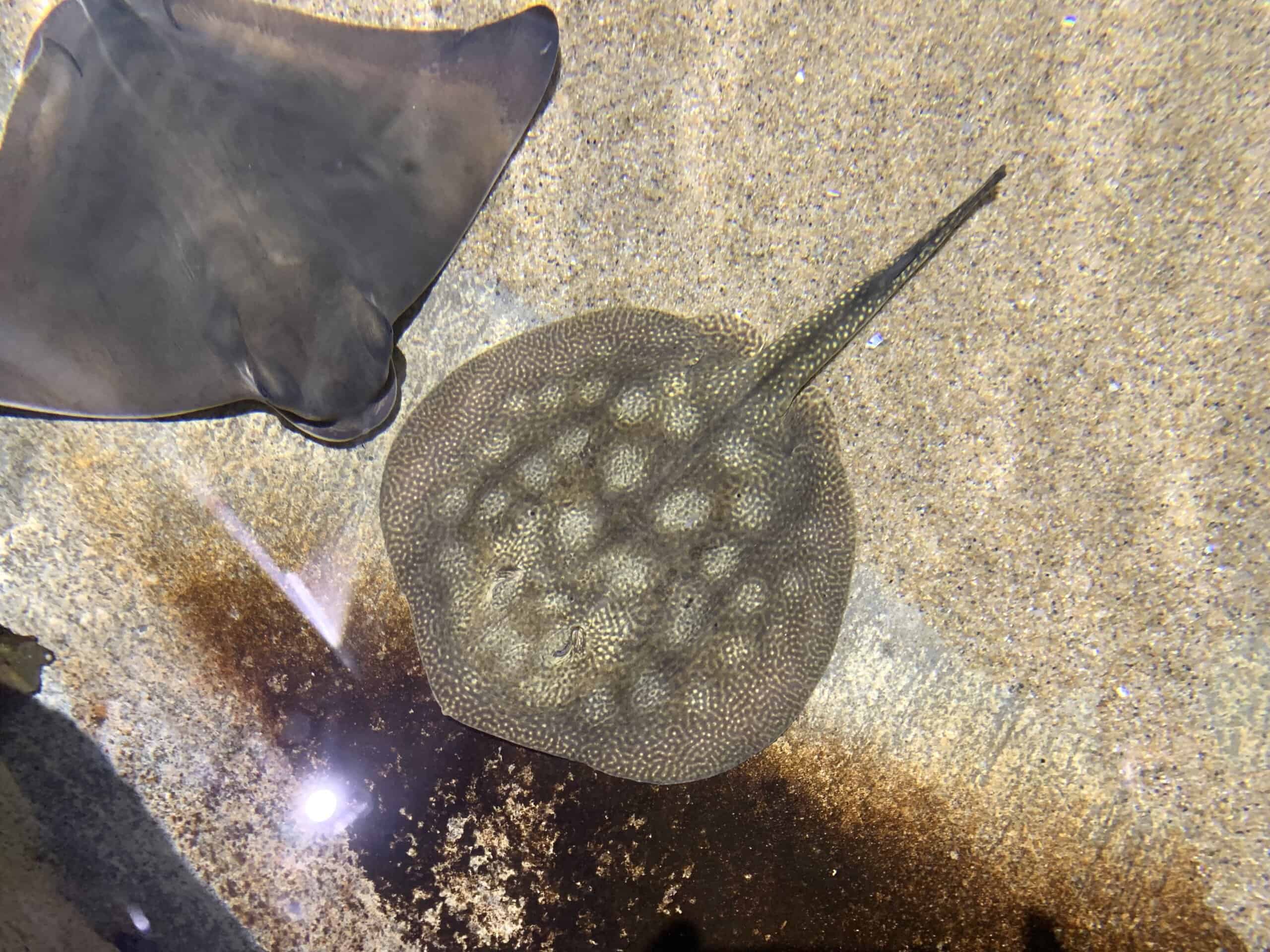
Pictured: a bat ray (left) and a round stingray (right).
©Coughdrop12, CC BY-SA 4.0 <https://creativecommons.org/licenses/by-sa/4.0>, via Wikimedia Commons – Original / License
Both bat rays and round stingrays are endemic to the Pacific Ocean. Round stingrays are endemic to the Northeastern Pacific, where their range extends from Northern California’s Humboldt Bay to Panama. They are most prevalent on the coasts around the Baja Peninsula and Southern California. Bat rays are found in tropical and temperate waters along the West Coast of North America, from Oregon down to the Gulf of California. Additionally, there is a separate population around the Galápagos Islands.
Bat rays live in kelp beds, estuaries, bays, rocky-bottomed shorelines, and muddy or sandy sloughs. They can be found at the surface of the water to up to 150 feet below the surface, typically staying between 8 and 100 feet deep. Round stingrays live in tropical to warm-temperate waters near shore, primarily at depths above 50 feet, but have been observed at a maximum depth of 298.56 feet below the surface. They primarily inhabit soft-bottomed areas with abundant eelgrass, as well as rocky reefs.
Size and Appearance
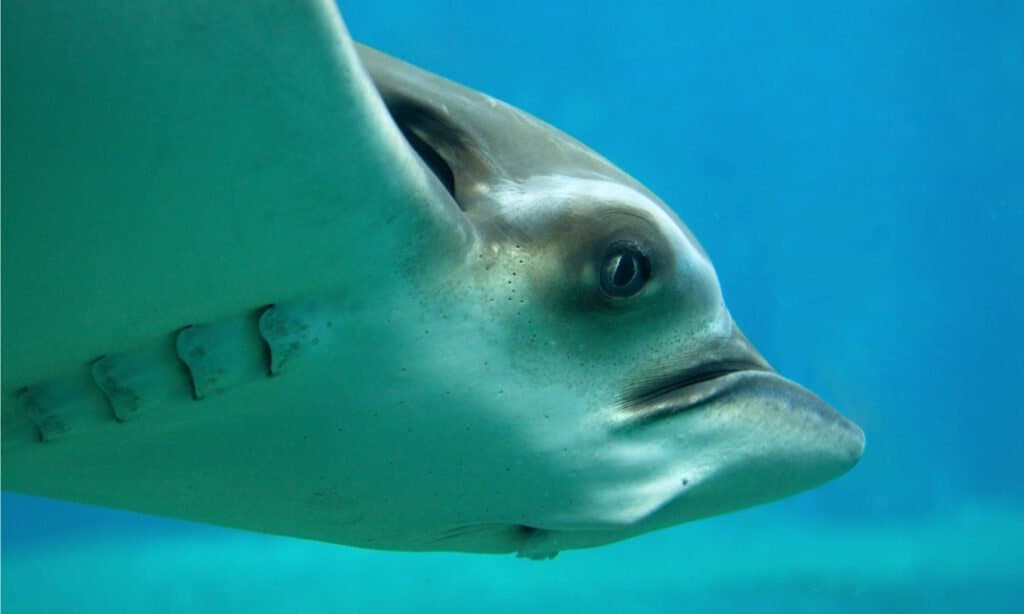
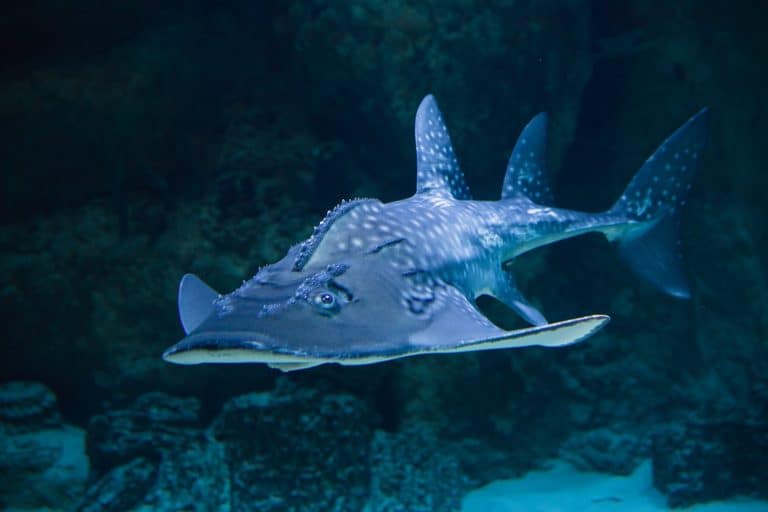
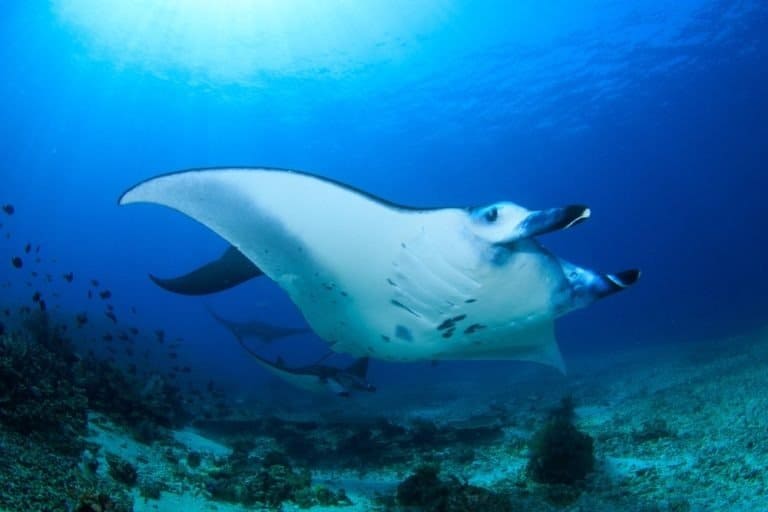
Bat rays have a distinct, protruding snout.
©Daleen Loest/Shutterstock.com
Bat rays measure 4 to 5 feet long, have a maximum disc width of 6 feet, and typically weigh 20 to 30 pounds. The largest specimens have weighed up to 200 pounds, and there are unverified reports of one weighing 240 pounds. Females are larger than males. Round stingrays are much smaller. They measure up to 1.8 feet long, have a maximum disc width of approximately 1 foot, and weigh up to 3 pounds. However, there are many stingray species larger than the bat ray, with the giant freshwater stingray (Urogymnus polylepis) being the largest. It has a maximum disc width of 8 feet, measures up to 16 feet long, and can weigh over 800 pounds.
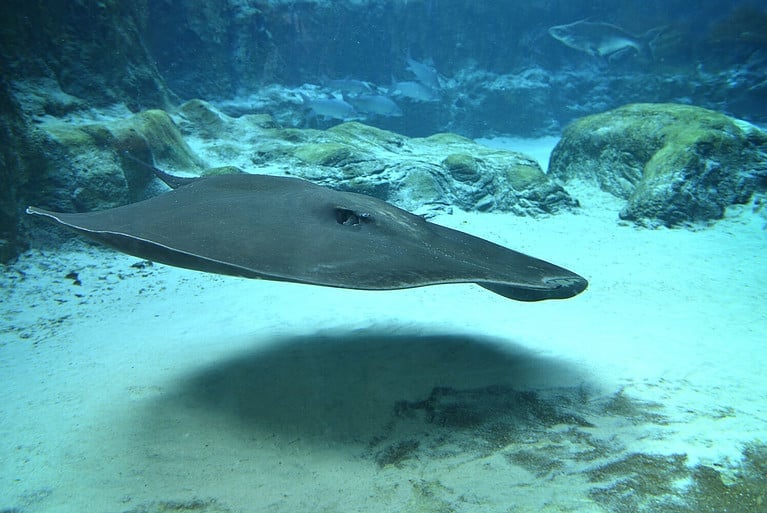
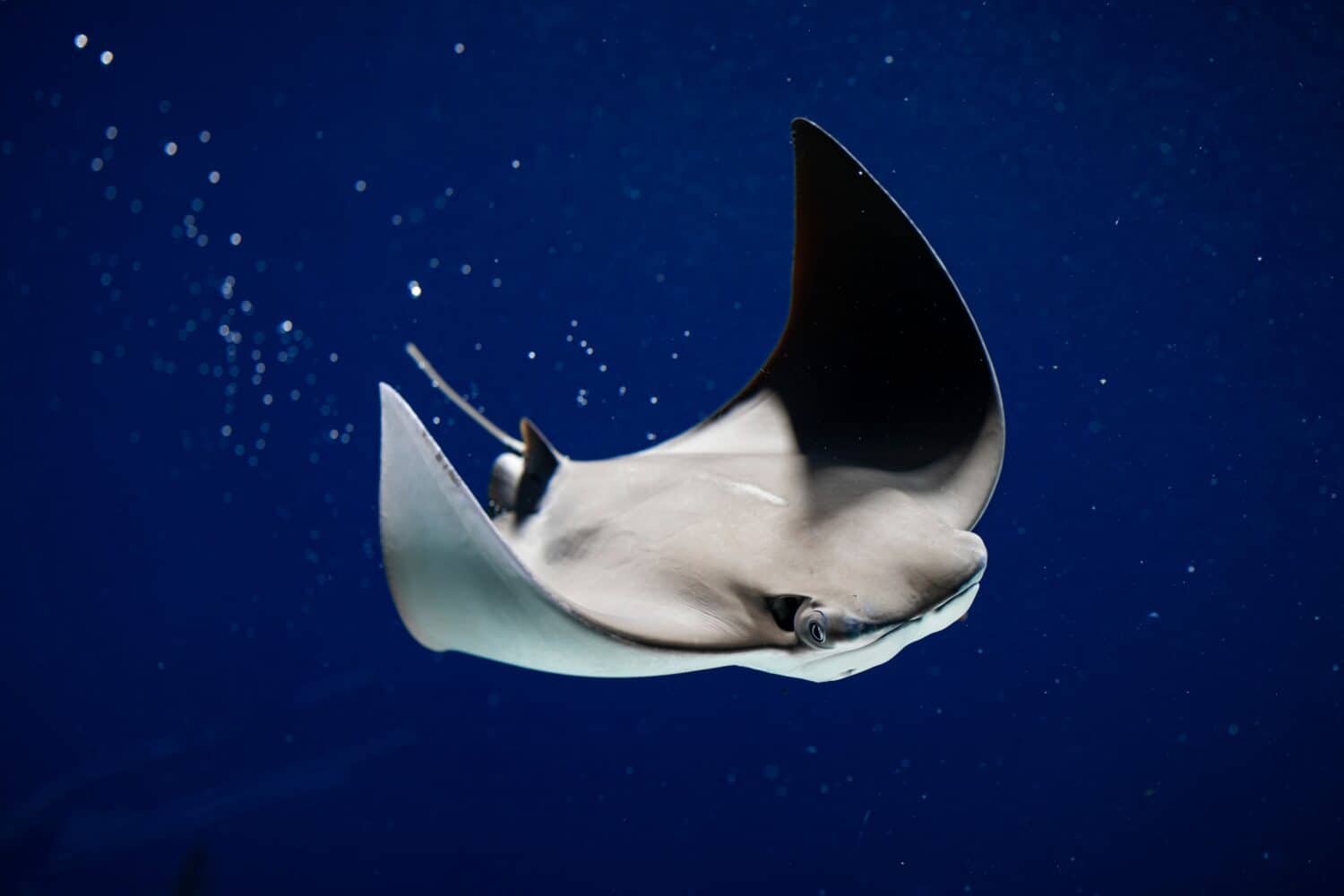
Bat rays have a diamond-like shape because their pectoral fins are pointed and wing-like. Most stingrays are nearly round in shape, with the round stingray exemplifying this quality. The dorsal side of its round pectoral fin is grayish-brown or brown in a reticulated pattern with pale-yellow spots. Its ventral side is white or off-white. Bat rays have an even black or dark brown coloring on their dorsal sides, and are white underneath. Other notable features of the bat ray include its broad, raised head, protruding snout, and whip-like tail that can be twice the length of its body.
Movement
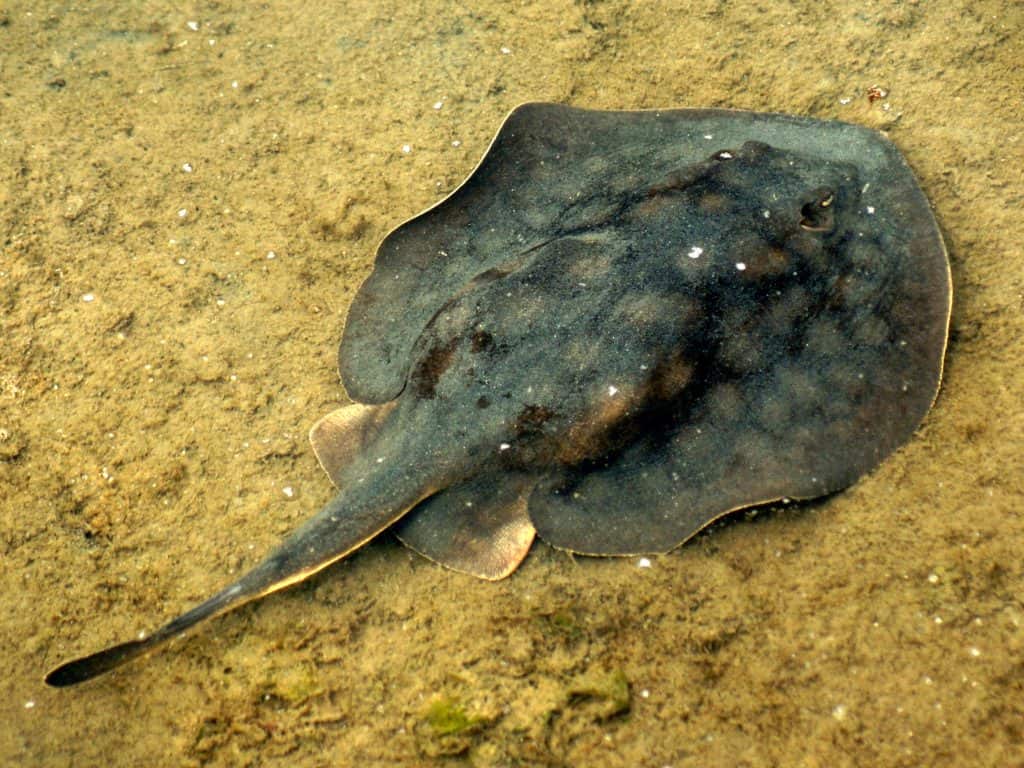
A round stingray performing undulatory locomotion.
©robin miller from studio city CA, CC BY 2.0 <https://creativecommons.org/licenses/by/2.0>, via Wikimedia Commons – Original / License
All stingray species use their pectoral fins to move, whereas most sharks and fish use their tail fin. There are two types of locomotion used by stingrays: undulatory and oscillatory. Undulatory locomotion is used for foraging and precise movements. It is performed by using the pectoral fins to create multiple rippling waves. Oscillatory locomotion is used to achieve faster speeds when swimming long distances. It is performed by flapping the pectoral fins like a bird flapping its wings. Rounded pectoral fins like those of the round stingray are better suited to undulatory locomotion. The bat ray’s pointed pectoral fins are ideal for oscillatory movements.
Predators and Prey
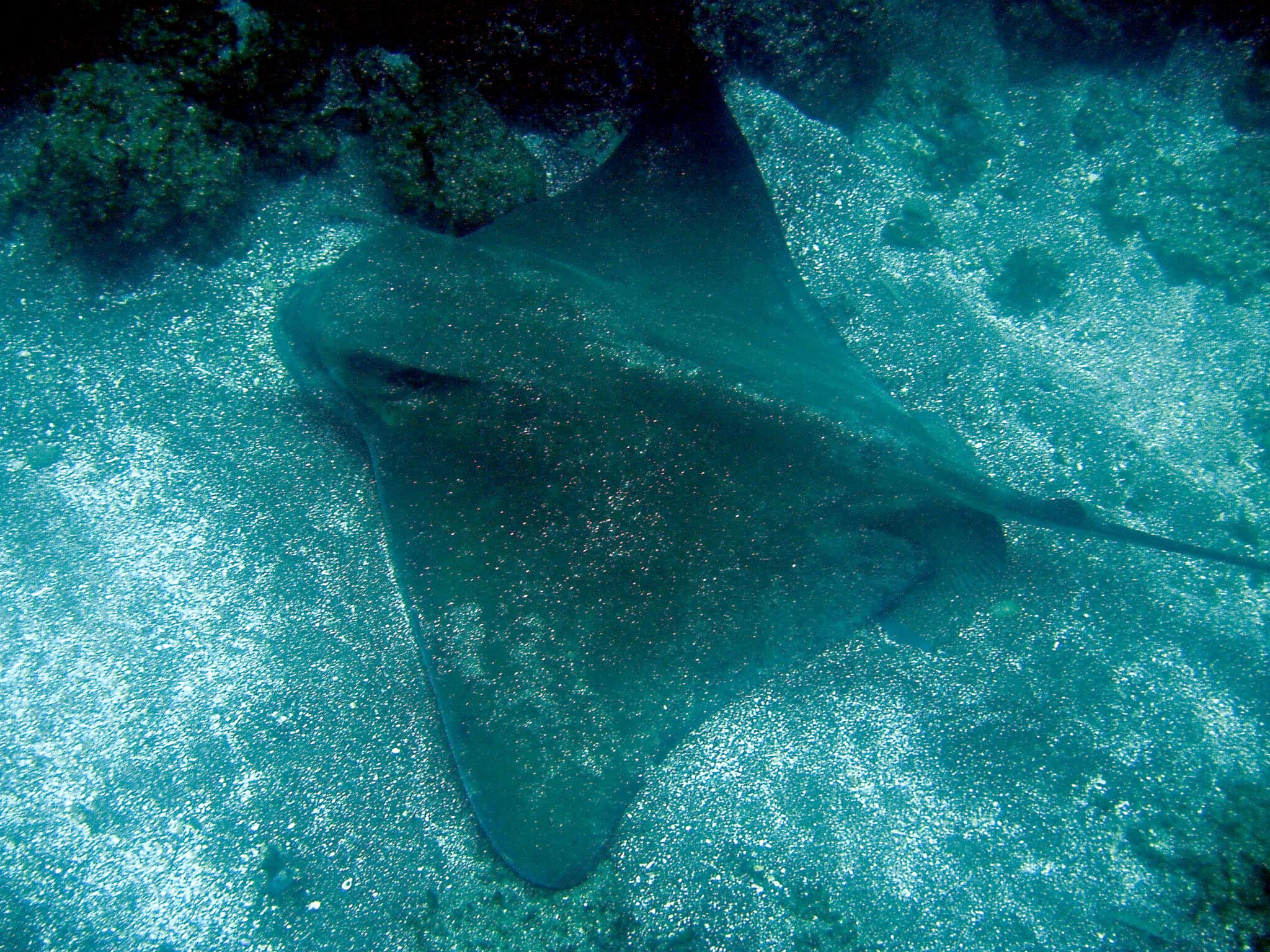
A bat ray while foraging.
©Claire Fackler, CINMS, NOAA, Public domain, via Wikimedia Commons – Original / License
Bat rays and round stingrays are both foragers that dig pits in the benthic layer to uncover prey. Round stingrays use their mouths and pectoral discs to dig, and bat rays use their snouts. These pits are of great ecological importance as they enable small fish to find prey they would otherwise be unable to access. The pits can be up to 7.8 inches deep and 13 feet wide. Bat rays prey on shellfish, clams, crabs, shrimp, sea cucumbers, ophiuroids, teleost fish, polychaetes, and gastropods. Additionally, adults will prey on spoon worms. Round stingrays are diurnal foragers that prey on mollusks such as clams, mussels, and oysters.
Despite their natural camouflage, bat rays are often preyed upon by larger marine animals. Their predators include great white sharks, broadnose sevengill sharks, and California sea lions. Round stingrays are preyed upon by Northern elephant seals, giant sea bass, leopard sharks, and a variety of large sharks. They are also known to host approximately 40 different parasites. These parasites include copepods, leeches, tapeworms, and the protozoan Eimeria chollaensis.