
Quick Take
- Bull sharks are a single species (Carcharhinus leucas) while reef sharks comprise five species, including blacktip, Caribbean, Galapagos, grey, and whitetip reef sharks.
- Bull sharks are euryhaline, able to adapt to both fresh and salt water, and inhabit coastal waters, estuaries, and some freshwater lakes or rivers.
- Reef sharks primarily inhabit coral reefs and are typically docile, but can be aggressive if threatened or near food.
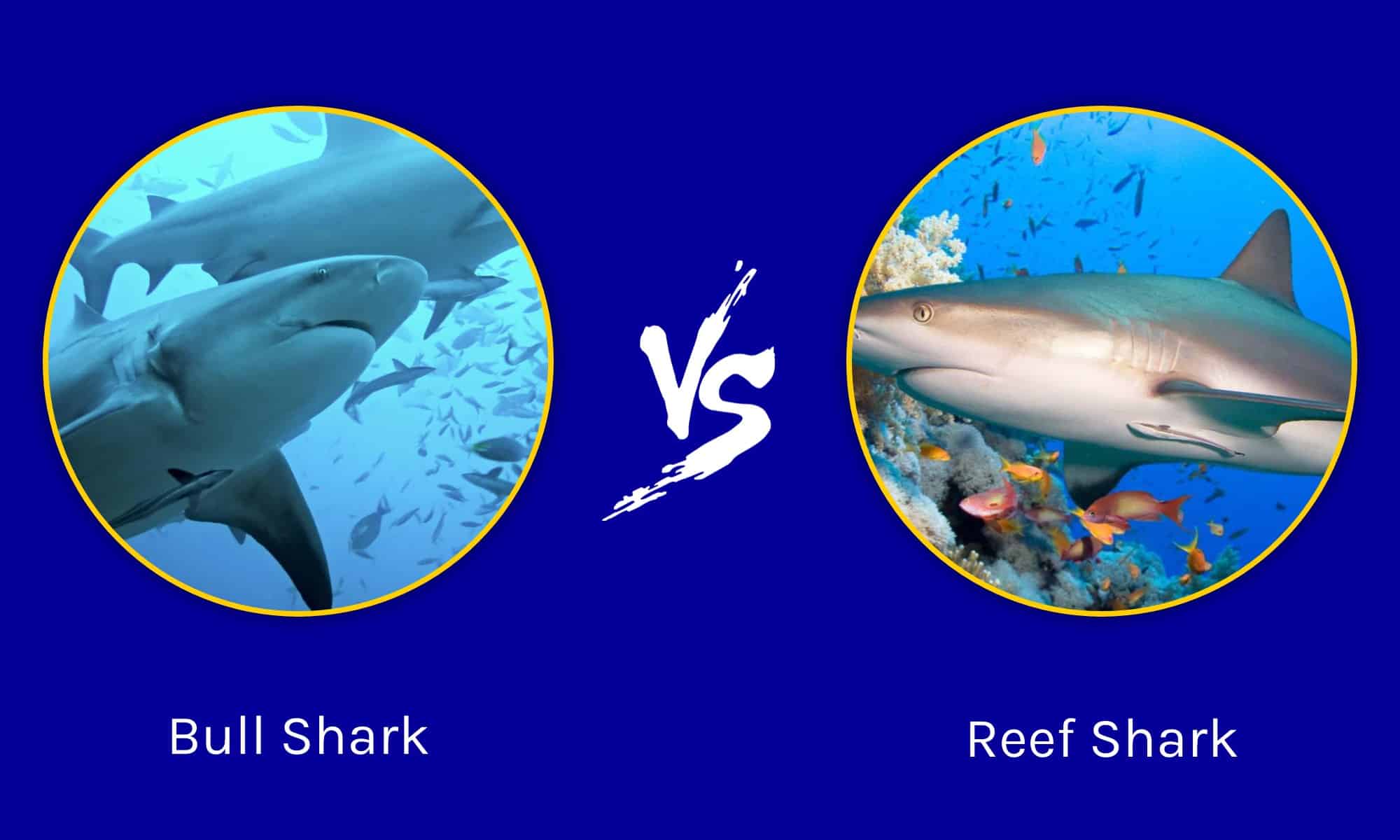
Bull sharks and reef sharks are requiem sharks belonging to the Carcharhinidae family. Bull sharks (Carcharhinus leucas) are an individual species, whereas there are five different species of reef sharks. These include the blacktip reef shark (C. melanopterus), the Caribbean reef shark (C. perezi), the Galapagos shark (C. galapagensis), the grey reef shark (C. amblyrhynchos), and the whitetip reef shark (Triaenodon obesus). Continue reading to learn the differences and similarities between bull sharks and reef sharks.
Habitat and Distribution
Bull sharks and reef sharks are found in three of the world’s five oceans: the Atlantic, Pacific, and Indian oceans. However, the Galapagos shark is the only reef shark species to live in all three. Blacktip, whitetip, and grey reef sharks are distributed across the Indo-Pacific, and Caribbean reef sharks are endemic to the Atlantic. All six of these requiem sharks inhabit warm coastal waters, with only blacktip and whitetip reef sharks living in the open ocean. Blacktips and whitetips are also found in the Red Sea, and blacktips are additionally found in the Eastern Mediterranean Sea.
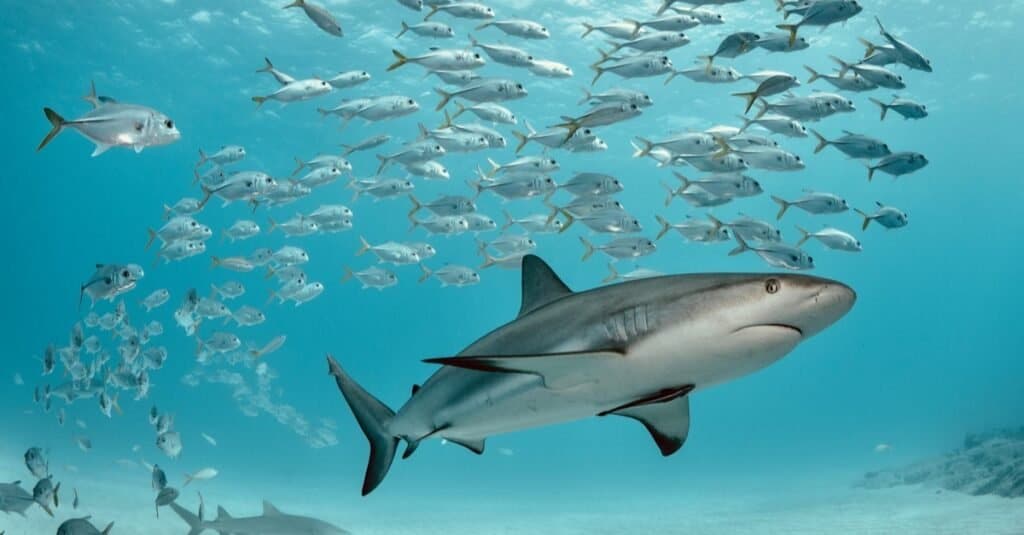
Reef sharks inhabit the areas around coral reefs.
©Maui Topical Images/Shutterstock.com
As their name suggests, reef sharks primarily inhabit coral reefs and their surrounding areas. They are typically found in shallow water near drop-offs at the reef’s edge. Reef sharks are found at different depths depending on the species. The grey reef shark dives the deepest, having been recorded at depths of up to 3,300 feet. Bull sharks are euryhaline, meaning their sophisticated osmoregulatory systems enable them to adapt to water of various salinities. They primarily inhabit coastal waters and estuaries. However, there are populations in many freshwater lakes, including Lake Nicaragua, and in rivers, where they have been found as far as 2,500 miles up the Amazon River and 700 miles up the Mississippi River. Bull sharks have been recorded at depths of up to 490 feet. However, they typically do not swim deeper than 98 feet.
Size and Appearance
While bull sharks and reef sharks are of similar lengths, bull sharks are heavier. Bull sharks typically measure 7 to 11 feet long and weigh 200 to 500 pounds. Females are larger than males, and pregnant females can weigh up to 1,300 pounds. The weight and length of reef sharks vary greatly depending on the species. The largest species is the Galapagos shark. It measures up to 12 feet long, has an average weight of 190 pounds, and can weigh up to 430 pounds. The Caribbean reef shark is the second-largest reef shark, measuring up to 9.8 feet long and weighing up to 150 pounds. Blacktip, whitetip, and grey reef sharks are smaller. Blacktips measure up to 6.6 feet long and weigh up to 30 pounds. Whitetips measure up to 6.9 feet long and weigh up to 40 pounds. Grey reef sharks measure up to 8.5 feet long and weigh up to 74 pounds.
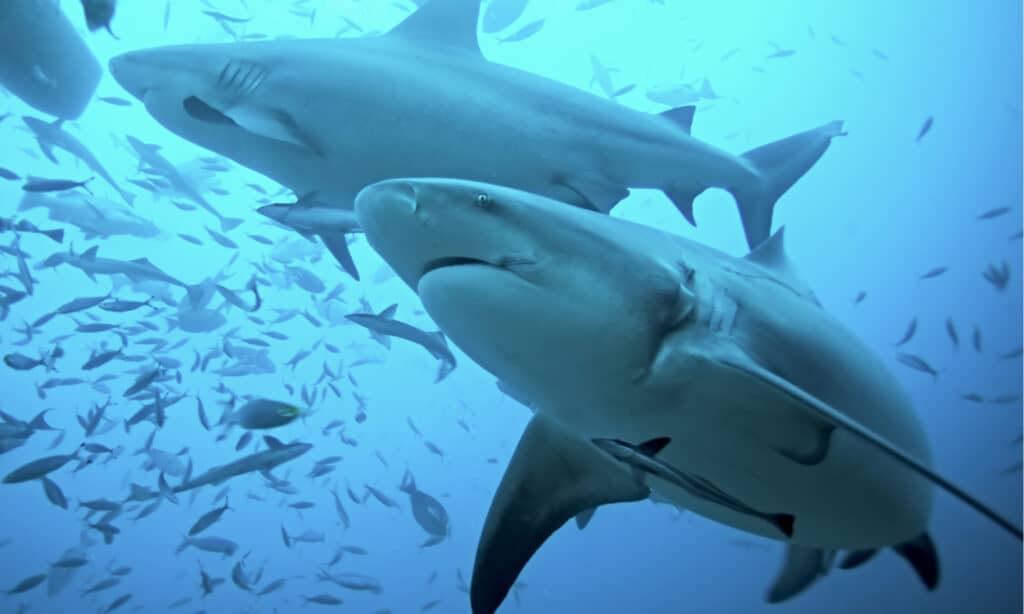
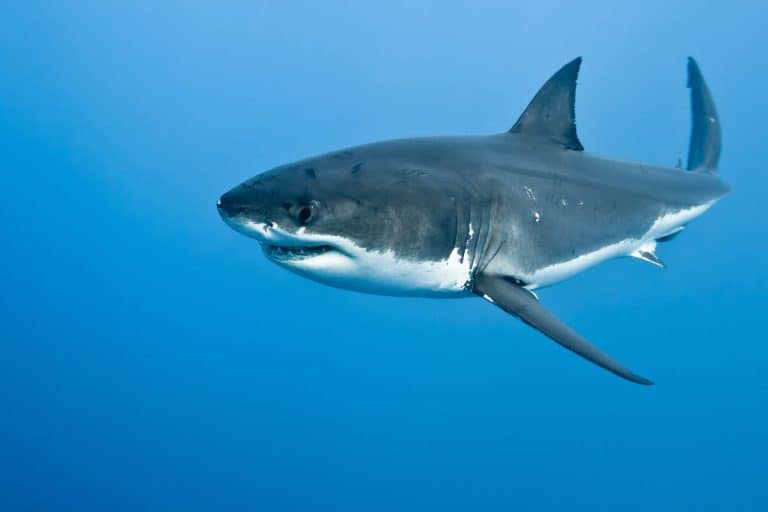
The top part of a bull shark’s body is dark gray and fades to a paler color on the underside.
©Martin Prochazkacz/Shutterstock.com
Bull sharks are wider and heavier than reef sharks, and they have smaller eyes. Their dorsal side is dark gray, and their ventral side is white. Bull sharks have large pectoral fins and a large first dorsal fin. However, their second dorsal fin is small, and they lack an interdorsal ridge. Compared to bull sharks, all reef sharks have slender, streamlined bodies. Like bull sharks, all reef sharks have gray, gray-brown, or brownish-gray dorsal sides and white ventral sides. However, there are significant differences in appearance between species. Whitetip reef sharks have scattered small, dark spots on their skin, and the tips of their first dorsal fin and upper caudal fin lobe are bright white.
Temperament
Bull sharks are known to be bold, aggressive, territorial, curious, unpredictable, and opportunistic predators. They are one of three species, along with tiger sharks and great white sharks, considered most likely to bite humans. Historically, bull sharks have been responsible for over 100 unprovoked attacks on humans, 27 of which have been fatal, according to the International Shark Attack File (ISAF). The species is believed to be responsible for the Jersey Shore shark attacks of 1916, which are often, and inaccurately, thought to be the inspiration for the novel Jaws. Most of these attacks result from the bull shark’s bump-and-bite method for determining if something is prey.
Reef sharks are typically docile and curious. They are not generally dangerous to humans, but they can become aggressive if threatened, provoked, or near food. The latter is quite common, with whitetip, blacktip, and grey reef sharks often accidentally attacking spearfishers in an attempt to steal their catch. Galapagos sharks are known to be persistent, inquisitive, and easily excited by fishing activities. Excited Galapagos sharks are nearly impossible to deter. When driven away, they circle back and incite more sharks to follow. Using weapons against them can trigger a feeding frenzy. However, when interacting with divers, reef sharks are typically shy, indifferent, or may approach out of curiosity and remain docile unless provoked.
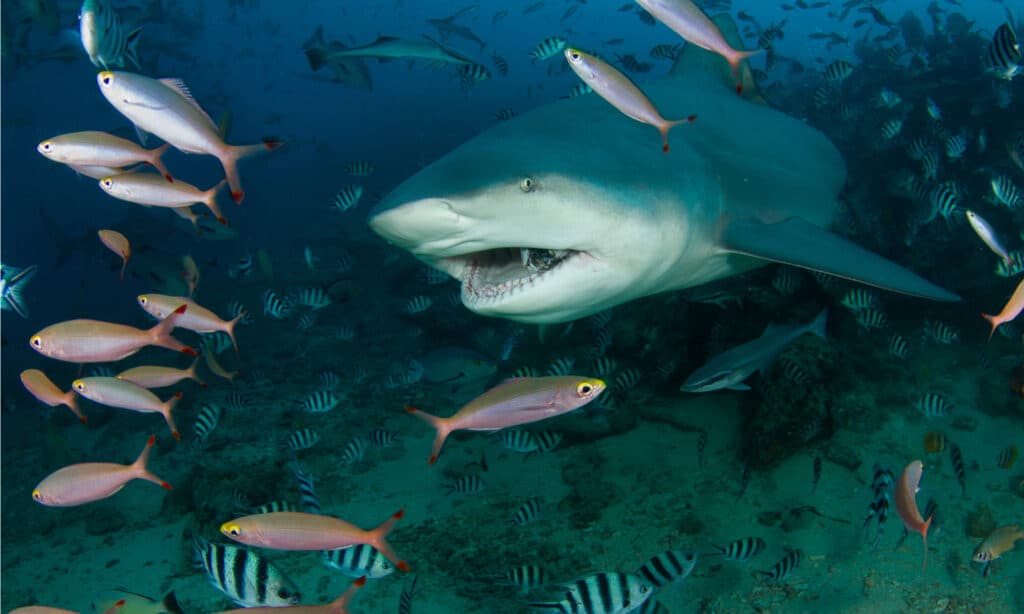
Bull sharks are more aggressive than most shark species.
©chatchai kusolsinchai/Shutterstock.com