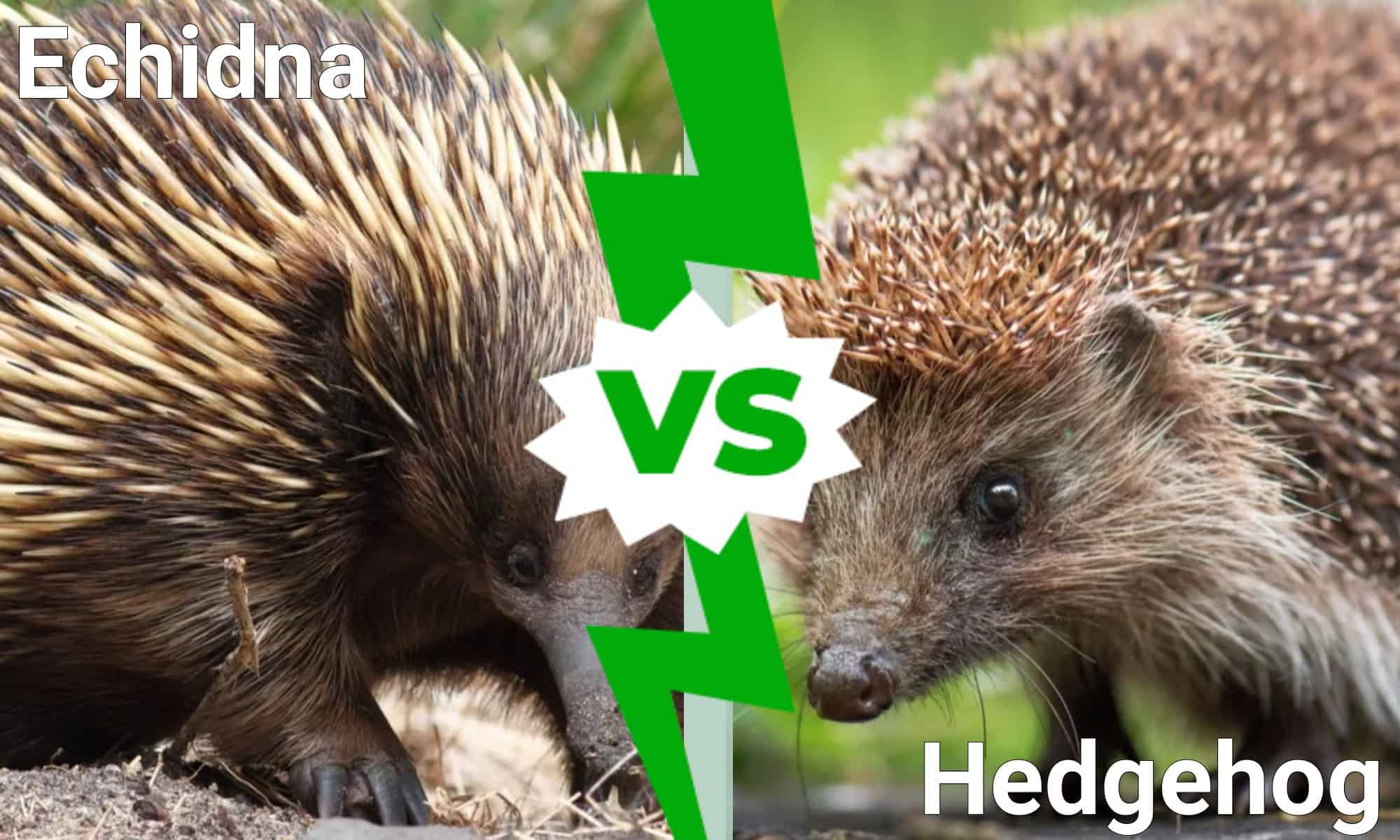

While both echidnas and hedgehogs have those trademark spines, there are a number of physical and behavioral differences between the two animals. In this article, we’ll cover the differences between these two mammals, including size, preferred habitats, reproduction, and more. Read on to learn what sets echidnas and hedgehogs apart.
Comparing an Echidna vs. a Hedgehog
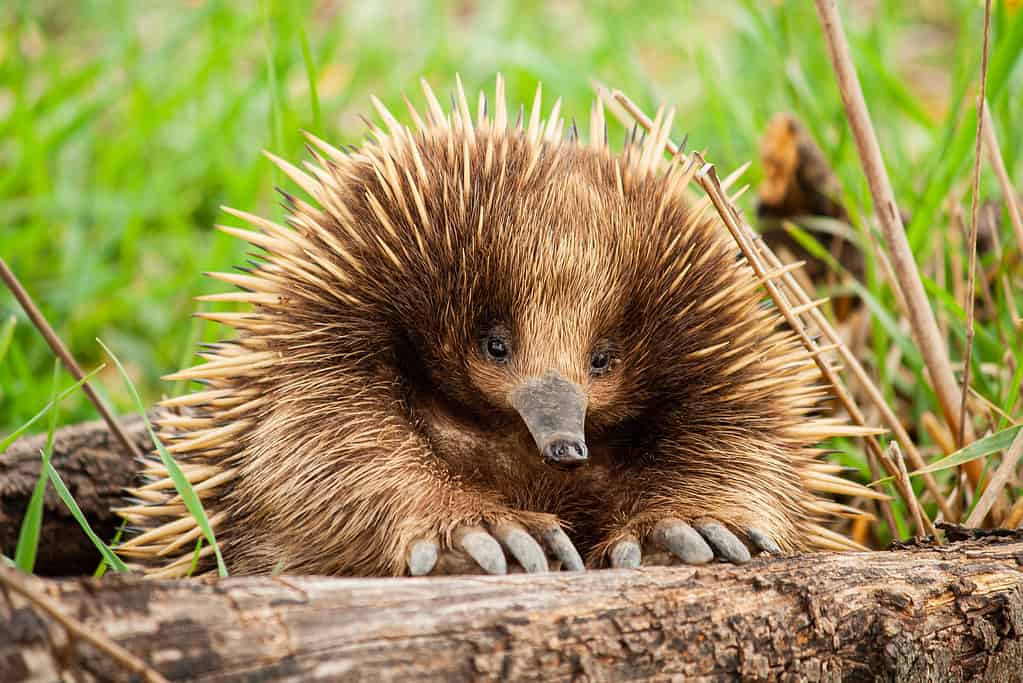
There are four species of echidna, including one short-beaked species and three long-beaked species.
©Jarrod Calati / via Getty Images
| Echidna | Hedgehog | |
|---|---|---|
| Size | Varies by species; 14 to 30 inches; 5.5 to 22 pounds | Varies by species; 1-2 pounds; 4 to 12 inches long |
| Physical Characteristics | Round body covered in spines; large, rear-facing claws for burrowing; narrow, elongated snout hides a long tongue | Compact body covered in short spikes; tiny feet with barely visible claws; cone-shaped face or snout |
| Distribution and Habitat | Australia, Tasmania, and New Guinea; rainforests, grasslands, high mountains, and forests | Africa, Asia, Eurasia, Europe; dry grasslands, deserts, gardens, woodland edges, urban areas |
| Behavior | Digs, leaving only spines exposed as a defense mechanism; burrows | Curls into a ball as a defense mechanism; makes nests |
| Reproduction | Monotreme; lays eggs and young drink mother’s milk | Placental; gives birth to live young |
| Lifespan | 15-20 years in the wild, up to 50 years in captivity | 2-4 years in the wild, 6-10 years in captivity |
Key Differences Between an Echidna and a Hedgehog
As mentioned above, these two animals are both furry mammals with spines. Yet there are significant differences between the two, including size, physical characteristics, distribution and habitat, behavior, reproduction, and lifespan. Take an in-depth look at each difference in the paragraphs below.
Size
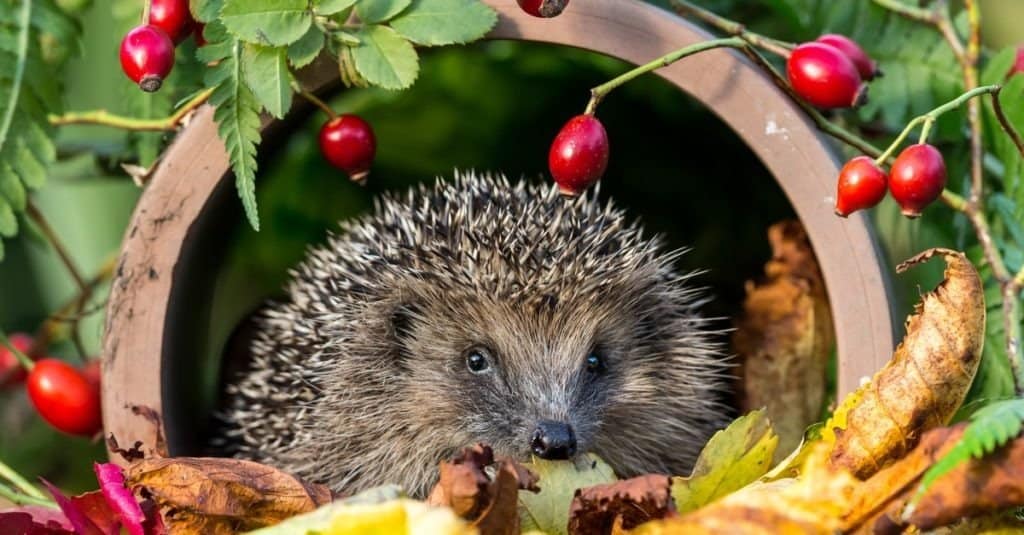
The average hedgehog weighs 1-2 pounds, while echidnas can weigh 5.5-22 pounds.
©Anne Coatesy/Shutterstock.com
One primary difference between echidnas and hedgehogs is their size. All four echidna species are larger than hedgehogs. There is one species of short-beaked echidna (Tachyglossus aculeatus) and three species of long-beaked echidna: the eastern (Zaglossus bartoni), western (Z. bruijnii), and Sir David’s long-beaked echidna (Z. attenboroughi). They measure between 14 and 30 inches long and can weigh from 5.5 to 22 pounds.
There are at least 19 species of hedgehog (Erinaceidae), but they are all relatively small. Depending on the species, they range from 4 to 12 inches long. Even the largest hedgehogs only weigh between 1 and 2 pounds.
Distribution and Habitat
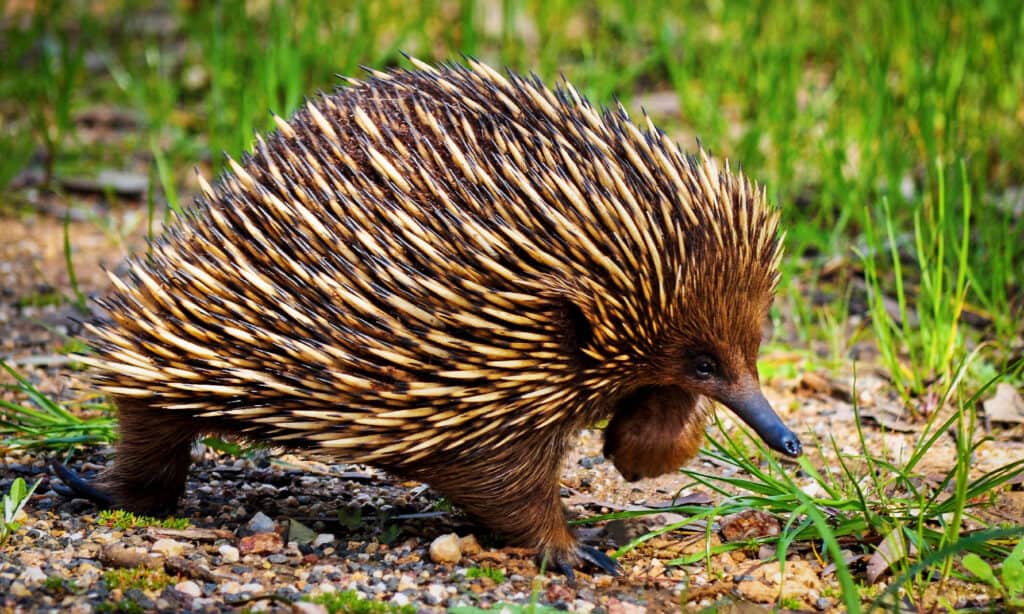
Echidnas are found exclusively in Australia, including Tasmania, and New Guinea.
©Vicki Cain/Shutterstock.com
You will not find echidnas and hedgehogs living in the same geographical area. The short-beaked echidna is found in Australia, including Tasmania. The three long-beaked echidnas are found in New Guinea. The short-beaked echidna inhabits rainforests, deserts, and grasslands, while the long-beaked echidna favors high elevation forests and mountainous regions.
Hedgehogs are found in Europe, Asia, Africa, and have also been introduced to New Zealand, making hedgehogs more widespread than echidnas. They live in a wide range of habitats, including deserts, savannas, forests, dry grasslands, gardens, woodland edges, and even urban areas.
Physical Characteristics
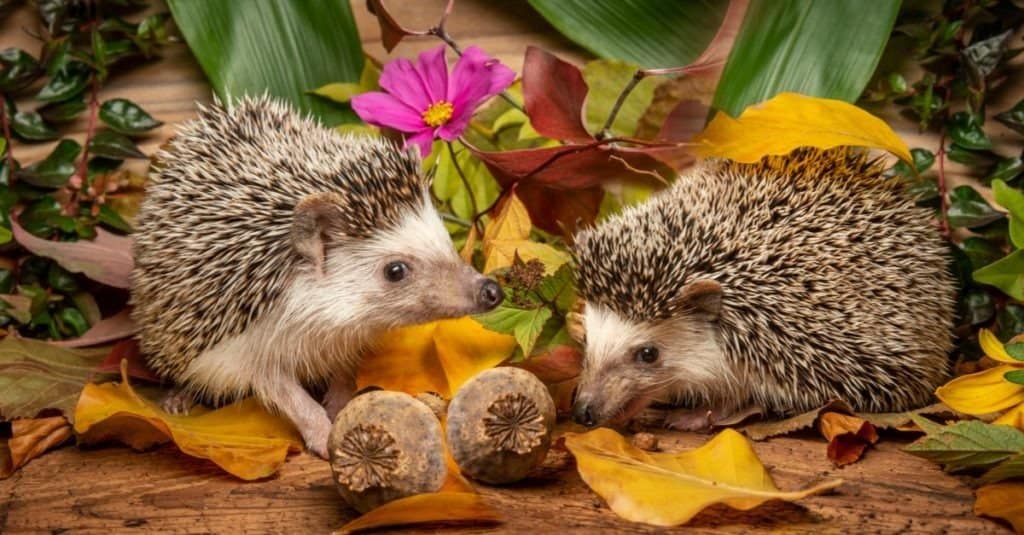
Hedgehogs have very small, dainty feet with small, curved claws.
©Kuttelvaserova Stuchelova/Shutterstock.com
While both of these animals have spines, there are many physical differences between them. Echidna spines are like modified hairs, hollow and barbless with a foam-like core. These animals tend to be a solid color, with fur that can be reddish to dark brown or black. There are regional variations in spine color. They also have large feet and thick black nails because they frequently burrow in the ground. Echidnas have long tongues and elongated snouts with electroreceptors. Most animals with this ability are aquatic, but echidnas use them to detect the weak electrical fields of prey in the soil.
In contrast, hedgehog spines are solid and pointed, but they are unbarbed and have a sponge-like core. Many species of hedgehogs have a two-toned appearance. The most common hedgehog has a cream underbelly and face with brown and cream spikes. Hedgehogs have very small and dainty feet with small, curved claws for digging and burrowing, although most hedgehogs make nests. They have cone-shaped snouts with sensitive, wet noses that give them an excellent sense of smell.
Behavior
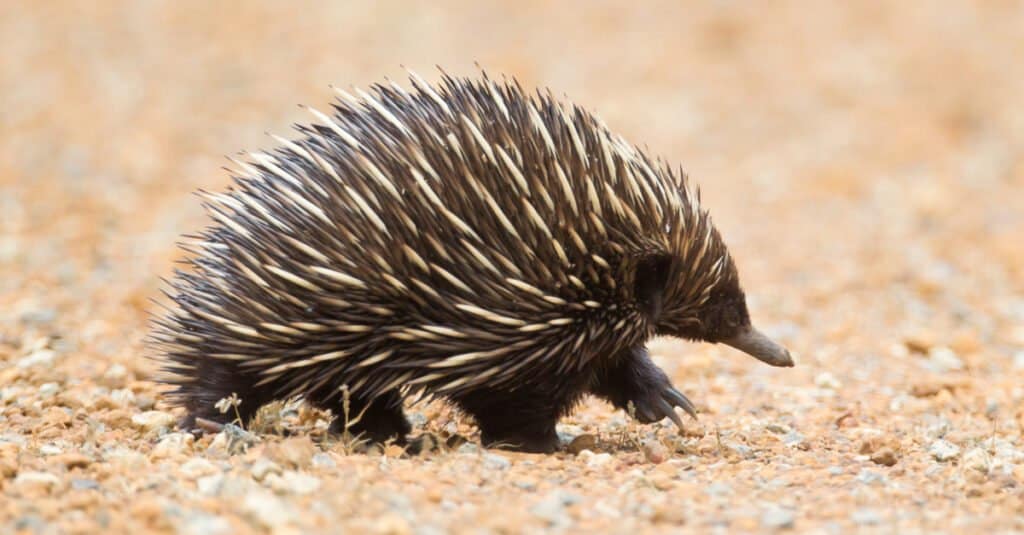
Both of these animals rely on their spines as a form of defense.
©Jukka Jantunen/Shutterstock.com
There are also a few behavioral differences between echidnas and hedgehogs. While both of them reveal their spines when stressed or threatened, hedgehogs can fully roll into tight balls, concealing their faces and limbs. Echidnas cannot fully roll up; instead, they dig down and expose their spines.
Echidnas are prolific diggers, creating burrows or using logs for shelter. As noted above, some hedgehogs do burrow, especially those in warmer climates, but most build nests. Echidnas and hedgehogs are primarily nocturnal, though echidnas adjust their activity based on temperature. Both of these spiny animals prefer a solitary lifestyle, coming together with others of their species primarily for mating.
Reproduction
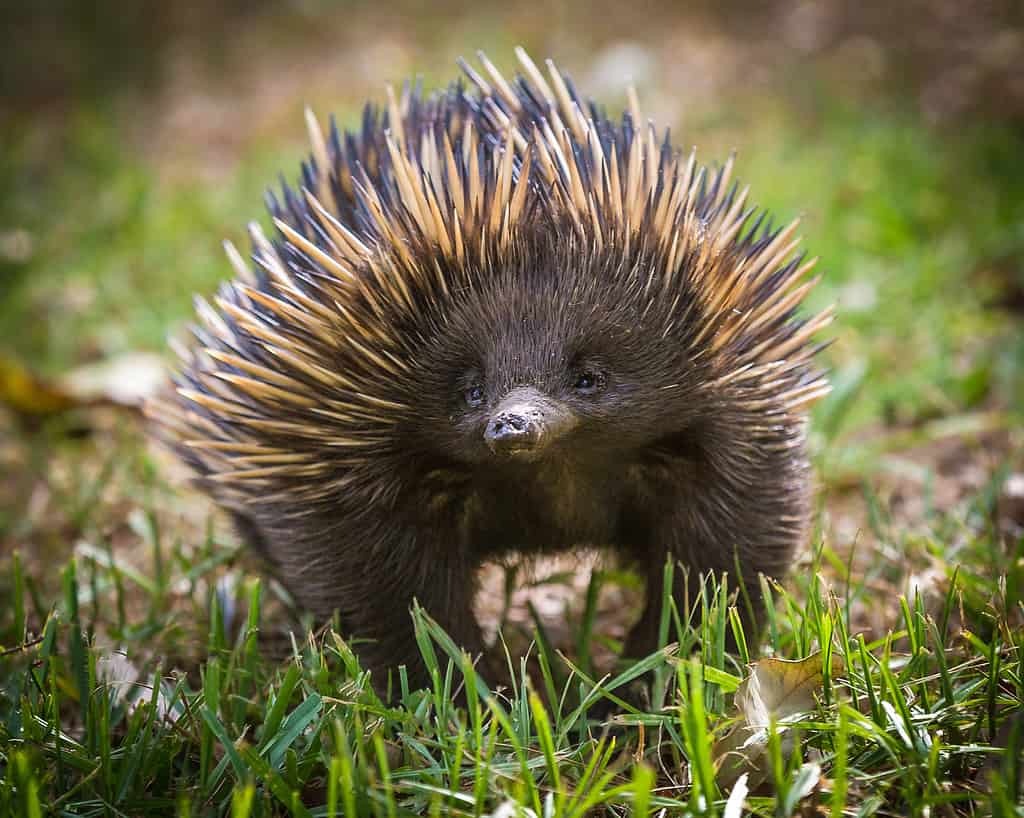
Echidnas are monotremes, which means they are mammals that lay eggs.
©pelooyen/iStock via Getty Images
One of the most significant differences between these two animals concerns reproduction. Hedgehogs are placental mammals that give birth to live babies. After a gestation period of roughly 4 to 6 weeks, hedgehogs give birth to 4 to 7 babies, called hoglets. They generally give birth once or twice a year. Depending on the species, hoglets can take from 6 to 13 weeks to be weaned.
Echidnas are monotremes like platypuses. They are mammals, but they lay eggs, and the young drink their mother’s milk. Echidnas usually lay a single egg each year. The newly laid egg is put in a pouch on the mother’s belly until it is ready to hatch. After about 10 days, the baby echidna, or puggle, hatches. The mother does not have teats like other mammals, so the puggle laps up the milk the mother secretes from special glands in her pouch. The weaning process is believed to take from 7 to 9 months, although some sources suggest it can take as long as 12 months.
Lifespan
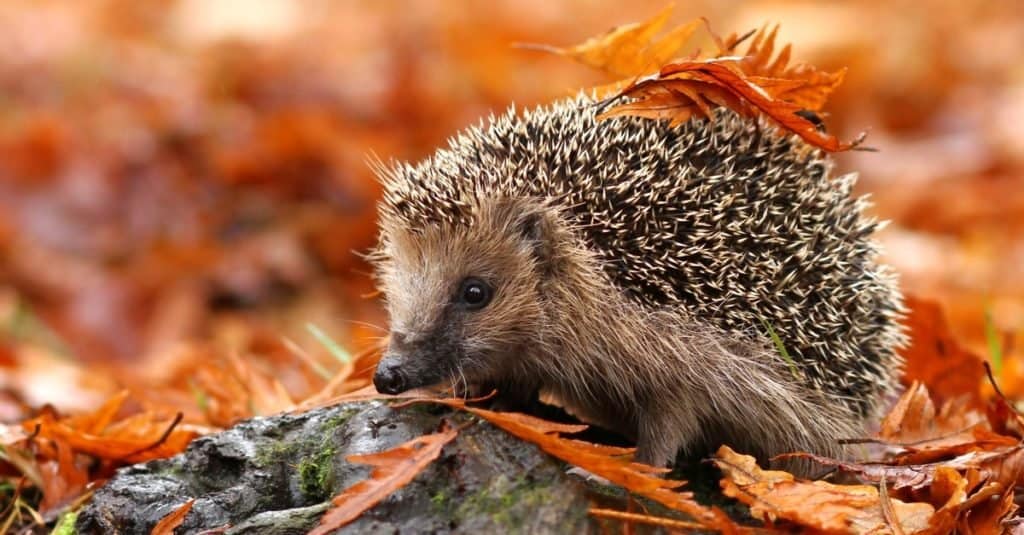
The average wild hedgehog lives 2-4 years, while wild echidnas live 15-20 years.
©Miroslav Hlavko/Shutterstock.com
The final difference between an echidna and a hedgehog is their lifespans. Echidnas far outlive hedgehogs and by a wide margin. The average hedgehog lives anywhere from 2-4 years in the wild and 4-6 years in captivity, though some can live up to 8-10 years. The oldest hedgehog ever recorded was believed to have been 16 years old at the time of death.
However, wild echidnas live for 15 to 20 years and have been recorded to live up to 50 years in captivity. Researchers believe their longevity is partially because their cellular membranes are peroxidation-resistant, which means they are resistant to damage from free radicals, like other long-lived mammals such as humans and naked mole-rats. Echidnas also have a low metabolic rate and a low body temperature, which helps conserve energy. They can also conserve energy by entering a state of torpor, which is similar to hibernation, to survive extreme temperatures.