
Gray whales and humpback whales are among 14 extant species of baleen whales. They are large whales with baleen plates that can sometimes be challenging to differentiate. It’s even more difficult because the gray whale and the humpback can sometimes be seen in the same color. But, this doesn’t make them the same. Let’s explore the differences between gray and humpback whales.
Comparing the Gray Whale and Humpback Whale
Key Differences
The key differences between a gray whale and a humpback are their physical appearance, diet, habitat, reproduction, and lifespan. Humpback whales weigh more than gray whales and are generally longer. Gray whales are bottom feeders, while humpbacks are not. Furthermore, humpbacks have a wider range than gray whales. But that is not all.
Gray Whale vs. Humpback: Taxonomy
Gray whales and humpbacks may both be baleen whales, but they come from different families and genera. The gray whale belongs to the family Eschrichtiidae, while the humpback whale belongs to the family Balaenopteridae. Their respective species names are Eschrichtius robustus and Megaptera novaeangliae.
Gray Whale vs. Humpback: Physical Appearance
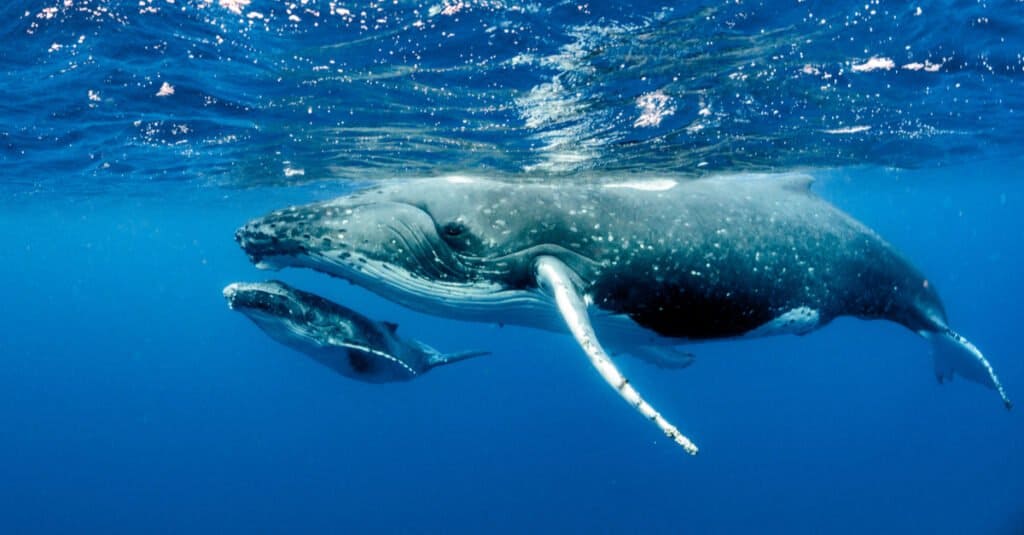
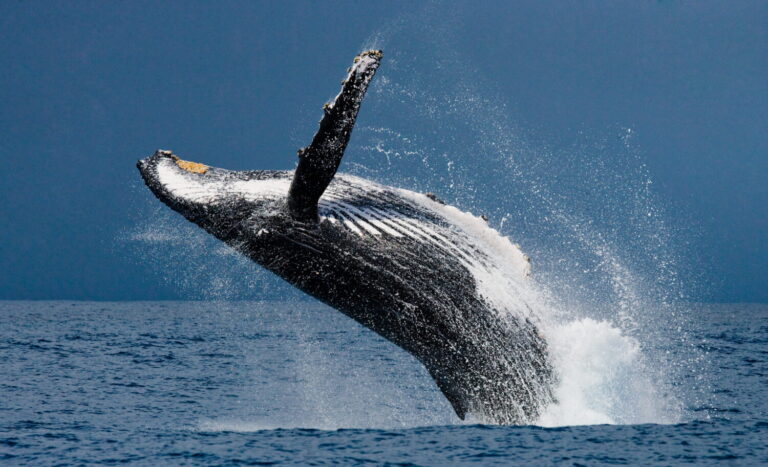
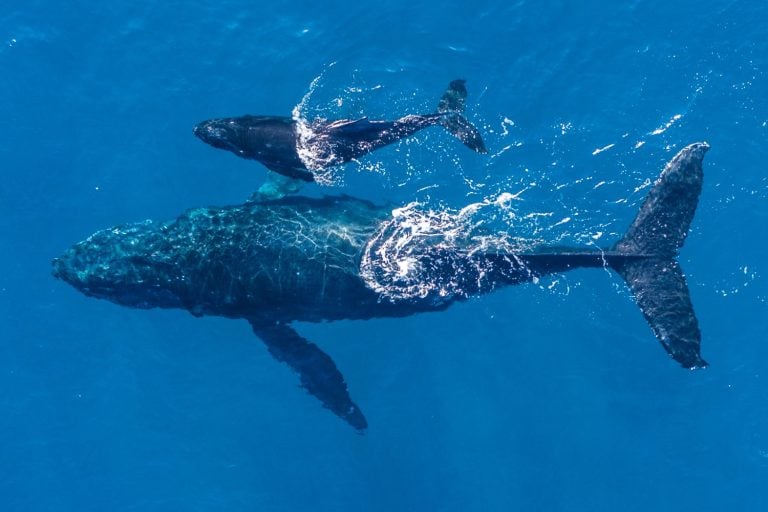
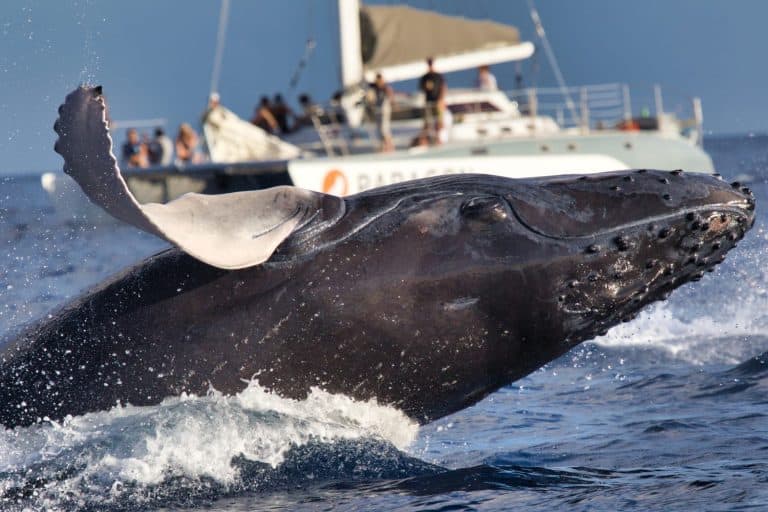
Humpback whales measure between 48 and 62 feet long and can weigh as much as 200,000 pounds.
©Imagine Earth Photography/Shutterstock.com
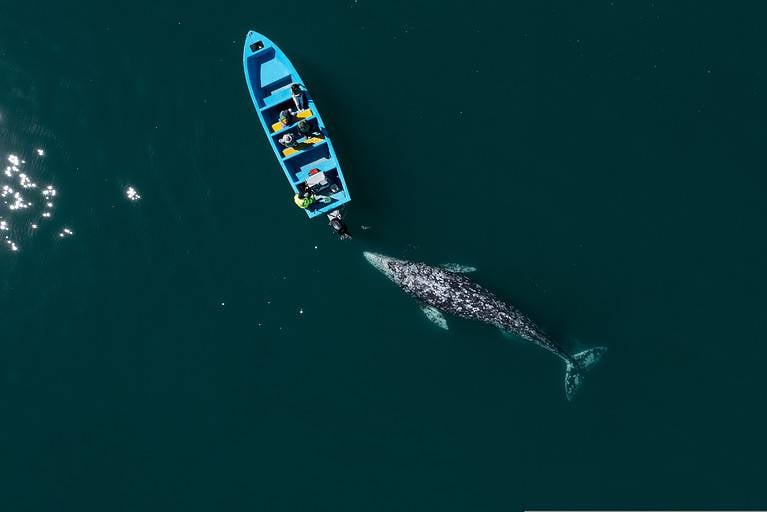
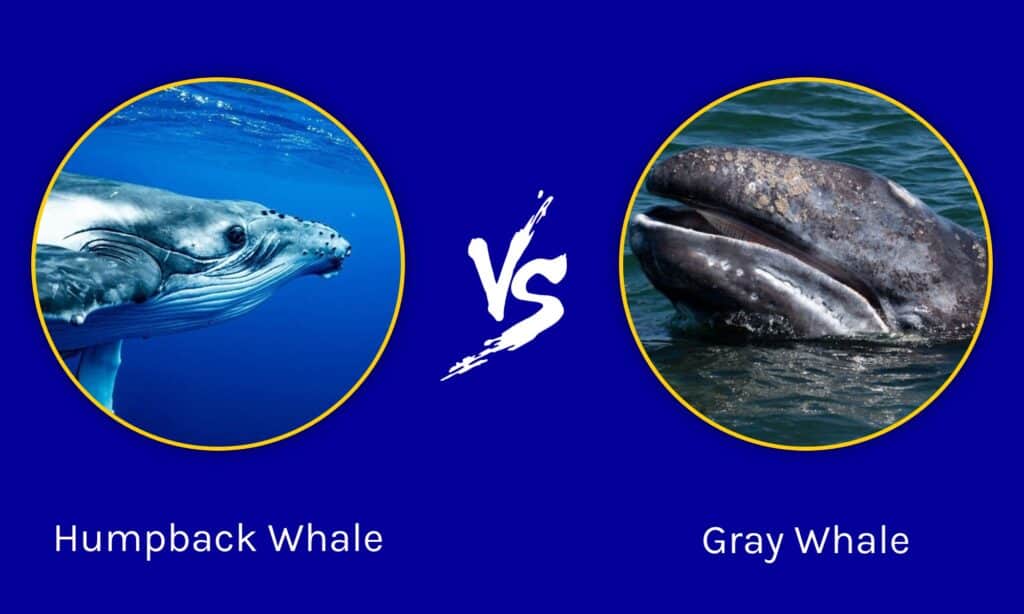
Just like their name indicates, gray whales are gray. They are large and measure up to 49 feet in length and 90,000 pounds in weight. Although gray whales don’t have dorsal fins, they have wide and short pad-like pectoral flippers. In place of their dorsal fins are humps and right below them are tiny bumps that travel all the way down to their fluke. They are easily differentiated from humpbacks because they have flatter throat grooves than humpbacks. They have 130 to 180 baleen plates that help them filter food while feeding.
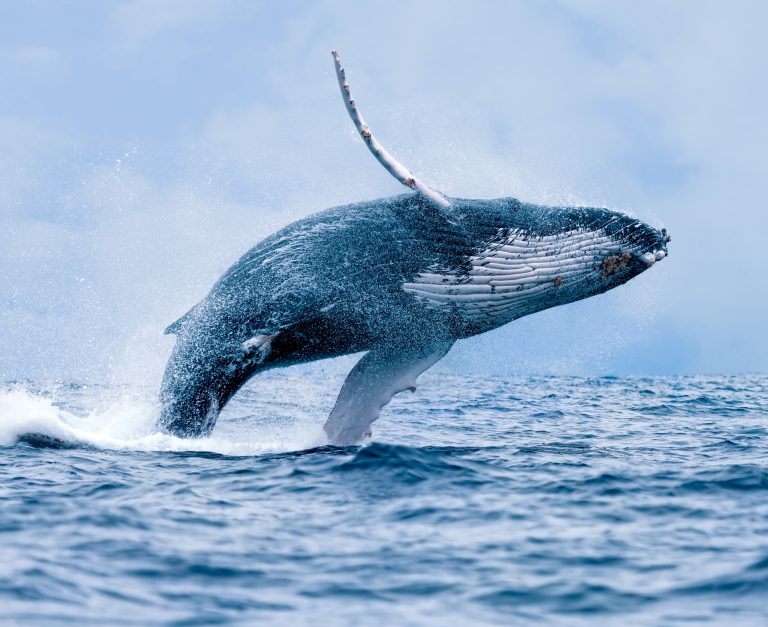
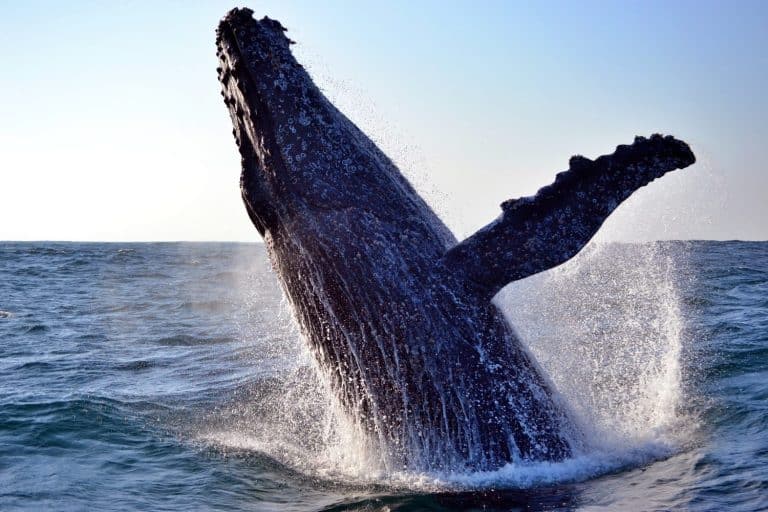
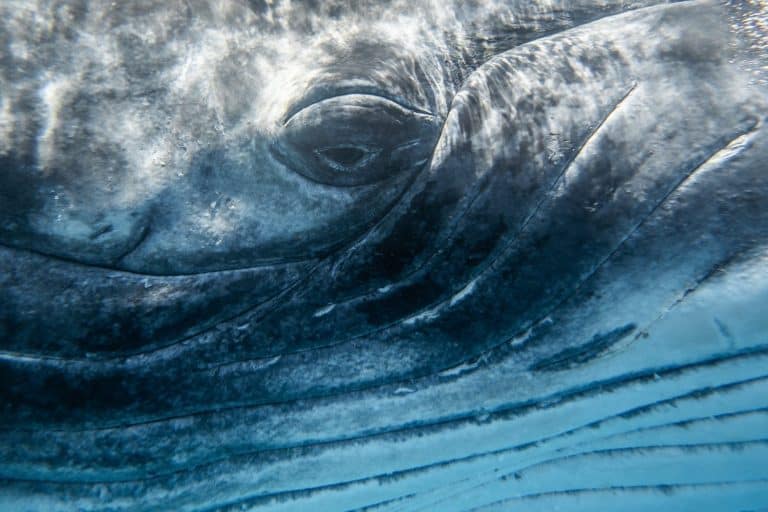
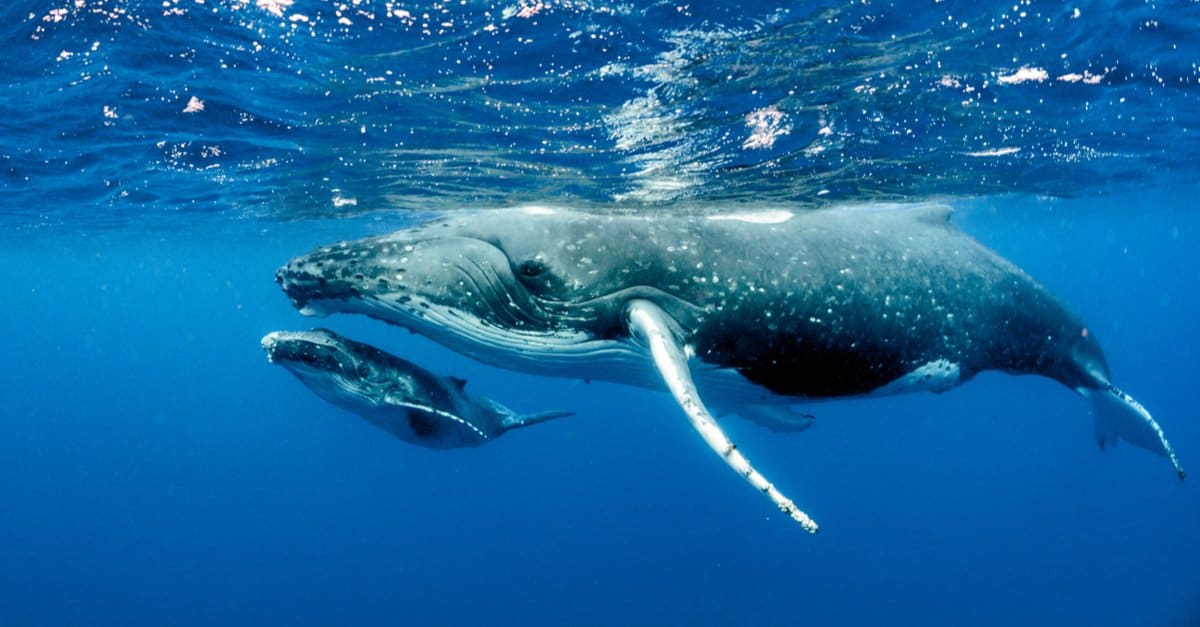
On the other hand, the bodies of humpbacks range between black and grey. They are easily distinguished from gray whales by their white underbellies. Humpbacks measure up to 48 feet to 62 feet in length and weigh between 80,000 and 200,000 pounds. Unlike their “gray” counterparts, they have both pectoral flippers and dorsal fins. The pectoral flippers are long and are close to their eyes, whereas the dorsal fins are small. They have more swollen throat grooves than gray whales. Humpbacks have bumps too, but these bumps are concentrated around their heads only. They have 270 to 400 overlapping baleen plates that help them filter food while eating.
Gray Whale vs. Humpback: Distribution and Habitat
Gray whales have a shorter range than humpbacks. Gray whales are found in the eastern and western parts of the North Pacific Ocean. They often migrate between seasons to feed or breed. In summer, the ones in the Eastern region migrate to the waters located in Northern California, Oregon, Washington, and British Columbia, Canada. In the fall, they migrate to Mexico and Baja California, where they breed.
Humpbacks have a wider range than gray whales. They are well adapted to tropical and polar waters. So, they live in the Atlantic Ocean, Pacific Ocean, Arctic Ocean, and some of the waters bordering Antarctica. Similarly, humpbacks migrate between seasons to feed or breed.
Gray Whale vs. Humpback: Behavior and Diet
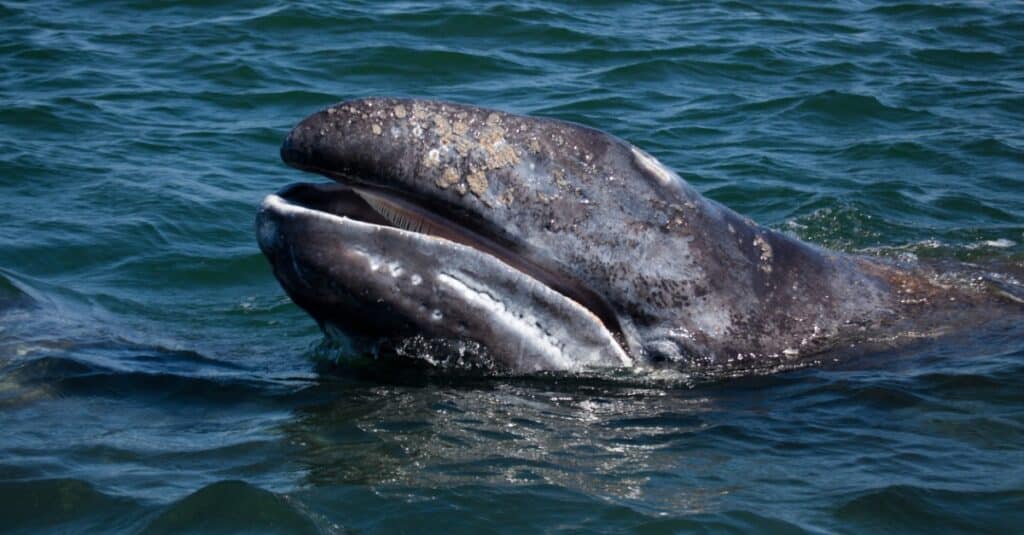
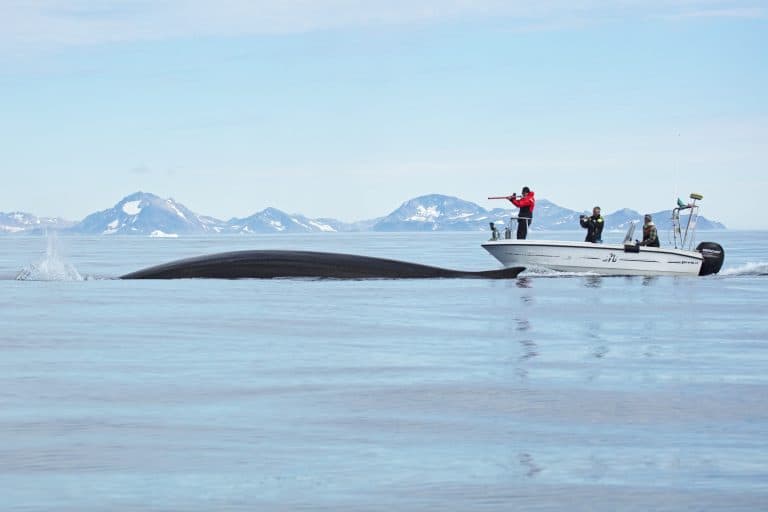
The gray whale is a bottom feeder.
©Mogens Trolle/Shutterstock.com
Gray whales are migratory aquatic mammals. They can travel long distances of up to 12,700 miles. They are capable of migrating alone or in small groups. Sometimes, migrating groups eventually split up. Occasionally, they come together to feed or breed, but social groups formed are not long-lasting.
Interestingly, gray whales are bottom feeders, and their diet comprises primarily invertebrates like amphipods. They usually suck their food and filter them with their baleen plates. To feed, they go to the bottom and roll with their sides while sucking their food.
The social behavior of humpbacks is similar to that of gray whales. They are migratory aquatic animals that can travel in groups or alone. But they don’t travel long distances like gray whales and can cover only about 3,000 miles. Social groups formed are usually transient.
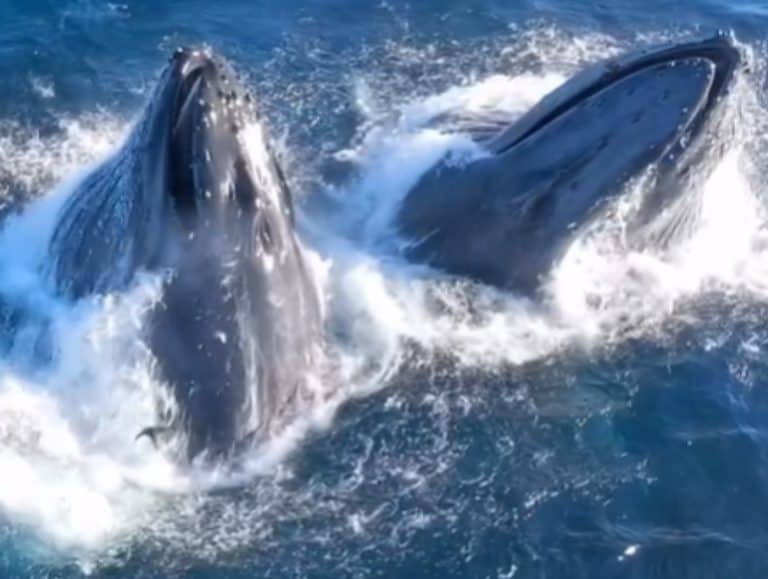
In contrast to the gray whale’s feeding habits, humpbacks feed right beneath the water’s surface. Their diet primarily consists of krill, salmon, herring, haddock, sand lance, pollock, and other small fish. Male humpbacks are popular for making sounds that can travel about 20 miles.
Gray Whale vs. Humpback: Reproduction and Lifespan
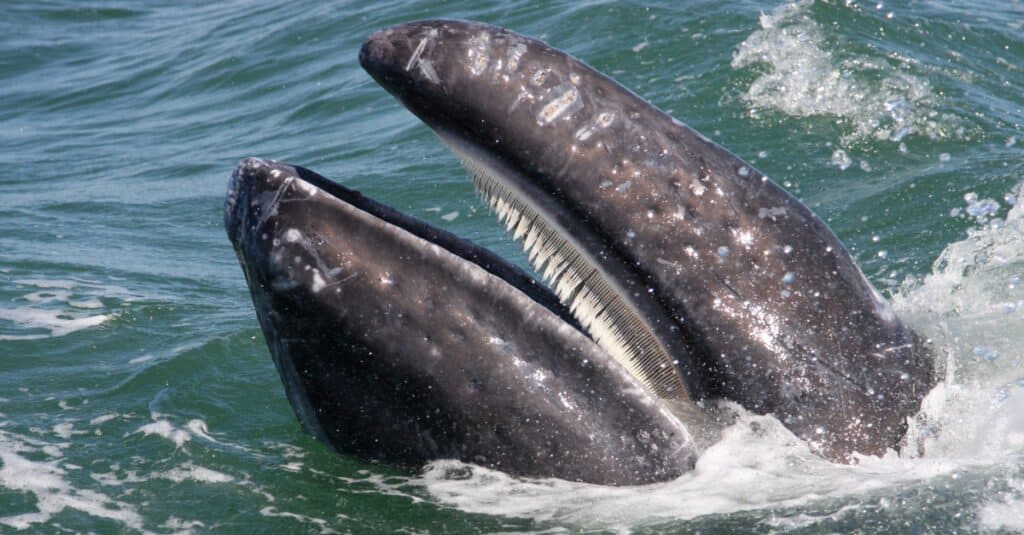
Gray whales have a lifespan of 50 to 60 years.
©jo Crebbin/Shutterstock.com
Mating season for both gray whales and humpbacks is usually biennial. Both whale species are polygynous and usually breed during winter. They usually migrate from their summer feeding camps to their wintering zones during breeding seasons. For gray whales, gestation lasts for 12 to 13 months. On average, a gray whale’s lifespan is between 50-60 years.
In contrast, the gestation period for humpbacks lasts eleven and a half months. While mothers are protective of calves, the males are usually not affectionate or attached to their offspring. On average, a humpback’s lifespan is between 45-50 years.
Summary of Gray Whale and Humpback
| Gray Whale | Humpback | |
|---|---|---|
| Taxonomy | – Family Eschritidae – Species name: Eschrichtius robustus | – Family Balaenopteridae – Species name: Megaptera novaeangliae |
| Physical Appearance | – Color: Gray – Length: ~49 feet – Weight: 90,000 pounds – Baleen Plates: 130-180 | – Color: Ranges from gray to white to black; underbelly is white – Length: 48-62 feet – Weight: 80,000-200,000 pounds -Baleen Plates: 270-400 |
| Habitat | – Found in eastern and western parts of the North Pacific Ocean and travels south along the North American coast to Mexico and Baja California to breed – Can travel long distances, up to 12,700 miles | – Found in the Atlantic, Pacific, and Indian oceans and waters bordering Antarctica – Can travel about 3,000 miles |
| Behavior and Diet | – Bottom feeders – Diet comprises invertebrates like amphipods | – Feeds just beneath the water’s surface – Diet comprises krill, salmon, haddock, herring, and other small fish |
| Reproduction and Lifespan | – 12- to 13-month gestation – 50- to 60-year lifespan | – 11-month gestation – 45- to 50-year lifespan |