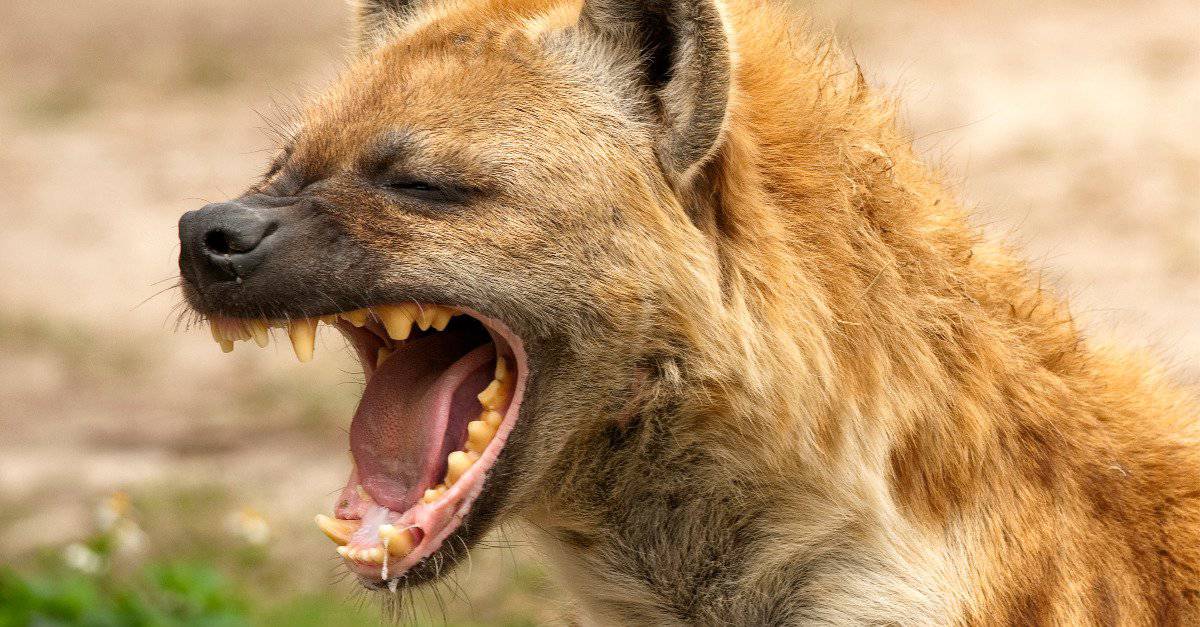

The cackling hyena and the snarling wolf would likely never meet in the wild. However, it would be interesting to see how a hyena would fare against a wolf if they went head-to-head in a fight. These two species share a number of attributes, notably that they live in packs, are similar in size, can run at similar speeds, and have incredible senses of smelling and hearing. Their differences will determine which pack animal will take the win. Let’s learn more about which animal has what advantage in this battle of the beasts.
Comparing a Hyena and a Wolf
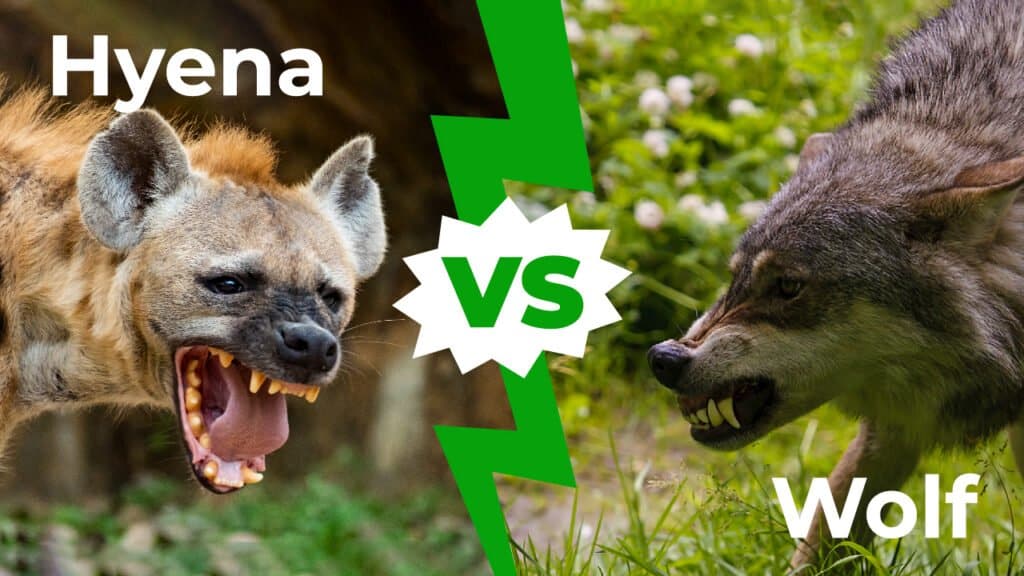
Key Factors in a Fight Between a Hyena and a Wolf
A few key factors will determine whether the hyena chuckles hardily or cries pitifully after a bout with a ferocious wolf. Those factors boil down to their physical attributes (size, speed, bite power and teeth, senses. Nature is tough, but so are these two pack animals. Let’s dive into the details to see how each one measures up.
Hyena vs. Wolf: Size
The largest hyena species is the spotted hyena (Crocuta crocuta). Spotted hyenas’ physical stats measure up similar to those of gray wolves, the largest, most widespread, and well-known of the four wolf species.
On average, spotted hyenas grow to be 4-5.9 feet long and 30-32 inches tall at the shoulder, and weigh 88-190 pounds. This is very similar to the length, height, and weight of gray wolves: 4-7 feet long, including the tail, 26-33 inches tall at the should, and 60-145 pounds.
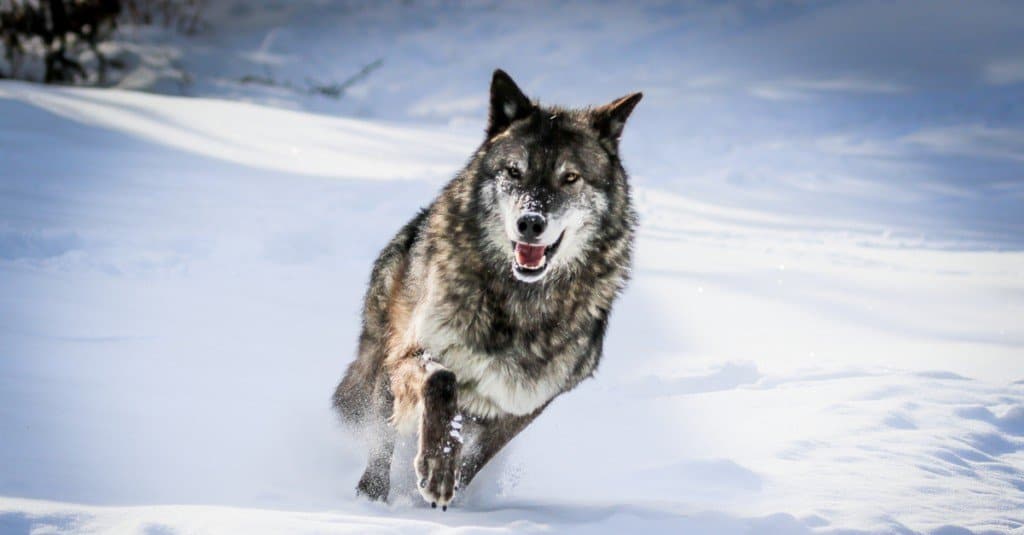
Spotted hyenas are slightly heavier than gray wolves, but they’re roughly the same size in terms of height and length.
©Holly S Cannon/Shutterstock.com
Based on these stats alone, the hyena has a significant weight advantage. Interestingly, female spotted hyenas weigh about 10% more than males, so this match-up would be pitting a female spotted hyena against a male gray wolf. In the animal kingdom, size dimorphism varies quite a lot. It’s often assumed that male mammals are larger and heavier than females, but this is not the situation universally, as this case shows.
The only significant difference in terms of size is weight. Hyenas have the advantage here.
Hyena vs. Wolf: Speed
It should come as no surprise that hyenas are fast. Why? Well, while they live in packs like wolves, hyenas taxonomically are more closely related to cats than canids. Spotted hyenas can reach a top speed of 37 miles per hour, but they really excel in a chase. These animals, known for their endurance, can maintain speeds of about 28-31 miles per hour over several miles, allowing them to exhaust their prey.
For their part, wolves are no slouch in the running game. Well-known for their endurance, wolves are known for maintaining a cruising speed of 5-8 miles per hour for hours on end, and they can kick into high gear, reaching speeds of 35-40 miles per hour in short bursts, which can come in handy to close a chase for a meal.
This is a very close one to call. Hyenas may have the advantage here, but the explosive power of wolves shouldn’t be overlooked.
Hyena vs. Wolf: Bite Force
Both these animals have powerful jaws and teeth. While wolves have not had their bite force effectively measured, lab studies have yielded estimates of 400-1,200 PSI, which is more than sufficient to break bones. The bite force of the spotted hyena is confirmed at the top range of the estimate for wolves. With a bite force over 1,100 PSI, hyenas, too, can crush bones. In fact, they have quite the reputation for osteophagy (bone-eating).
Again, this is close. The hyena’s fearsome reputation as a bone-crusher eeks out the win here but only barely.
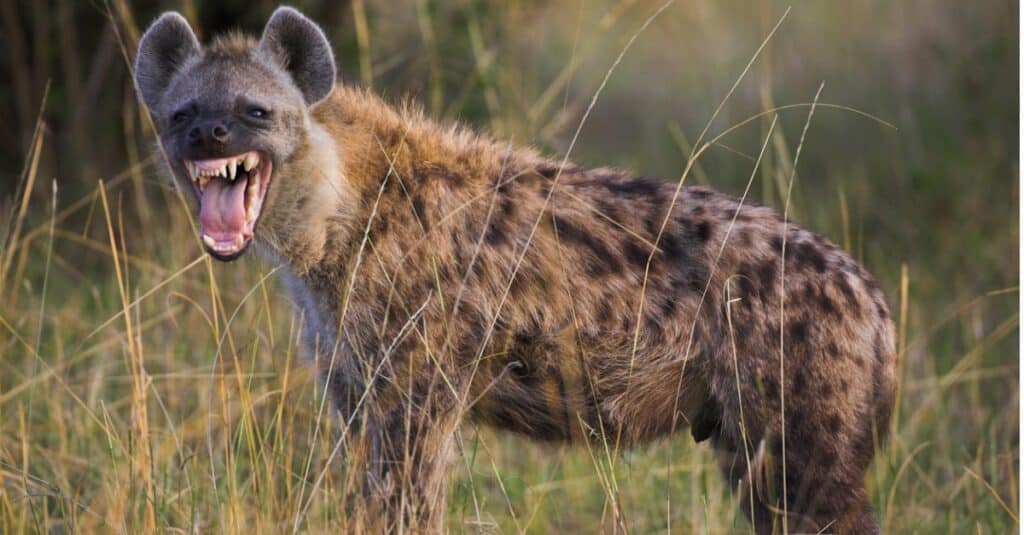
Although hyenas enjoy a reputation for bone-eating, they aren’t the only ones capable of crushing bones with their teeth.
©iStock.com/AndyDiamond
Hyena vs Wolf: Senses
The senses of hearing and smelling in gray wolves and spotted hyenas are off the chart. Gray wolves can hear sounds from as far away as six miles in forests and 10 miles in open areas. Their sense of smell could be considered their most acute sense. Some researchers have suggested that wolves’ sense of smell could be 80 to 100 times more sensitive than humans’. And while they cannot see colors as brightly as humans can, their eyes have a greater proportion of rod cells to cones, which is crucial to being able to see in low-light conditions.
Nearly the same can be said of spotted hyenas. This animal’s senses of hearing, smelling, and seeing are so attuned to its role in the ecosystem. Like wolves, the ratio of rods to cones in their retinas is high, about 100:1, providing this crepuscular hunter with the best chance of hunting prey at dawn and dusk.
Neither one appears to have an advantage over the other. This is a draw.
Who Wins in Hyena vs. Wolf?
In three of the four areas discussed—size, speed, and bite force—the spotted hyena has the advantage—albeit only slightly. The fourth category, senses, was a draw. This is an awfully tough match-up to call.
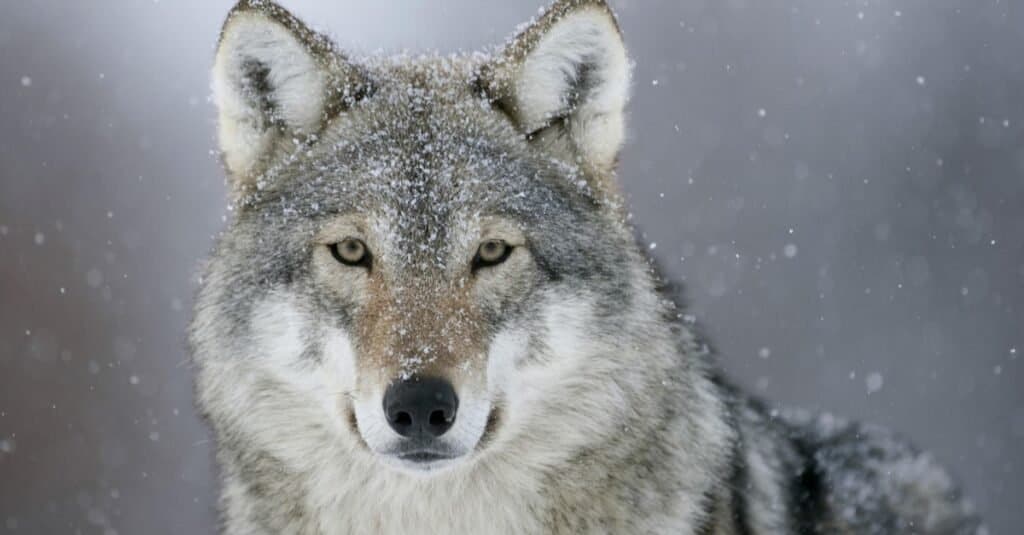
The winner of this match-up leans toward the hyena, but don’t overlook the gray wolf’s chances.
©nataliatamkovich/Shutterstock.com
With a bird’s-eye view of their physical attributes, the spotted hyena walks away with the win, but the explosive speed at which the wolf can move could be all the difference this underdog needs to maneuver out of the path of the hyena’s bone-crushing bite and land its own.
What do you think?