
Quick Take
- The animal you'd expect to be bigger actually isn't, and the size comparison between woolly mammoths and modern elephants will surprise you. Compare their sizes →
- Woolly mammoths' most iconic physical features were not merely decorative. Each one served a specific survival purpose in extreme conditions. See their survival features →
- One species of modern elephant is far more closely related to woolly mammoths than most people realize, and the resemblance is still visible today. Explore the relationship →
- Mammoth tusks and elephant tusks look nothing alike, and the difference goes far deeper than just size. See tusk differences →
Woolly mammoths (Mammuthus primigenius) and modern elephants have similar origins. They share ancestral roots in the order Proboscidea and the family Elephantidae, originating in Africa before diverging into different lineages roughly 6 million years ago. Woolly mammoths lived during the Pleistocene Epoch, with most populations becoming extinct around 10,000 years ago. Yet we can still see some of their characteristics in modern-day elephants, especially Asian elephants (Elephas maximus), with whom mammoths share the most genetic similarities. Read on to learn more about woolly mammoths and elephants, and discover what sets these animals apart.
Comparing Woolly Mammoths vs. Elephants
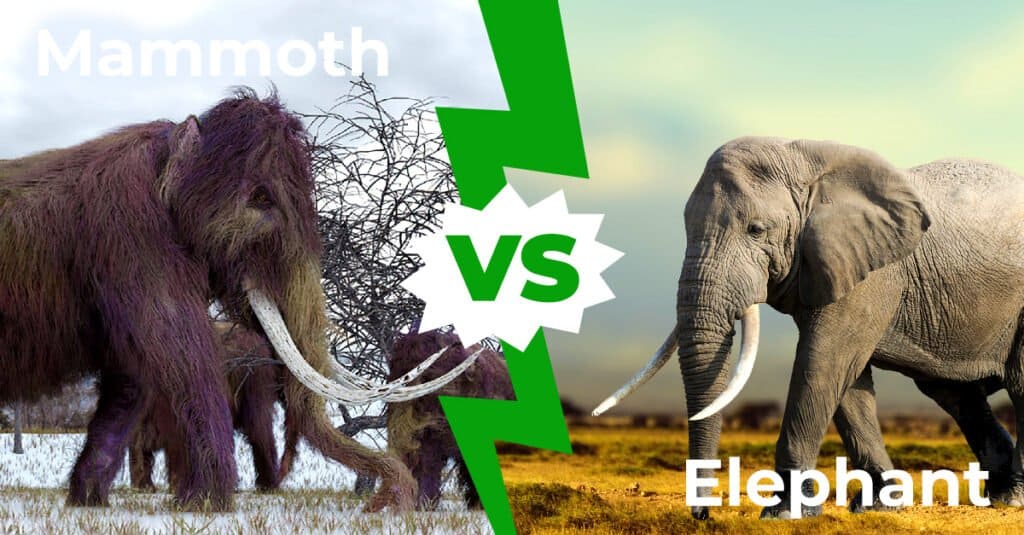
| Woolly Mammoth | Elephant | |
|---|---|---|
| Size | Height: 11-12 feet Weight: 4-6 tons | Height: 13 feet (African); 11 feet (Asian) Weight: 2-7 tons, with African elephants being larger |
| Appearance | 2 layers of fur; small ears and tail; high-domed head, shoulder hump, and sloped back; very long tusks curving in spirals | Sparse, bristly hairs; large floppy ears; gently curved (in one direction) or straight tusks |
| Distribution and Habitat | Eurasia and North America; northern tundra and steppes | Africa, India, and Southeast Asia; tropical and subtropical forests and savannas |
Woolly Mammoths vs. Elephants: Key Differences
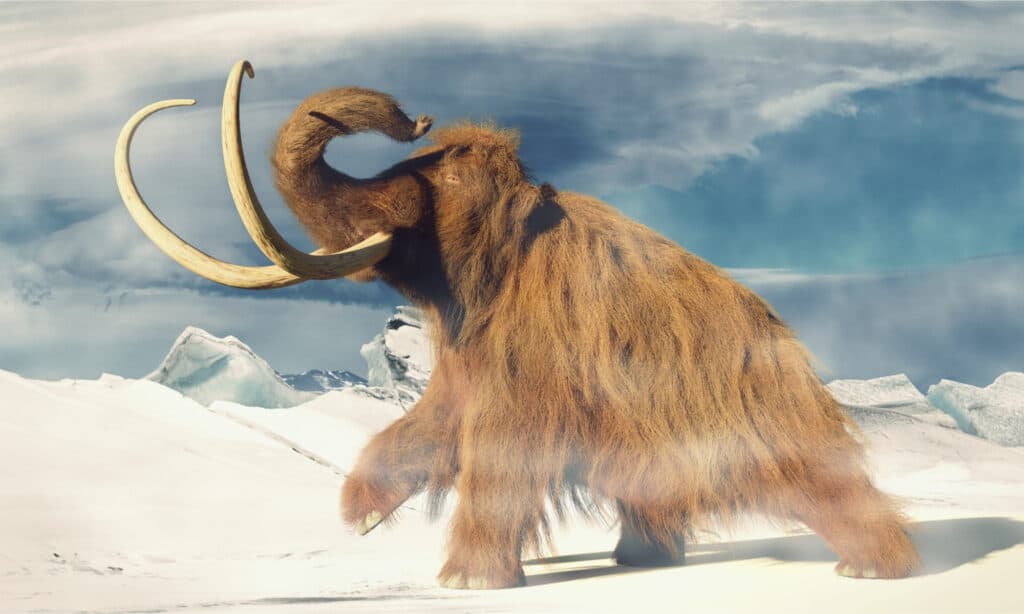
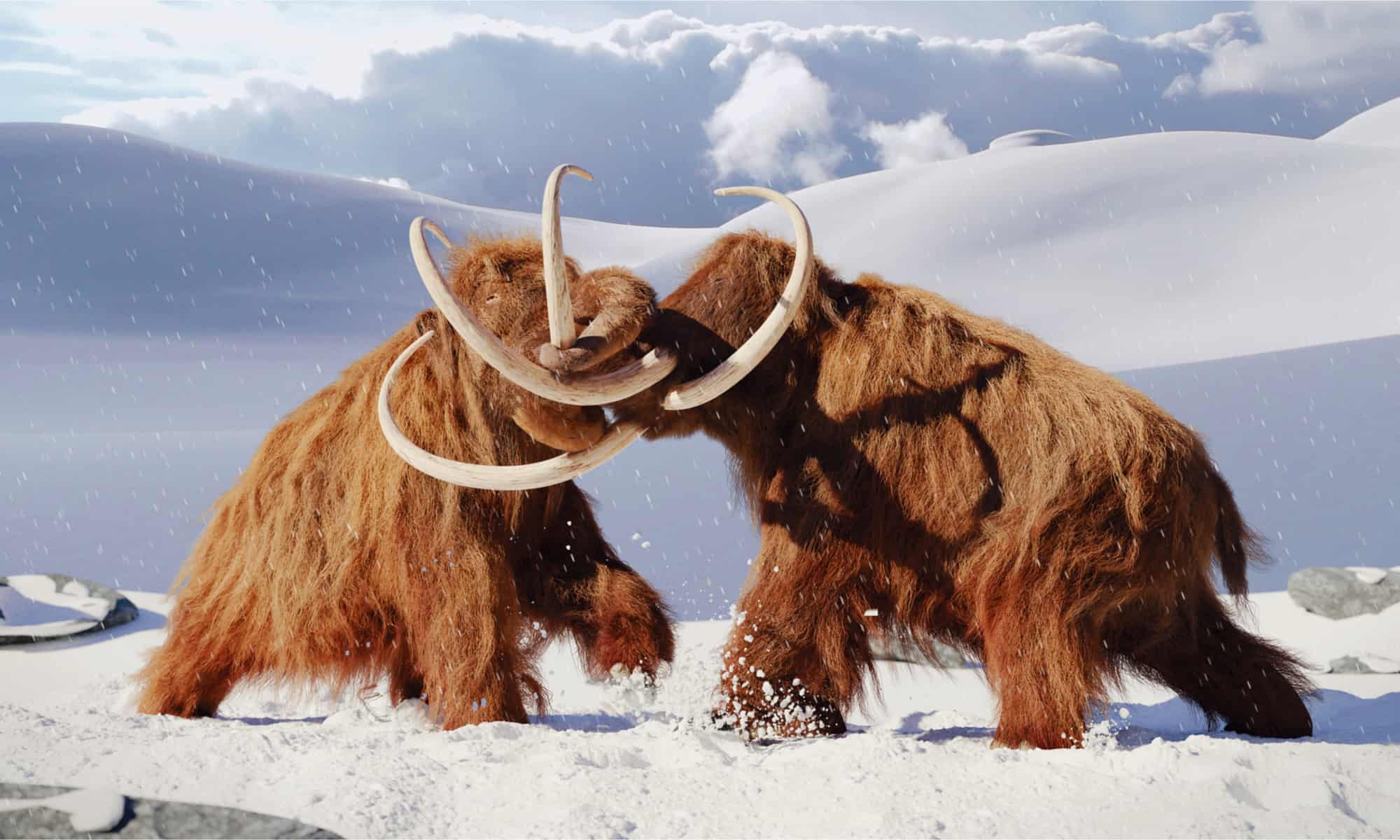
Woolly mammoths had two layers of fur.
©Dotted Yeti/Shutterstock.com
Woolly mammoths and elephants may be related, but they look very different and lived in completely different climates. Keep reading as we break down all the key differences between a woolly mammoth vs. an elephant.
Size
When we think of animals that lived tens of thousands, or even hundreds of thousands of years ago, we expect these animals to be enormous. Many of them were gigantic in comparison to today’s animals, but surprisingly, the largest modern African elephants (African bush elephant Loxodonta africana; African forest elephant Loxodonta cyclotis) are actually slightly larger than woolly mammoths were. An adult male woolly mammoth is estimated to have reached between 11 and 12 feet tall and to have weighed between 4 and 6 tons.
However, African elephants can reach up to 13 feet tall and can weigh up to 7 tons or even more. Like woolly mammoths, Asian elephants are also slightly smaller than African elephants, reaching about 11 feet tall and weighing up to 6 tons. So modern Asian elephants are about the size that a woolly mammoth would have been.
Woolly mammoths were about the size of modern Asian elephants.
©Dmytro Gilitukha/Shutterstock.com
Appearance
To stay warm, the woolly mammoth had two layers of fur. The outer guard layer was shaggy and could be as long as 3 feet or more, while the woolly under layer kept them insulated against the cold. They had high, domed heads, a distinctive shoulder hump, and a sloping back. The hump probably worked like a camel’s hump, storing fat for when resources were scarce. It may have also helped them maintain a healthy core body temperature.
Their ears and tails were also smaller than elephant ears. The small size was an evolutionary survival tactic. Large ears and tails were more likely to get frostbite, took too much energy to keep warm, and let too much heat escape. Small ears and tails were more efficient for mammoths to survive freezing temperatures. One of the woolly mammoths’ most distinctive features was their enormous tusks. A mammoth’s tusks grew in spirals and could reach up to 12 feet in length.
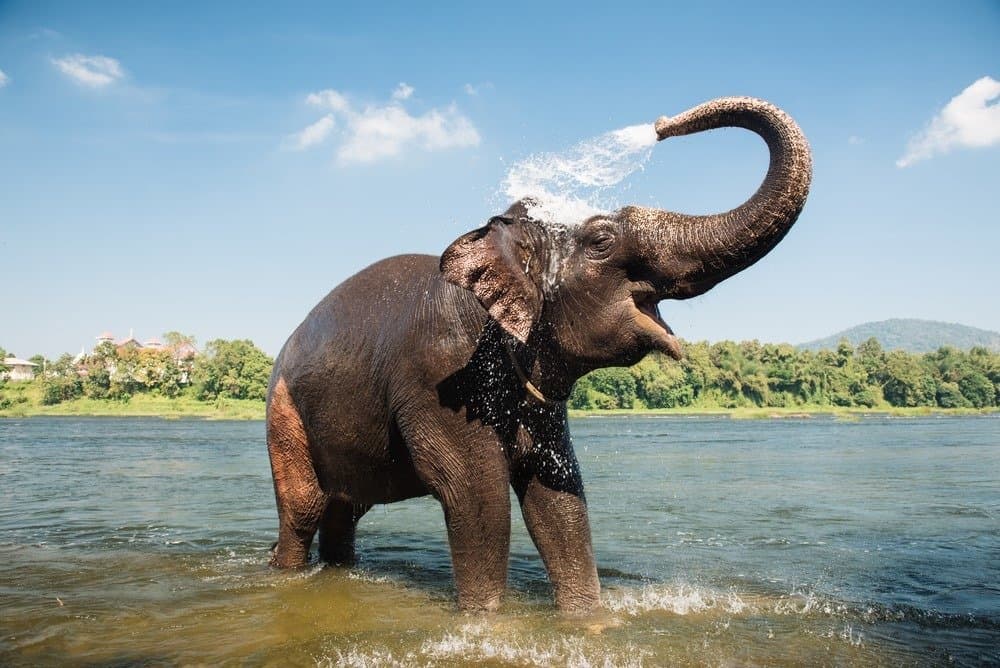
Modern elephants have sparse, bristly hairs which are believed to conduct heat away from their thick skin. They also have large floppy ears, with the African elephant’s ears being the largest. Although they can also use their ears for communication, they are primarily used for thermoregulation. While they have impressive tusks, they’re not nearly as long as a woolly mammoth’s were, nor as curved. Modern elephant tusks are either gently curved in one direction or they are straighter. Elephant tusks can reach up to 10 feet long, with most being between 5 and 8 feet.
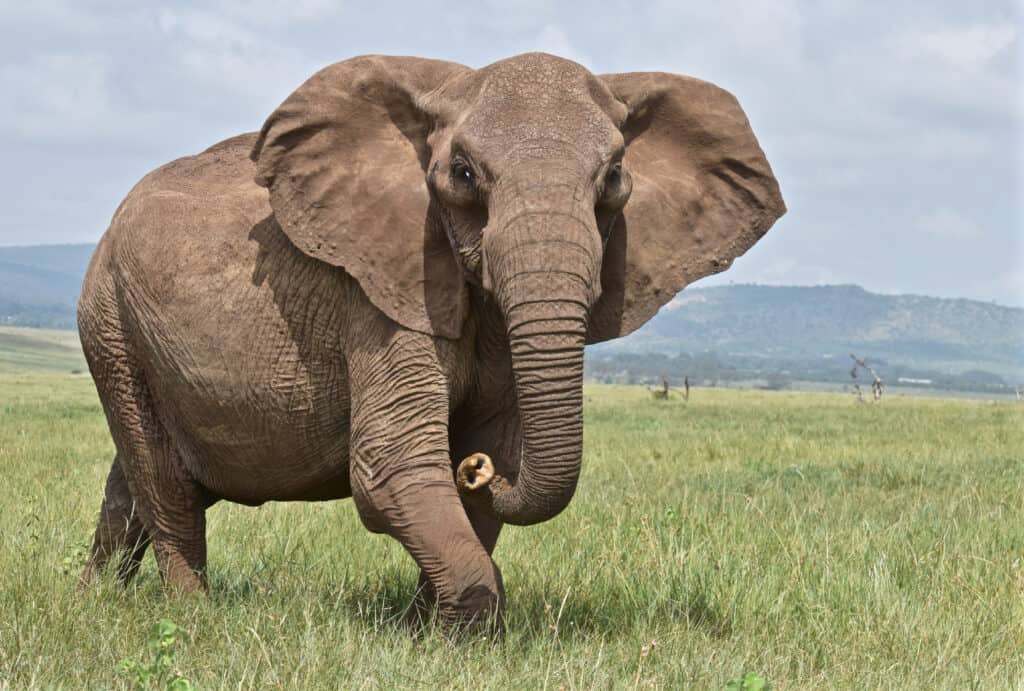
Elephants release heat through their large floppy ears.
©AndyElliott/Shutterstock.com
Distribution and Habitat
During the ice ages, woolly mammoths lived in the frigid climate of the Northern Hemisphere. You could find woolly mammoths on the arid steppe tundra in far northern Europe, Asia (Siberia), and North America. A woolly mammoth’s cold grassland habitat is sometimes referred to as “mammoth steppe.” Their diet consisted primarily of grasses, sedges, and rushes, supplemented by forbs, shrubs, and small flowering plants. There is also fossil evidence that mammoths lived near water like modern elephants.
Modern elephants live in the warm climates of Africa, India, and Southeast Asia. They inhabit a variety of environments, from tropical rainforests to open grasslands, wooded savannas, and even semi-deserts. Their diets consist of grass, leaves and twigs, tree bark, roots, and fruit. Elephants also live near rivers, streams, ponds, or water holes for drinking and bathing.
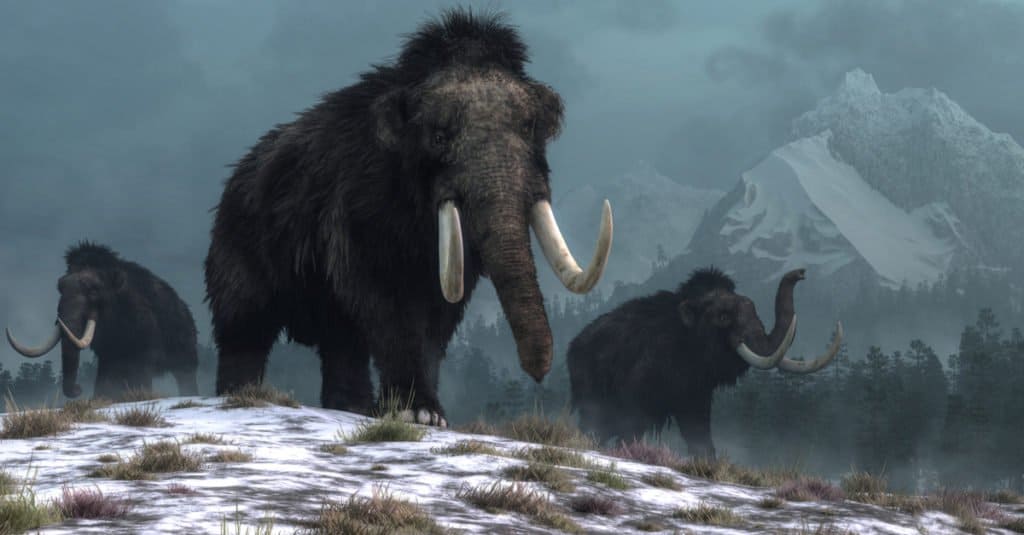
Woolly mammoths lived in the arid steppe tundra in northern Europe, Asia (Siberia), and North America.
©Daniel Eskridge/Shutterstock.com