
Quick Take
- Elephants have cracked a communication challenge that scientists thought only humans had mastered, a finding that changes what we know about animal intelligence. See what makes this groundbreaking →
- Why would an elephant need dozens of different gestures to achieve just two goals? The answer reveals something unexpected about how they manage social risk. Explore the 41 gestures →
- The gesture an elephant chooses could be the difference between a peaceful resolution and a life-threatening fight, and this choice is far from random. See how disputes turn dangerous →
- Understanding how elephants argue turns out to matter far beyond biology, and conservationists are watching this research closely for a very specific reason. See the conservation implications →
Elephant communication has fascinated scientists for years, and we already know that they predominantly use sounds and scents to signal things to other elephants. More recent studies have shown that they also use visual, tactile (touch), and multisensory signals in different contexts. Elephants can greet each other, play, and advertise for mating opportunities. For example, African savannah elephants greet each other by touching trunks. It is the intentionality of elephant communication, however, that remained undetermined. A fascinating new study has revealed how elephants use gestures to resolve disputes and alter their communication style depending on the recipient.
What Is Intentionality in Communication?
Intentionality describes the ability to communicate underlying thoughts to specific recipients to influence their behavior and/or understanding. It is a defining feature of human language. Intentionality can also be divided into different orders depending on complexity.
The simplest is called first-order, or goal-directed intentionality, when the goal is to trigger a specific reaction in the recipient. Asking for help is one example. In second-order intentionality, the intention is to change the recipient’s mental state. An example would be telling someone that you are hurt. Finally, the highest orders are very complex! This would be “wanting you to know that I know that you know I am hurt”. First-order intentionality has been demonstrated in several species. In primates, intentional gesturing is widespread, and they use a wide range of gestures and body parts. However, there has been no conclusive evidence of animals having the intention of changing another’s mental state. Until now!
Why Study Elephants?
These magnificent creatures rely heavily on hearing and olfaction; they are large-brained animals and live for a long time. More importantly, they establish multi-level fission–fusion social communities. Female elephants live in a more stable arrangement of family groups led by an older matriarch. Male elephants live in a more fluid social system with bachelor groups forming and breaking up.
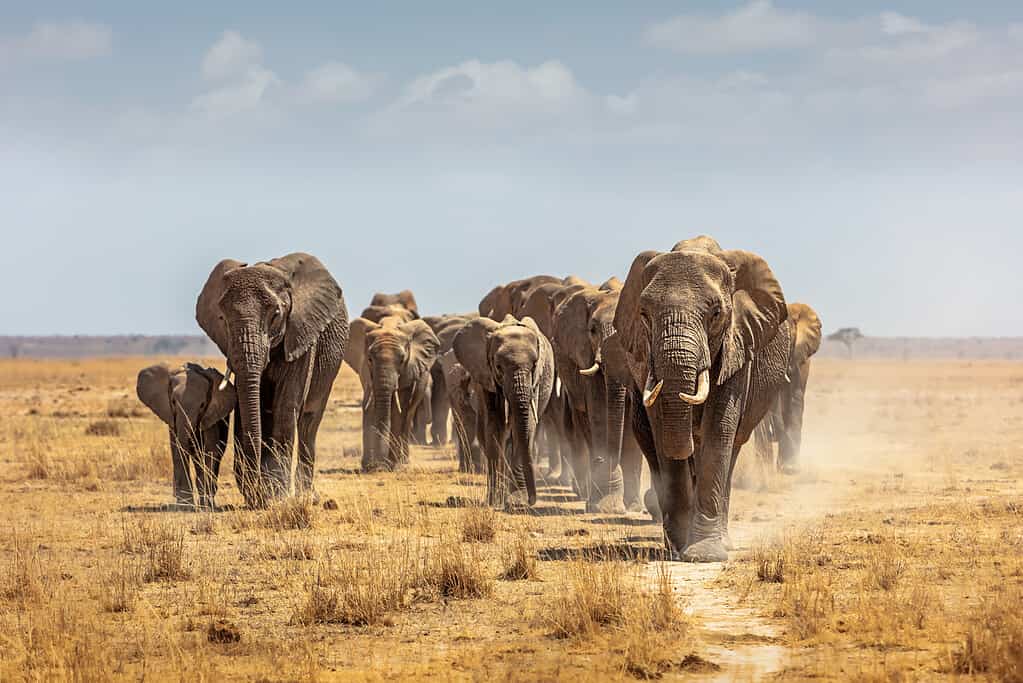
Elephants need to communicate to maintain social bonds.
©adogslifephoto/ via Getty Images
To help smooth these multiple relationships, elephants need extensive and flexible intentional gestural systems. These need to indicate diverse social interactions and relationships. So, do elephants gesture intentionally to other elephants? This is what the new study set out to find out.
Elephants and Confrontation
Scientists decided to study a particular type of communication: agonistic interactions. These are social behaviors involving fights, threats, aggression, submission, and retreat. It’s all about confrontation!
Experts thought that this would be a fruitful area to study goal-directed intentional communication in wild elephants. Elephants often end up in confrontations when competing for resources, dealing with threats, or when asserting dominance. They can escalate to physical violence, during which the elephants can get badly hurt or even die. Therefore, if they can effectively communicate a goal, such as requesting that another elephant move away from a food source, the confrontation may be resolved without the need for physical aggression. No one needs to get hurt!
This study focused on two fenced, highly dense elephant populations living in the Marakele and Addo Elephant National Parks in South Africa.
How Do Elephants Settle Disputes?
The elephants in this study used 41 types of gestures to communicate that they wanted another elephant to ‘Move away’ and to ‘stop behavior’. They also used their trunk for almost half of their gesture types. The most common gesture aim was ‘move away’, which suggests that displacing another elephant from a location is particularly important to elephants.
The signaling elephants visually checked the recipient before and during gesturing to make sure that they had got the message. If they hadn’t, the elephant used further gestures until they had satisfied their goal and the other elephant had got the message.
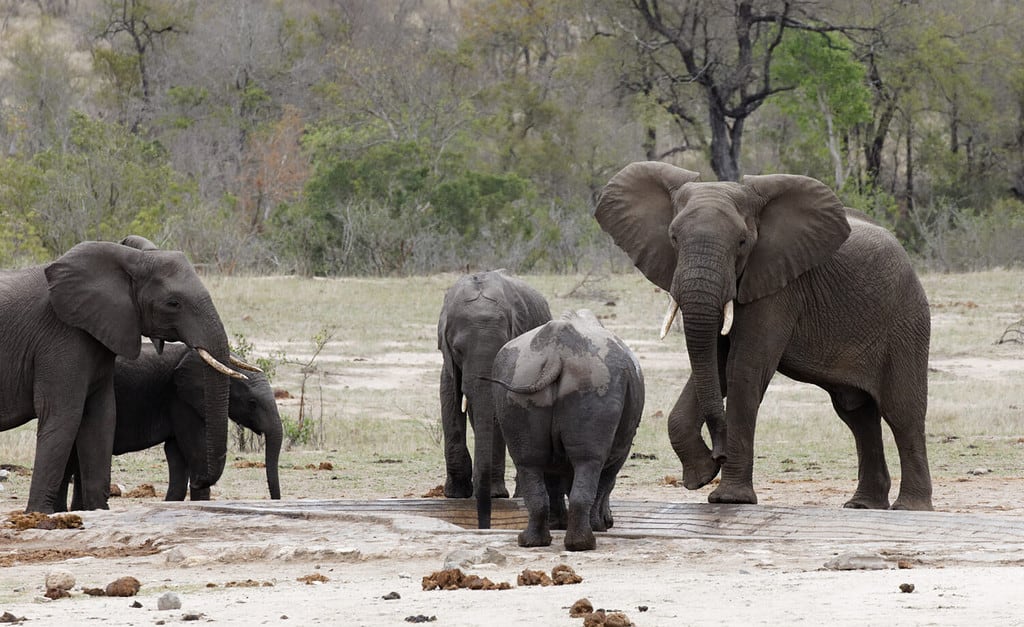
Elephants sometimes communicate with their ears.
©Beate Wolter/Shutterstock.com
But why so many gestures to achieve just two goals? The researchers think that this is connected to the recipients’ prior behavior. There is always the risk that agnostic behavior could escalate into physical aggression, which is risky for both parties. So, it is important to the signaling elephant that their intention is effectively communicated without triggering physical aggression. The different signals may mean more complex requests such as ‘move away further’ or even ‘move there,’ but further studies are needed to explore this.
Complex Communication
The nature of the relationship between the signaling elephant and the recipient may also be important. Elephant social relationships are large in number and complex. Some gesture types may only be used if the signaler feels confident in doing so. For example, an elephant may push or hit another elephant only if the recipient is a subordinate (lower on the social pecking order) or close kin. This means that they are less likely to respond with violence. In more uncertain relationships, elephants may use a more cautious gesture, such as ear flapping. However, further studies are needed to confirm this.
In South Africa, many elephants are confined to fenced parks or reserves and can experience high population densities. These conditions can increase competition and the risk of violent escalation. Therefore, this type of research is essential to inform park management strategies to mitigate unsustainable aggression and the associated injuries.