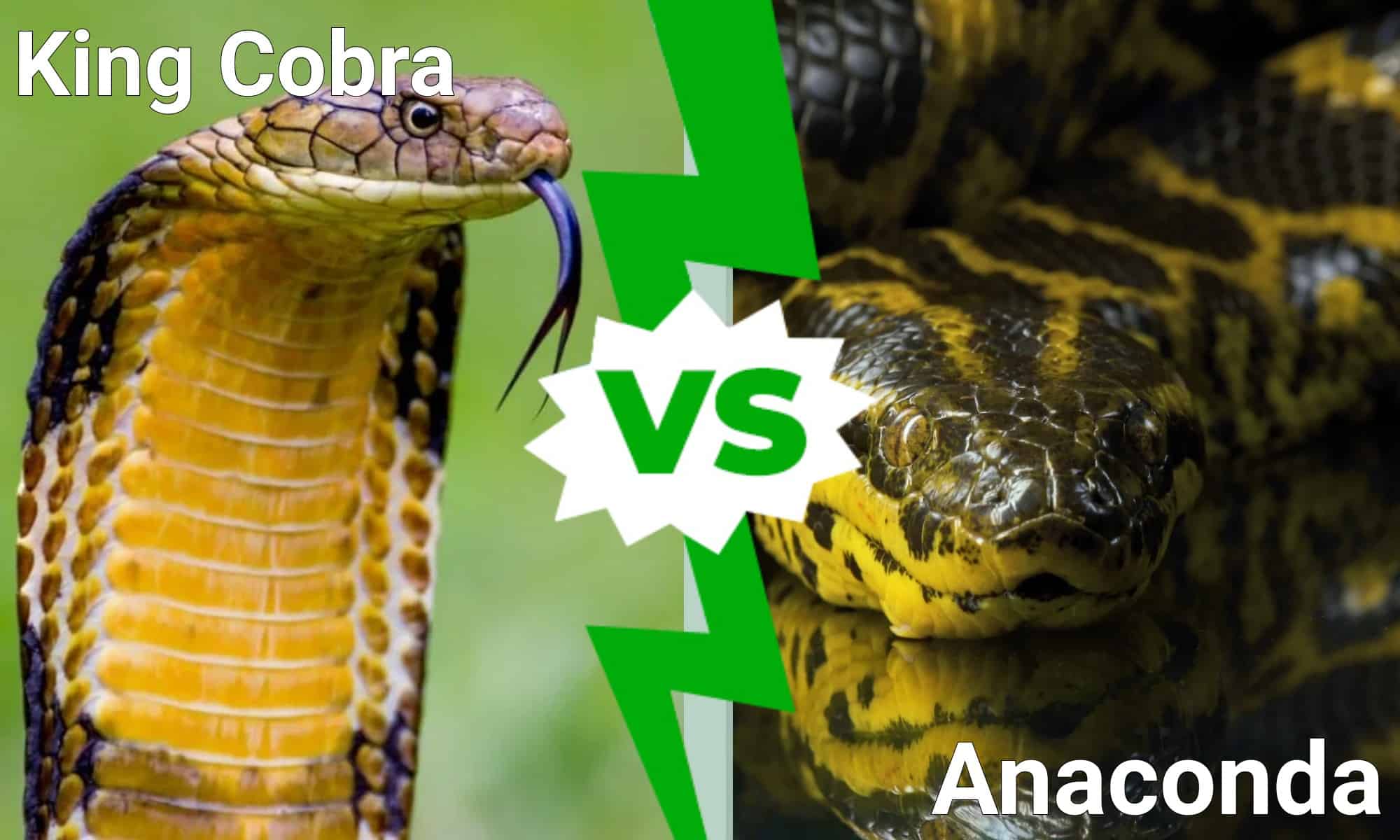

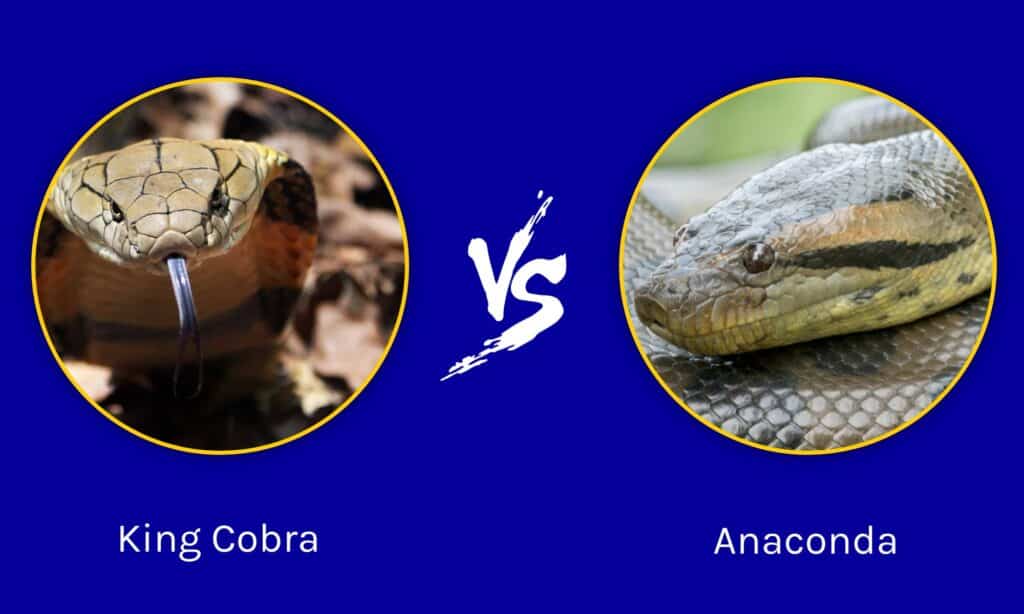
The king cobra (Ophiophagus hannah) is a venomous snake found in South and Southeastern Asia. Their genus name means “snake eating” in Greek because king cobras eat other venomous snakes. An anaconda is an enormous constrictor that lurks in the flooded wetlands of South America. The term “anaconda” refers to the Eunectes genus, which currently includes four anaconda species. However, it is most commonly used in reference to the green anaconda, or common anaconda (Eunectes murinus). Both snakes are deadly predators, but which snake is more dominant? We’re going to get to the bottom of this question by comparing both animals’ strengths to determine the answer.
Comparing a King Cobra and an Anaconda
| King Cobra | Anaconda | |
|---|---|---|
| Size | Weight: 13-26 pounds Length: 10-12 feet on average; up to 19 feet | Weight: 65-155 pounds average, can reach over 500 pounds Length: 15-16 feet on average, up to 30 feet |
| Speed and Movement | Estimated up to 12mph; slithering along the ground in a serpentine motion; swims and climbs | Estimated around 5mph on land; swims 10mph on the surface and in the water; can climb |
| Hunting Style and Sensory Abilities | Active and ambush hunter; binocular vision; chemosensory abilities | Ambush predator; chemosensory abilities |
| Attack Method | Lifts front third of its body several feet from the ground to strike; jaws grasp prey and 0.5-inch fangs deliver up to 1000mg of venom | Strong bite for grasping; powerful constriction |
| Defenses | Large size; threat display | Large size; eyes on their head allow them to skim the surface of the water; camouflage |
Key Factors in a Dominance Fight Between a King Cobra and an Anaconda
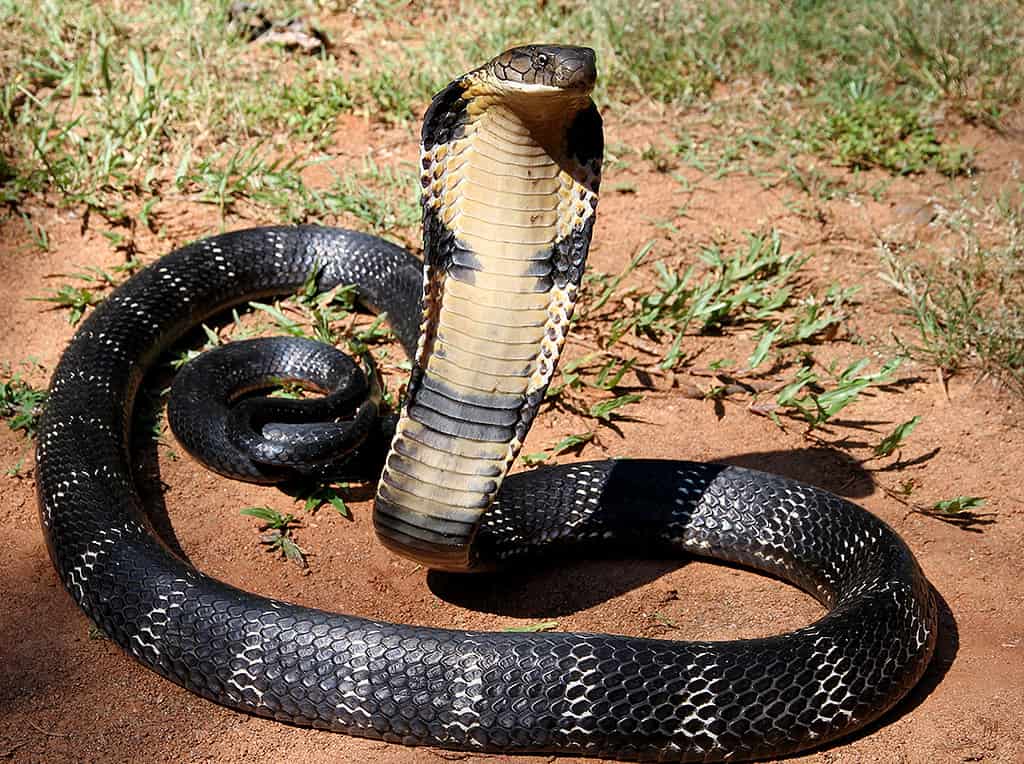
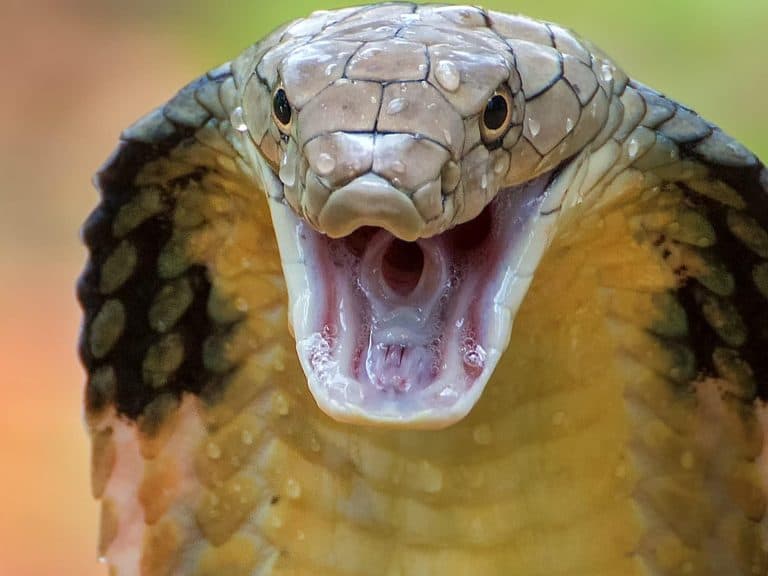
King cobras are the longest venomous snakes.
In the animal kingdom, the biggest and fastest animals usually win dominance fights. However, figuring out whether a king cobra or an anaconda is more dominant will require a closer examination. We will take an in-depth look at their respective sizes, speed and movement, hunting styles, methods of attack, and defense strategies to determine which animal would emerge as the victor.
Size
Anacondas are far larger than king cobras. The average king cobra is around 10-12 feet in length, with the longest on record reaching nearly 19 feet. They are the longest venomous snakes in the world. Compared to most snake species, king cobras also have heavy bodies, weighing from 13 to 26 pounds. Male king cobras are generally larger than the females.
However, the anaconda is the heaviest snake in the world, far outweighing the king cobra. The average anaconda is believed to weigh between 65-155 pounds, but the largest on record was around 500 pounds. They average 15-16 feet, but some large individuals can grow to nearly 30 feet long. Female anacondas can grow up to five times larger than males.
Speed and Movement
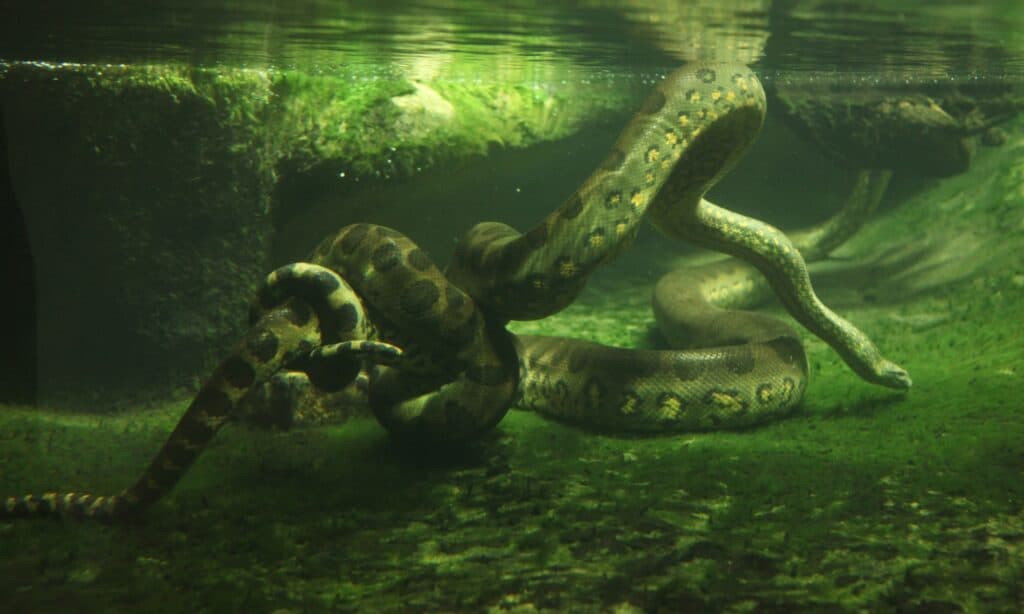
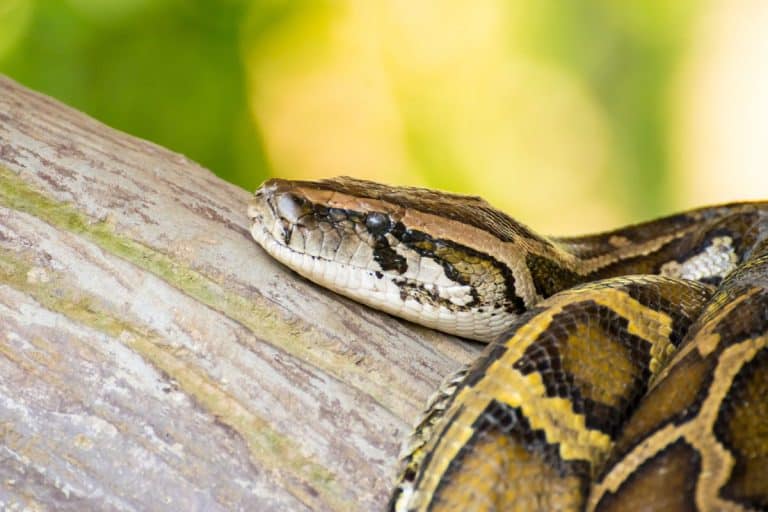
Anacondas spend more time in the water where they are faster and more agile.
©Vladimir Wrangel/Shutterstock.com
The king cobra has the advantage when it comes to speed on land. They are among the fastest snakes, slithering in a serpentine pattern at speeds of up to 12mph. They are also good swimmers and frequently hunt prey in the water. King cobras excel at climbing and often forage for food and take shelter in the forest canopy.
Anacondas are slower on land, but they are at home in the water. They can move at speeds of around 5mph on land, but they can swim along the surface of the water and underwater at around 10mph. Anacondas can also climb, but the large female snakes may not climb as frequently as juveniles and males.
Hunting Styles and Sensory Abilities
Both snakes are apex predators in their respective ecosystems. King cobras are both active hunters and ambush predators. Their primary prey is other snakes, including venomous snakes. The king cobra has a forked tongue that can taste the air and collect scent particles. These particles are interpreted by the Jacobson’s organ in the roof of the snake’s mouth, providing it with tracking information. Their binocular vision gives them excellent depth perception, and they can see moving people at up to 330 feet away. They can also detect vibrations in the ground to aid them in stalking prey.
Anacondas are primarily ambush predators. They use camouflage to hide in swamps, marshes, and rivers to wait for unsuspecting prey. Anacondas consume a wide variety of prey, including birds, fish, caimans, capybaras, and deer. Like king cobras, anacondas also use their tongues to pull scent particles from the air and can detect vibrations. Additionally, anacondas have heat-sensing pit organs on their upper lip to help them locate heat signatures.
Attack Methods
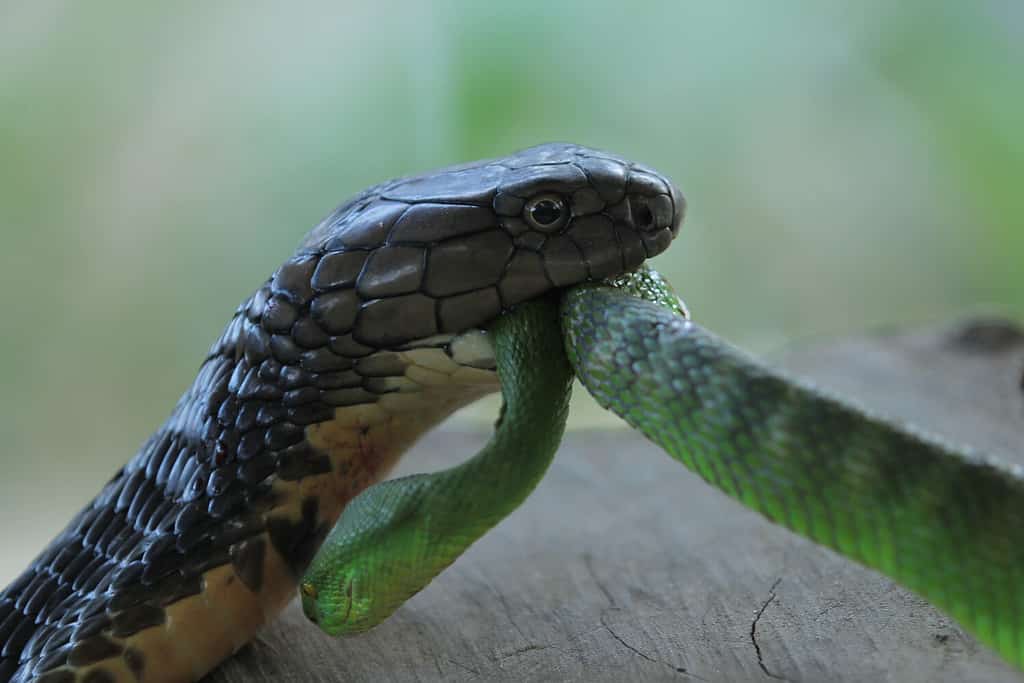
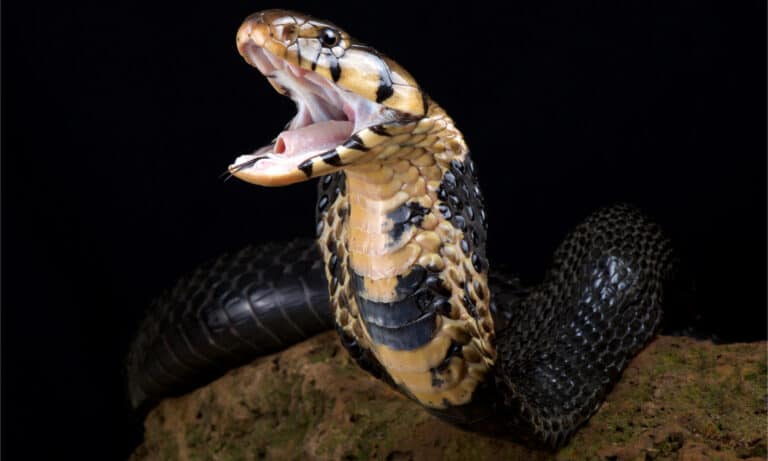
King cobras have powerful jaws to hold their prey until the venom takes effect.
©Mufti Adi Utomo/Shutterstock.com
King cobras rely on venom to kill their prey. They have 0.5-inch fangs that can inject up to 1,000mg of venom. This is said to be enough to kill 20 humans or an animal as large as an elephant in a single bite. They can raise the upper third of their bodies off the ground, enabling them to strike precisely and rapidly, sometimes more than once. King cobras also have powerful jaws to hold their prey until the venom takes effect.
The anaconda is a constrictor. When it targets prey, it lunges and clamps down with sharp, backward-facing teeth. Once secured, it will coil around its prey and constrict with its powerful muscles until it overwhelms the prey’s circulatory system. Scientists have found that cardiac dysfunction and lack of oxygen to the brain due to trauma to the circulatory system is what actually causes death, not suffocation. Drowning is also sometimes a cause of death, since anacondas tend to hunt in the water.
Physical Defenses
King cobras are typically more careful than other venomous snakes. Although they are not as large as anacondas, they are large compared to many other snakes. However, despite their intimidating size, king cobras prefer to avoid confrontations. Yet, when threatened, they raise their bodies 3-4 feet off the ground and flare their neck ribs to display a long, narrow hood. King cobras can also emit a low, growling sound using specialized pouches in their trachea.
The anaconda is a massive snake that uses its size as a physical deterrent. As adults, humans are their only natural predators. Despite this snake being so large, it can camouflage itself in tall grass, as well as in the water. Like king cobras, these snakes would rather retreat and escape. When threatened, anacondas coil their bodies into a tight ball and hiss to warn potential threats.
Which Animal Would Win in a Fight Between a King Cobra and an Anaconda?
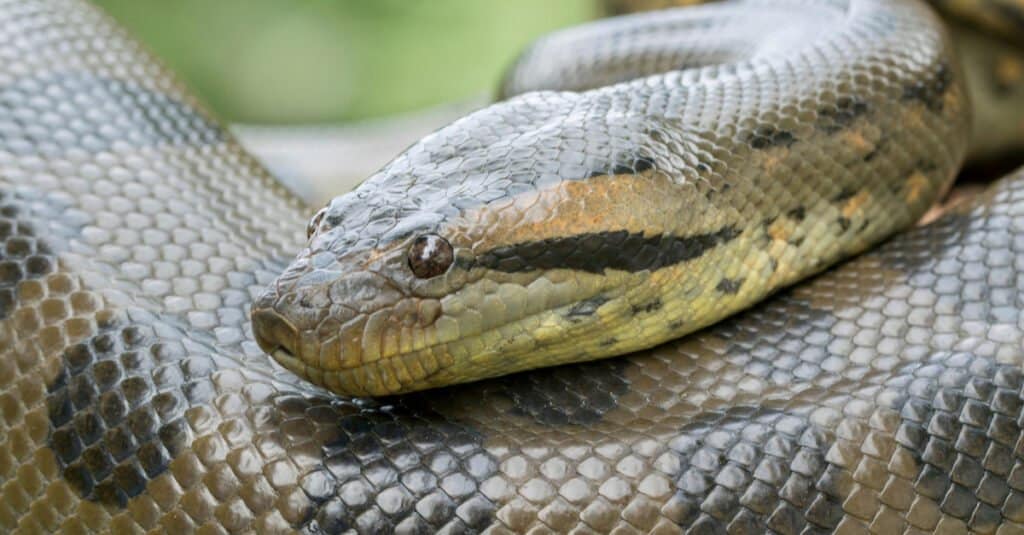
Despite the anaconda’s greater size, it is slower on land and lacks venom.
©Mark_Kostich/Shutterstock.com
King cobras and anacondas live in different parts of the world, although they favor similar habitats. In parts of Asia and Southeast Asia, constrictors such as pythons and king cobras have overlapping ranges. King cobras commonly feed on pythons, including Burmese and reticulated pythons. However, it is not without risk. In a fight between a constrictor and a king cobra in their native habitats, both snakes could die. The constrictor has no way to counter the cobra’s bite once it has coiled around the cobra’s body, and constrictors are often so large that the cobra may succumb to circulatory failure before its venom can immobilize the constrictor.
In a fight between a king cobra and an anaconda, if two average-sized snakes fought on land, the king cobra has the advantage, despite the anaconda’s greater size. King cobras are much faster on land and have significant experience fighting powerful, dangerous snakes. They inject a large amount of venom in only one bite that quickly immobilizes their prey. If a single bite is toxic enough to kill an elephant weighing upwards of 13,000 pounds, it can certainly kill even the largest anacondas. Although king cobras are good swimmers, anacondas spend more time in the water, where they are faster and more agile. So, the anaconda’s superior size and greater familiarity with aquatic habitats would likely give it the edge in the water. The outcome of a confrontation would also depend on the size, age, and condition of the individual snakes involved.