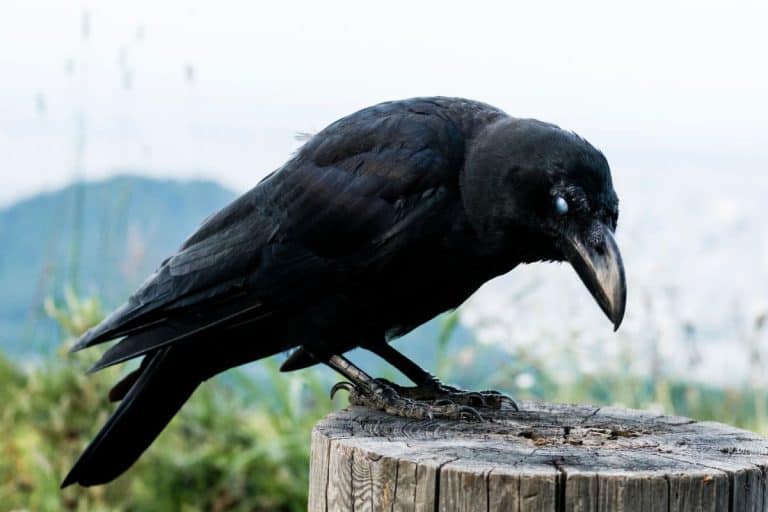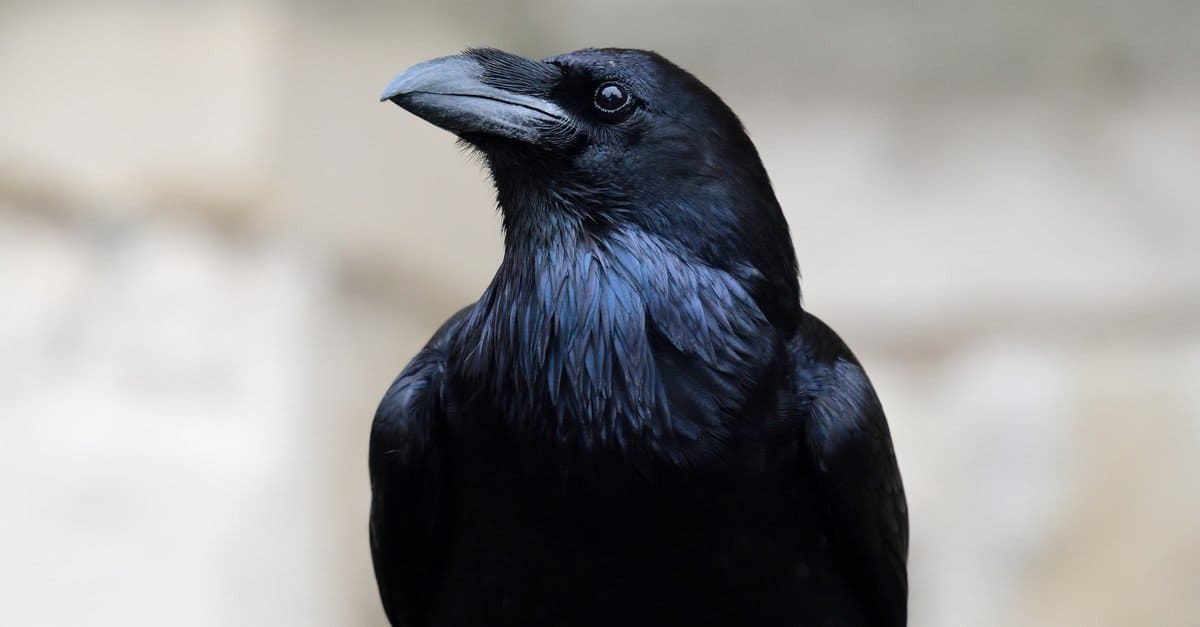

Typically, the name “crow” refers to several bird species in the Corvidae family that share common characteristics, such as glossy black plumage, omnivorous diets, and high intelligence. Other species in the family include rooks, magpies, and jackdaws. However, this article focuses on the two major groups in the Corvus genus: crows and ravens. After researching more than 40 different crow species in the genus Corvus, we have identified the 10 largest crows in the world.
10. Long-Billed Crow
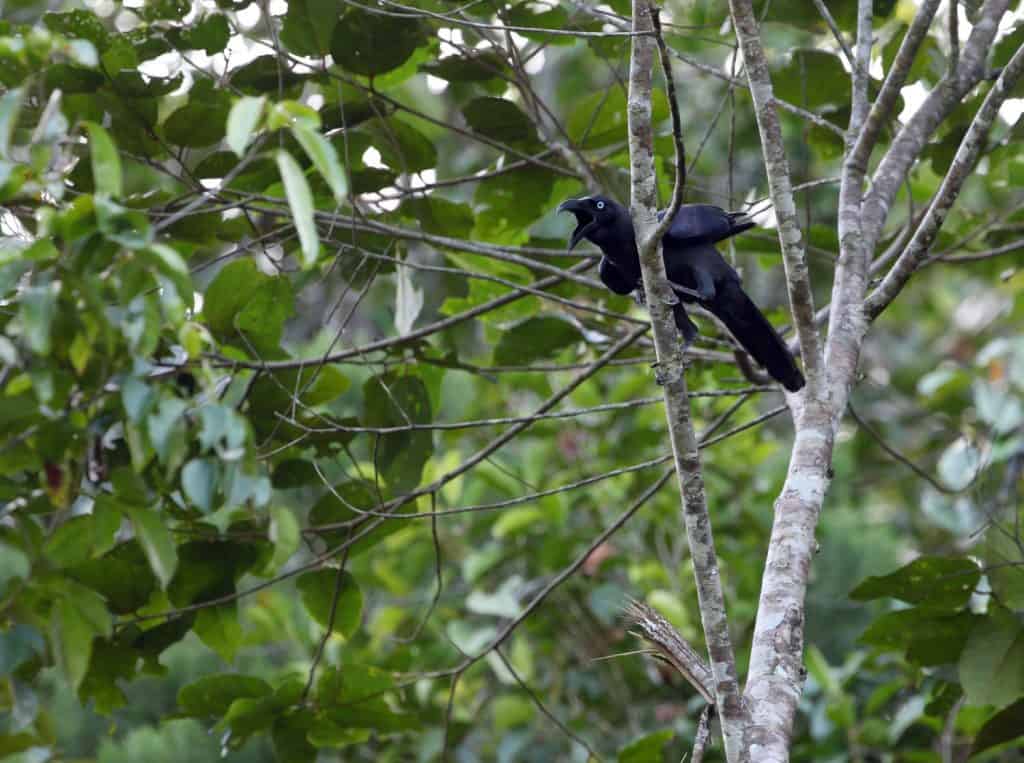
Long-billed crows are only found in the Maluku Islands of Indonesia.
©Agami Photo Agency/Shutterstock.com
The long-billed crow (Corvus validus), not to be confused with the large-billed crow, is native to the Northern Maluku Islands, an archipelago in Indonesia. These crows have very long beaks with proportionally shorter tails, giving them a top-heavy appearance. They have glossy, purplish-black plumage and striking pale-colored eyes. Long-billed crows grow between 17 and 21 inches long.
Long-billed crows inhabit forests at elevations below 4,000 feet. However, they may also be found in degraded forest areas and cultivated land. Little is known about their diet, but researchers believe they eat fruits, seeds, and insects due to their preference for the forest canopy. This bird is very vocal and has a distinct call, described as “krak-krak-krak.”
9. Torresian Crow
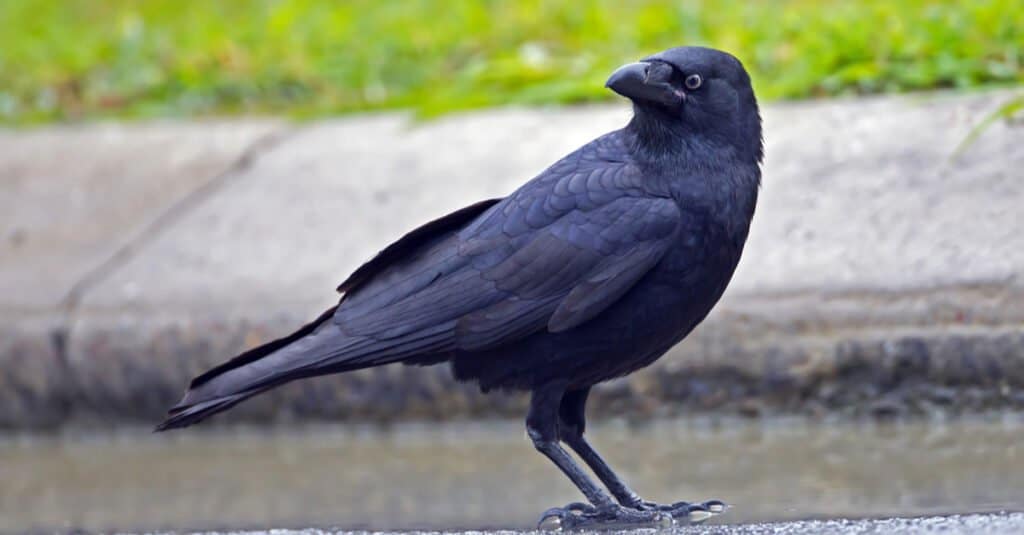
Torresian crows eat more grain than other corvid species.
©Wright Out There/Shutterstock.com
The Torresian crow (Corvus orru), also known as the Australian crow or Papuan crow, can be found in the upper two-thirds of Australia and parts of New Guinea. The Torresian crow has white eyes with a thin blue eye-ring. They are glossy black, with short neck feathers called hackles. The base of their neck and head feathers is white. Torresian crows reach between 19 and 21 inches in length.
These crows are common in coastal and tropical areas. They can be found on the fringes of the rainforest, in open forests, tall scrublands, beaches, and even arid regions, as long as there are tall trees nearby to nest in. Their diet consists of more grain than other corvids, but they also eat insects and other invertebrates. Torresian crows have a nasally, staccato call that is said to sound like “uk-uk-uk-uk.”
8. Forest Raven
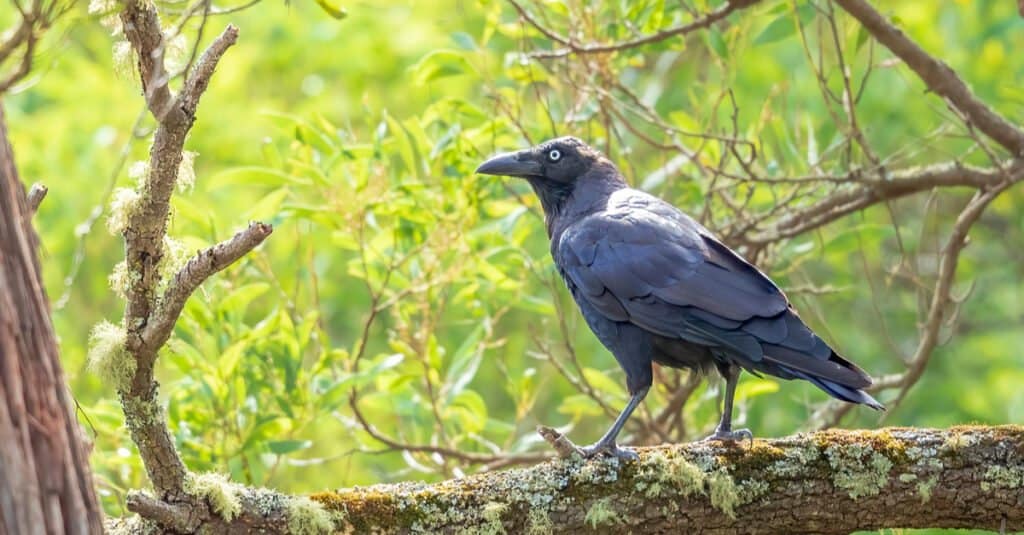
Forest ravens are the largest Corvus species in Australia.
©Wright Out There/Shutterstock.com
The forest raven (Corvus tasmanicus) is native to the island of Tasmania and the southeastern coasts of Australia. It is the largest Corvus species in Australia, reaching a length of 20 to 21 inches. It has glossy black plumage with a green to blue sheen. The forest raven can be identified by its heavy beak, white irises, throat hackles, and long legs. They have relatively short tails and large wings, with primary feathers that are nearly as long as their tails.
On mainland Australia, its distribution is limited to forests, but in Tasmania, it has been observed in a variety of environments, including alpine forests, terrain adjacent to open country, moors, eucalyptus forests, coastal scrub, and beaches. They are opportunistic feeders and scavengers, eating invertebrates, birds, small mammals, reptiles, plant matter, and carrion. Its call is deeper and more gravelly than that of many crow species, but it can also issue a loud bark as an alarm call.
7. White-Necked Raven
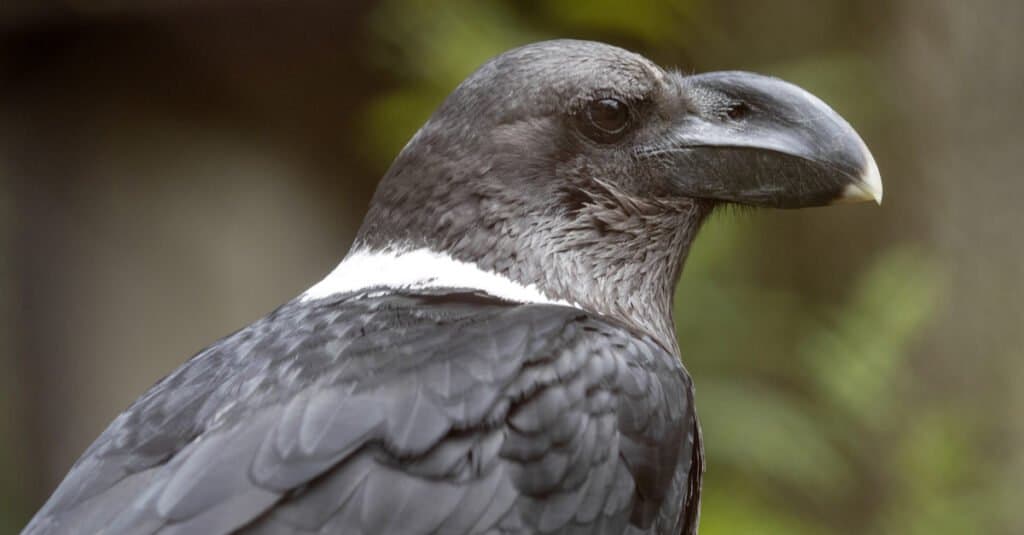
The white-necked raven prefers semi-arid hilly and mountainous regions.
©Vladislav T. Jirousek/Shutterstock.com
The white-necked raven (Corvus albicollis) is native to eastern and southern Africa. It is one of the largest African corvid species. This raven is more identifiable than other crow species because of its large, curved beak that ends in a white tip, along with a small patch of white feathers on the nape of its neck. The white-necked raven is predominantly glossy black but appears to have a purple sheen along its chest, throat, and neck. These ravens can reach up to 21.25 inches long.
White-necked ravens inhabit the hills and cliffs of semi-arid regions and areas with higher rainfall. They are opportunistic omnivores, with a diet of fruits, insects, roots, small reptiles and mammals, and even carrion. Their call sounds like a harsh “krrraw.”
6. Collared Crow
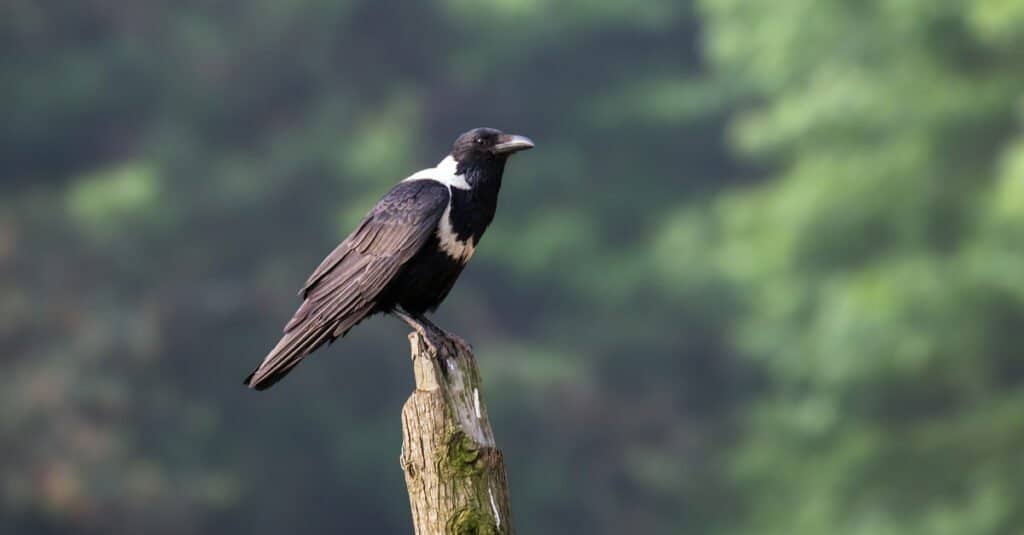
Collared crows can be recognized by the prominent patches of white feathers at their necks, backs, and chests.
©Agami Photo Agency/Shutterstock.com
The collared crow (Corvus torquatus) is native to China, Taiwan, and northern Vietnam. They are predominantly black with a blue, purple, and green glossy sheen. These crows can be recognized by a prominent collar of white feathers, as well as additional white patches on their upper backs and chests. They generally reach between 20 and 21.7 inches long.
Collared crows can be found in low-lying areas, including agricultural areas and wetlands. They primarily feed on insects and small invertebrates, including mollusks and crustaceans, due to their proximity to water. However, they will also forage for grain around rice paddies. Their call is higher-pitched than many other crows and sounds like a raspy “kaar-kaar.”
5. Brown-Headed Crow
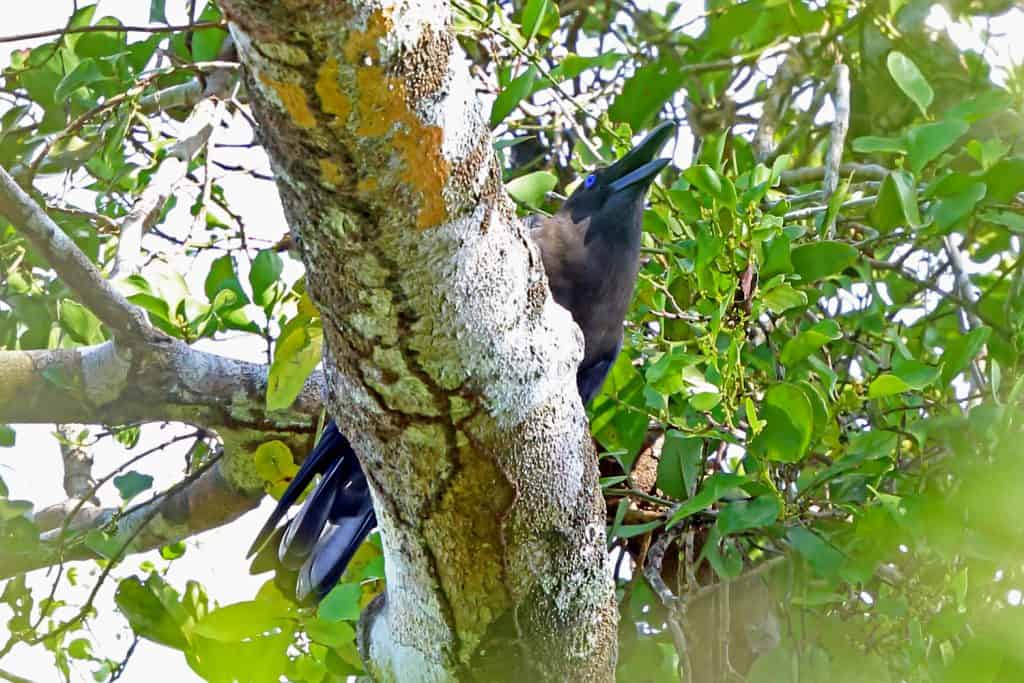
The brown-headed crow lives deep in the forests of eastern Indonesia.
The brown-headed crow (Corvus fuscicapillus) is endemic to eastern Indonesia. This crow has shiny black plumage with a purple sheen across most of its body, but the head and neck are usually dark brown. They have stout, arched beaks and blue eyes. These crows are believed to reach from 18 to 22 inches in length.
The brown-headed crow prefers the lowland canopy of old-growth forests, but they can also be found in mangroves and in forests that have regenerated. They avoid open and coastal habitats. These crows generally eat fruits found in the tree canopy, but they may also forage for insects. Their call is a typical crow caw.
4. Brown-Necked Raven
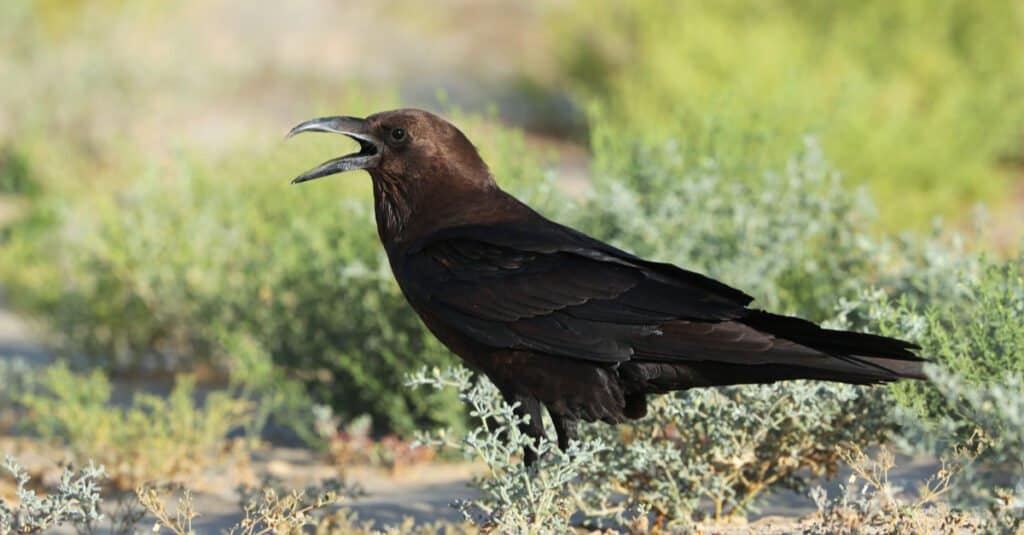
Brown-necked ravens prefer desert environments.
©Agami Photo Agency/Shutterstock.com
Similar to the brown-headed crow, the brown-necked raven (Corvus ruficollis) has shiny black plumage with a brown neck and head. The feathers tend to turn browner as the bird prepares to molt. Brown-necked ravens have a large range across northern Africa and the Middle East. They generally grow between 20 and 22 inches long.
The brown-necked raven prefers desert environments with oases and palm groves. Their diet includes lizards, snakes, locusts, grasshoppers, carrion, palm dates, and fruit. Their calls are similar to the croaks of the common raven, but those of brown-necked ravens are higher pitched and less throaty.
3. Large-Billed Crow
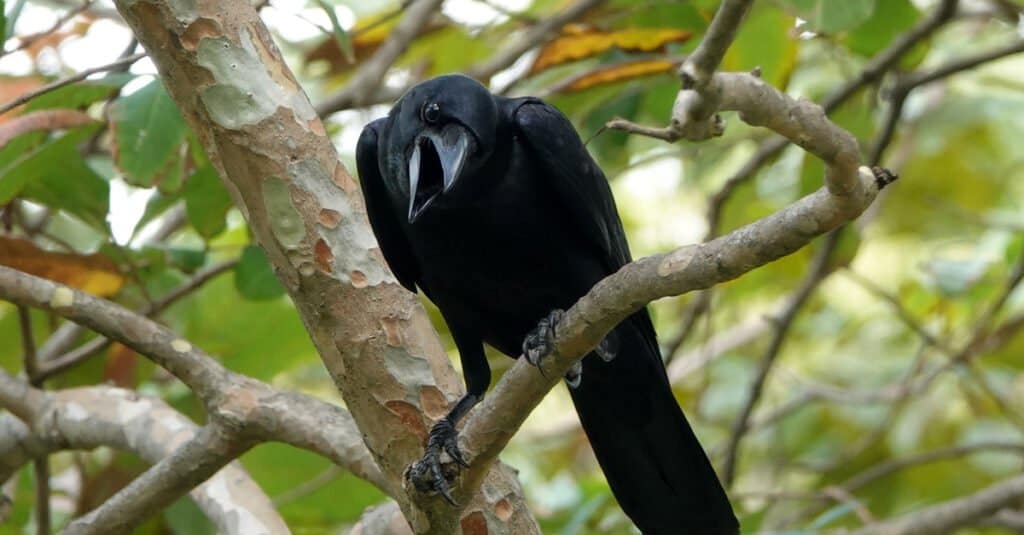
Large-billed crows are a common species all across Asia.
©Marut Sayannikroth/Shutterstock.com
As the name indicates, the large-billed crow (Corvus macrorhynchos) has a large, arched, dagger-shaped beak. Their feathers are completely black with a bluish-purple sheen of variable glossiness. This large crow is common across Asia and reaches between 18 and 23 inches in length.
They can be found in a wide range of habitats, including urban centers, woodlands, and agricultural areas. These crows are adaptable and are known to be scavengers, feeding on garbage, carrion, and food stolen from other animals. Their call is typically a deep, harsh croak or caw.
2. Common Raven
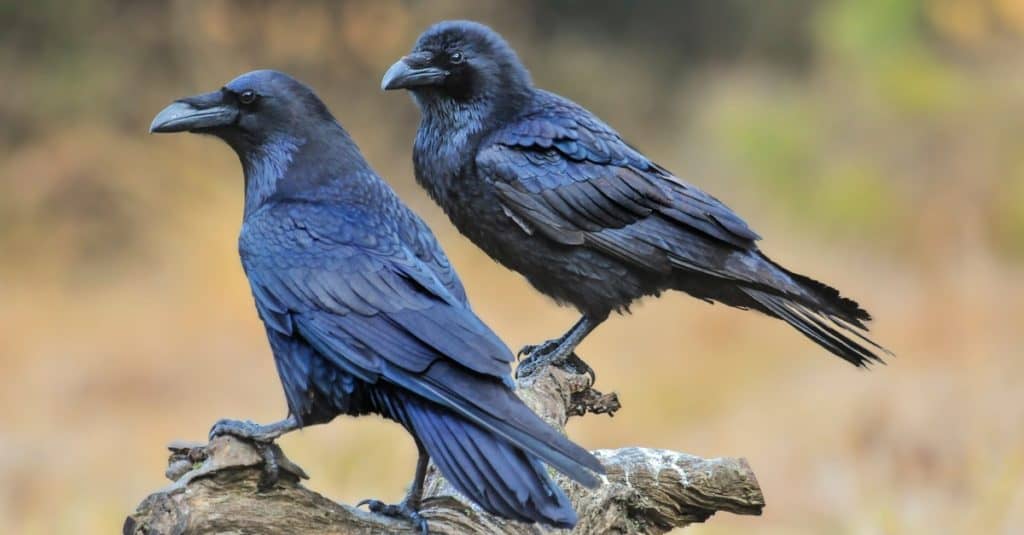
The common raven is thought to be one of the smartest bird species.
©Krasula/Shutterstock.com
The widely distributed common raven (Corvus corax) is the second largest of all crows. The common raven is found in a wide range of habitats across the Northern Hemisphere. In North America, they can be found in open areas and forests, as well as in urban settings. They can grow from 22.1 to 27.2 inches in length and regularly reach weights upwards of 3 pounds. They have large, sturdy beaks and glossy black feathers with a bluish purple sheen. These birds are completely black, including their eyes and legs.
The common raven is an opportunistic omnivore, feeding on nearly anything that they can find. Their diet generally consists of carrion, small mammals and reptiles, insects, arthropods, pet food, and human garbage. The common raven is also believed to be one of the most intelligent bird species. They have a deep croaking call, but they can mimic the calls of other birds, as well as some human speech.
1. Thick-Billed Raven
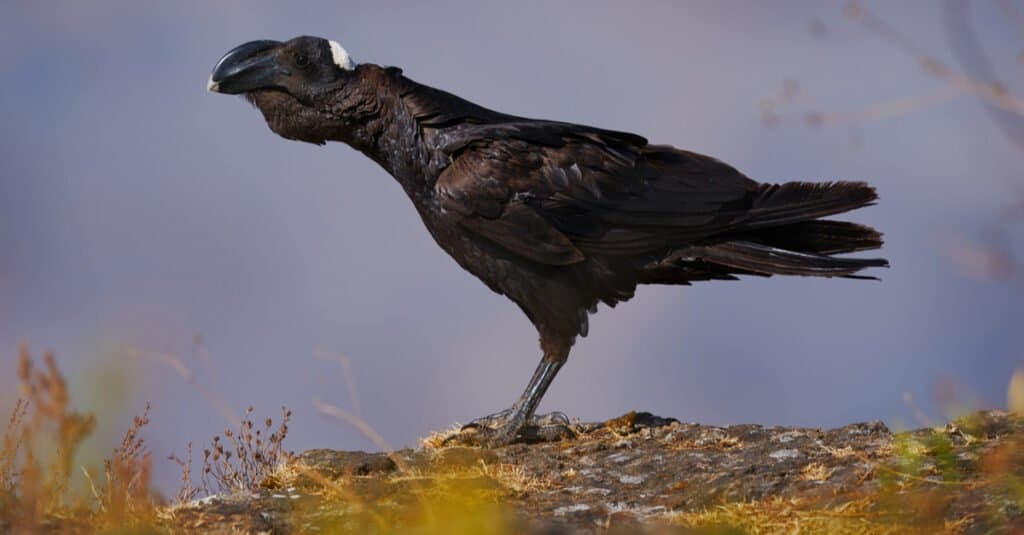
The thick-billed raven is endemic to northeastern Africa.
©Ondrej Prosicky/Shutterstock.com
The largest species of crow in the world is the thick-billed raven (Corvus crassirostris), which some sources indicate can reach up to 28 inches long. Like the common raven, they can also reach weights over 3 pounds. True to its name, the raven has a thick, blunt bill that is noticeably curved. The raven’s plumage is mostly black with a purple sheen. It has a white patch on the back of its head and another at the tip of its bill. They also have long, shaggy feathers on their necks.
The thick-billed raven primarily lives in the highlands of Eritrea, Ethiopia, and Somalia, at elevations between 5,000 and 11,150 feet. These ravens are omnivores and scavengers, so their diet includes a wide variety of insects, small mammals and reptiles, eggs, grain, fruit, carrion, and garbage. Their call is a low, harsh, rattling “g-r-r-r-r-r,” sound that is lower and raspier than those of most other corvids.