
Quick Take
- The largest marsupial, the red kangaroo dominates the vast Australian interior.
- The eastern and western grey kangaroos look similar and have overlapping ranges, but they rarely interbreed in the wild.
- There is a sub-species of western grey kangaroo that only lives on Kangaroo Island southwest of Adelaide.
- Kangaroos are sexually dimorphic, with males typically weighing two to three times more than females.
Kangaroos are the largest marsupials in the world. Marsupials are a type of mammal that have a pouch where the young complete development. Kangaroos, wallabies, wallaroos, quokkas, and other similar marsupials belong to the subfamily Macropodinae. Macropods generally have large hind legs and feet and long, muscular tails for balance. There are over 50 species of macropods, but only the six largest species are commonly referred to as kangaroos.
Kangaroos are native to Australia (including Tasmania) and New Guinea. However, the four largest kangaroo species are found in Australia. Like many animals, kangaroos are sexually dimorphic, meaning that males and females differ in characteristics, such as color and size. Male kangaroos are larger than females, so the maximum lengths, heights, and weights listed below are for males. Read on to discover the four largest kangaroos from smallest to largest.
4. Antilopine Kangaroo
- Head and Body Length: 3.9 feet long
- Tail Length: 2 feet long
- Standing Height: 3.6 feet tall
- Weight: 112 pounds
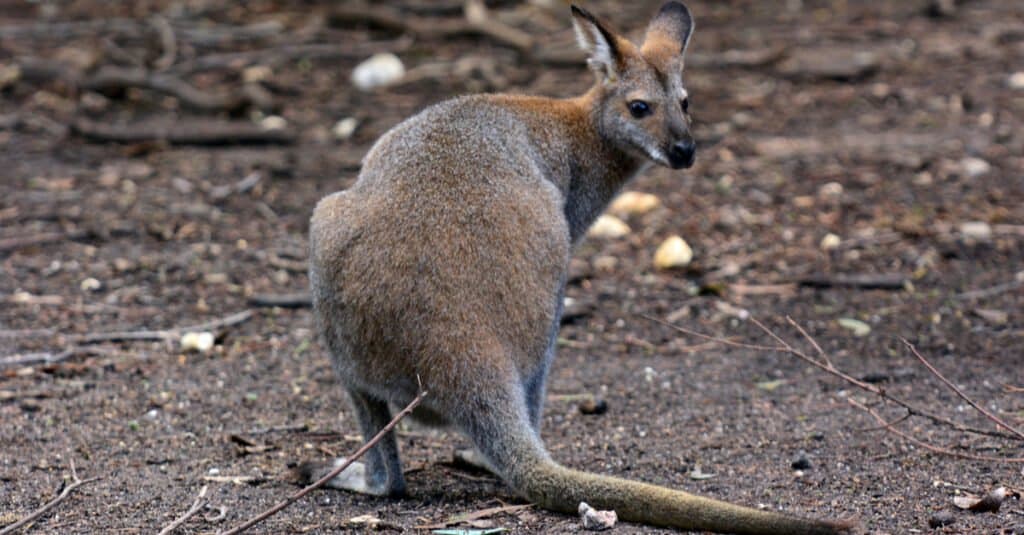
Antilopine kangaroos are also called antilopine wallaroos.
©ChameleonsEye/Shutterstock.com
The antilopine kangaroo (Osphranter antilopinus) is the smallest of the four great kangaroo species. It is sometimes referred to as the antilopine wallaroo. The antilopine kangaroo lives in the woodlands and tropical monsoon forests of northern Australia. Their range includes northern Queensland (Cape York Peninsula), the Northern Territory, and the Kimberley region of Western Australia.
Generally, males are a reddish-tan color with a cream underbelly. Females are usually greyer around the head and shoulders and are significantly smaller, typically weighing less than half as much as males. These kangaroos also have black muzzles with pale cheeks and darker paws and tail tips. Antilopine kangaroos primarily eat short grasses, but they may also eat small amounts of forbs.
3. Western Gray Kangaroo
- Head to Body Length: 4 feet long
- Tail Length: 3 feet long
- Standing Height: 4.9 feet tall
- Weight: 158 pounds
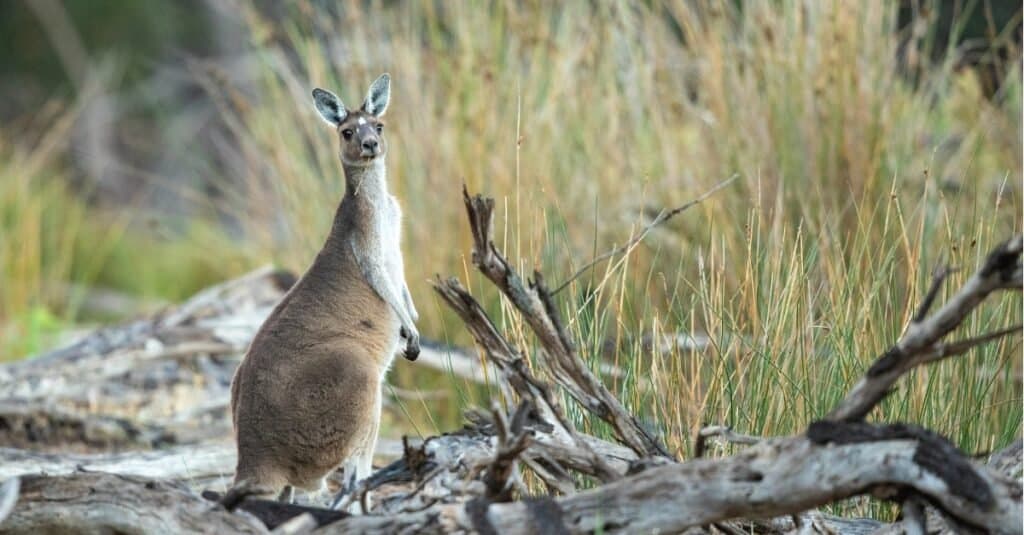
Western gray kangaroos live along Australia’s southern coast.
©iStock.com/Lea Scaddan
The western gray kangaroo (Macropus fuliginosus) lives across southern Australia, from Western Australia east through South Australia, southwest Queensland, west New South Wales, and western Victoria. Part of its range overlaps with the larger eastern gray kangaroo, but they use different habitats and rarely interbreed. There is also a subspecies of the western grey kangaroo (Macropus fuliginosus fuliginosus) on Kangaroo Island, located about 70 miles southwest of Adelaide. These kangaroos prefer open grasslands, woodlands, and scrublands. They primarily eat grasses but also consume the leaves of trees and shrubs.
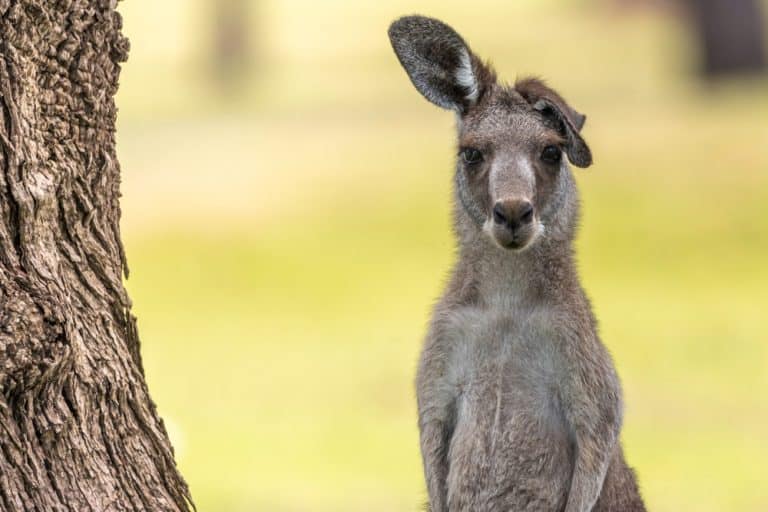
The western gray kangaroo has a gray to brown coat, with paler shades around the chest, belly, and the front of the neck. They have darker faces, paws, and tail tips. They also have a white stripe along their jawline. Kangaroo Island kangaroos are more of a smoky brown color with shorter limbs, ears, and tails. Male western gray kangaroos weigh about twice as much as females.
2. Eastern Gray Kangaroo
- Head and Body Length: 4.26 feet long
- Tail Length: 3 feet long
- Standing Height: 6 feet tall
- Weight: 187 pounds
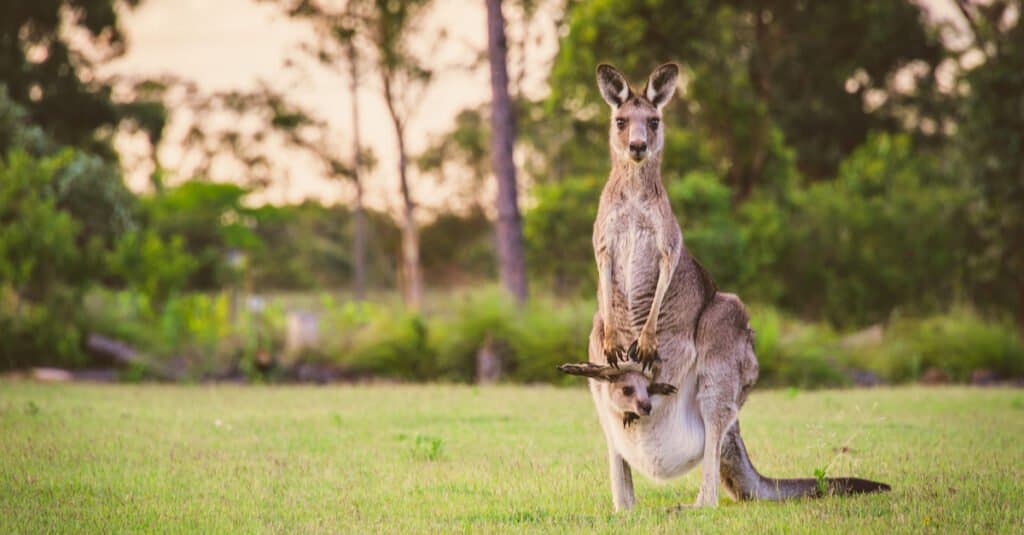
The eastern gray kangaroo is the most commonly sighted because its range extends close to major cities.
©IntoTheWorld/Shutterstock.com
The second-largest kangaroo species, the eastern gray kangaroo (Macropus giganteus), is found in the eastern third of Australia from the inland plains to the coast. This includes most of Queensland and New South Wales. There is also a population on the island of Tasmania. These kangaroos can be found in open woodlands, grasslands, and mountain forests at all elevations. They prefer grasses and green shoots, but they will eat a variety of plants, including fungi.
Their habitat range overlaps with the red kangaroo, but the two species are easy to differentiate, as the eastern gray kangaroo has fluffy, light grey fur with darker fur on the face and dark fur at the tip of the tail. Eastern kangaroos are similar in appearance to western gray kangaroos, but western greys are browner with darker brown faces. Males weigh twice to three times more than the average female.
1. Red Kangaroo
- Head and Body Length: 4.6 feet long
- Tail Length: 3.3 feet long
- Standing Height: 6 feet tall, but some large males may reach up to 6.5 feet
- Weight: 203 pounds
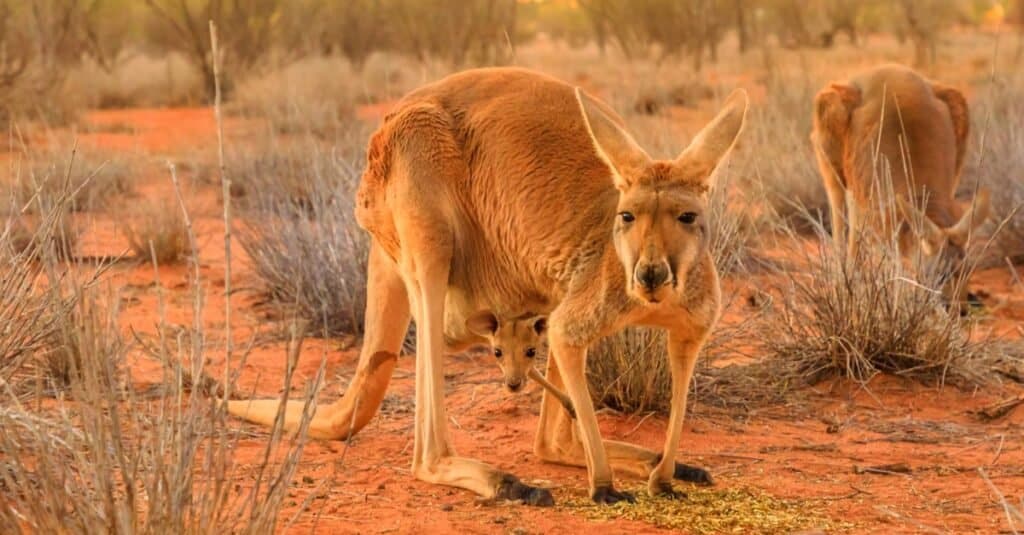
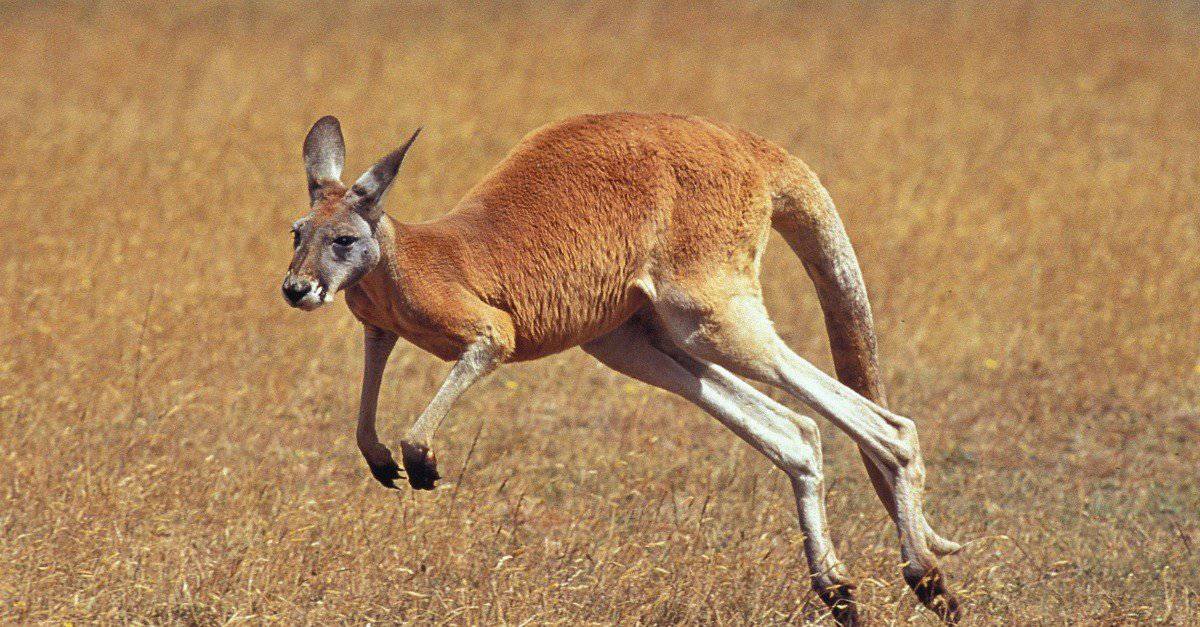
Red kangaroos prefer the arid regions of the country’s interior.
©Benny Marty/Shutterstock.com
The red kangaroo (Osphranter rufus) is the largest kangaroo species on Earth. The red kangaroo has a wide distribution across the drier areas of Australia’s interior. They prefer arid, flat, open scrublands and grasslands with a few trees for shelter and shade. Red kangaroos primarily eat grasses, but they will also eat shrubs in drier seasons. Their diet changes to mostly forbs during the wet season.
Red kangaroos have short, dense, woolly coats that range from blue-grey to red, with red on their backs and pale bellies. Females are often a smoky blue-grey but may also be red like males. Red kangaroos are distinguished from other species by their white underbellies and the white patches from the base of their ears to the corners of their mouths. Males are usually around twice as heavy as females.