
Quick Take
- Its head feathers don't look like feathers at all, and the structural reason why is stranger than you'd expect. See the unusual feathers →
- Despite being a fruit-eater, this bird has a surprising predatory streak that most people wouldn't associate with its colorful appearance. Explore the bird's diet →
- Scientists still can't fully explain why this bird evolved such outlandish headgear, though their best theory is quietly fascinating. See the leading theory →
The curl-crested aracari looks like it was made in a kid’s craft session! Take a look at this Instagram post to see for yourself. The unusual feathers on top of its head don’t look like feathers at all; you might even mistake them for plastic or enamel. So, what do we know about these extraordinary birds, and what purpose do those unique feathers serve?
What Does the Curl-crested Aracari Look Like?
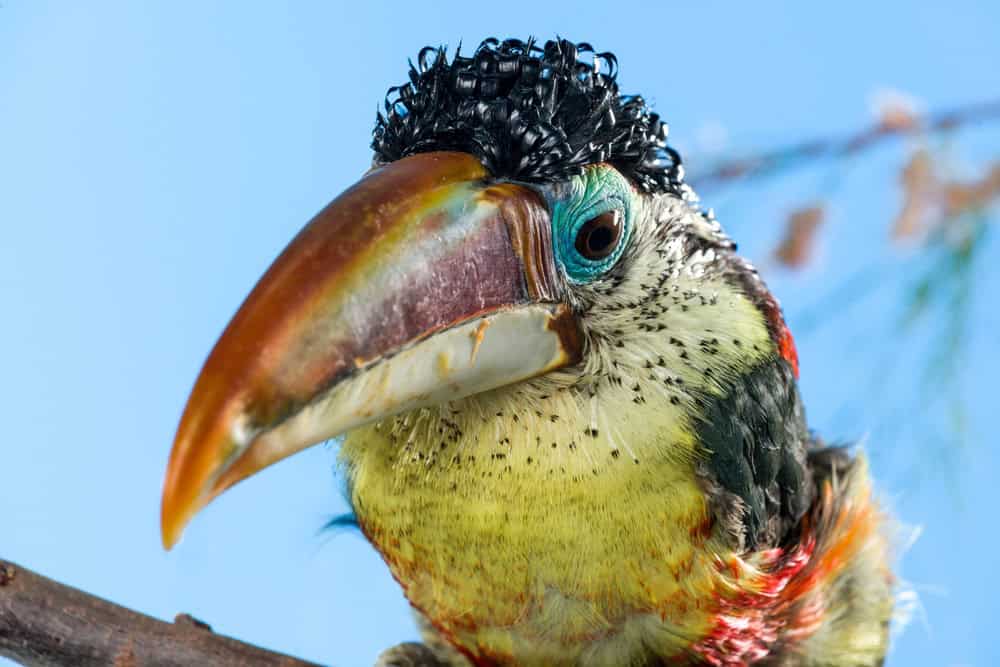
These incredible birds are members of the Ramphastidae family, so they are toucans. All members of this family are brightly marked, neotropical birds with colorful bills. The curl-crested aracari, however, has taken things to the next level. They have bare blue skin around their eyes, whitish-yellow facial feathers, a red back, and a yellow breast with red blotches and a single red band. Their bill is multicolored and has an orange tip. Their most characteristic feature, however, is their black, curled head feathers that look like pieces of plastic, enamel, or curled ribbon.
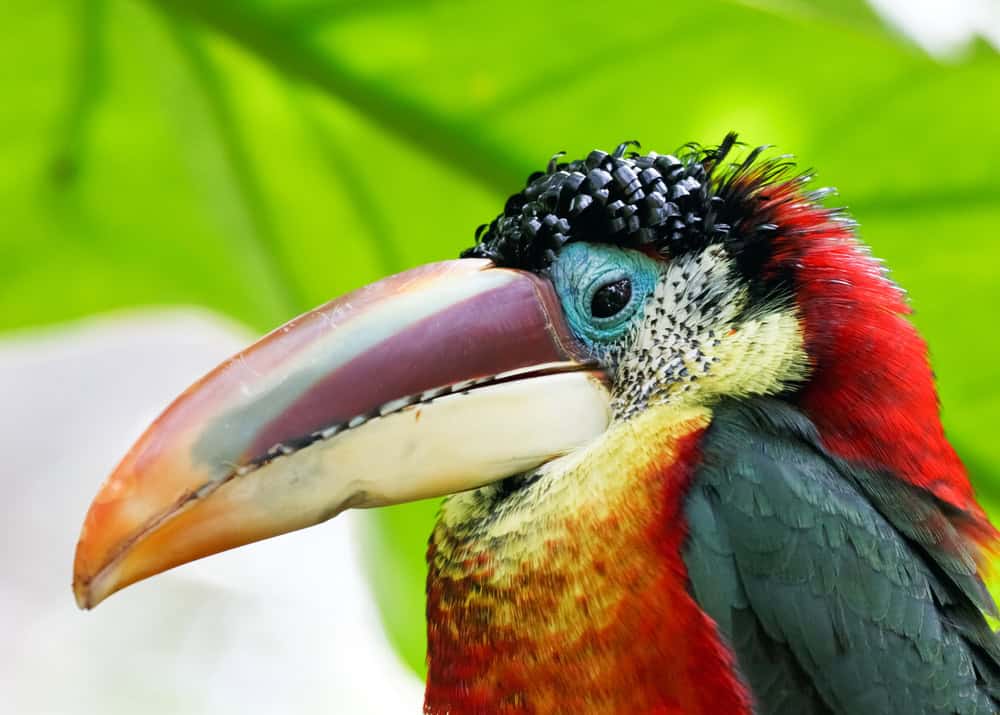
Curl-crested aracari have modified head plumage.
©topseller/Shutterstock.com
These highly specialized feathers do not have soft barbs, like regular feathers. Instead, the shaft and vanes are flattened and fused together. This creates a glossy, plastic-like appearance, with the feathers looped into shiny ringlets.
What Do We Know About These Birds?
These birds are found only in lowland terra firme forests of western Amazonia, in southern Peru (south of the Amazon), western Brazil, and northern Bolivia. Here, they live in small groups (up to 12 birds) and spend their time in the forest canopy, foraging for fruit. However, there are some records of them tearing apart the nests of other birds and feeding on the eggs. They may move around locally but do not migrate over long distances.
They communicate with each other using a series of “eeee-yak” sounds.
Currently, they are classed as Least Concern by the IUCN, and no immediate threats have been identified.
What Are the Curl-crested Aracari’s Feathers for?
Experts are not certain why the curl-crested aracari has such strange feathers. To date, they are not known to serve any specific anatomical purpose. Therefore, they are likely a form of visual ornamentation and are used for species recognition, courtship displays, or both.