Quick Take
- Canada geese can travel up to 1,500 miles during a single 24-hour period.
- Unihemispheric slow wave sleep allows birds to keep 1 eye open and aware to monitor for threats.
- Geese often sleep in the water in large flocks to avoid terrestrial predators.
- Great frigatebirds can sleep during flight, but this ability has not yet been proven in geese.
Geese are large waterfowl that belong to the family Anatidae, which also includes swans and ducks. They inhabit a variety of aquatic habitats, such as lakes, ponds, marshes, rivers, and streams. They are often seen flying overhead, day or night, in their characteristic “V” formation, honking to communicate with their flock. Some geese are year-round residents, but others are migratory, traveling thousands of miles south for the winter. But where do geese sleep? Do they sleep in the water or in nests on land? How and where do geese sleep on such long journeys? Read on to learn more about the surprising sleeping habits of geese.
Geese Facts
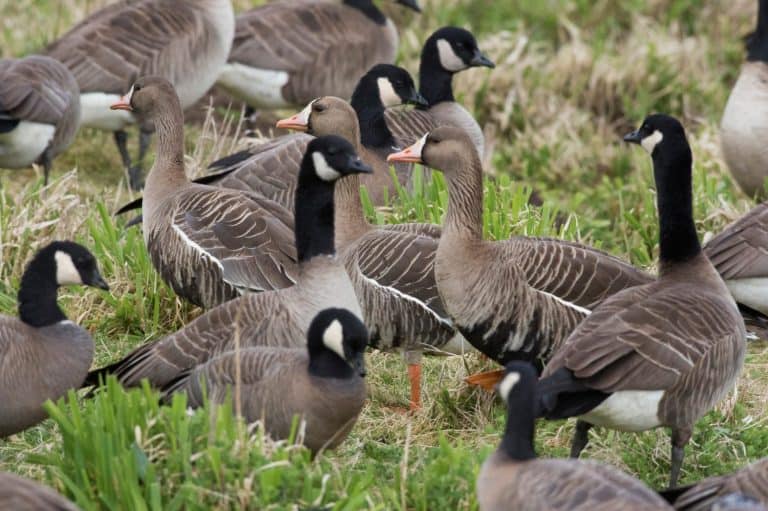
The most common and widely distributed goose in North America is the Canada goose (Branta canadensis). There are at least 11 recognized subspecies, primarily separated by breeding distribution, size, and coloration. Canada geese are found in every U.S. state except Hawaii. The most widespread subspecies is the giant Canada goose (Branta canadensis maxima), found in the Eastern U.S., the Midwest, and the South.
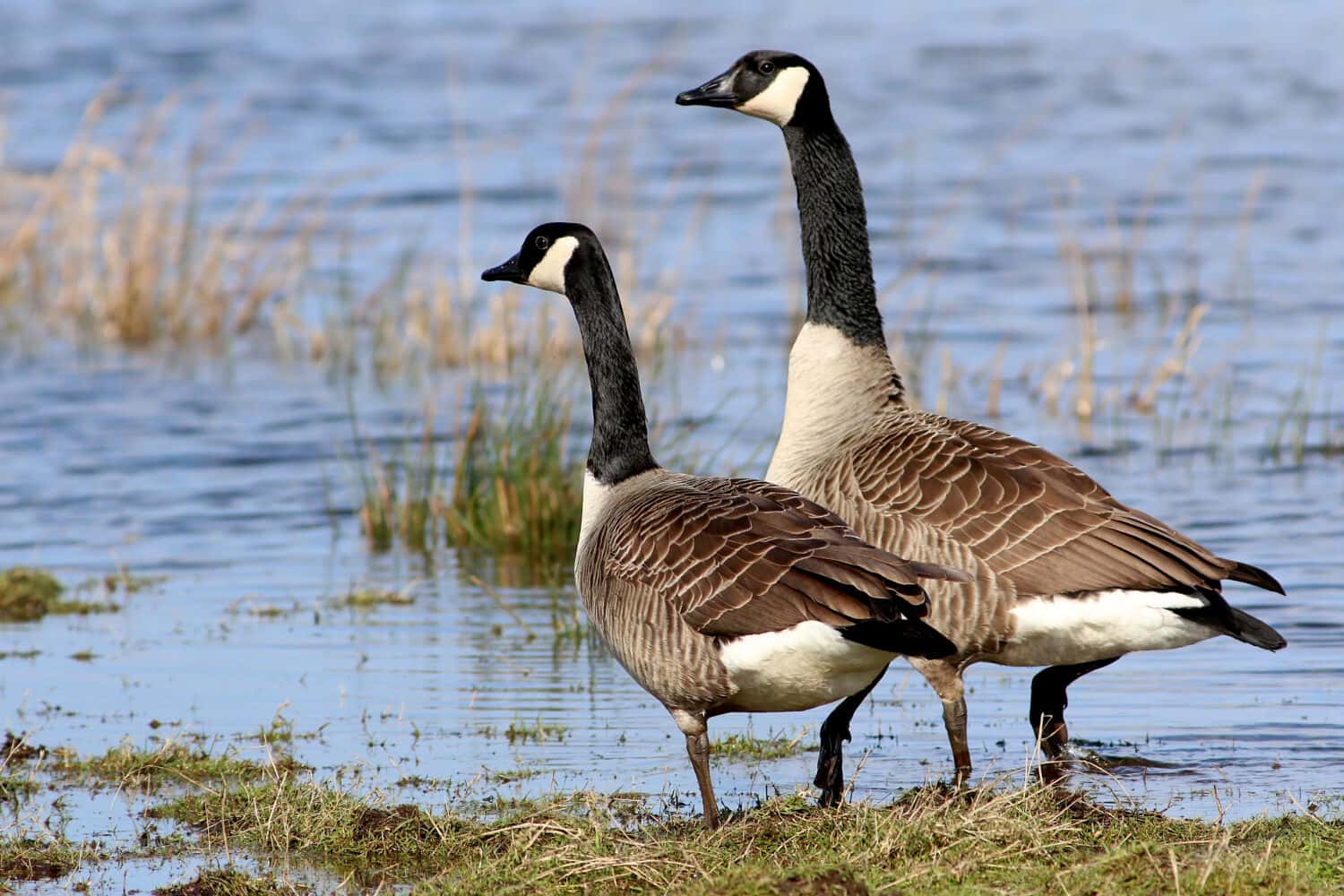
Canada geese are found in 49 of 50 states, with the exception of Hawaii.
©Ger Bosma Photos/Shutterstock.com
These large birds weigh between 6.6 and 19 pounds. They reach lengths of 2.5 to 3.6 feet with wingspans measuring between 4 and 5.5 feet. They are easily recognized by their black heads, long black necks, and white markings on their cheeks. Their bills, legs, and webbed feet are also black. They have tan to greyish-brown body feathers with paler underparts and dark tail feathers. During the spring and summer, they typically eat more aquatic plants, grasses, and sedges, while their fall and winter diet consists of more berries, seeds, and agricultural crops.
While some geese still migrate south for the winter, many populations are year-round residents. Increasing urbanization and milder winters have reduced the need for geese to migrate. They have adapted to urban and suburban environments that provide resources throughout the year. Habitats such as parks, large lawns, golf courses, agricultural fields, and man-made ponds offer food, shelter, and water that never completely freezes. There are also fewer predators in urban and suburban areas.
The Sleeping Habits of Geese
Geese are generally diurnal, so they typically sleep at night unless they are migrating. However, they may also take power naps if they are in a safe area. Canada geese often sleep in the water in large flocks. Geese and many other birds sleep with one eye open, directed toward potential threats. They are capable of unihemispheric slow wave sleep (USWS), which means one cerebral hemisphere sleeps while the other remains awake. Researchers have also discovered that Canada geese can swim while asleep, suggesting that sleep in birds is not incompatible with motion.
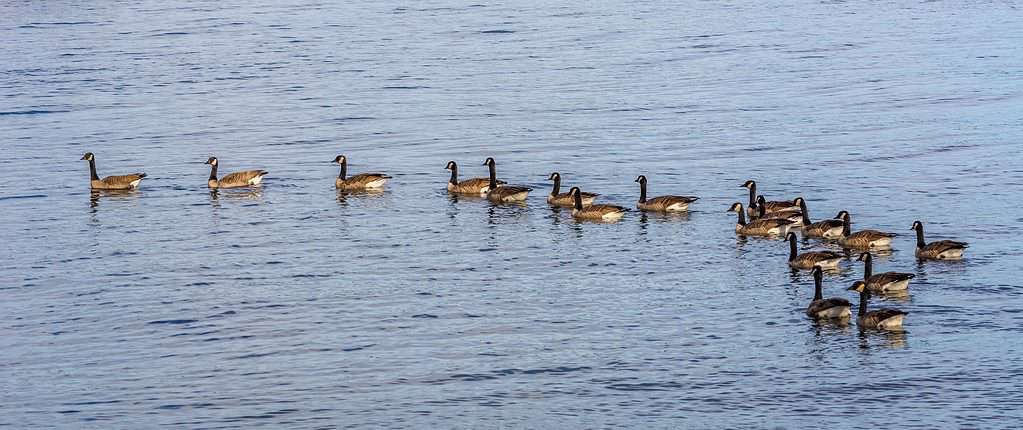
Geese often sleep in the water in large flocks.
©Marv Vandehey/Shutterstock.com
Geese also sleep on land. They sleep on islands to avoid terrestrial predators, in open fields that provide good visibility, and along shorelines so they can quickly escape to the water if a threat approaches. Geese may sleep in a sitting or standing position. Canada geese tend to sleep on one leg with their heads facing backward and tucked into their back feathers. Geese also build their nests on land in elevated areas near water, such as muskrat mounds or islands. Newly hatched goslings are precocial and able to walk, feed, and swim within 24–48 hours. They typically sleep near their parents until they are fully independent at around a year old.
Can Geese Sleep While Flying?
Scientists have shown that great frigatebirds (Fregata minor), large seabirds that spend weeks or longer flying over the ocean, can sleep during flight with one hemisphere at a time or both simultaneously. While it seems possible that migratory birds like Canada geese, which are also known to be capable of unihemispheric sleep, could sleep during flight, there is no evidence that they can.
In fact, during migration, Canada geese typically utilize specific staging areas or stopover sites to rest and feed before continuing their journey. They often fly during the night because the air is cooler. This keeps them from overheating, as they rely more on active flapping than soaring. They are not dependent on daytime thermals, and there is less turbulence at night. Depending on how far they are traveling, Canada geese may not stop at all. These birds can fly up to 1,500 miles in a 24-hour period, weather and a good tailwind permitting.