
H
Species Profile

Hawaiian Goose (Nene)

Branta sandvicensis

The lava-walking goose of Hawaiʻi
Florian Muharremi/Shutterstock.com

Hawaiian Goose (Nene) Distribution

Click a location to explore more animals from that region

Endemic Species
Loading map...

Found in 1 state/province

Hawaiian goose outdoor

At a Glance

Wild Species
Diet Omnivore
Activity Diurnal+
Lifespan 10 years
Weight 3 lbs
Status Vulnerable
Did You Know?

It's the only goose (genus Branta) endemic to a tropical oceanic island-and the only Branta that is largely non-migratory.

Scientific Classification

The Hawaiian goose (Nēnē) is a goose species endemic to the Hawaiian Islands and the state bird of Hawaiʻi. It is adapted to upland volcanic slopes and grasslands and is notable for conservation recovery efforts after severe historical declines.

Kingdom
Animalia
Phylum
Chordata
Class
Aves
Order
Anseriformes
Family
Anatidae
Genus
Branta
Species
Branta sandvicensis

Distinguishing Features

  • Endemic Hawaiian goose; often called Nēnē
  • More terrestrial habits than many geese; adapted to rough lava terrain
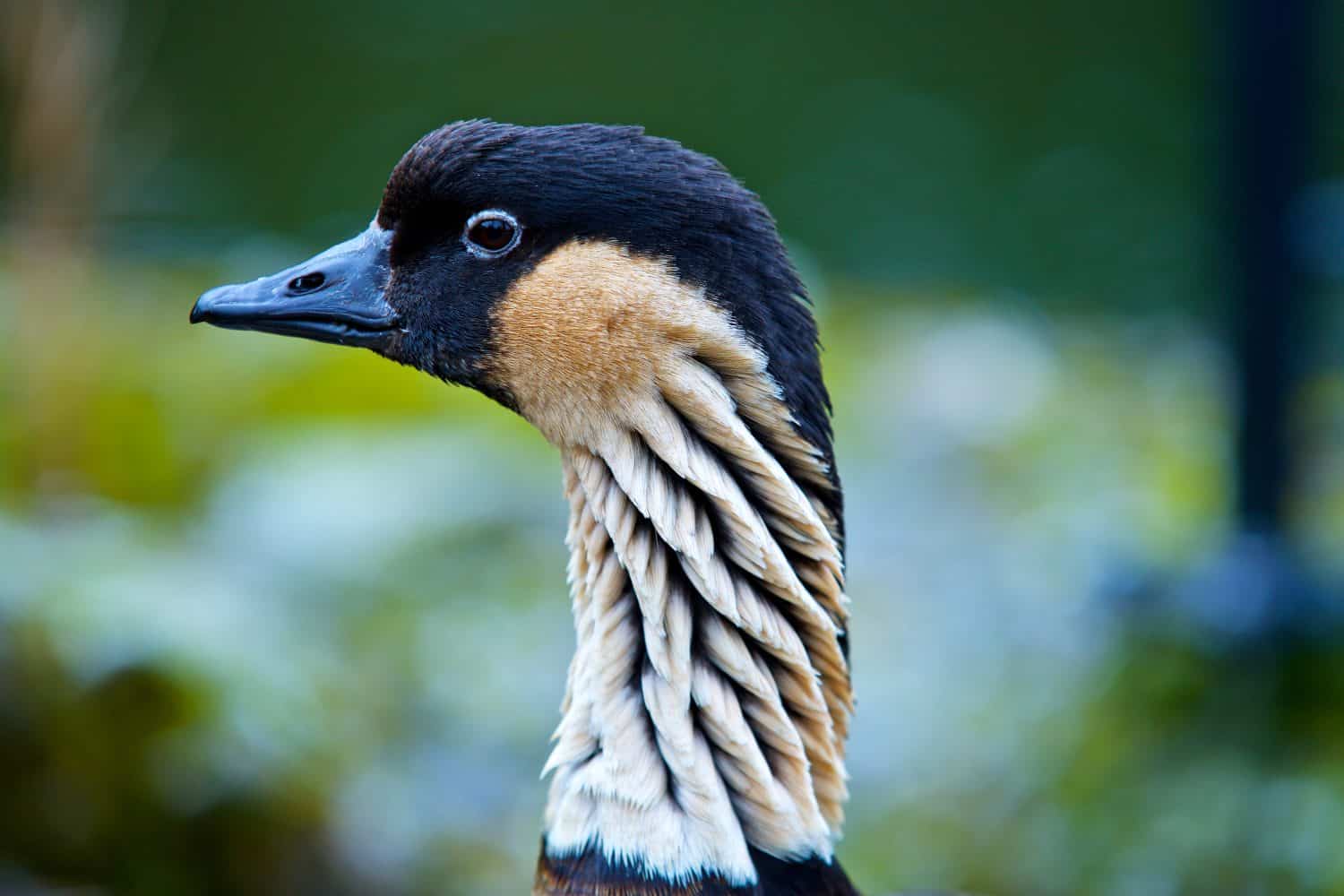
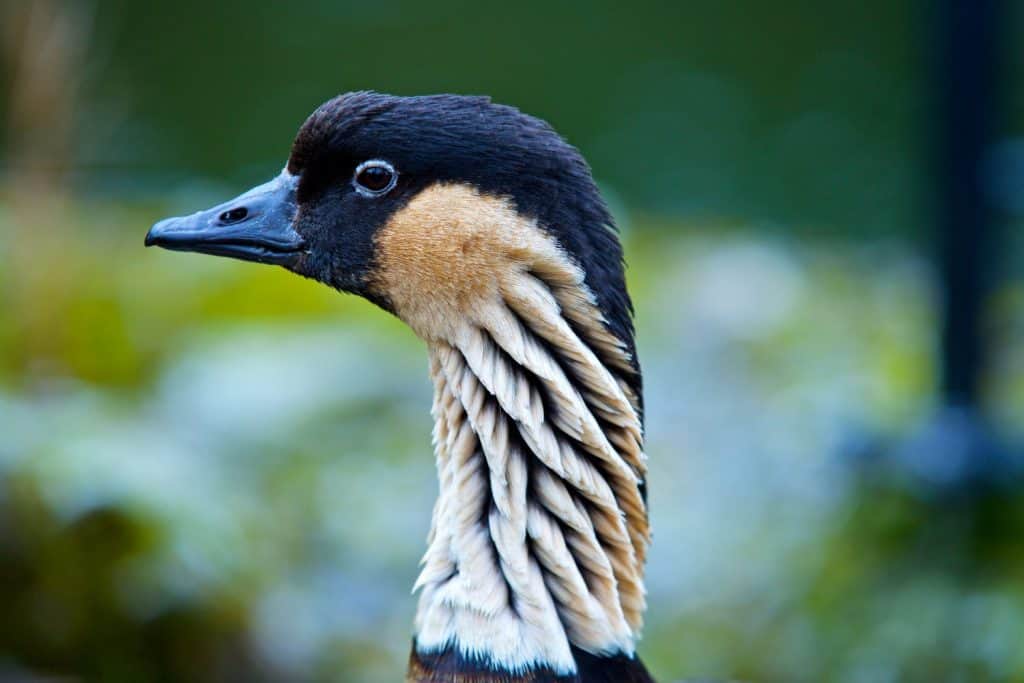
  • Black head with buff/cream cheeks and a heavily furrowed neck with pale markings
  • Relatively reduced webbing compared with many other geese (an adaptation for walking)

Physical Measurements

Length
2 ft (1 ft 10 in – 2 ft 2 in)
Weight
5 lbs (3 lbs – 7 lbs)
Top Speed
40 mph
About 65 km/h

Appearance

Primary Colors
Secondary Colors
Skin Type Feathered body with bare keratinized bill; bare, scaled skin on legs and feet (dark/blackish).
Distinctive Features
  • Endemic Hawaiian Goose (Nene; Branta sandvicensis) with a thick, deeply furrowed neck that often reads as striped-an adaptation associated with its distinctive appearance among Branta geese (distinct endemic species, not a Canada Goose).
  • Reduced foot webbing and relatively long, strong legs compared with many geese-terrestrial adaptation for walking on lava flows, upland grasslands, and shrublands on Hawaii's volcanic slopes (often feeds and moves extensively on land).
  • Size (adults): total length 56-69 cm; wingspan 105-120 cm (reported in major references such as Birds of the World/HBW and conservation species accounts).
  • Adult mass typically ~1.5-3.0 kg, with males averaging heavier than females (values commonly reported in species accounts; exact mass varies by island, season, and condition).
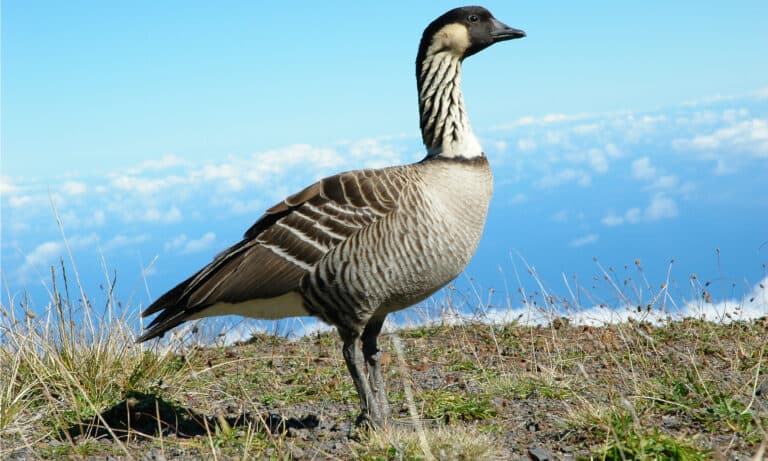
  • Bill and head black with paler buff/cream facial areas; body brown-gray with pale feather margins creating a scaly look; tail/wing tips black.
  • Behavioral notes tied to appearance/ecology: largely grazing/browsing on terrestrial vegetation; tends to be more terrestrial than many other Branta, often reluctant to swim; flight capability retained but frequently used less than in more migratory Branta.
  • Longevity: can exceed a decade; maximum reported longevity commonly cited around ~17 years in the wild and >20 years in captivity (figures reported in zoo/mark-recapture and species account summaries).
  • IUCN lists the Nene (Branta sandvicensis) as Vulnerable. Threats include introduced predators (mongooses, feral cats and dogs), habitat loss, and vehicle strikes. Recovery: captive breeding, island moves, predator control and habitat work; distribution is uneven.

Sexual Dimorphism

Sexes are very similar in plumage (monomorphic coloration); dimorphism is mainly in size/mass, with males typically larger/heavier. Field separation by plumage alone is generally unreliable.

  • Slightly larger overall body size and higher average body mass (often toward the upper end of the ~1.5-3.0 kg range in species accounts).
  • Otherwise same plumage pattern: black head/bill, buff/cream face/neck areas, furrowed neck, brown-gray body with pale edging.
  • Slightly smaller and lighter on average than males; may appear more compact-bodied in direct comparison.
  • Otherwise same plumage pattern and coloration as males; plumage-based sexing is not dependable without measurements or behavioral context (e.g., pair roles during breeding).

Did You Know?

It's the only goose (genus Branta) endemic to a tropical oceanic island-and the only Branta that is largely non-migratory.

Adults are typically 56-66 cm long with a wingspan about 105-120 cm; males average heavier than females (about 2.1-3.0 kg vs. ~1.5-2.6 kg).

Unlike most geese, the Nene has reduced foot webbing and longer toes, better for walking on lava, grasslands, and rocky ground.

Breeding is seasonal: typical clutch size is 2-5 eggs; incubation is ~29-32 days; goslings fledge at about 10-12 weeks.

Its call sounds like "ne-ne," which is also the Hawaiian name, an onomatopoeia commonly cited for the bird's naming.

After crashing to just a few dozen birds in the mid-20th century, captive breeding, predator control, and reintroductions rebuilt island populations (IUCN currently lists it as Vulnerable).

Unique Adaptations

  • Reduced webbing and longer toes: increases traction and walking efficiency on rough, jagged lava and smooth, ropy lava and uneven upland terrain, key for a goose living far from wetlands.
  • Robust legs and feet: suited to steep volcanic slopes and long overland movements between feeding and nesting areas.
  • Cryptic plumage patterning: brown body with pale-edged feathers and a contrasting black face/crown helps break up the outline in dry grass and shrub habitats.
  • Thick neck with distinctive furrowed appearance: characteristic of the species; commonly described as giving a "ruffled" or "grooved" look to the neck feathers.
  • Flexible diet for island environments: can exploit a wide range of native and introduced grasses and herbs, supporting survival in changing, human-influenced landscapes.

Interesting Behaviors

  • Strong pair bonds: Nene commonly form long-term monogamous pairs and defend nesting territories during the breeding season.
  • Terrestrial foraging: feeds largely by grazing and browsing on grasses, leaves, seeds, and fruits rather than relying on open water feeding typical of many geese.
  • Seasonal altitude shifts: on Hawaii (Big Island), birds often use higher-elevation shrublands and grasslands in the breeding season and may move to lower elevations afterward as food and water change.
  • Vigilant flocking outside breeding: can gather in loose flocks for feeding and predator detection, especially in open pasture/grassland habitat.
  • Nest-site selection on land: nests are typically on the ground in dense vegetation or sheltered spots; adults rely on camouflage and vigilance rather than water refuges.
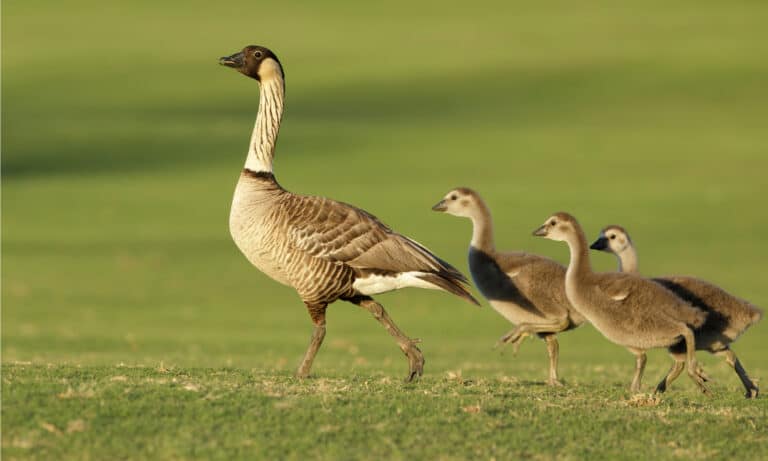
  • Family cohesion: parents lead goslings between feeding areas; goslings are precocial (mobile soon after hatching) but remain guarded until fledging.

Cultural Significance

The Nene (Hawaiian goose, Branta sandvicensis) is Hawaii's state bird and a symbol of the islands. Its name echoes its two-note call. It shows recovery after nearly being lost by protected areas, predator control (cats, mongooses, dogs), captive breeding, and reintroductions.

Myths & Legends

Name-as-voice tradition: In Hawaiian naming practice, animals are often named for sounds; the story commonly told about the goose is that "nene" comes from its soft, nasal two-syllable call.

As Hawaii's state bird, the nene (Hawaiian goose, Branta sandvicensis) appears in state and local symbols and is used in conservation education as a symbol for protecting native Hawaiian ecosystems.

A common story in Hawaii says the Nene (Branta sandvicensis) fell to a tiny group mid-20th century, then was rebuilt by captive breeding and releases, seen as an island comeback tied to care.

Conservation Status

VU Vulnerable

Facing a high risk of extinction in the wild.

Population Increasing

Protected Under

  • United States Endangered Species Act (ESA): listed as Endangered (federal protection; take prohibited; recovery planning and critical habitat/management actions implemented).
  • State of Hawaii protected wildlife status (state-level protections; hunting prohibited; species is the state bird).
  • U.S. Migratory Bird Treaty Act (MBTA): prohibits take/possession except as permitted.
  • United States Endangered Species Act of 1973 (listed as endangered in 1967; reclassified to threatened in 2013).
  • Species notes (biology used in conservation planning): adult length ~56-69 cm; wingspan ~105-120 cm; mass commonly ~1.7-3.0 kg (males) and ~1.5-2.6 kg (females). Typically monogamous; ground nester; clutch usually 3-4 (range ~2-5); incubation ~29-32 days; fledging ~10-12 weeks; diet largely grasses/herbs/berries; often more terrestrial than most geese and adapted for walking on rugged volcanic terrain.
  • United States Endangered Species Act (ESA) - listed as Threatened (downlisted from Endangered in 2020).

Life Cycle

Birth 3 goslings
Lifespan 10 years

Lifespan

In the Wild
1–20 years
In Captivity
5–24 years

Reproduction

Mating System Monogamy
Social Structure Socially Monogamous
Breeding Pattern Long Term
Fertilization Internal Fertilization
Birth Type Internal_fertilization

Hawaiian Goose (Nene; Branta sandvicensis) is mostly socially monogamous, forming long-term male–female pairs year-round. Breeding is seasonal; parents share care: female incubates, male guards, both lead goslings. Clutch size 2–5 eggs; incubation ~29–32 days; goslings fledge ~10–12 weeks.

Behavior & Ecology

Social Flock Group: 12
Activity Diurnal, Crepuscular
Diet Omnivore Tender green grass shoots (notably pili grass, Heteropogon contortus, in native dry grasslands; also other lush pasture grasses where present).

Temperament

Generally gregarious and tolerant in nonbreeding flocks, but strongly territorial and more aggressive during nesting and while tending goslings (Birds of the World: Branta sandvicensis).
Nene (Branta sandvicensis) are cautious in natural upland habitat but often get used to people in parks and golf courses, reducing how far they fly away and increasing bold feeding.
Dominance interactions include threat displays and chasing, especially around defended mates, nests, and young; aggression is typically higher in breeding adults than in nonbreeders (Birds of the World: Branta sandvicensis).

Communication

Contact calls between mates and within family groups Typical Branta-style honks/cackles), used to maintain cohesion during foraging and movement (Birds of the World: Branta sandvicensis
Alarm calls in response to threats; intensity increases with proximity to goslings and nest sites Birds of the World: Branta sandvicensis
Hisses and harsher calls during agonistic encounters Threatening/chasing) and nest defense (Birds of the World: Branta sandvicensis
Visual threat and dominance displays: upright posture, neck extension, head pumping/bobbing, open-bill threat, short rushes/chases-common behaviors in Anatidae, with heightened use during breeding and brood defense Birds of the World: Branta sandvicensis
Pair-bond and family cohesion behaviors: close following, synchronized walking/feeding, and spatial positioning of adults around goslings to shield them from conspecifics and predators Birds of the World: Branta sandvicensis
Territorial signaling through persistent site attendance and aggressive approach displays near nest/brood areas, reducing intrusion by other nene Birds of the World: Branta sandvicensis

Habitat

Biomes:
Savanna Tropical Dry Forest Alpine Wetland Freshwater Marine
Terrain:
Island Volcanic Mountainous Hilly Plateau Plains Valley Rocky Coastal +3
Elevation: Up to 8202 ft 1 in

Ecological Role

Upland grazing/browsing waterfowl that links grassland/shrubland plant production to higher trophic levels; also a minor seed/fruit consumer that can move propagules within dry-to-mesic Hawaiian ecosystems.

Grazing and browsing that can influence plant community structure and vegetation height in alpine/subalpine grasslands and shrublands Potential seed dispersal (endozoochory) for some fruiting/berry-producing native plants (e.g., Vaccinium spp.) when fruits are consumed Nutrient redistribution via feces across foraging and roosting areas Prey base support for native and introduced predators/scavengers (eggs/goslings and occasionally adults), contributing to trophic dynamics

Diet Details

Main Prey:
Insects Terrestrial snails and other small invertebrates
Other Foods:
Grasses Sedges and other herbaceous ground plants Leaves and young shoots of low shrubs Grass and herb seeds Native shrub berries Agricultural and ornamental greens

Human Interaction

Domestication Status

Wild

The Hawaiian Goose (Nene, Branta sandvicensis) is a wild bird and has not been domesticated. Human settlers changed habitat and brought predators, causing a big decline to about 30 birds by the 1950s. Captive-breeding and reintroduction (including Wildfowl and Wetlands Trust Slimbridge with Hawaii and U.S. agencies) and legal protection, predator control, habitat protection, and moves between sites aid recovery.

Danger Level

Low
  • Defensive aggression during breeding season (hissing, chasing, biting, wing strikes), typically minor injury risk
  • Vehicle collision risk where birds forage near roads in parks/reserves
  • Zoonotic/disease considerations typical of wild waterfowl (e.g., fecal contamination; surveillance concerns for avian influenza), with low direct risk to casual observers when standard hygiene is used

As a Pet

Not Suitable as Pet

Legality: Nēnē (Hawaiian Goose) is not suitable and usually illegal as a private pet. It is a protected native migratory bird; having, selling, moving, or keeping one needs federal or state permits (zoos, breeding, science, education).

Care Level: Expert Only

Purchase Cost:
Lifetime Cost:

Economic Value

Uses:
Conservation funding and employment (captive breeding, reintroduction, predator control, monitoring) Ecotourism and wildlife viewing value in Hawaii Cultural/symbolic value (state bird of Hawaii) Education and research value
Products:
  • non-consumptive wildlife viewing (park visitation)
  • conservation program services (captive propagation and release)
  • educational exhibits (permitted institutions)

Relationships

Predators 7

Small Indian Mongoose Urva auropunctata
Feral Cat Felis silvestris catus
Dog
Dog Canis lupus familiaris
Black rat
Black rat Rattus rattus
Norway Rat
Norway Rat Rattus norvegicus
Polynesian Rat Rattus exulans
Feral Pig
Feral Pig Sus scrofa

Related Species 8

Canada Goose Branta canadensis Shared Genus
Cackling Goose Branta hutchinsii Shared Genus
Brant Branta bernicla Shared Genus
Barnacle Goose Branta leucopsis Shared Genus
Red-breasted Goose Branta ruficollis Shared Genus
Greylag Goose Anser anser Shared Family
Mallard
Mallard Anas platyrhynchos Shared Family
Mute Swan Cygnus olor Shared Family

Ecological Equivalents 4

Animals that fill a similar ecological role in their ecosystem

Canada Goose Branta canadensis A similar grazer is a ground-feeding goose that eats grasses and herbs and can use human-made lands. The nene (Branta sandvicensis) is smaller and more land-adapted with reduced webbing on the feet; length 56–69 cm, wingspan 105–122 cm, weight 1.4–3.0 kg.
Greylag Goose Anser anser Ecological counterpart as a large-bodied, ground-nesting, grazing waterfowl that uses open grasslands and agricultural areas. Provides a functional analogue for diet and grazing behavior, even though it is not insular or endemic.
Hawaiian Duck Anas wyvilliana Occurs in Hawaii and faces the same threats—introduced predators, habitat change, and conservation efforts—but feeds by dabbling in wetlands rather than grazing in upland areas. Included as native waterfowl in the same recovery plans.
Hawaiian Coot Fulica alai Not closely related taxonomically (Rallidae vs. Anatidae), but overlaps in ground‑nesting vulnerability and predator suite in Hawaii. Shares conservation‑relevant ecology—nesting near or on the ground and sensitivity to introduced mammals—even though it is more wetland‑dependent.

The beautiful Hawaiian goose, or nene, was designated the state bird of Hawaii in 1957, which was before Hawaii became a state. It is considered the rarest goose in the world due to overhunting by humans and predation by the exotic animals they brought to the islands with them. The good news is the goose’s numbers are recovering slowly but surely.

Where To Find the Hawaiian Goose

As its name suggests, the Hawaiian goose is only found naturally in Hawaii. Specifically, it’s found on the big island, Oahu, Kaua’i, Maui, and Molokai. It prefers a habitat where the trees and bushes are not particularly dense, including scrublands, grasslands, and coastal dunes. It’s even found on the slopes of volcanoes whose vegetation is sparse.

Hawaiian Goose Nests

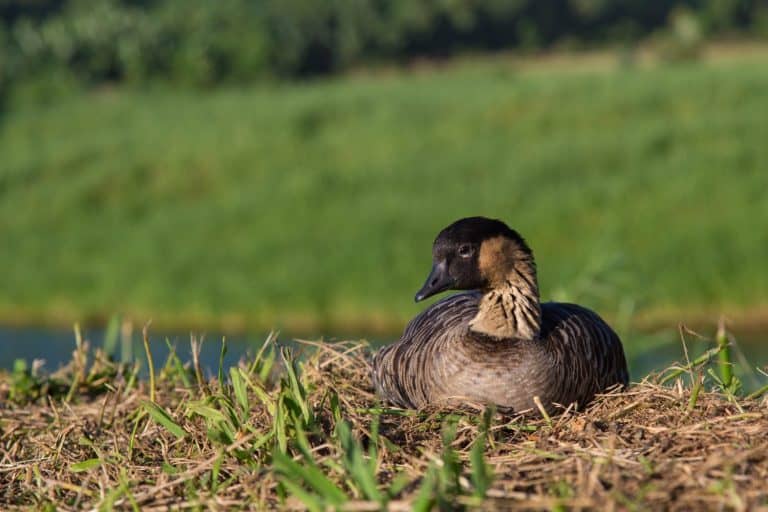
The nest of the Hawaiian goose is made when the female scrapes a bit of a depression beneath a tree or a bush, then lines it with vegetation and down. It is often near the very place where she was hatched.
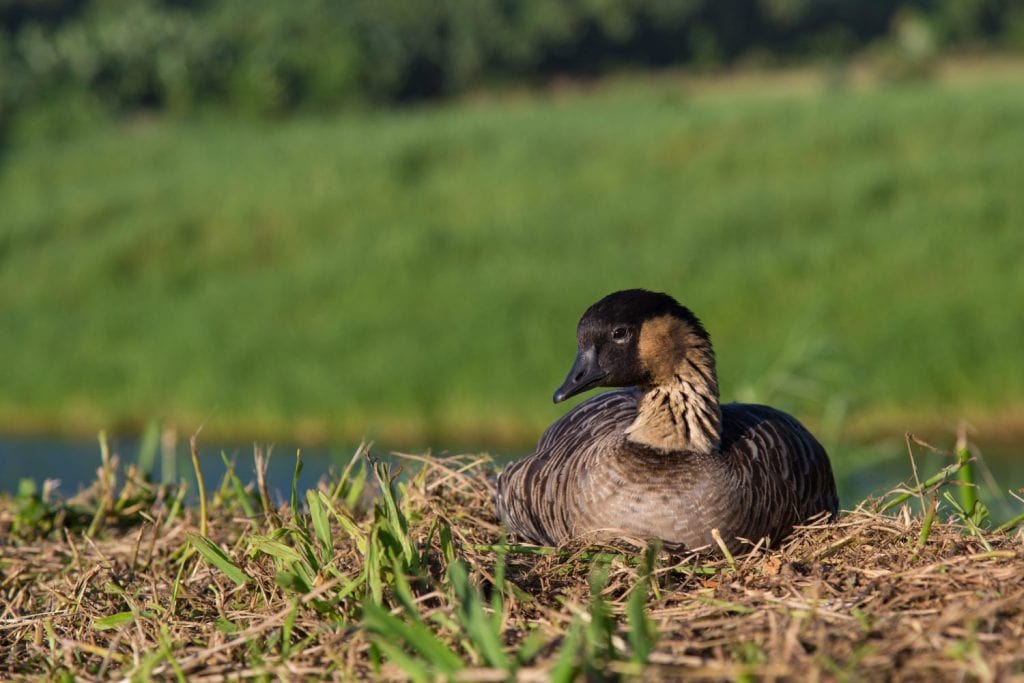
An endangered Nene goose sitting on nest, in Kauai, Hawaii. It is the protected and native State bird of Hawaii. Endemic to the Hawaiian islands.

An endangered Nene goose sitting on a nest in Kauai, Hawaii. It is the state bird of Hawaii and is endemic to the Hawaiian islands.

Hawaiian Goose Scientific Name

The scientific name of the Hawaiian goose is Branta sandvicensis. Branta is a Latinized form of Brandgás, an Old Norse word for “burnt goose.” Sandvicensis is Latin for “from Hawaii,” as the islands used to be called the Sandwich Islands. There’s only one species and no subspecies.

Hawaiian Goose Appearance

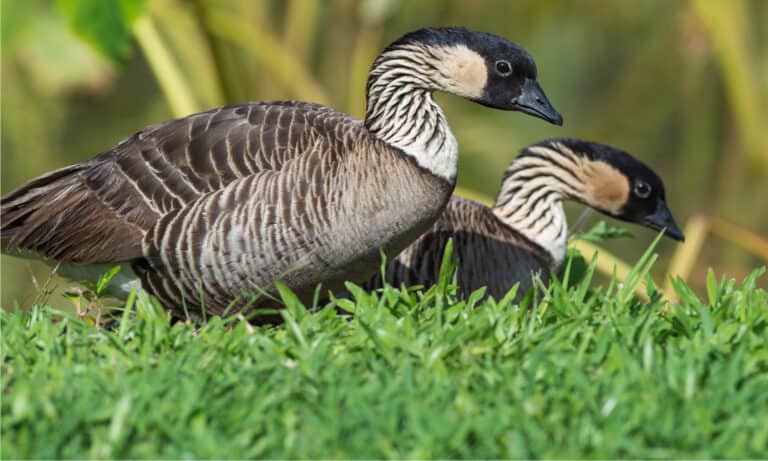
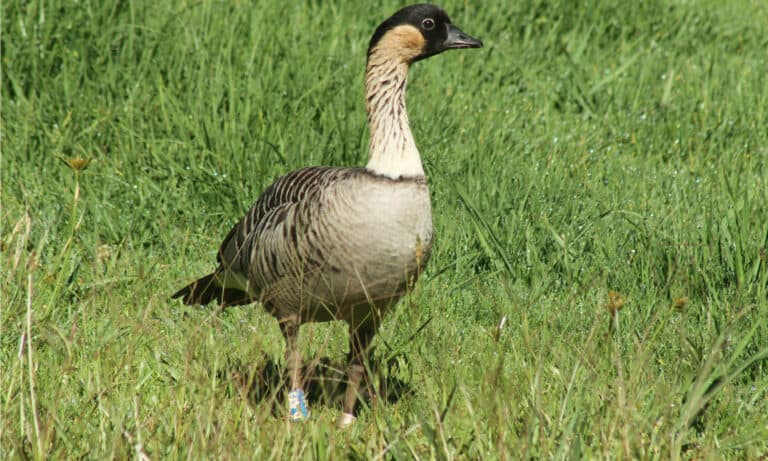
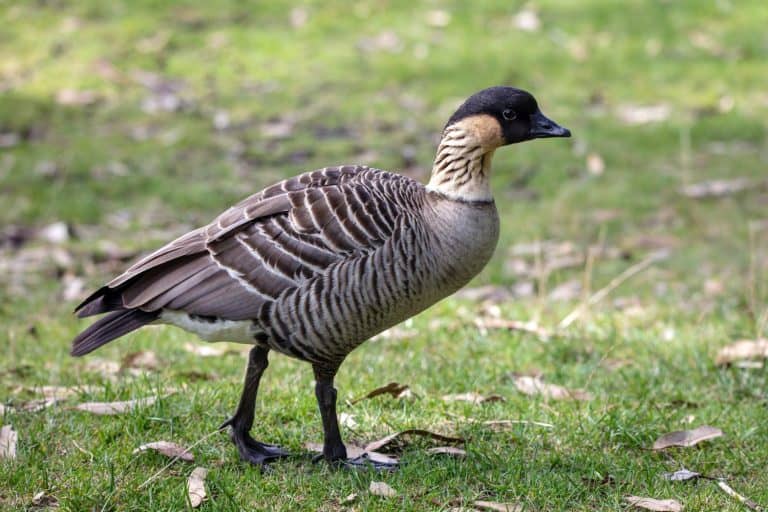
The nene is considered a medium-sized goose, with a length of 20.87 to 25.98 inches and a weight of 3.96 to 5.07 pounds. The goose’s face and the top of its head are black, as are its eyes, feet, and beak. There are cream-colored patches on its cheeks. The long neck is buff-colored and streaked with interesting black grooves that can reveal the bird’s skin. The body and wings are brown or grayish, with white-tipped wings. The tail is also black but white underneath. Males and females appear similar, but females are generally smaller than males.

Nene, the Hawaiian Goose, Standing in Natural Habitat

The male and female Hawaiian goose are similar in appearance.

Hawaiian Goose Behavior

The nene is gregarious and forms flocks, or gaggles of up to 30 birds, though the basic unit of the Hawaiian goose is their immediate family. Their legs and feet are adapted to run over volcanic ground, and the goose seems to prefer running to flying, even though it can fly. It can also swim if it must. The goose has a great repertoire of calls and vocalizations, including cackles, trumpeting, shrieks, murmurs, and the telltale “nēnē.” The Hawaiian goose utilizes a complex threat display that involves stretching out its neck, bristling its feathers, and hissing. A gaggle of geese can also come together and try to ward off a threat.

The goose is active during the day, but at night it doesn’t roost in the trees, but sleeps on the ground with its feet tucked under it.
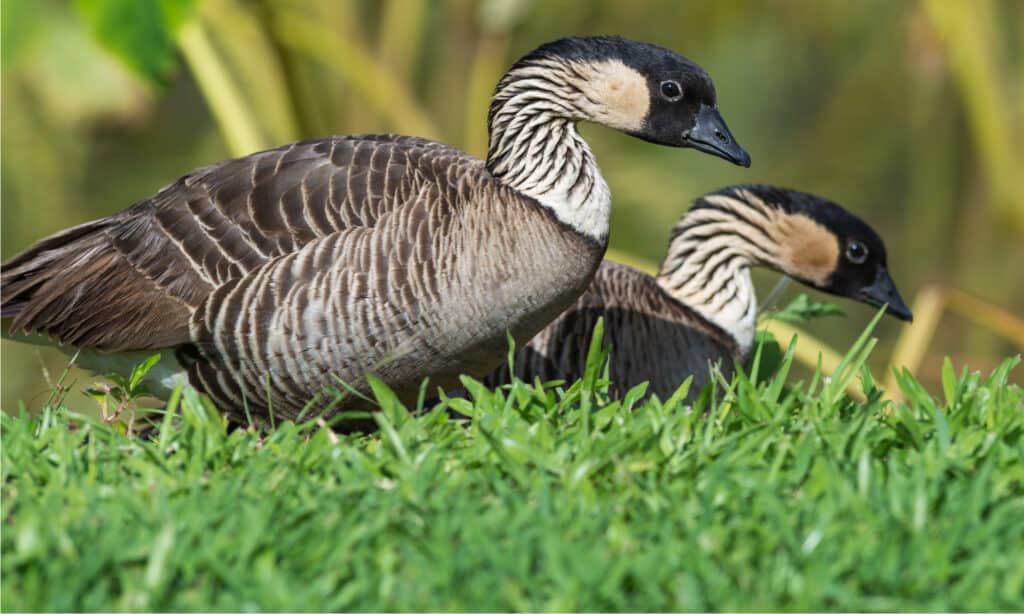
Hawaiian goose

The nene is a very endangered species on the Hawaiian Islands.

Hawaiian Goose Diet

The nene has an herbivorous diet and only eats terrestrial plant material. This includes blades of grass, berries, seeds, flowers, and leaves. They are partial to the bottom of the grass blade, which is more nutritious, and use their beaks to pull the grass up. They are partial to grasses such as carex, broomsedge, rat’s tail grass, and violet crabgrass.

Hawaiian Goose Predators and Threats

The Hawaiian goose is preyed upon by a variety of predators. Its reluctance to fly away probably makes it more vulnerable than it might be. Initially, it was hunted and eaten by humans. When this practice threatened the population, it was made the state bird of Hawaii. Still, humans brought with them, purposefully or accidentally, predators who cared not about the goose’s status. These included pet dogs and cats, rats, birds of prey, and pigs. The Indian mongoose is especially responsible for preying on Hawaiian goose eggs.

Other threats to Hawaiian geese are exposure to the elements, parasites, disease, and trauma.

Hawaiian Goose Reproduction, Babies, and Lifespan

The nene has an energetic courtship ritual. The male struts in front of the female while displaying the white beneath his tail. If she accepts him, they both make trumpeting calls, and the male chases off other rivals. The pair then vocalizes loudly to each other before mating. Unlike other waterbirds, Hawaiian geese mate on land. They are monogamous and mate for life.

The goose is also different from other geese in that its breeding season stretches from August into April, though most pairs mate in October and March. The female lays one to five eggs, and the male guards her, though she doesn’t stay on the nest all the time. Now and then, she gets up to give herself a break and find food. The eggs hatch 29 to 31 days after they’re laid, and the female broods the chicks until their down is dry. After this, chicks are able to find food on their own, but they follow their parents until the next breeding season. The nene is ready to reproduce when it’s two to three years old. Hawaiian geese are long-lived birds and can have a lifespan of 28 to 42 years.
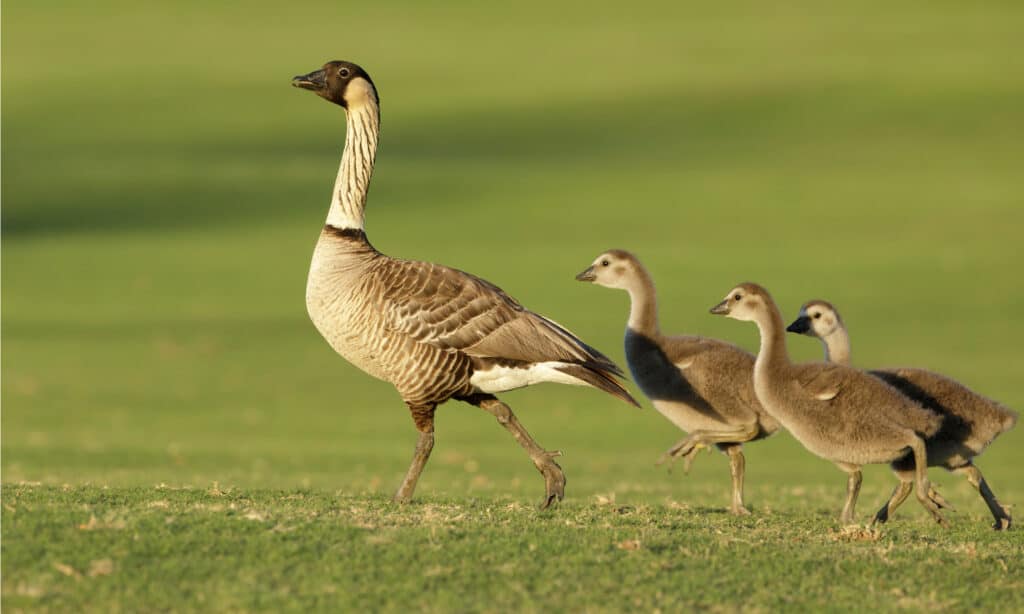
Hawaiian goose

Chicks will follow the parents until the next breeding season.

Hawaiian Goose Population

Despite the fact that it’s the state symbol and state bird of Hawaii, the Hawaiian goose is the rarest goose in the world. There are only about 2,200 of them, and 1,000 of these are in captivity. Its conservation status is listed as near threatened by the IUCN Redlist.

View all 288 animals that start with H

Sources

  1. ITIS / Accessed March 27, 2022
  2. Wikipedia / Accessed March 27, 2022
  3. The Spruce / Accessed March 27, 2022
  4. Green Global Travel / Accessed March 27, 2022
  5. Kidadl / Accessed March 27, 2022
Austin S.

About the Author

Austin S.

Growing up in rural New England on a small scale farm gave me a lifelong passion for animals. I love learning about new wild animal species, habitats, animal evolutions, dogs, cats, and more. I've always been surrounded by pets and believe the best dog and best cat products are important to keeping our animals happy and healthy. It's my mission to help you learn more about wild animals, and how to care for your pets better with carefully reviewed products.
Connect:

Thank you for reading! Have some feedback for us?


Hawaiian Goose (Nene) FAQs (Frequently Asked Questions)

The Hawaiian goose doesn’t migrate and doesn’t seem to like to fly unless it has to. It may become nomadic if the food in its home range is scarce.