
Quick Take
- One Georgia hawk has a face so owl-like that even experienced birdwatchers do a double-take when they spot it. Meet the owl-faced hawk →
- The smallest hawk in the U.S. has figured out a clever trick to find prey in your own backyard, and the trick involves your bird feeder. See the bird feeder predator →
- One of Georgia's most common hawks is rarely seen, and its preferred habitat explains why. Discover its hidden habitat →
- The red-tailed hawk's famous screech isn't actually its own. Hollywood stole it for a completely different bird. Uncover Hollywood's stolen screech →
Georgia is home to a variety of diverse wildlife, whether you’re looking at the native flora and fauna or visiting some of the zoos and aquariums. Over 400 bird species have been recorded in Georgia, including hawks. While some hawks may pass by the state on their migration route further south, these are the six hawks you can find for most or all of the year. Read on to learn about the six types of hawks in Georgia.
1. Broad-Winged Hawk
| Characteristics | Measurements |
|---|---|
| Weight | 9.3-19.8 ounces |
| Length | 13.4-17.3 inches |
| Wingspan | 31.9-39.4 inches |
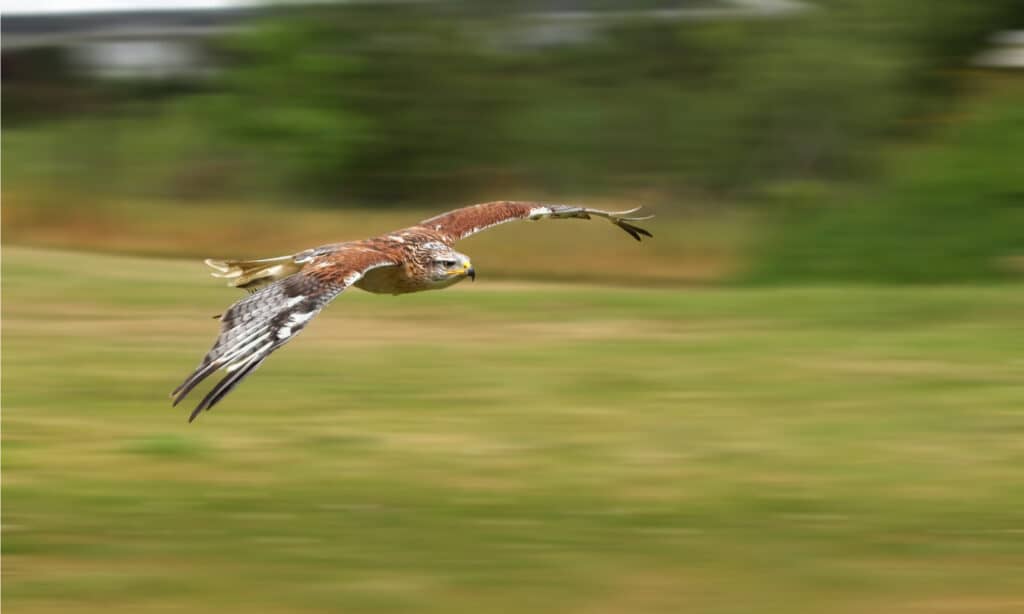
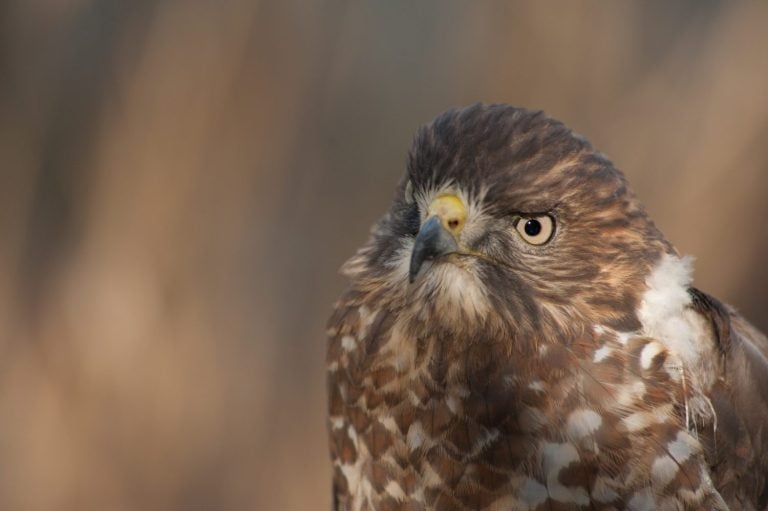
Although they can be hard to spot due to their preferred habitats, broad-winged hawks are quite common in Georgia.
©pr2is/Shutterstock.com
Although the broad-winged hawk (Buteo platypterus) is one of the more common types of hawks in Georgia, you might not realize it because they favor deep forests and rural environments. So if you live in the city, it can be difficult to spot them during your day-to-day routine. However, if you happen to see one, these birds can be easily recognized. Broad-winged hawks are highly migratory. They can be found throughout the state during most of the year, but they favor Central and South America during the cooler months.
The broad-winged hawk is a short and stout hawk. These birds have a fairly rectangular shape, with even their short tails ending in a blunt shape rather than tapering off the way many of the other types of hawks’ do. These birds have reddish-brown heads, white and brown barred underparts, and wide black and white bands on the tail. The edges of their light-colored wing undersides are dark brown.
2. Cooper’s Hawk
| Characteristics | Measurements |
|---|---|
| Weight | 7.8-14.5 ounces (male); 11.6-24.0 ounces (female) |
| Length | 14.6-15.3 inches (male); 16.5-17.7 inches (female) |
| Wingspan | 29 to 37 inches |
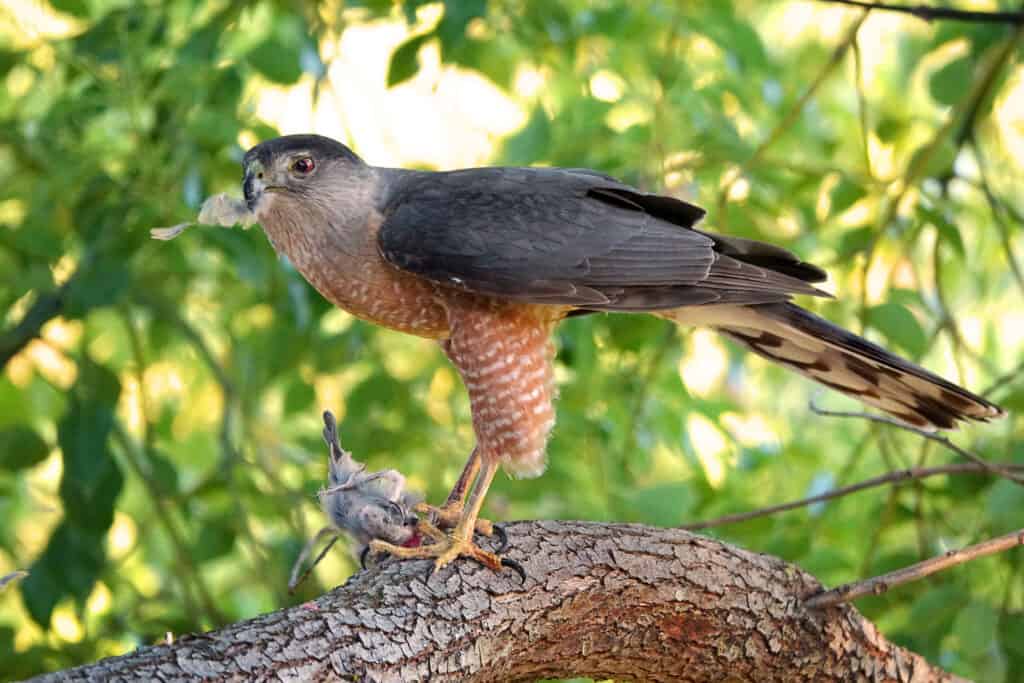
The Cooper’s hawk primarily preys on smaller birds.
©iStock.com/Linda Koski
Cooper’s hawk (Astur cooperii) is one of many types of hawks in Georgia. They’re of an average build, although they do have rather large heads. These hawks are expert flyers, and they spend their time flying at high speeds through their forest homes. Cooper’s hawks are bluish-grey with reddish bars on their light-colored undersides and thick, dark bands on their rounded tails. They have slim bodies, short, wide wings, and long tails.
For the most part, hawks hunt like any other predator. They catch their prey and then use their talons or beak to deliver a fatal blow. This isn’t true for Cooper’s hawks, however. They prefer to use their razor-sharp talons when hunting prey. Cooper’s hawks are also distinctive in that they primarily hunt other birds. These hawks can be found across the state in forests, woodlands, and even in urban and suburban neighborhoods.
3. Northern Harrier
| Characteristics | Measurements |
|---|---|
| Weight | 10.6-26.5 ounces |
| Length | 18.1-19.7 inches |
| Wingspan | 40.2-46.5 inches |
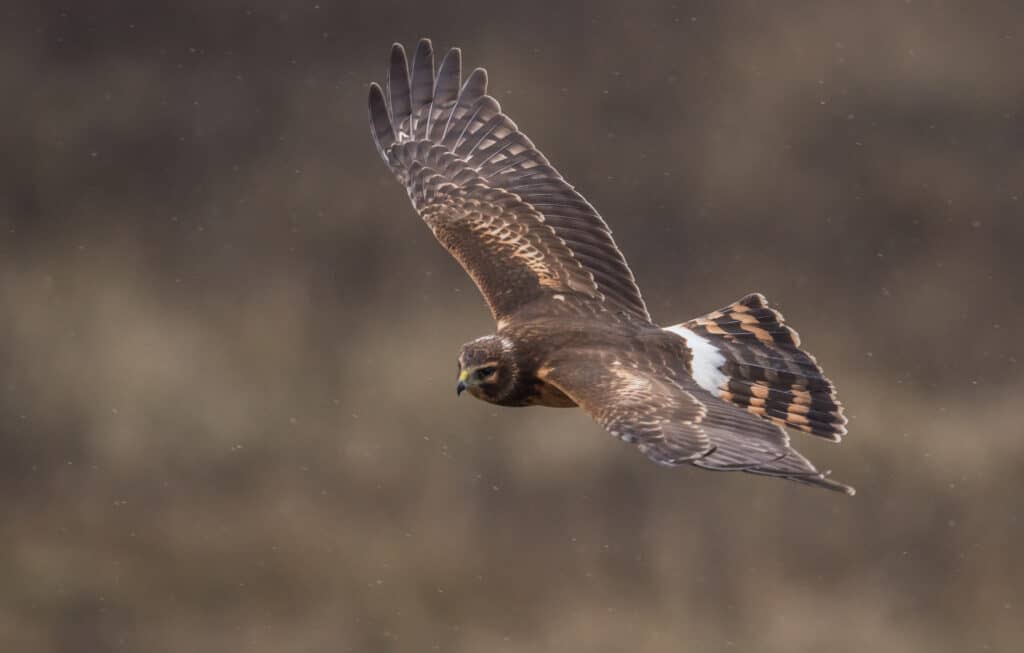
The northern harrier flies low and slow with its wings in a shallow “V” shape.
©Harry Collins Photography/Shutterstock.com
When it comes to identifying, the northern harrier (Circus hudsonius), you may find yourself doing a double-take. This is because the northern harrier has a flat face similar to an owl. Male birds are grey with light-colored underparts. They have dark wingtips, wing edges, and dark banding on the tail. Females are brown with light undersides streaked with brown. They also have black banding on the tail. Both sexes have a white rump patch.
The northern harrier is a winter resident, frequently seen wintering along the Georgia coast, specifically around the Savannah National Wildlife Refuge. These birds prefer flying closer to the ground. They like to fly low over clearings, such as meadows and grasslands. When they perch, they choose lower vantage points rather than the highest available. When they’re in flight, rather than holding their wings straight out at their sides, they fly with their wings in a slight “V” shape.
4. Red-Shouldered Hawk
| Characteristics | Measurements |
|---|---|
| Weight | 17.1-27.3 ounces |
| Length | 16.9-24.0 inches |
| Wingspan | 37.0-43.7 inches |
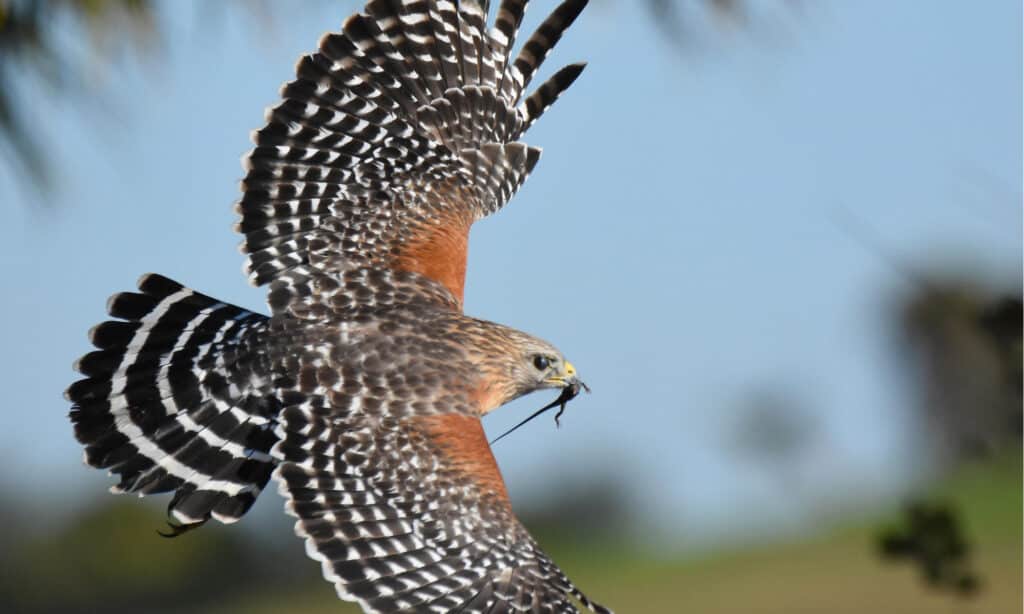
Adult red-shouldered hawks have a very rich, red coloration on their “shoulders” and chest.
©MTKhaled mahmud/Shutterstock.com
Despite being one of the most common hawks in the United States, the red-shouldered hawk (Buteo lineatus) actually has a fairly limited range. Unlike other types of hawks, which can thrive almost everywhere, the red-shouldered hawk prefers tall forests over water. This means that they do best in the swampy areas of the southeast, which is why they’re one of the most common types of hawks across the state, with the exception of mountainous regions.
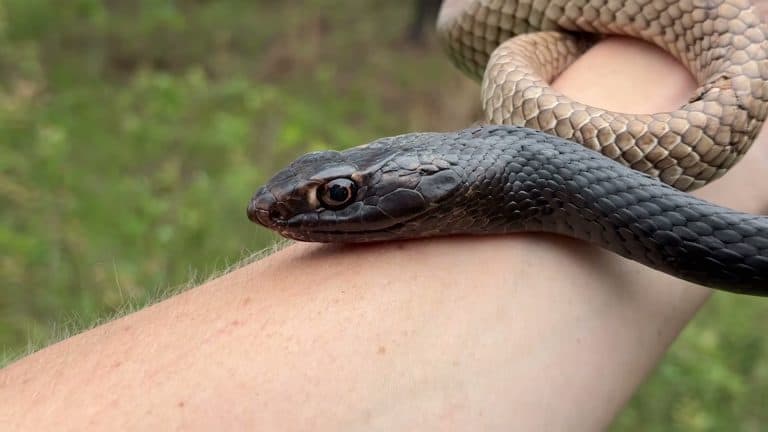
Red-shouldered hawks have dark-and-light checkered wings with black-and-white banded tails. As their name indicates, these hawks have reddish-colored shoulders and chests. All birds have light-colored crescents close to the wingtips while in flight. Because of their habitat, the red-shouldered hawk’s diverse diet is made up of the many animals found in semi-aquatic habitats. This includes crawfish, snakes, frogs, toads, and similar prey.
5. Red-Tailed Hawk
| Characteristics | Measurements |
|---|---|
| Weight | 24.3-45.9 ounces (male); 31.8-51.5 ounces (female) |
| Length | 17.7-22.1 inches (male); 19.7-25.6 inches (female) |
| Wingspan | 44.9-52.4 inches (male); 44.9-52.4 inches (female) |
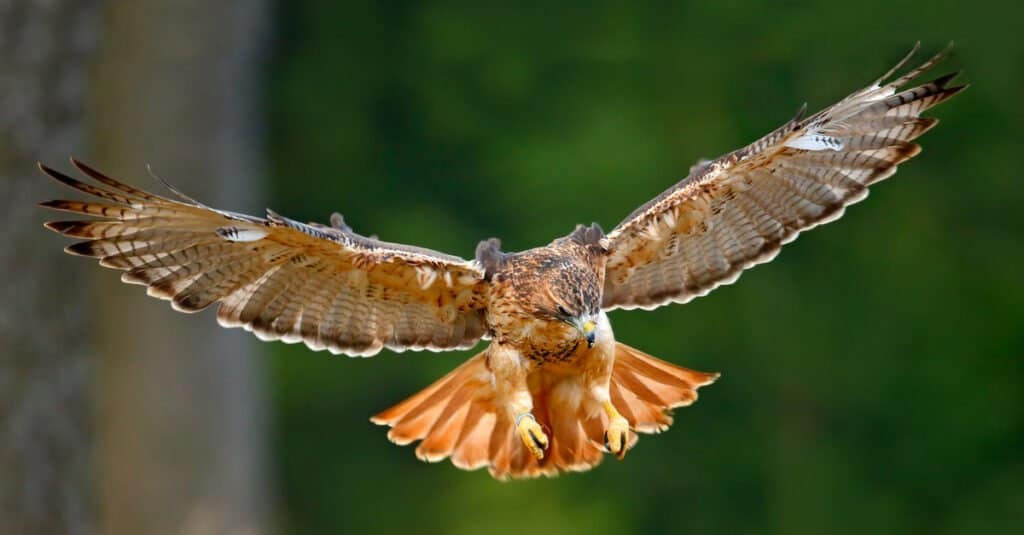
In Georgia, the red-tailed hawk is shades of brown with a cinnamon-colored tail.
©Ondrej Prosicky/Shutterstock.com
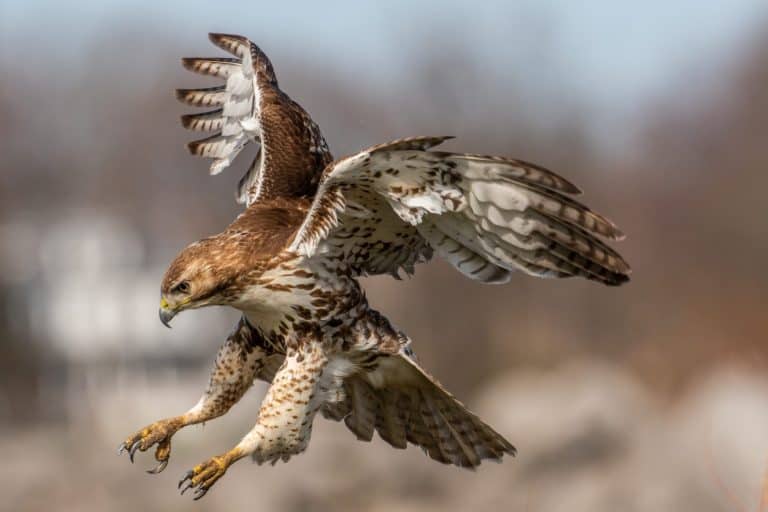
The red-tailed hawk (Buteo jamaicensis) is one of the most well-known types of hawks in Georgia. They are found in every part of the state and in nearly every different type of habitat. In fact, you can find the red-tailed hawk in almost every state in the continental United States. You can also find them in Central America and further north into Canada. East of the Mississippi, these hawks are generally brown with light-colored chests, dark streaks on their bellies, and cinnamon-red tails that are pale underneath.
Not only are they a common sight in nature, but they’re also a common figure in media. Whether it’s in movies and shows (where they act as a voice actor for that iconic bald eagle screech) or in books, red-tailed hawks seem to pop up everywhere in pop culture. Red-tailed hawks are also one of the most popular species used in falconry. Falconry is a hunting sport in which birds of prey, including many of Georgia’s hawk species, are trained to hunt small prey like mice and rabbits.
6. Sharp-Shinned Hawk
| Characteristics | Measurements |
|---|---|
| Weight | 3.1-7.7 ounces |
| Length | 9.4-13.4 inches |
| Wingspan | 16.9-22.1 inches |
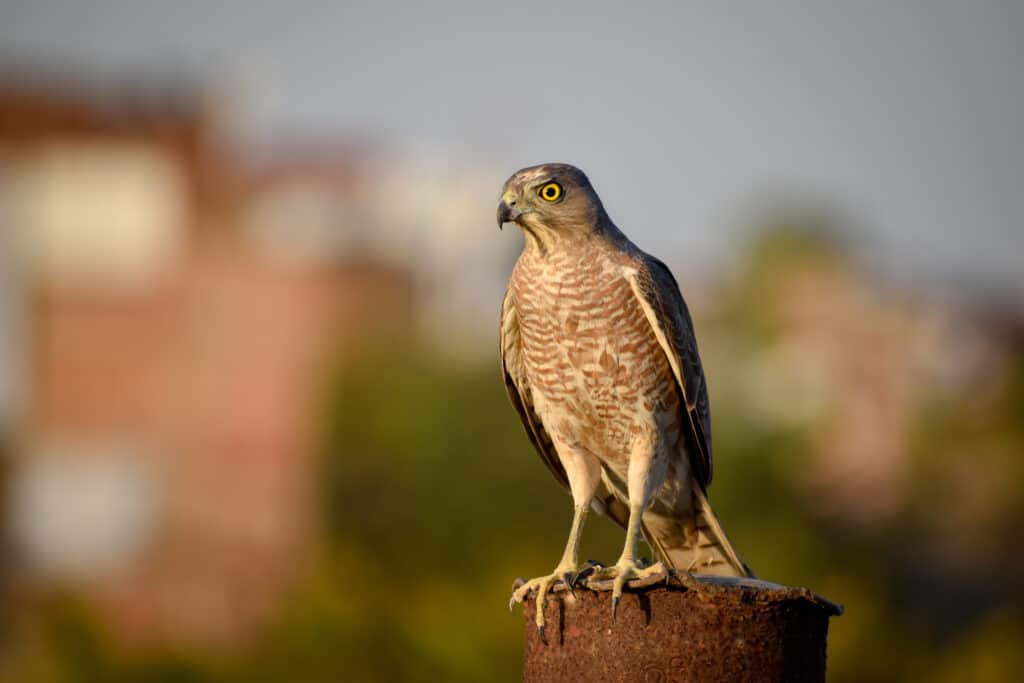
Sharp-shinned hawks are good at navigating and flying through dense vegetation.
©Vizz Effect/Shutterstock.com
Usually, it is hard to miss a hawk. They’re large, with some having wingspans several feet wide. However, the same cannot be said for the sharp-shinned hawk (Accipiter striatus), the smallest hawk in the United States and Canada. These hawks are bluish-grey with reddish-orange bars across their light-colored breasts. They also have wide, dark bands across their long tails. During the breeding season, they are found in the mountainous regions, but during winter and migration, they have been recorded in the Piedmont, central, and coastal areas.
Despite being some of the smaller birds you’ll find in the wild and the smallest type of hawk in Georgia, the sharp-shinned hawk is still an effective predator. You’ll notice that they tend to frequent suburban and urban areas, especially around bird feeders. However, they’re not interested in the birdseed you’re putting out. Instead, they like to take this opportunity to hunt the small songbirds that will come to eat at the feeders. They will also make a quick meal out of mice and other small mammals that will visit as well.