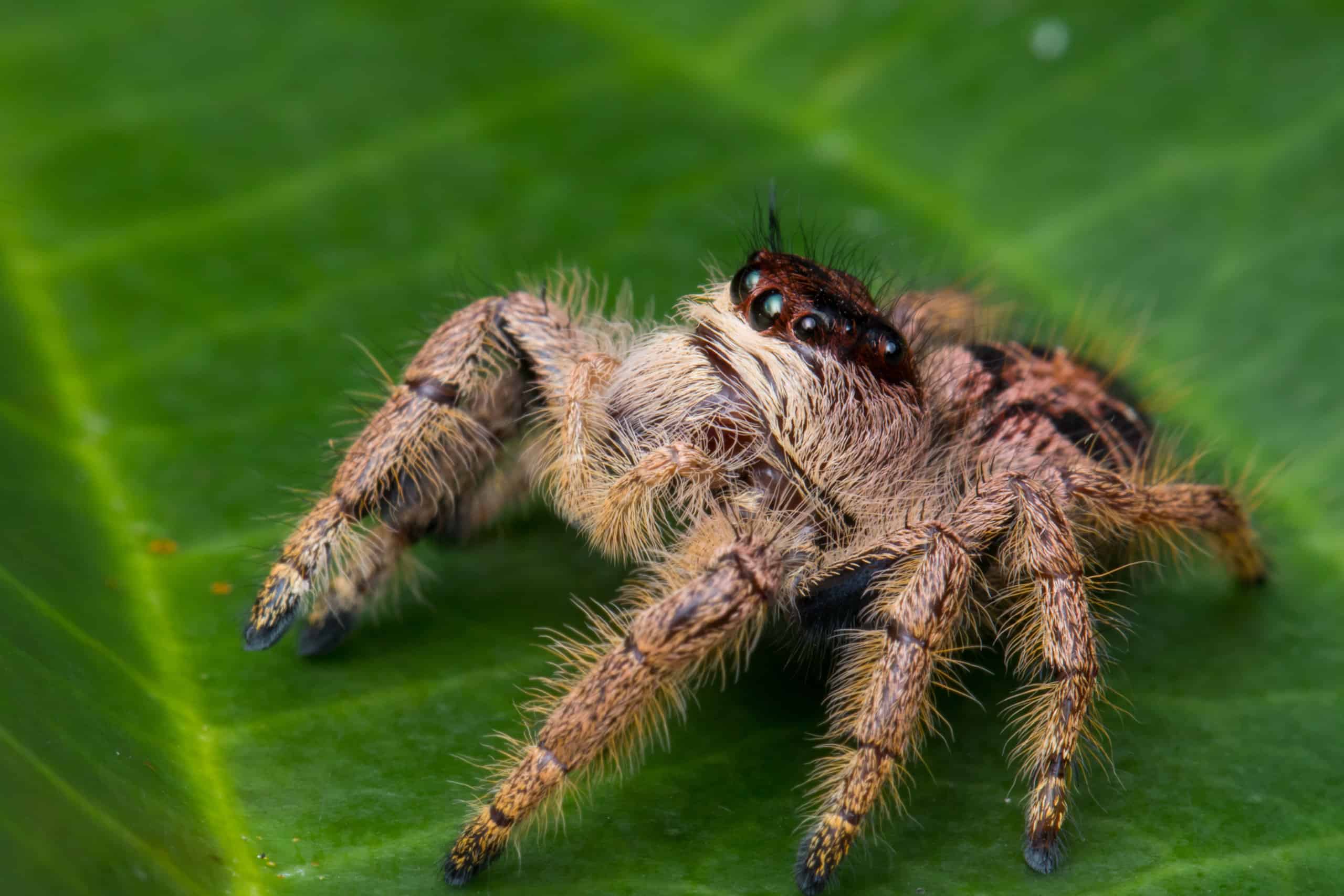

Jumping spiders are a group of small arachnids that belong to the family Salticidae. There are over 6,000 species of jumping spiders, making it one of the largest spider families. These spiders have compact bodies, large eyes, and powerful jumping abilities. Most jumping spiders are very small, measuring less than a centimeter in length. However, some jumping spiders can grow much larger, relatively speaking. Keep reading to meet the largest jumping spider in the world and learn all about this tiny powerhouse.
The Discovery of the Largest Giant Jumping Spider
The largest jumping spider species discovered so far is Hyllus giganteus, commonly called “the giant jumping spider.” These titans of the jumping spider world can reach lengths of 0.71-0.98 inches. To put that into perspective, smaller jumping spider species only range from 0.19 to 0.30 inches. Even the second-largest jumping spider, Hyllus diardi, is only 0.59 inches.
German spider specialist Carl Ludwig Koch discovered the first giant jumping spider in 1846. These spiders are native to the forests of Southeast Asia and Australia, where they dwell in trees. Giant jumping spiders do not spin webs like many other spiders. Giant jumping spiders do not spin webs like many other spiders. Instead, they actively hunt in their forest homes, searching for prey with their camera-like eyes before pouncing on it. Researchers have found that jumping spiders can leap at least 6.3 inches, which is nearly 6.5 times the giant jumping spider’s size. For comparison, that would be like a 5-foot woman jumping 32.5 feet.
Giant Jumping Spiders Have Distinctive Colors and Markings
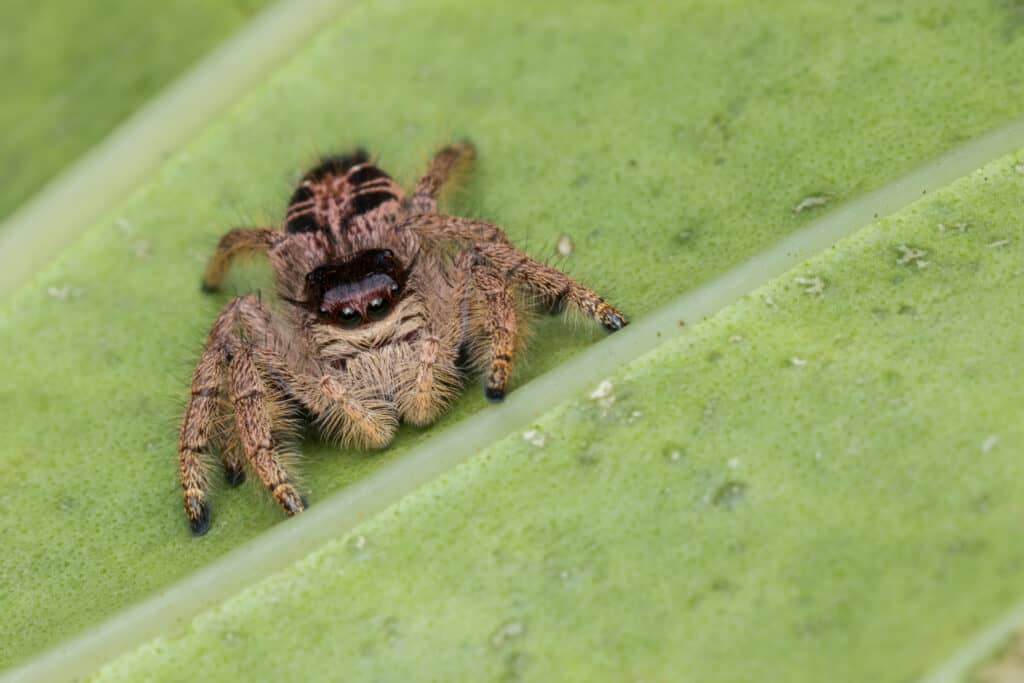
Female giant jumping spiders have dark bands across their heads.
©iStock.com/Thien Woei Jiing
In addition to their size, giant jumping spiders can be distinguished from other species in their family by their distinctive markings. You can also differentiate between male and female spiders. Female giant jumping spiders have pale stripes at the tops of their faces and dark bands across their heads. They have mottled beige and brown abdomens. Male giant jumping spiders are generally much darker, with longer appendages, longer mouthparts, and less hair than the females.
The Largest Jumping Spider as a Pet
Jumping spiders are often kept as pets, and large spiders like the giant jumping spider are in demand precisely because of their size. However, there are some considerations to take into account. As this spider is native to tropical regions, they have specific requirements that can make care more difficult. For example, they need higher temperatures and humidity, which will require additional supplies such as a heating mat and a thermometer.
These spiders are also arboreal, so spider experts recommend an enclosure that is taller than it is wide. They require the proper substrate, and broad-leafed plants are also suggested to mimic the natural habitat of these tree-loving spiders. Jumping spiders are active hunters, so they prefer live food. For advice on the proper setup and care of giant jumping spiders, consult your local exotic veterinarian or pet store.
Are Giant Jumping Spiders Dangerous?
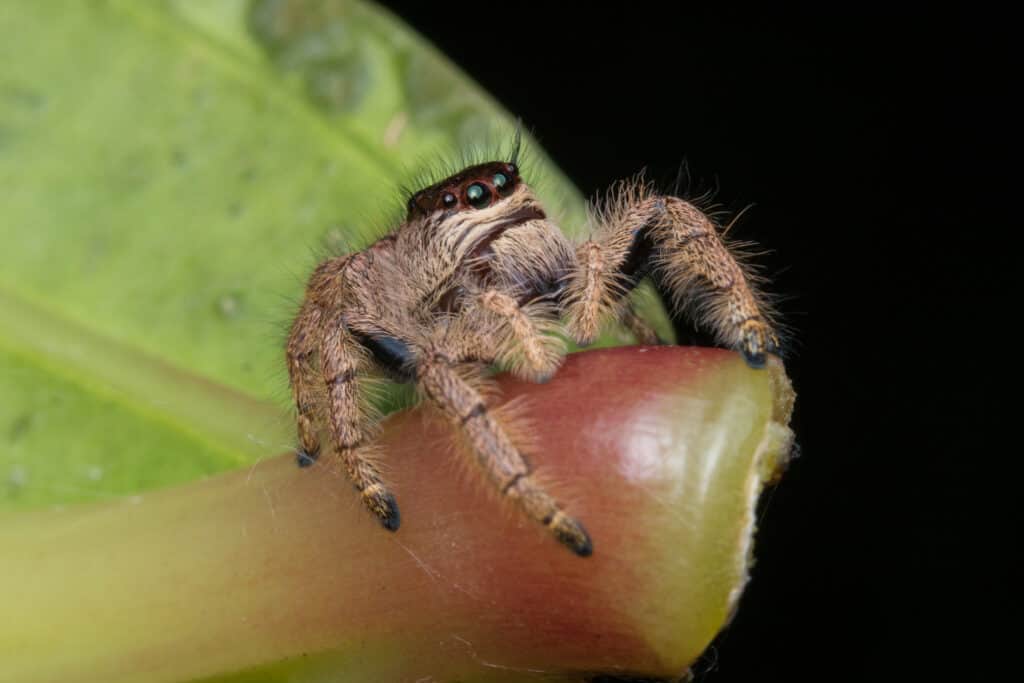
Jumping spiders are not considered aggressive and their venom is not medically significant to humans.
©iStock.com/Thien Woei Jiing
While it might be startling to have a giant jumping spider land on you, they rarely bite, and their venom is not considered medically significant to humans. Giant jumping spiders are not aggressive and rarely bite people. As a matter of fact, they are considered to be easygoing by arachnid enthusiasts and generally safe to handle. However, if they feel threatened, they will defend themselves, but they generally use their venom on prey such as other spiders and cockroaches.
If one bites you, you may experience localized pain, redness, itching, and swelling. Pet owners note that the symptoms are similar to those of a mosquito bite and are temporary. However, due to their large size, a bite will be more painful than a bite from a smaller jumping spider.