Komodo dragons are the largest known lizards in the world. They evolved in isolation in the islands around the Indonesian archipelago. The species was undisturbed until its eventual discovery by the Western world during World War I. The Komodo dragon is a species of monitor lizard. In addition to being the largest lizard in the world, it is known to be one of the most aggressive. Komodo dragons are carnivores and highly efficient predators with the ability to hunt and consume a wide variety of prey, including animals more than twice their size. So, let’s take a look at the diet of the Komodo dragon and discover everything you need to know about how they hunt!
What Does The Komodo Dragon Eat?
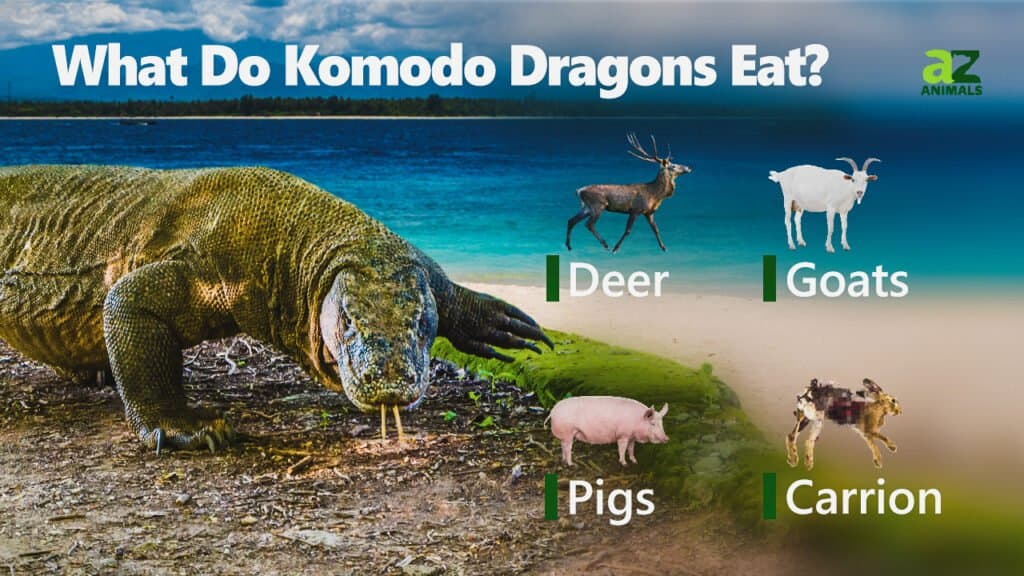
The Komodo dragon is a consummate carnivore, and its diet consists primarily of meat and includes animals such as deer, goats, and pigs. This species prefers to hunt live prey. However, they are such voracious eaters that they will also consume any dead animals they come across. The Komodo dragon is huge, able to grow up to ten feet long and weigh up to 330 pounds. The largest Komodo dragon weighed an impressive 365 pounds.
Experts hypothesize that the Komodo dragon evolved to be so large in response to sharing its habitat with large prey such as mammals. Currently, the sheer power and size of this species allow it to hunt and kill animals much larger than itself.
A Complete List Of Foods The Komodo Dragon Eats
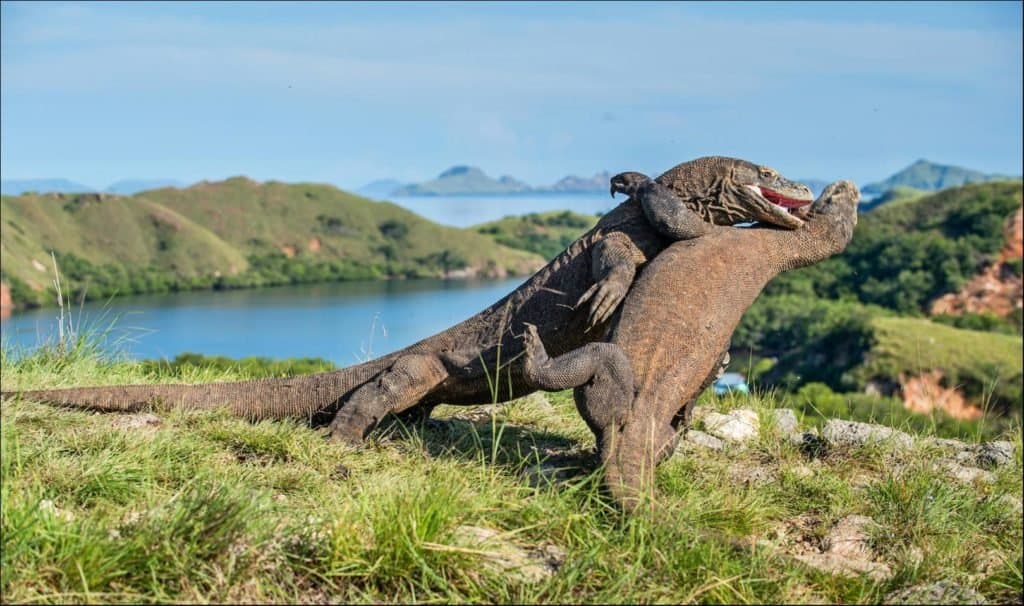
Komodo dragons will hunt each other. Large Komodo dragons eat dead and live members of their species.
©Sergey Uryadnikov/Shutterstock.com
The Komodo dragon is a solitary species of monitor lizard and is an opportunistic hunter. They will hunt and kill anything that crosses their path. This includes both living and dead members of their species, as well as humans. While Komodo dragons do not hunt together, they have been spotted in small groups gathered around one carcass.
Prey selection is dependent on the Komodo dragon’s size. Large adult Komodo dragons hunt large mammals that were introduced to their natural habitat by humans. These are animals such as pigs, dogs, goats, deer, horses, and water buffalo. They also eat prey that is indigenous to their habitat, including rodents, deer, wild boar, and monkeys. They will also eat dead animals. Smaller adult dragons will consume insects, smaller lizards, birds, and snakes.
Additionally, large Komodo dragons will cannibalize their smaller counterparts. They will actively hunt them in the same manner as any other prey. Komodo dragons are also adept climbers and will hunt in trees to find food. The smaller members of the species are most likely to climb to catch prey while avoiding larger dragons. Large dragons refrain from climbing to hunt, preferring the larger mammals on the ground.
The Komodo dragon’s diet doesn’t change much throughout the year. This is largely due to their ability to consume virtually any type of prey.
How Much Food Do They Eat?
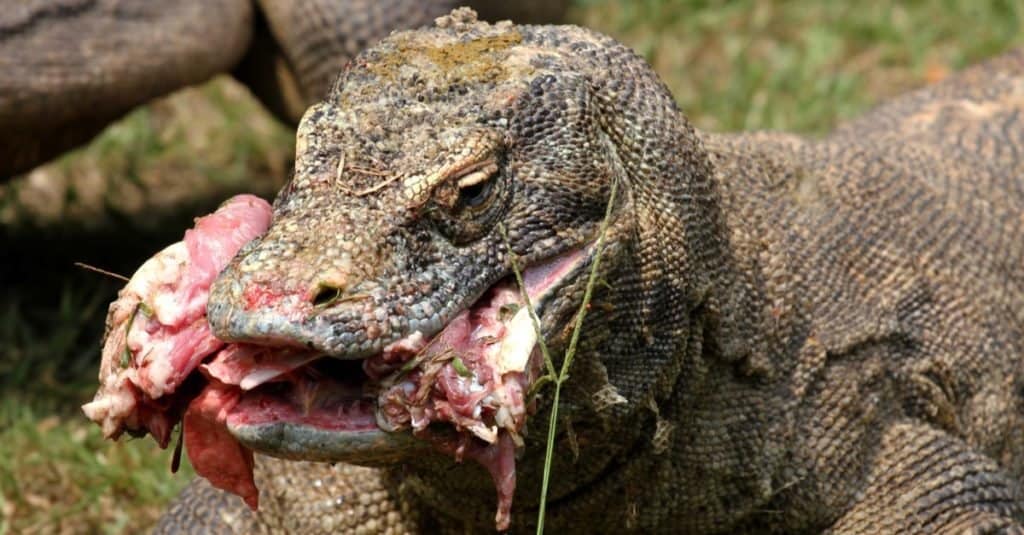
Komodo dragons seek out prey consistently, and most of their time is spent looking for food. However, they can go for several hours without food while hunting. This is due to their ability to consume substantial amounts of food at one time. The species’ sharp and serrated teeth and lack of molars mean the Komodo dragon cannot chew their food. Primarily, they are used to rip bits of meat off a carcass into manageable bites. These pieces are propelled to the back of the mouth and swallowed in whole chunks.
Komodo dragons also have a stomach that can expand when needed. This physical adaptation allows them to consume up to 80% of their body weight. A large Komodo dragon may reach up to 330 lbs in weight. This means it would be capable of consuming an impressive 265 lbs of meat in one meal.
Komodo dragons also have the unique ability to swallow an animal that is nearly equal in weight to themselves in one sitting. This has been witnessed multiple times, such as when a 101-pound Komodo dragon was observed devouring a 90-pound wild pig without leaving any remains behind. Another case reported that a 110-pound dragon consumed an even larger 68-pound pig within 17 minutes.
Baby Komodo Dragons Have To Be Careful
Newly hatched Komodo dragons are called hatchlings. Currently, there is no evidence that they receive parental care from the female after the nine-month incubation and hatching period. The juveniles begin hunting on their own immediately after hatching. They feed on the same prey that smaller adult Komodo dragons consume. This begins with insects and progresses to smaller animals like lizards and birds.
Additionally, juvenile Komodo dragons are at risk of being consumed by larger members of their species. To avoid being eaten, these juveniles will often roll in the fecal matter of larger dragons. They do this to cover their scent and avoid detection. When in a feeding circle, smaller lizards will adopt appeasement strategies. They do so by using a ritualized walk of exaggerated side-to-side steps. The strategy also involves holding their tails straight out to avoid an attack.
Do Komodo Dragons Have Any Natural Predators?
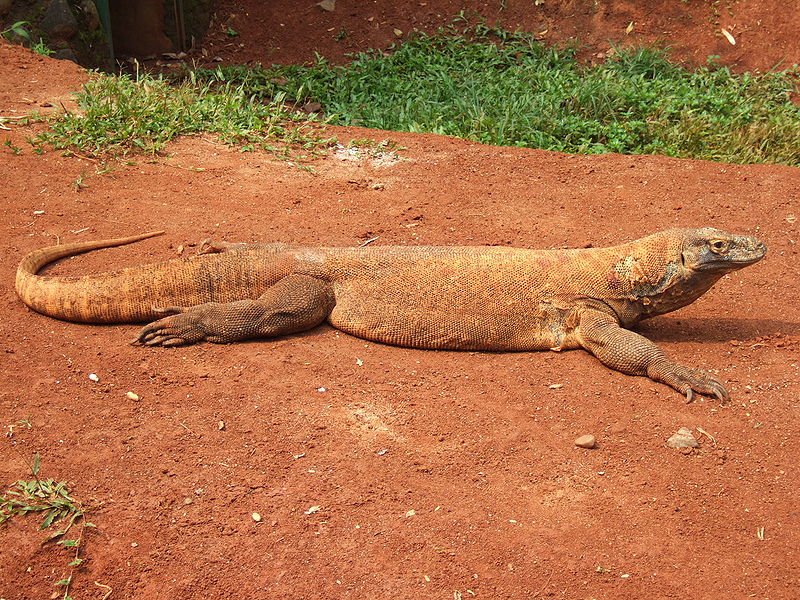
Komodo dragons are apex predators.
©Midori; derivative work: WolfmanSF, CC BY-SA 2.1 JP – Original / License
As the largest and most dangerous predator in its habitat, the Komodo dragon has no natural predators, meaning they are apex predators in their environment. However, the dragon is cannibalistic, and larger members of the species will hunt smaller members. Within their natural habitat, they are at the top of the environmental food chain.
Fossils have been discovered recently that suggest how they got this distinction. The fossils may indicate that the Komodo dragon evolved in response to the presence of large land mammals. The fossils indicate the presence of prehistoric mammals that appear similar to modern elephants. Experts are examining the possibility that the Komodo dragon adapted by getting larger, too.
How Does Their Diet Impact Other Species?
As apex predators, the diet of the Komodo dragon directly impacts the populations of the other animals that share the same environment as them. However, as they have such a wide and varied diet, it doesn’t put a particular strain on any one species. Despite this, they also still impact smaller predators, which might typically prey on the same animals, as these smaller predators have to compete against the larger, more dangerous Komodo dragon for a meal.
How Does The Komodo Dragon Hunt?
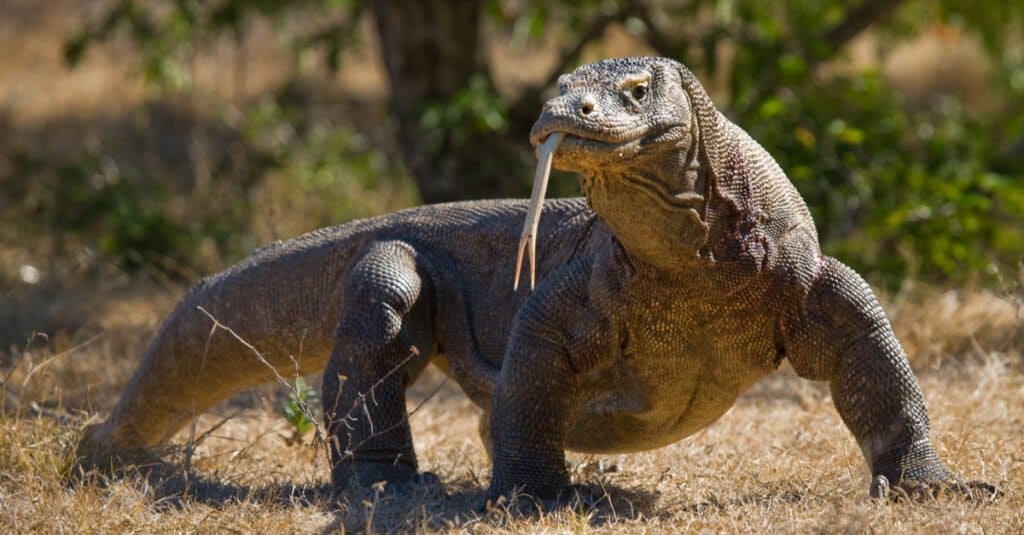
Komodo dragons rely on their tongues to find food and scent the air with them, the same way snakes do.
©GUDKOV ANDREY/Shutterstock.com
The Komodo dragon’s hunting strategy relies on stealth and power. They are capable of spending hours in one spot on a game trail waiting for passing prey. When a sizable victim crosses their path, they ambush the prey. Then they use their powerful jaws and serrated teeth to deliver a devastating bite.
Additionally, the Komodo dragon’s saliva is known to have over fifty diverse types of infectious bacteria. Researchers have also found that Komodo dragons have venom glands in the mouth. When prey receives a Komodo dragon bite, it sometimes manages to escape. However, the resulting bacterial infection and venom often result in death within a few days.
Like other monitor lizards, the Komodo dragon has keen eyesight. Their vision is specifically adapted to detect movement, and they can see objects up to 985 feet away. However, this species does not rely on its eyesight to detect prey. It also has extremely poor hearing in comparison to humans.
Instead, the Komodo dragon relies primarily on its advanced sense of smell to detect prey. Like snakes, the Komodo dragon uses its forked yellow tongue to sample air. Then the tongue retracts into the mouth to press on the Jacobson organs located on the top palate. Using these chemical analyzers, the Komodo dragon can distinguish small prey from larger and more desirable prey. This heightened sense of smell also helps the Komodo dragon track prey they have bitten that escaped.
Are Komodo Dragons Dangerous to Humans?
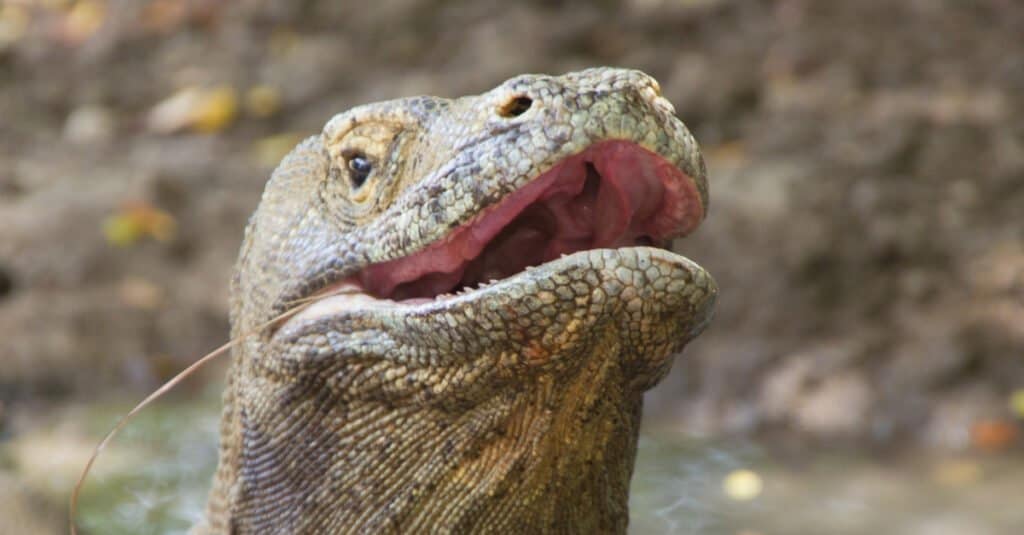
Komodo dragons will hunt and attempt to kill humans.
©vladivlad/Shutterstock.com
Komodo dragons are highly dangerous animals. They should never be approached in the wild or while in captivity by anyone other than a highly trained professional. This species is one of the few considered as man-eaters. They will hunt and kill a human being as readily as any other form of prey. There have been quite a few accounts of people being ambushed, bitten, and actively hunted down by Komodo dragons.
Additionally, individuals have been brutally attacked by captive Komodo dragons as well, including trained professionals. The venom and infectious bacteria transferred in the Komodo dragon’s bite can also kill you. For both the safety of people and the Komodo dragon itself, experts strongly urge the public to stay away. People must avoid this animal and its habitats.
Are Komodo Dragons Endangered?
The Komodo dragon is classified as an Endangered species by the IUCN. This is due to hunting and loss of natural habitat, as well as a decreased level of available prey. This species faces the increased threat of extinction shortly. There are estimated to be fewer than 3,000 Komodo dragons left, with around 1,300 to 1,500 mature individuals.
However, the tourism of recent years that has been generated by increased interest in the Komodo dragon has helped raise awareness. This awareness has sparked new vitality, and efforts to preserve this species and what remains of its habitat have increased.