
Hearing is one of an animal’s most important skills in the wild for survival. Unfortunately, not all are lucky enough to hear or even have ears. Some animals can become deaf as a result of a disease or trauma. For example, all dog and cat breeds, whether purebred or mixed, can develop deafness. Moreover, it can be unilateral or bilateral deafness.
Congenital deafness is possible, too, meaning animals are born deaf. Some studies show that merle, piebald, and albino animals are more likely to be born deaf. On the other hand, some animals don’t even have hearing as a biological sense, meaning it’s completely normal for their bodies to be either deaf or almost deaf. The paradox is that some animals can have ears and be almost completely deaf, while others lack external ears but can “hear” through vibrations!
This post was updated on August 27, 2025 to clarify armadillo speed, specific hearing frequency in select animals, and the percentage of white/blue-eyed cats without hearing.

3 Deaf or Nearly Deaf Animals
We’ve found three animals that are deaf or nearly deaf. Keep reading to learn some incredible facts about them!
Armadillos

Armadillos have a keen sense of smell and large claws for digging and finding food.
©Klaus Balzano/Shutterstock.com
Armadillos are New World placental mammals that form the Cingulata order. They have a leathery armor shell and measure around 30 inches long, tail included. The largest armadillo is called the giant armadillo and can reach up to 59 inches long. The smallest is the pink fairy armadillo, measuring 5-6 inches long.
Although armadillos aren’t considered completely deaf, some studies suggest armadillos have limited high-frequency hearing. Besides this, their eyesight is very poor. So how do armadillos survive? First, they are agile runners and can reach speeds of up to 20 miles per hour. Moreover, they are excellent swimmers and can even walk underwater! Even though nature hasn’t gifted them good eyesight and hearing, armadillos have a keen sense of smell and large claws for digging and finding food. Their armor helps protect them from predation.
Cephalopods

The Cephalopoda class consists of octopus, squid, nautilus, or cuttlefish.
©iStock.com/:TheSP4N1SH
The Cephalopoda class consists of octopus, squid, nautilus, or cuttlefish. Cephalopods are unique thanks to their bilateral body symmetry, sets of arms and tentacles, and prominent heads. While some cephalopods are very small, measuring 0.3 inches long, some can reach more than 45 feet long!
Years ago, cephalopods were considered completely deaf. However, studies show that some cephalopods can, in fact, hear low-frequency sounds. They use their statocysts to detect sound underwater. The statocyst is a balance sensory receptor consisting of a sac-like structure that contains statolith, a mineralized mass, and setae, innervated sensory hairs. While the statocyst doesn’t primarily have hearing functions, cephalopods use the balance organs to sense vibrations.
One cephalopod that uses its statocyst to hear is the longfin inshore squid, or Doryteuthis pealeii. Research showed that they could hear between 30 and 500 Hz, meaning they could hear the waves, the wind, and the sounds of reefs but not the high-frequency sounds emitted by their primary predators, dolphins and toothed whales. However, if the water temperature dropped below 46.4 degrees Fahrenheit, their hearing would be disrupted.
Naked Mole-Rats
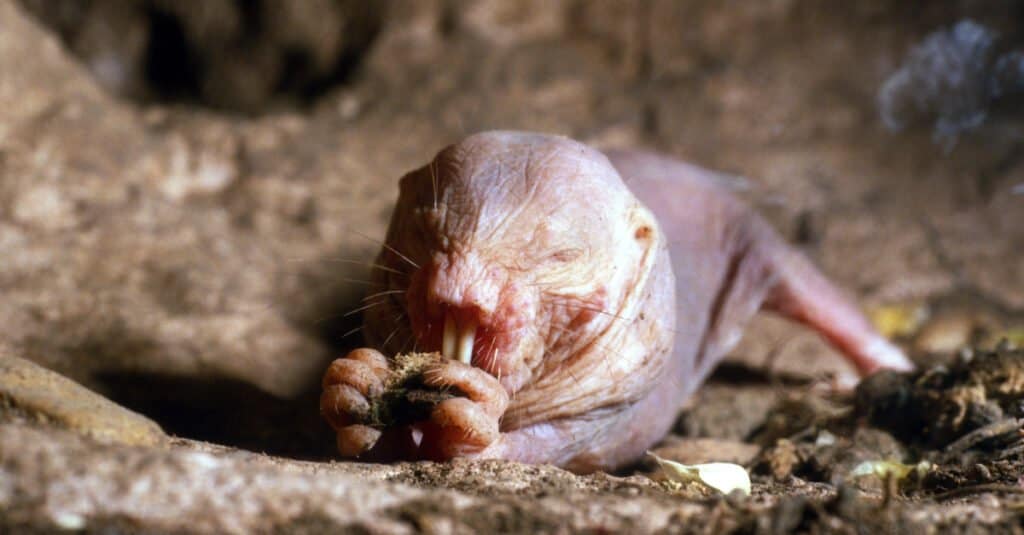
Naked mole rats are the only thermoconformer mammals with an almost entirely cold-blooded type of body temperature regulation.
©Neil Bromhall/Shutterstock.com
Naked mole rats are also called sand puppies. They are native to the Horn of Africa and Somali regions. Naked mole rats are the only thermoconformer mammals (being able to regulate their body temperature) with a somewhat cold-blooded type of body temperature regulation. Moreover, besides Damaraland mole rats, naked mole rats are the only recognized mammals to exhibit eusociality. All these traits make them extremely adaptable and help them survive in harsh environments.
On the other hand, their sense of hearing isn’t very strong, and this is due to their abnormal outer hair cells, which can’t amplify sound. Studies showed that naked mole rats can perceive 50 Hz–12.8 kHz sounds, with sensitivity concentrated at the low end.
3 Animals Without Ears
Would you believe us if we told you that some animals don’t need external ears to hear? Or that others use their legs for hearing purposes? Read on to find out more about them!
Salamanders
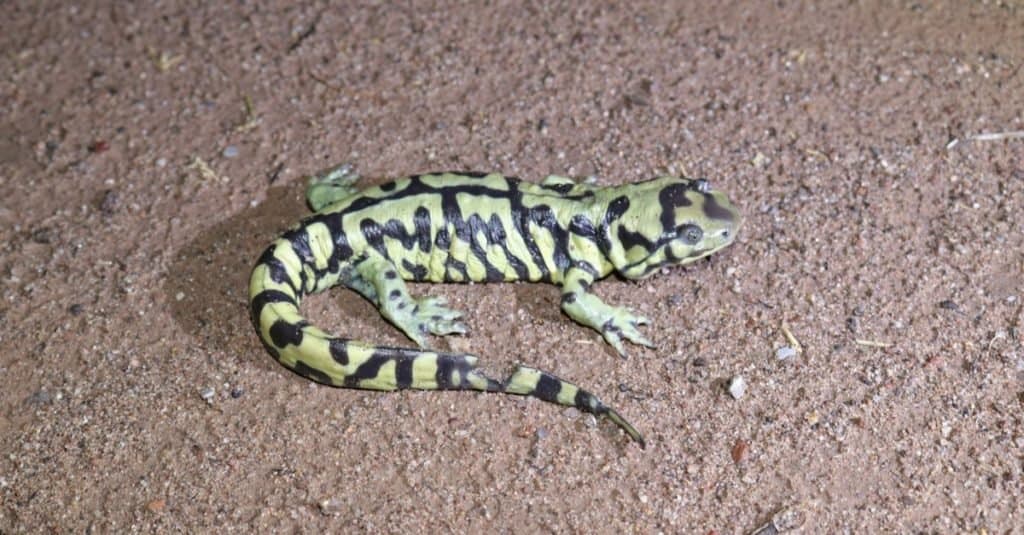
Salamanders possess regenerative abilities, meaning they can grow damaged body parts.
©Creeping Things/Shutterstock.com
Salamanders have a lizard-like appearance – blunt snouts, slender bodies, short limbs, and long tails. Like lizards, salamanders possess regenerative abilities, meaning they can grow damaged body parts.
Many salamander species lack the middle ear cavity, the eustachian tube, and the eardrum. However, like frogs, they have an opercularis system that allows them to detect airborne sounds, primarily low-frequency vibrations of 500-600 Hz. Experts believe the sounds are picked up by the forelimbs and transmitted further to the inner ear.
Spiders

Some spiders use their webs for hearing, as they function as reconfigurable auditory sensors.
©iStock.com/Henrik_L
Spiders are arthropods with eight legs. They do not have antennae, which distinguishes them from insects. Scientists have previously believed that spiders couldn’t detect airborne sounds. However, it was later discovered that they use the hair receptors on their legs to capture low-frequency sounds. Moreover, some spiders use their webs for hearing, as they function as reconfigurable auditory sensors.
Earless Seals

Earless seals are part of the Phocidae family.
©Sergey Uryadnikov/Shutterstock.com
Earless seals are part of the Phocidae family. They’re also called “true seals” or “crawling seals.” While they do not have external ears, they have a very good sense of hearing. They can hear sounds at frequencies of between 30–50 kHz underwater! On land, however, they can detect frequency ranges closer to humans.
What Is an Animal with Congenital Deafness?
White domestic cats often have congenital sensorineural deafness caused by inner ear degeneration. Moreover, this disease is linked to the cat’s eye color. Cats with two blue eyes are at a higher risk of being born with congenital sensorineural deafness. Roughly 65–85% of all-white, blue-eyed cats are deaf in one or both ears. Moreover, white cats with only one blue eye may be deaf only on the side of the blue eye.