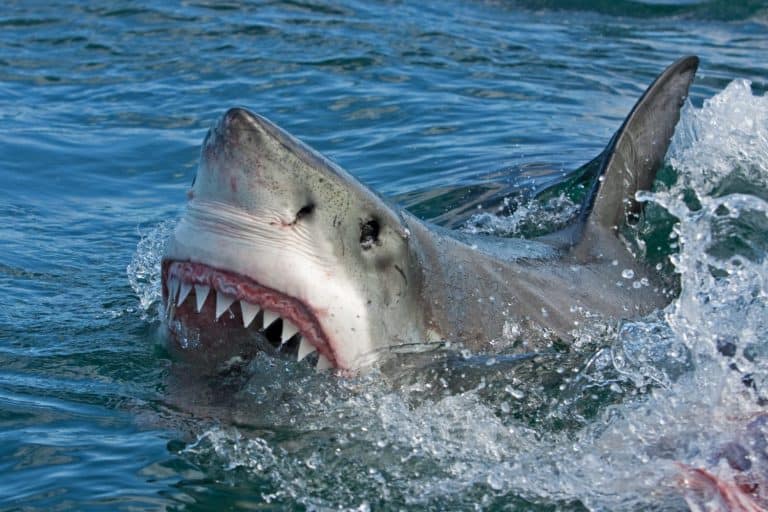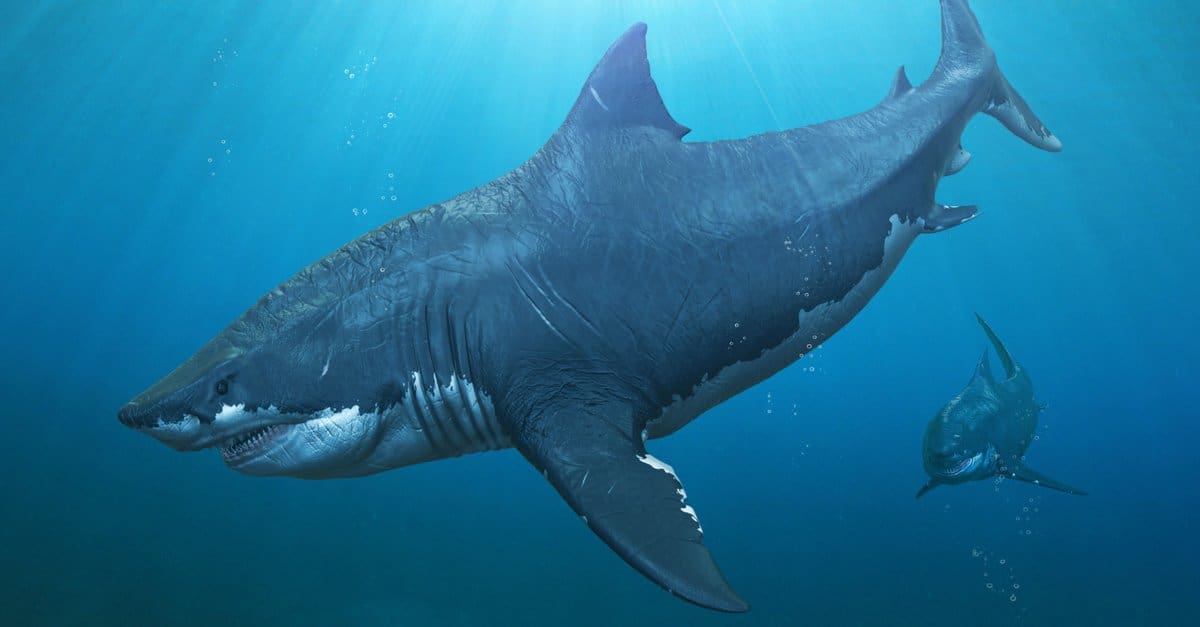

Hundreds of years ago, something peculiar happened…
People started finding “dragon” teeth along ocean shores. Big, six-inch-long dragon teeth.
How could that be possible? Well, today we know those teeth belonged to the largest shark to ever swim the ocean blue: the megalodon (Otodus megalodon). While the megalodon was the largest shark species, was it the largest sea creature ever? Let’s find out!
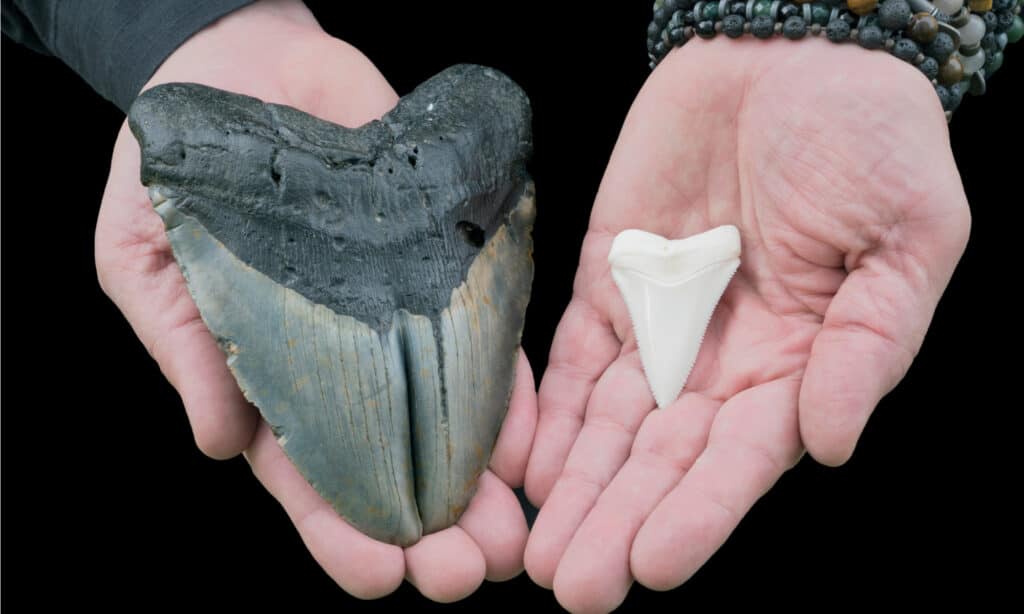
This photo shows the difference in size of a tooth between the extinct megalodon and today’s great white shark.
©Mark_Kostich/Shutterstock.com
The Gargantuan Megalodon
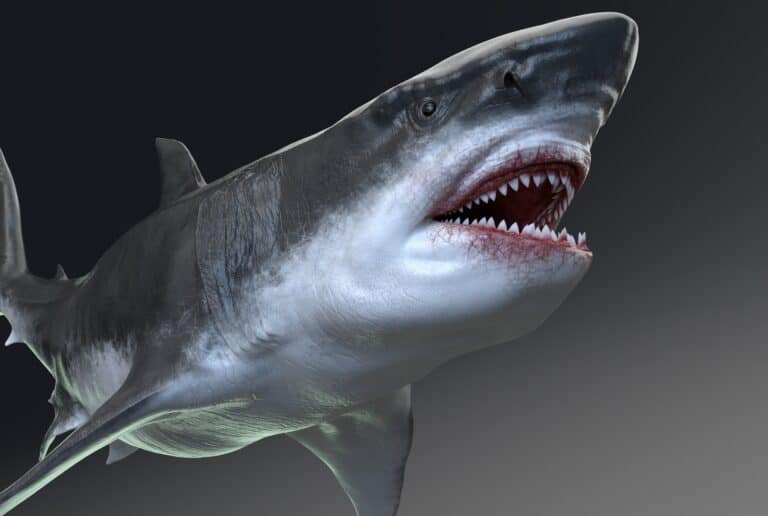
Just how impressive was the megalodon? For starters, it is believed that the megalodon may have weighed 20 to 50 times that of today’s heaviest great white shark. And, no, that’s not a typo. Typically, great whites weigh between 1,500 and 2,400. However, the heaviest great whites are estimated to weigh close to 5,000 pounds.
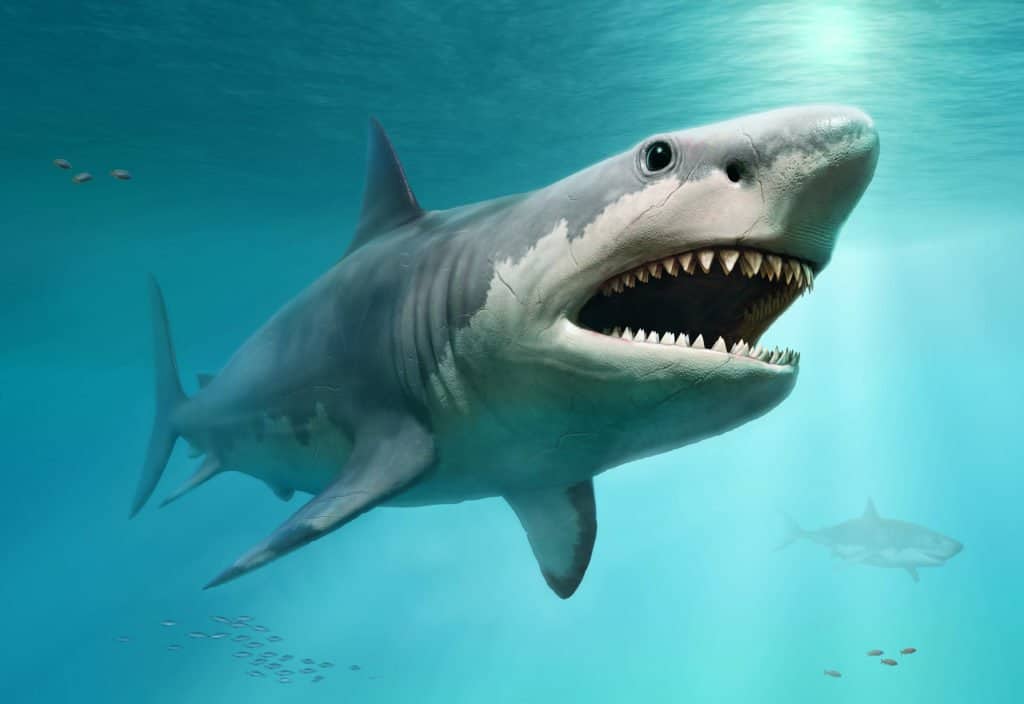
Megalodons may have weighed 20 to 50 times that of the largest great white sharks today, which is estimated to be about 5,000 pounds.
©Warpaint/Shutterstock.com
Conservative estimates of the megalodon’s size place its maximum size at 105,733 pounds (47,960 kg). Larger maximum size estimates place this shark’s highest potential weight at 227,510 pounds (103,197 kg). For perspective, a single megalodon was approximately the weight of about 1,250 fully grown adults!
Research published in 2020 concluded there’s simply no other predatory shark that’s comparable to the megalodon. The other sharks in the megalodon’s order reached just 23 feet (7 m), which amounts to just half the megalodon’s length and a fraction of its weight. This led the authors of the study to declare that the megalodon had “off-the-scale gigantism.”
Yet, the extinct megalodon is not the only giant of the deep and still pales in comparison, both in length and weight, to a creature alive today.
Mosasaurus
Massive aquatic lizards roamed world’s waterways during the Cretaceous period (145.5 to 65.5 million years ago). Mosasaurus is genus used for an extinct group of reptiles that grew to lengths recent estimates (Grigoriev 2014) place at 56 feet. At the time, Mosasaurus wouldn’t have encountered any sharks nearly the size of the megalodon, although these giant aquatic lizards would have had plenty of competition from other apex predators of the time such as Plesiosaurus, another marine reptile.
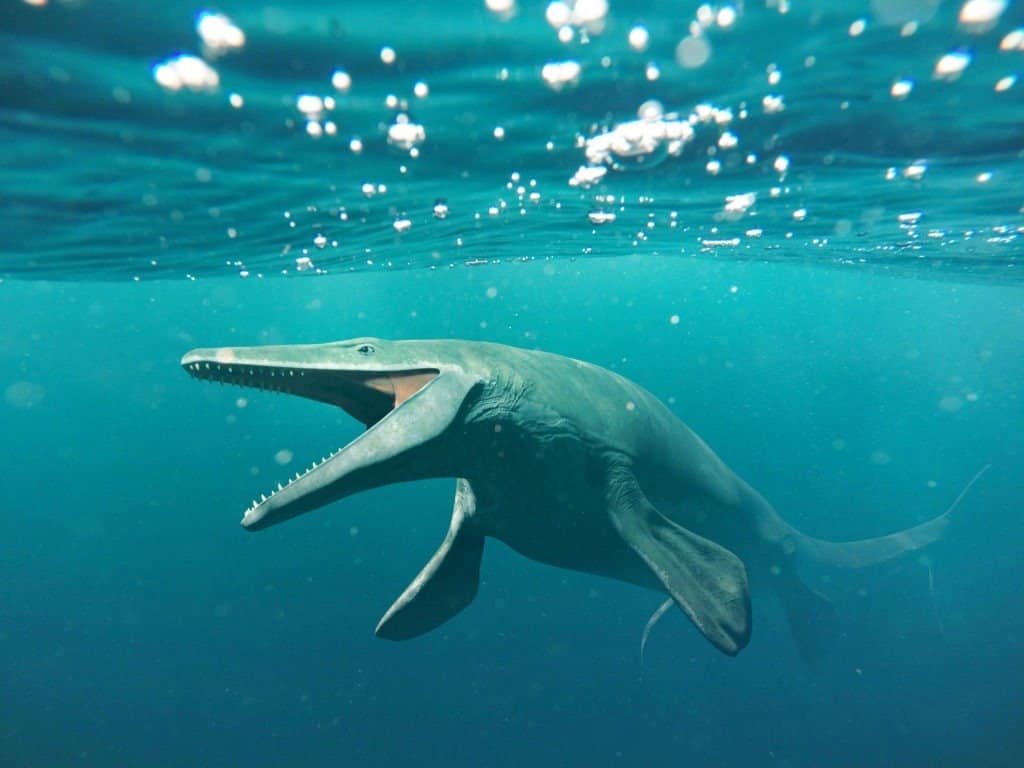
Enormous aquatic lizards roamed the oceans during the Cretaceous period.
©Dotted Yeti/Shutterstock.com
Mosasaurus had 250 teeth, and scientists estimate its bite force at around 13,000 to 16,000 psi. The size of their jaws would have made them predators of much smaller sea animals than the megalodon. They likely would have used ambush tactics to take their prey.
Livyatan
While the megalodon was an order of magnitude larger than other sharks of its era, it did face competition from the Livyatan, an extinct predatory sperm whale. There is one species in the genus, Livyatan melvillei.
The weight of Livyatan rivaled that of the megalodon. An adult Livyatan was estimated to weigh 100,000 pounds and to grow up to 57 feet in length. Its teeth reached more than a foot in length, making Livyatan the creature with the largest known biting teeth.
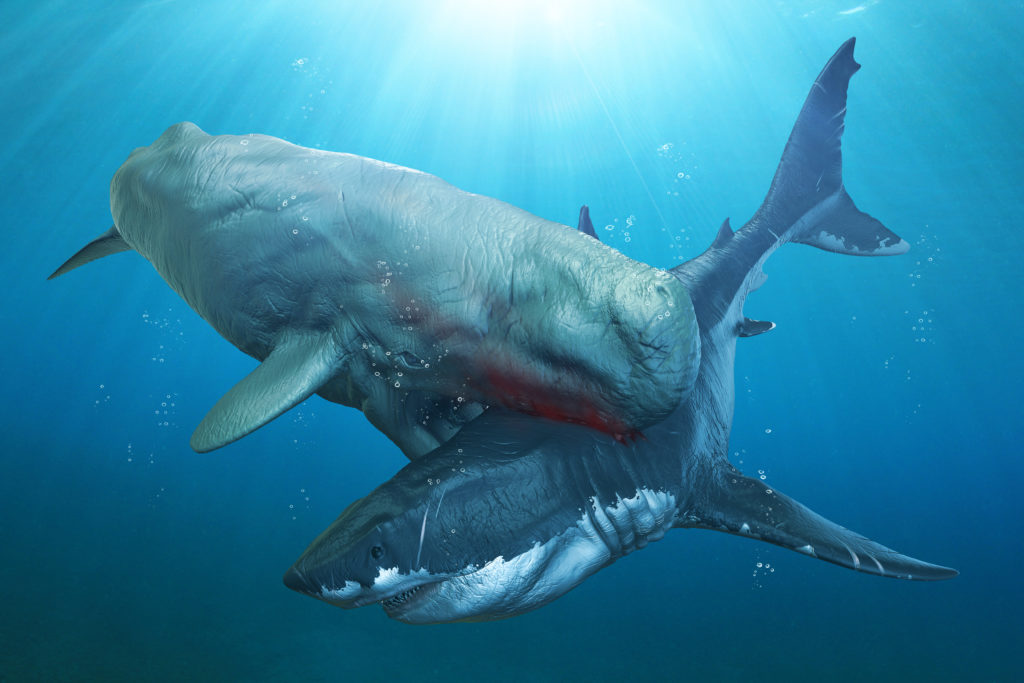
The megalodon faced competition for prey from a predatory sperm whale thought to have weighed as much as the massive shark.
©Herschel Hoffmeyer/Shutterstock.com
Like the megalodon, Livyatan is believed to have died out between 2.6 and 3.6 million years ago. The two apex predators both likely struggled to adapt to changes in the climate and the loss of their primary prey of small- to medium-size whales.
Recently, and with some frequency, the presence of killer whales has prompted great white sharks to flee an area. In one encounter, after killer whales entered a great white hunting ground off the coast of California, a great white shark fled to Hawaii. It would seem that some of today’s fiercest sharks are facing a predatory whale in the same way its ancient cousins did millennia ago.
Great White Shark
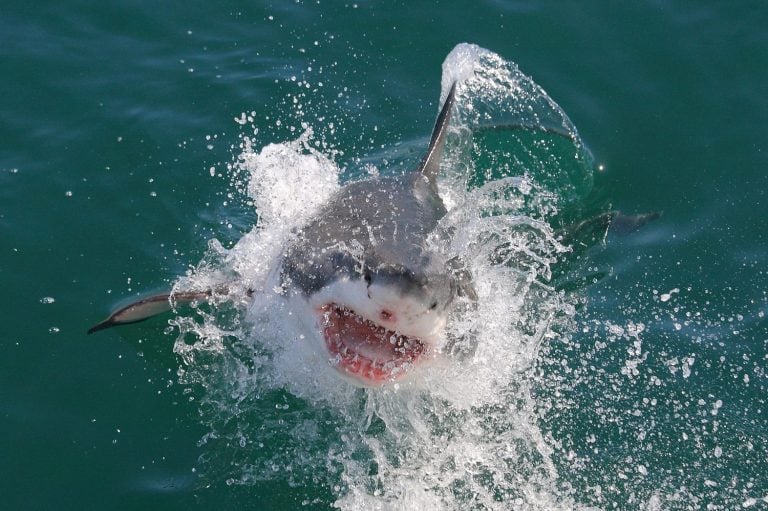
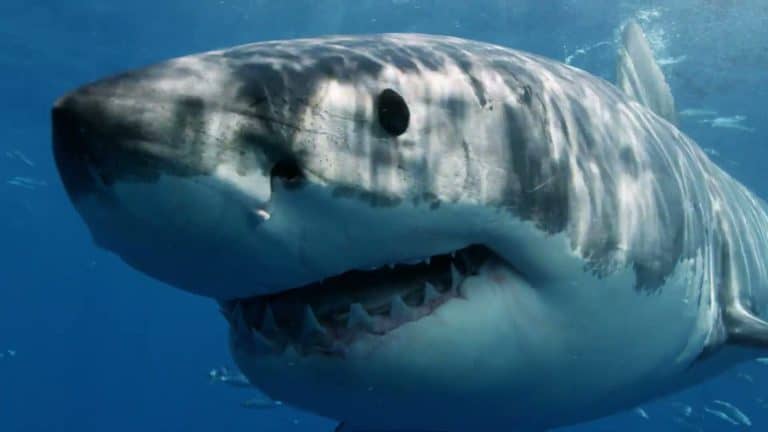
The great white pales in length and weight compared to the megalodon, even though it is today’s largest predatory fish. However, when it comes to survival, bigger isn’t always better. Researchers have proposed that the much smaller great white shark may have actually contributed to megalodon’s extinction.
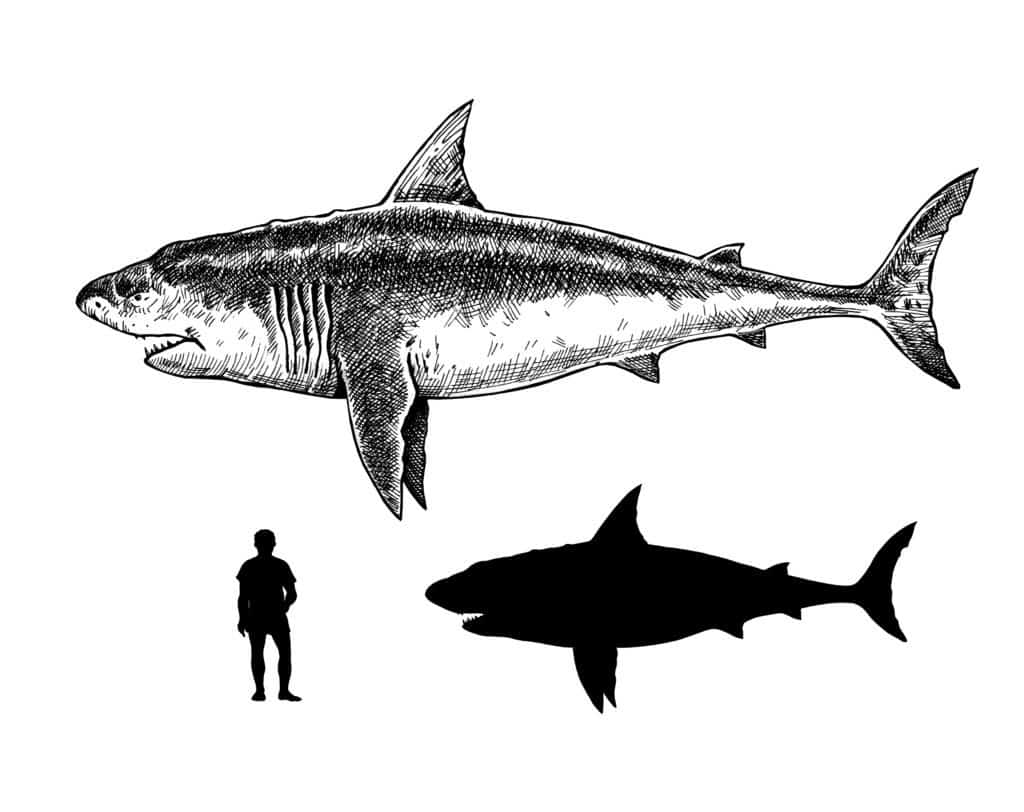
This illustration shows the height/length difference between an adult human male, a great white shark, and a megalodon.
©Sammy33/Shutterstock.com
The theory goes as follow: Around the time when megalodons were struggling to adapt to cooling ocean temperatures, great white sharks adapted and began competing with juvenile megalodons by hunting smaller whales, their primary prey. Megalodon and Livyatan populations began to tetter out 2.6 to 3.6 million years ago, and in their place rose great white sharks and killer whales—much smaller apex predators of the seas.
Additionally, without the presence of massive apex predators, whales that filter feed began growing to massive sizes. In fact, this development led to the adaptation of the largest animal to ever live on Earth.
Blue Whale
The megalodon and blue whale never met, as the earliest fossils of the modern blue whale date back to roughly 1.5 million years ago, which is about one million years after the megalodon is believed to have hunted the oceans.
However, as it pertains to length and weight, the blue whale dwarfs even the largest megalodon estimates. Blue whales typically average 80-100 feet (24-30.5 m) in length and weigh 100,000-330,000 pounds (45,360-149,685 kg), with whales in the Antarctic being larger. Females are also generally larger than males.
The record for longest blue whale belongs to a female caught in 1909. She measured 110 feet, 1.6 inches (34 m) at Grytviken, a whaling station on South Georgia Island in the South Atlantic. No weight was recorded. By weight, the largest blue whale record goes to another female, this one caught in the Southern Ocean around Antarctica in 1947. She weighed 418,878 pounds (190,000 kg) and was 90 feet, 6 inches (27.6 m) in length.
In other words, these female blue whales were more than twice the estimated length and weight of the megalodon, making the blue whale the largest known creature to ever live on the Earth.
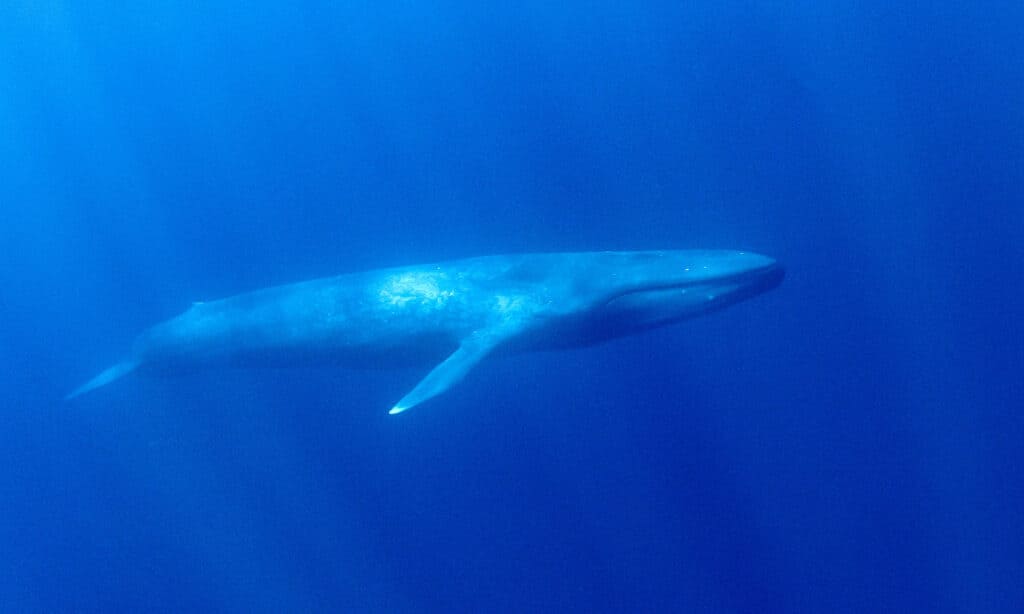
The blue whale is the largest known creature to ever roam—on land or sea—the Earth.
©iStock.com/richcarey
But the blue whale shouldn’t start celebrating yet. There are several incomplete fossils that may—one day—point toward another creature that could challenge the blue whale’s title as the biggest animal ever.
In 2018 paleontologists discovered a three-foot jaw segment belonging to a newly discovered ichthyosaur, another group of extinct marine reptiles. Examinations of the jaw segment to more complete ichthyosaur fossils have yielded estimates that this animal could have grown to 85 feet in length and roamed the oceans about 200 million years ago. At that size, the creature may have weighed more than any blue whale that’s ever been recorded.