
Manatees are one of the most loved animals in the world, and for good reason. These gentle sea mammals are friendly, fun-loving, and live their lives at an easy pace. But how old is the oldest manatee ever recorded? And how does this easy-going animal, affectionately dubbed the “sea cow,” contribute to conservation efforts for animals worldwide? Perhaps their easy-going approach is the secret to their long lifespan? To answer these questions, we need to learn a bit more about this very unique mammal. Let’s get started!
The Gentle Giant of the Aquatic Ecosystem
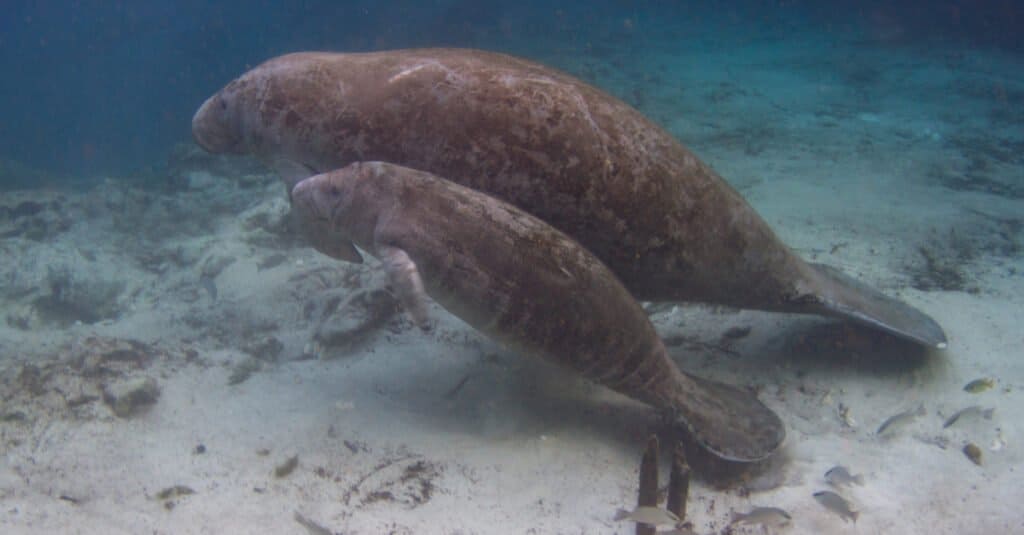
Manatees are easy-going mammals.
©Peter Douglas Clark/Shutterstock.com
Manatees are the only living members of the family Trichechidae. They are grouped with the Dugongidae family under the order Sirenia. There are three species of manatees, and they are aquatic mammals that feed exclusively on plant life. They must consume large quantities to sustain themselves, as this vegetation is low in protein and nutrients. Their unique physical adaptations and hindgut digestive system are designed for a vegetarian lifestyle. They have large prehensile lips studded with sensory bristles to find and select edible plants. Their molars are lost and regrown regularly due to abrasive sand and sediment. This causes wear, so teeth are replaced to cope with their dietary needs. Worn teeth move to the front of the mouth when new molars come in. Then they are eventually lost and replaced throughout the entire lifespan of the manatee.
Manatee Physical Characteristics
Manatees differ in size depending on the species, and some physical characteristics differ slightly as well. In general, manatees are between eight and 13 feet long and typically weigh between 800 and 1,200 pounds, although some can be larger. They are varying shades of grey, black, or brown. Manatees have stout and tapered bodies and flat, rounded tails used for propulsion. They have two front flippers but lack hind flippers or legs.
Manatees are dense and heavy animals because their ribs do not have marrow. They can control the volume of air spaces in their lungs. The lungs are also oriented to be parallel to the water’s surface. This allows them to keep a horizontal position in water, from the bottom to the surface. Manatees can replenish 90 percent of the air in their lungs and stay underwater for over 20 minutes.
The Long Lifetime of a Manatee
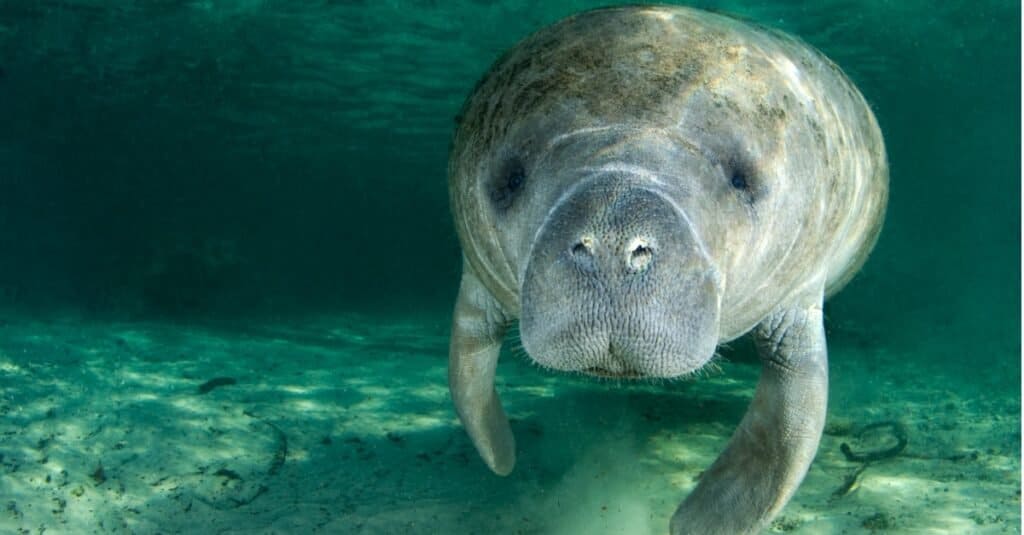
Manatees are friendly but solitary.
©A Cotton Photo/Shutterstock.com
Manatees have a very long lifespan. Age estimates based on growth rings within the ear bones indicate they can live for over 50 years. However, the life of a manatee is largely solitary for such a friendly creature. Still, groups, referred to as aggregations, are formed for short periods. These periods can last for hours or even several days. Aggregations of males are formed for mating purposes, often involving up to 20 males centered around one receptive female. Aggregations may also form in areas with plentiful food sources or warm water. At times, over 300 manatees are known to gather near warm-water outflows near Florida power plants. West Indian manatees (the species found in Florida) migrate south during cold weather seasons. Manatees also migrate in response to fluctuating water conditions.
They are active both day and night and can sleep submerged. They also sleep while breathing at the water surface. Manatees move an average of five miles an hour. However, they can reach up to 15 miles per hour if needed.
How Do Manatees Communicate?
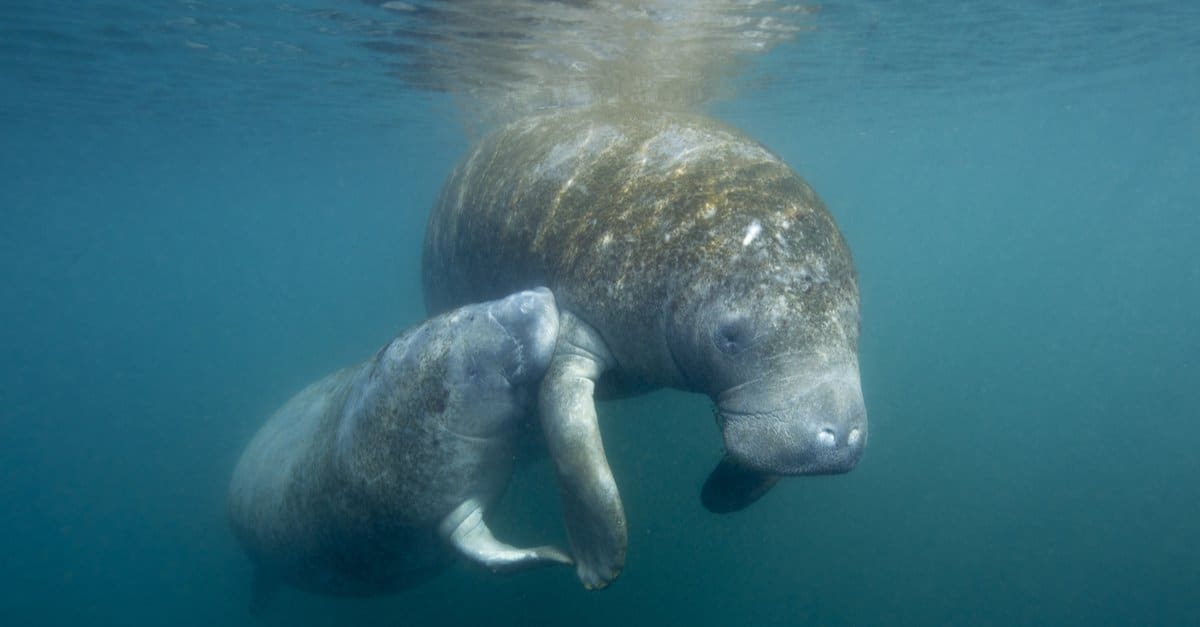
Manatees communicate using unique underwater sounds. These sounds are generally chirps, squeaks, and grunts. They are also very tactile, with sensory hairs over their bodies. These hairs help the manatee to communicate with touch. They have many hairs that are concentrated on the muzzle and face. These types of communication are especially important for communicating with their young.
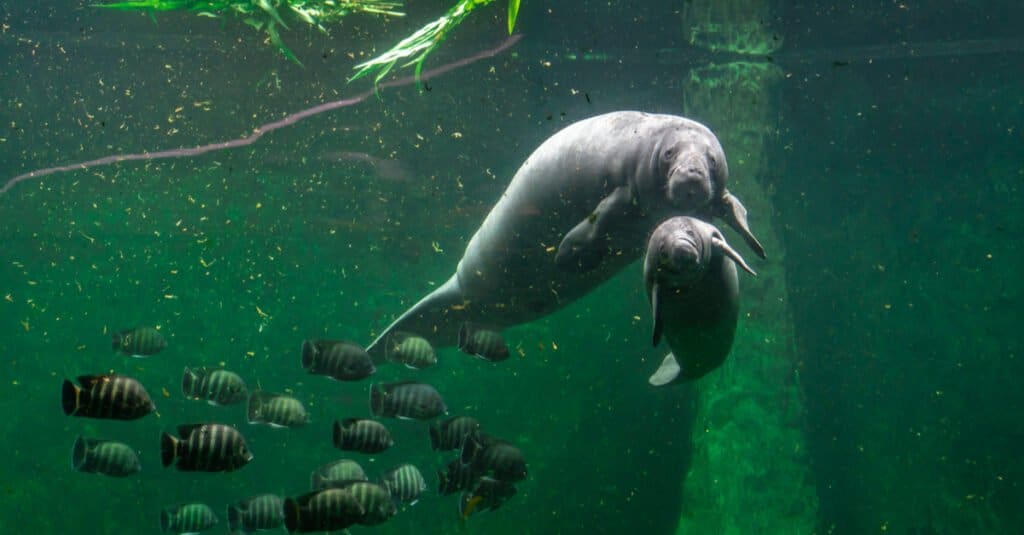
Manatee mother and calf.
©Lukasz Machowczyk/Shutterstock.com
How Does a Manatee’s Life Start?
All three species mate year-round. They have seasonal mating periods that are high in the spring and lower in the winter months. However, they reproduce slowly. Sexual maturity occurs around three years of age. A female manatee will produce a calf every two to three years, on average. Twin births occur but are very rare. The gestation period for a manatee calf is nearly one year. Calves stay with their mothers for up to two years before reaching adulthood. During this time, they continue to nurse but start consuming plants fairly young.
Snooty: The World’s Oldest Recorded Manatee
Snooty is the Guinness World Record holder for being the oldest recorded manatee. He received recognition for this on March 10, 2017. He died later that year on July 23, which was two days after his 69th birthday. In addition to being the oldest recorded manatee, Snooty was also the first manatee born in captivity.
Snooty was a West Indian manatee born on July 21, 1948, at the Miami Aquarium. At the age of 2, Snooty was moved to his home at the South Florida Museum of Manatee County. He lived in a controlled environment within a 60,000-gallon pool. He shared his home with his fellow manatees, Randall, Baca, and Gale.
While Snooty got along well with his aquatic roommates, he displayed a marked preference for people. He enjoyed the company of his caretakers. Snooty was also known to be highly affectionate and playful. He welcomed new guests and enjoyed a good belly rub. All in all, he was well-loved by countless fans and adored by the entire state of Florida.
Sadly, Snooty passed away just two days after celebrating his 69th birthday. Due to a tragic accident, Snooty became trapped in the underwater plumbing for the exhibit’s life support system. This accident was caused by a damaged access panel that allowed him to enter.
Unfortunately, Snooty entered but was unable to find a way out. While museum workers scrambled to find a way to rescue him, they, unfortunately, did not get to Snooty in time to save his life. However, Snooty will be forever remembered as the oldest and most well-loved manatee.
Another Contender
In June 2025, Gulfarium Marine Adventure Park announced that it had welcomed Romeo, a manatee known to be more than 70 years old, which would make him the oldest known manatee.
Conservation: Manatees Are Endangered
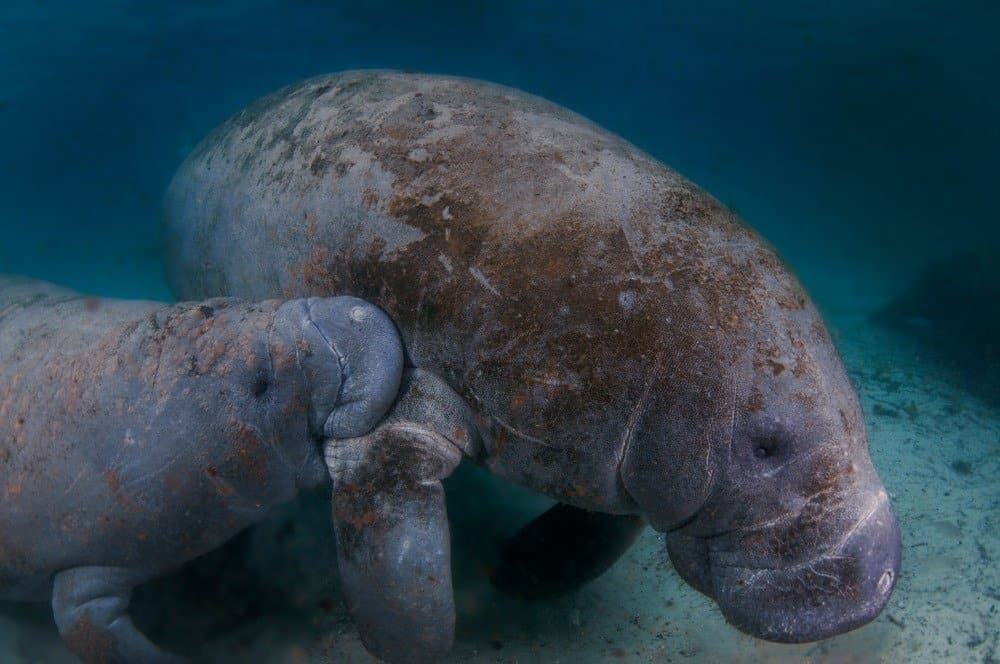
Manatees have the ability to live for a long time, but many only survive for 10 years in the wild.
©Greg Amptman/Shutterstock.com
The manatee has the natural ability to live for over 50 years. However, many do not make it past the age of ten. Manatees have no natural predators. The biggest and only real threat to this majestic animal is humans. This is largely due to pollution of their food sources caused by fertilizer runoff and septic and sewage leaks. These conditions often result in an algal bloom in their habitat. Algae blooms cause destruction to vast acres of seagrass the manatee depends on.
Additionally, collisions with watercraft and alarming temperature changes threaten manatees. All of these factors contribute to the dangers human beings cause to all three species. As a result, all three species of manatees are classified as vulnerable on the IUCN Red List. They are also protected under the Endangered Species Act, and they also fall under the Marine Mammal Protection Act.
The Florida manatee is protected by the Florida Sanctuary Act of 1978 as well. This explicitly states that “it is unlawful for any person, at any time, intentionally or negligently, to annoy, molest, harass or disturb any manatee.”