M
Species Profile

Mantella Frog

Mantella

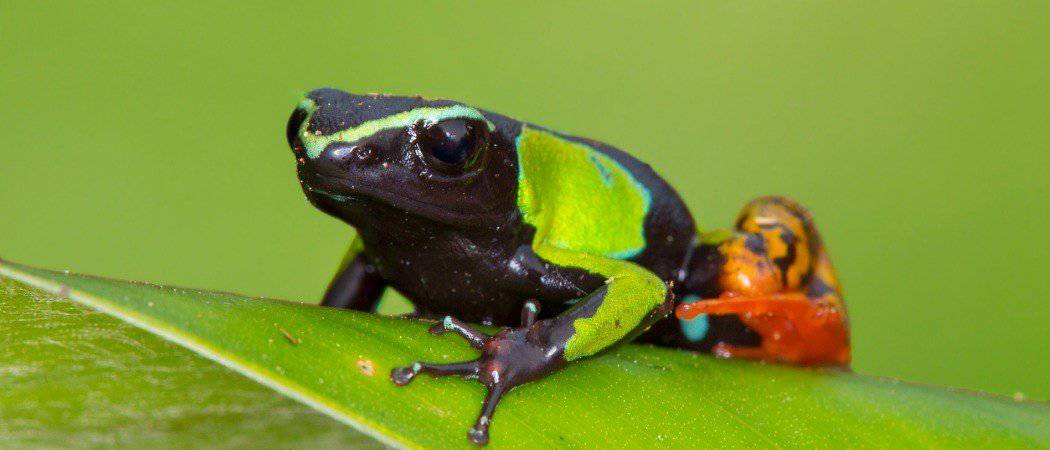
Madagascar's living warning labels
iStock.com/Massimo_S8

Mantella Frog Distribution

Click a location to explore more animals from that region

Endemic Species
Loading map...

Found in 1 country

Mantella Frog on leaf

At a Glance

Genus Overview This page covers the Mantella Frog genus as a group. Stats below are general traits shared across the genus.
Also Known As Madagascar poison frog, Malagasy poison frog, Madagascan poison frog, Malagasy poison-dart frog
Activity Diurnal+
Lifespan 5 years
Weight 0.007 lbs
Status Not Evaluated
Did You Know?

All Mantella frogs are endemic to Madagascar-found nowhere else on Earth.

Scientific Classification

Genus Overview "Mantella Frog" is not a single species but represents an entire genus containing multiple species.

Mantella frogs are a genus of small, brightly colored frogs endemic to Madagascar, famous for aposematic (warning) coloration and skin alkaloid toxins (acquired largely through diet). They are often compared to Neotropical poison dart frogs due to similar ecology and coloration, though they are not closely related.

Kingdom
Animalia
Phylum
Chordata
Class
Amphibia
Order
Anura
Family
Mantellidae
Genus
Mantella

Distinguishing Features

  • Small-bodied frogs with vivid warning coloration (often orange, red, yellow, green, or patterned black/bright combinations)
  • Endemic to Madagascar (key biogeographic cue)
  • Toxic/alkaloid skin secretions, largely diet-derived
  • Terrestrial or semi-terrestrial habits; many live in leaf litter

Physical Measurements

Males and females differ in size

Weight
0 lbs (0 lbs – 0 lbs)
Top Speed
5 mph
hopping
Poisonous

Appearance

Primary Colors
Secondary Colors
Skin Type Mostly smooth to slightly granular, often with a subtle sheen; skin contains granular glands and may be mildly textured on the dorsum, varying among species and habitats.
Distinctive Features
  • Small-bodied frogs: adult snout-vent length roughly 1.8-4.0 cm across species (smallest to largest).
  • Endemic to Madagascar; many species are microendemic with restricted ranges and localized color morphs.
  • Aposematic coloration is common; alkaloid skin toxins are largely diet-derived (e.g., ants/mites), so toxicity varies strongly by species, locality, and diet.
  • Primarily diurnal and terrestrial; frequent in leaf litter, mossy ground cover, and near forest edges, with some tolerating disturbed habitats.
  • Breeding generally tied to seasonal rains; eggs often laid on land near water, with tadpoles developing in small pools, seepages, or slow water-exact sites vary by species.
  • Typical lifespan spans ~3-8 years in the wild; in captivity, some species can reach ~10-15 years with optimal care.
  • Often compared ecologically to Neotropical poison dart frogs, but not closely related; similar warning colors evolved convergently.

Sexual Dimorphism

Sexual dimorphism is usually mild: females are often larger and more robust, while males more commonly call and defend small areas. Males may show darker throats, vocal sac development, and subtle forelimb/nuptial pad differences, varying by species.

  • Often slightly smaller/slimmer on average, with proportionally longer limbs in some species.
  • Vocal sac present; males produce advertisement calls and may show a darker throat.
  • May develop subtle nuptial pads or thickened forearms during breeding season.
  • Often larger and heavier-bodied, especially when gravid.
  • Typically lack vocal sac development and prominent calling behavior.
  • Abdomen may appear fuller when carrying eggs; differences can be minimal in some species.

Did You Know?

All Mantella frogs are endemic to Madagascar-found nowhere else on Earth.

Across the genus, adults are small: roughly ~1.8-4.0 cm snout-vent length (smallest to largest species).

Many species advertise toxicity with bold "aposematic" colors (yellows, oranges, greens, reds, blacks), but patterns vary widely among species.

Their skin alkaloid toxins are largely acquired through diet (notably ants and mites); captive-bred individuals often have far lower toxin levels due to different diets.

They're often compared to Neotropical poison dart frogs because of similar bright colors and alkaloids-an example of convergent evolution, not close relatedness.

Most Mantella are active by day and live on the forest floor or in leaf litter, but species differ in preferred habitats (rainforest, swampy areas, dry forests, montane zones).

Conservation status varies strongly by species: some have very restricted ranges and are threatened by habitat loss and past collection for the pet trade.

Unique Adaptations

  • Aposematism (warning coloration): high-contrast colors and patterns signal chemical defenses; the genus showcases broad diversity in color morphs and patterning.
  • Diet-derived alkaloid sequestration: many Mantella store defensive alkaloids obtained through prey, linking toxicity to local food webs.
  • Skin gland chemistry for defense: granular skin glands help deliver noxious compounds, complementing visual warning signals.
  • Convergent "dart-frog" ecological strategy: similar combination of diurnal activity, bright colors, and alkaloids evolved independently from poison dart frogs.
  • Microhabitat specialization: different species specialize on particular Malagasy ecosystems (e.g., lowland rainforest leaf litter vs. seasonal dry forest), contributing to high endemism and range restriction.

Interesting Behaviors

  • Diurnal foraging: many species are most active in daylight, hunting tiny arthropods in leaf litter and low vegetation.
  • Site fidelity and small home ranges: individuals often remain in localized patches of suitable cover, though the degree varies among species and habitats.
  • Breeding tied to water availability: many species breed seasonally with rains; eggs are typically laid on land in moist sites and tadpoles develop in nearby water (pools, marshy edges, slow water), but exact sites differ among species.
  • Male advertisement calling: males call to attract mates and maintain spacing; call structure and calling microhabitat vary across species.
  • Predator deterrence display: bright coloration plus skin chemicals discourages many predators; some individuals adopt alert postures or remain conspicuously visible rather than hiding.

Cultural Significance

Mantella frogs are symbols of Madagascar's unique wildlife and appear in conservation messages and ecotourism. Past frog trade raised habitat protection awareness. Local views vary by region, with some taboos or rain links, not always about Mantella.

Myths & Legends

Madagascar's tradition of local taboos sometimes extends to wildlife, including amphibians; in some communities frogs are treated with avoidance or respect tied to local custom and place-based spiritual rules (which vary widely by region).

In Malagasy stories, frogs are linked to rain and the wet-season's renewal. This fits frogs' seasonal calling and breeding. These beliefs are about frogs in general, not Mantella specifically.

In the 1800s, European naturalists noticed Mantella frogs' bright colors and often compared them to American poison dart frogs. This lasting idea of 'Madagascar's dart frogs' reflects convergent evolution.

Conservation Status

NE Not Evaluated (genus-level; individual Mantella species range from Least Concern (LC) to Critically Endangered (CR), with several Vulnerable/Endangered and some Data Deficient)

Has not yet been evaluated against the criteria.

Population Decreasing

Protected Under

  • CITES Appendix II (Mantella spp.; international trade regulated)
  • Madagascar national biodiversity/wildlife protection framework (species and habitat protections vary by site)
  • Populations occur within Madagascar's protected-area network (coverage and enforcement variable)

You might be looking for:

Golden mantella

28%

Mantella aurantiaca

Bright orange, one of the best-known Mantella; endemic to Madagascar and heavily impacted by habitat loss and collection.

Baron's mantella

18%

Mantella baroni

Black-and-yellow/orange patterned species from eastern Madagascar rainforests.

Madagascar mantella

14%

Mantella madagascariensis

Often greenish/black with contrasting markings; rainforest-associated Mantella.

Green mantella

10%

Mantella viridis

Green-toned Mantella from Madagascar; similar ecology to other forest-dwelling species.

Harlequin mantella

8%

Mantella cowanii

Striking patterned mantella; among the more conservation-sensitive species.

Life Cycle

Birth 30 tadpoles
Lifespan 5 years

Lifespan

In the Wild
2–10 years
In Captivity
6–18 years

Reproduction

Mating System Promiscuity
Social Structure Transient
Breeding Pattern Transient
Fertilization Substrate Spawning
Birth Type Substrate_spawning

Most Mantella breed seasonally in rains; males call from small territories or calling sites and mate opportunistically with multiple partners. Pairs form briefly for external fertilization as eggs are placed on moist ground/vegetation near water; parental care is limited or absent.

Behavior & Ecology

Social Aggregation Group: 3
Activity Diurnal, Crepuscular, Cathemeral
Diet Insectivore Ants and mites (major alkaloid sources for many Mantella spp.)
Seasonal Hibernates 0 mi

Temperament

Generally wary and quick to flee, but often conspicuous in the open due to aposematic coloration
Male territoriality is common in breeding contexts; intensity varies among species and habitats
Tolerance of nearby conspecifics ranges from scattered spacing to high local densities at breeding sites
Handling/close approach frequently triggers defensive postures and rapid escape rather than aggression

Communication

Advertisement calls (typically short chirps/trills) used by males to attract mates and space rivals
Courtship calls or call-rate changes during close interactions
Disturbance-associated sounds are uncommon; most responses are silent flight
Visual signaling via bright color patterns; posture changes can enhance warning display
Tactile communication during amplexus and positioning at oviposition sites
Chemical cues likely involved in mate recognition and site fidelity; evidence varies across species
Spatial signaling through calling perch choice and territory occupancy around breeding microhabitats

Habitat

Biomes:
Tropical Rainforest Tropical Dry Forest Savanna Wetland Freshwater
Terrain:
Island Coastal Hilly Mountainous Plateau Valley Riverine +1
Elevation: Up to 6561 ft 8 in

Ecological Role

Diurnal leaf-litter micro-predators that help structure Madagascar forest-floor arthropod communities and participate in diet-toxin trophic transfer (sequestering alkaloids from prey into defensive skin secretions).

Regulation of leaf-litter invertebrate populations (especially ants/mites and other microarthropods) Energy transfer from detrital food webs (leaf-litter arthropods) to higher trophic levels (predators of frogs) Contribution to chemical-ecology dynamics (prey-derived alkaloid sequestration influencing predator-prey interactions) Bioindicator potential for forest-floor microhabitat quality and invertebrate community composition

Diet Details

Main Prey:
Ants Mites Termite Small beetles Springtails Fly larvae and small adult flies Small wasps and other hymenopterans Small spiders and other tiny leaf-litter arthropods +2

Human Interaction

Domestication Status

Wild

Mantella frogs are wild frogs from Madagascar and are not domesticated. People affect them by cutting and changing habitat, studying them, watching them in nature, and collecting them for pets in the past. Some are bred in captivity now, but captive breeding is not the same as domestication; conservation guides trade.

Danger Level

Low
  • Skin alkaloids can cause localized irritation, burning sensations, or mild poisoning symptoms if transferred to eyes/mouth or ingested (risk varies by species and is often lower in captivity due to diet).
  • Potential allergic reactions or dermatitis from skin secretions or contact with vivarium materials/feeder insects.
  • General amphibian hygiene risk (e.g., Salmonella exposure) if hands are not washed after handling or cleaning enclosures.
  • Greater risk is typically to the frog: handling can stress individuals and damage sensitive skin; toxins/oils from human skin can also harm them.

As a Pet

Suitable as Pet

Legality: Laws differ by species and country. Many Mantella are CITES-listed (often Appendix II) and protected by national laws. Madagascar exports are often restricted; imports may need permits and proof they were bred in captivity. Avoid wild-caught frogs.

Care Level: Experienced

Purchase Cost: $60 - $300
Lifetime Cost: $1,200 - $5,000

Economic Value

Uses:
International and domestic pet trade (primarily captive-bred, where legal) Ecotourism and wildlife viewing in Madagascar Scientific research value (chemical ecology, coloration, behavior, conservation biology) Conservation breeding and education programs
Products:
  • captive-bred animals for hobbyist collections (where legal)
  • husbandry supplies demand (vivaria, live feeder insect production)
  • research outputs (publications, educational displays)

Relationships

Predators 5

Madagascar cat-eyed snake Madagascarophis
Madagascar hognose snake Leioheterodon
Malagasy birds Coua spp.
Tenrec
Tenrec Tenrecidae
Large arthropods Araneae; Mantodea; Carabidae

Related Species 5

Reed frogs Boophis Shared Family
Madagascar frogs Mantidactylus Shared Family
Malagasy leaf-litter frogs Gephyromantis Shared Family
Malagasy tomato frogs Dyscophus Shared Order
Poison dart frogs
Poison dart frogs Mantellidae Shared Order

Ecological Equivalents 5

Animals that fill a similar ecological role in their ecosystem

Dyeing poison dart frog Dendrobates tinctorius Convergent evolution: small, diurnal, vividly aposematic frogs with diet-linked alkaloid skin toxins and similar forest-floor foraging on ants and mites.
Strawberry poison dart frog Oophaga pumilio Similar warning coloration and chemical defense ecology (alkaloid sequestration). Both are largely diurnal and use complex microhabitats, with notable within-group variation in color patterns.
Golden poison frog Phyllobates terribilis Iconic aposematism and potent skin alkaloids; a useful ecological analogue even though the toxin chemistry and evolutionary history differ.
Midwife toad Alytes obstetricans Partial overlap in lifestyle and breeding: Mantella are terrestrial but require small bodies of water for their young. They lay eggs on land near water and may provide limited egg attendance, but do not carry eggs as Alytes does.
Harlequin toads Atelopus spp. Small, conspicuously colored, often diurnal amphibians with chemical defenses. They exhibit convergent signaling to predators despite distant relatedness.

Types of Mantella Frog

18

Explore 18 recognized types of mantella frog

Golden mantella Mantella aurantiaca
Baron's mantella Mantella baroni
Bernhard's mantella Mantella bernhardi
Betsileo mantella Mantella betsileo
Cowan's mantella Mantella cowanii
Yellow mantella Mantella crocea
Ebenau's mantella Mantella ebenaui
Expectant mantella Mantella expectata
Haraldmeier's mantella Mantella haraldmeieri
Climbing mantella Mantella laevigata
Madagascar mantella Mantella madagascariensis
Manery's mantella Mantella maneryi
Milotympanum mantella Mantella milotympanum
Black mantella Mantella nigricans
Beautiful mantella Mantella pulchra
Five-striped mantella Mantella quinquevittata
Green mantella Mantella viridis
Capuron's mantella Mantella capuroni

Mantella frogs are some of the most vibrantly colored, toxic, and tiny frogs in the world.

Mantella frogs are a genus of 16 species, 11 of which are near threatened, vulnerable, endangered, or close to extinct. As a warning to predators, they are vibrantly colored with some having spots or patterns. Because of their colors and size, the frogs are often called the “jewels of Madagascar.” Most mantellas excrete toxins through their skin.

Most other types of frogs are nocturnal, coming out at night and retreating during the day. But because they are so tiny and feature colors that warn off predators, these colorful frogs are active during the day. In many ways, adaptations like being so colorful and visible are keys to their survival.

5 Incredible Mantella Frog Facts!

  • Unlike other frogs, mantellas are diurnal
  • 11 species out of 16 mantellas are near threatened, vulnerable, endangered or critically endangered
  • Most mantella frogs are brightly colored, tiny and toxic
  • They are also called the “jewels of Madagascar” and Malagasy poison frogs
  • All of the frogs in this genus measure less than 1.22 inches in length

Mantella Frog Scientific name

The Mantella frog makes up the genus Mantella, first named in 1882 by Belgian-British zoologist George Albert Boulenger. These 16 species are part of the family Mantellidae and subfamily Mantellinae. The subfamily currently includes 128 known species but grows in number on an ongoing basis because of new discoveries. The frog genus gets its name from the Italian word mantella that means “cloak.”

Mantella Frog Appearance & Behavior

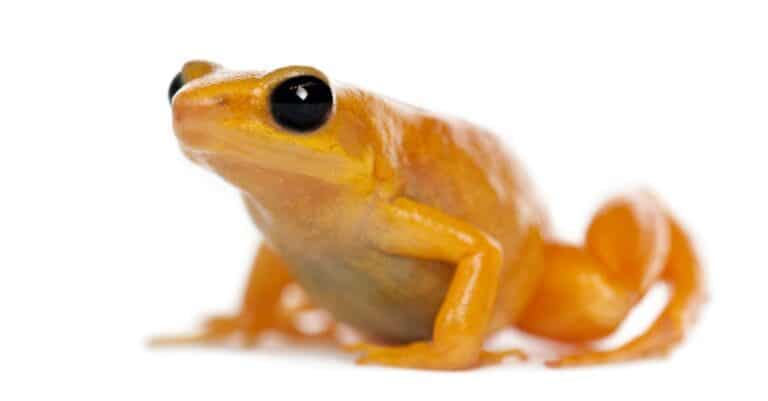
Most Mantella frogs have brightly colored markings for a very specific reason. Instead of wanting to camouflage themselves on the ground or in trees, they use their skin color to communicate to potential predators that they are toxic and not good to eat. These adaptations them aposematic. Their bright orange, bronze, yellow, blue, or green back markings are also why they are named for the feminine Italian word “cloak.”

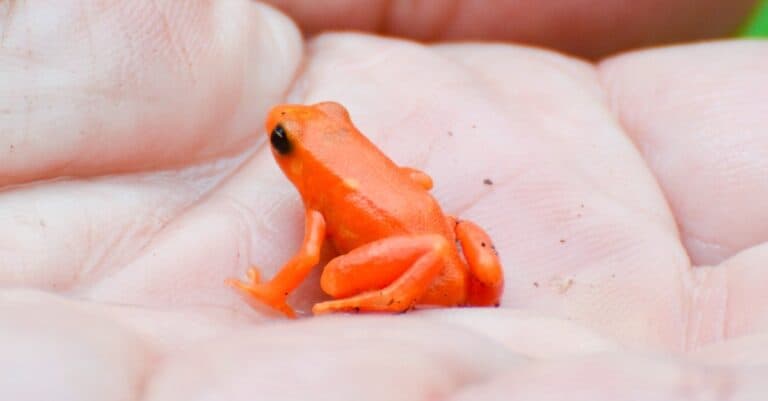
Mantella frogs are tiny. They only measure from 0.71in –1.22in (18mm-31mm) and are the second smallest genus of frogs in the world. They are similar in size to the smallest reptile in the world, the Virgin Islands dwarf gecko, and the smallest mammal, Kitti’s hog-nosed bat. Despite being so small, they are diurnal. They come out during the daytime to feed and explore, instead of being nocturnal like most other non-toxic frogs. In fact, they rely on their back colors being seen to keep them safe.

Adult mantellas live in colonies. These colonies are small but have two male frogs for every female. During the breeding season, the males move away to their own territories and become protective of their reign in those spaces, pushing out other males. Females are larger than males.
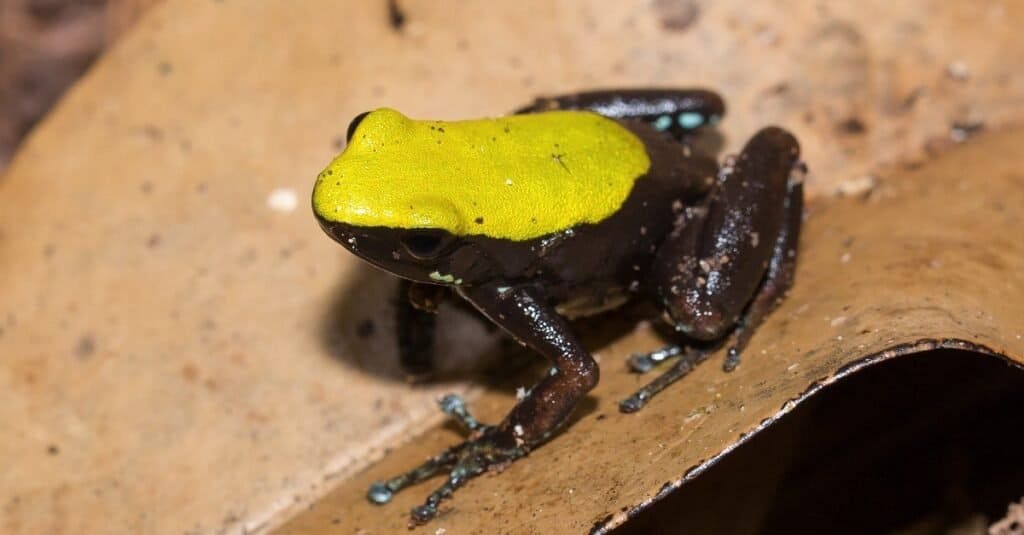
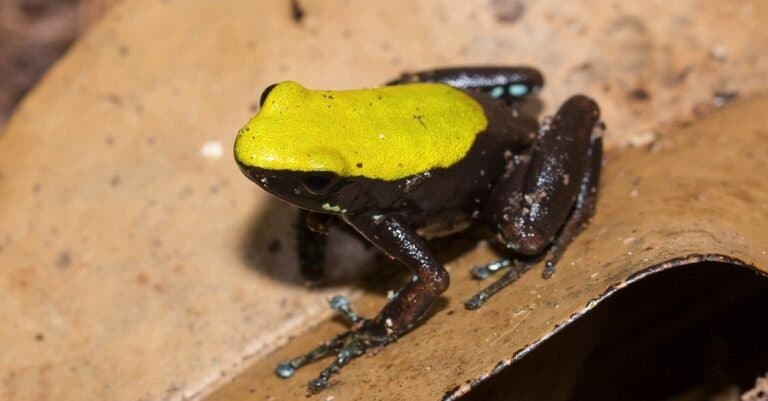
Beautiful small endemic black and yellow frog, Climbing Mantella (Mantella laevigata).

Beautiful small endemic black and yellow frog, Climbing Mantella (Mantella laevigata).

Mantella Frog Habitat

Mantella frogs live in the island nation of Madagascar off the coast of Africa and its smaller coastal islands. Within this region, the frogs live in various habitat types. They include primary and secondary rainforests, swamps, wet canyons, semi-arid streambeds, bamboo forests, seasonal streams, forest streams, and grassland savannah.

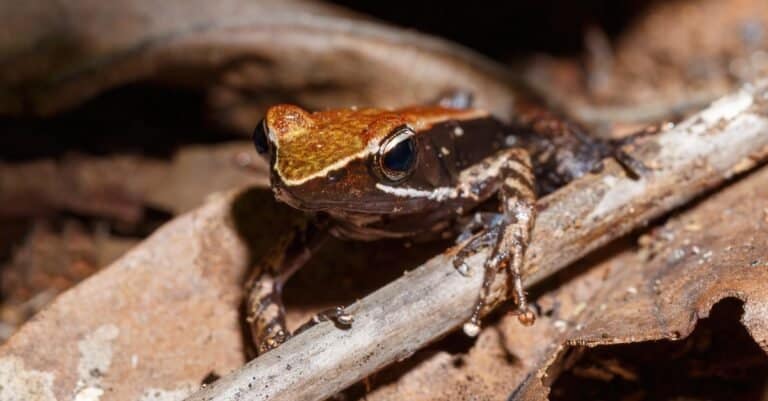
Some Mantellas have even made adaptations for living in unusual areas. The most adaptable members of the genus are Ebenau’s Mantella (Mantella ebenaui), brown Mantella (Mantella betsileo), and Cowan’s Mantella (Mantella cowanii). Some of these Mantellas have been found living behind human dwellings in trash piles and in regional trash dumps where they feed on flies and ants.

Most mantellas live on the ground. But two, such as the arboreal Mantellas, prefer living in trees. Among the frogs’ adaptations to their habitat include the absence of webbed toes. Mantellas do not have these features because they do not typically swim. They stay among leaves on the jungle floor, frequently climbing over debris like branches. Their legs are shorter in proportion to other frogs’ legs, too. Their short limbs help them climb better. One species, the arboreal Mantellas, have sticky rounded fingertips that help them climb and hang onto trees.

Mantella Frog Predators & Threats

What do mantella frogs eat?

Mantellas eat mostly fruit flies, ants, termites and other insects. From their diet, most frogs in the genus get alkaloid toxins that they use to defend themselves from their own predators. The frogs secrete the toxins through their skin to make a predator sick. These toxins also taste bad to creatures trying to eat them. Together with their brightly colored skin, this bad taste is one of their best survival adaptations.

What eats the mantella frog?

Small mammals, snakes and birds are the primary predators of Mantella frogs. These predators sometimes eat the frogs despite their aposematic colors warning them of the Mantellas’ foul taste and toxicity. In response to an attack, the frog excretes poison through their skin. This poison can make the aggressor sick but will not kill them.

Other threats to Mantella conservation include climate change and habitat loss from farming, agriculture, urban development, logging, and mining. Humans are also predators, targeting the Mantellas as part of the pet trade. Because mantellas absorb water through their skin like all other amphibians, they are highly vulnerable to changes in the environment. In fact, the frog’s population health is a good indicator of the environment’s health.

Reproduction, Babies, and Lifespan

Mantellas breed in spring. During this season, the males leave the colony and claim a territory that they protect from other males. If a male comes into the territory, the owner wrestles him to assert dominance, pushing the invader out.

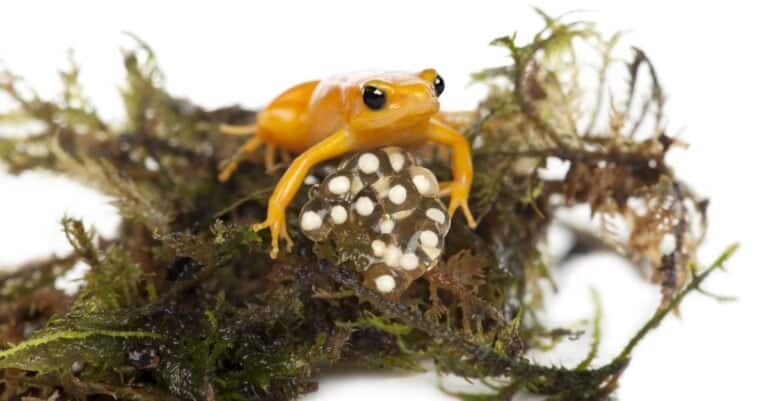
To start the mating ritual, the male calls out to females using rapid and short clicking sounds. In the first major rainstorm of the mating period, the ground-dwelling female deposits her eggs in short tunnels she creates or among damp leaves. The tree-climbing Mantella deposits eggs in tree holes. Males care for the eggs until they hatch into tiny tadpoles. Gestation is just a few days.

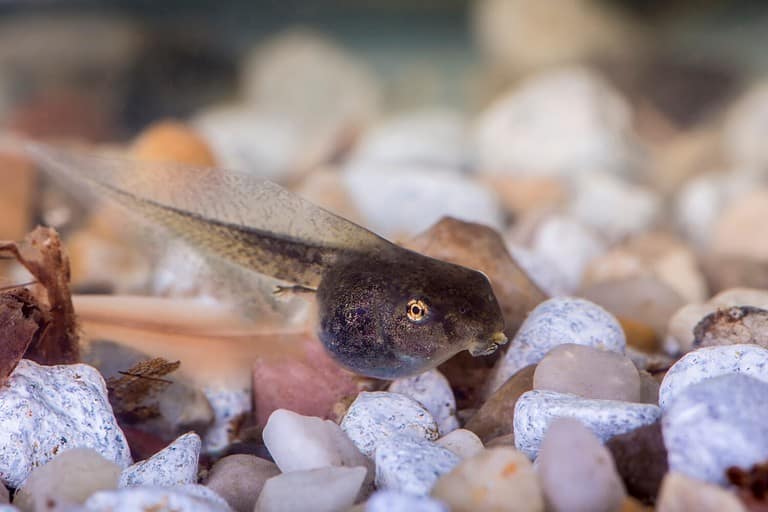
Tadpoles are washed by the rain into nearby pools. There, they feed on algae while they grow for about 6 to 8 weeks into froglets measuring 0.4 inches (11 millimeters) long, equal to the length of a dime. The froglets are not colorful like their parents. Instead, they are a well-camouflaged dull brown for the next several months. Over this period, they slowly transition into adult colors. At a year of age, they become sexually mature.

Mantella Frog Population

According to the IUCN, 11 species of the Mantella frog are at risk. One is critically endangered, five are endangered, four are vulnerable and one is near threatened. One of the biggest issues in the frogs’ conservation is climate change. Pollution is another problem because they absorb water through their skin, taking in environmental toxins. Human predation is another issue of conservation because there is a high demand on the pet market for these tiny animals.

  • Black-eared mantella (Mantella milotempanum) – Critically endangered
  • Green golden frog (Mantella viridis) – Endangered
  • Blue-legged mantella (Mantella expectata) – Endangered
  • Cowan’s mantella (Mantella cowanii) – Endangered
  • Haraldmeier’s mantella (Mantella haraldmeieri) – Endangered
  • Golden mantella (Mantella aurantiaca) – Endangered
  • Bernhard’s mantella (Mantella bernhardi) – Vulnerable
  • Eastern golden frog (Mantella crocea) – Vulnerable
  • Madagascan mantella (Mantella madagascariensis) – Vulnerable
  • Mantella manery – Vulnerable
  • Parker’s golden frog (Mantella pulchra) – near threatened
View all 329 animals that start with M

Sources

  1. Wikipedia / Accessed October 1, 2021
  2. National Geographic / Accessed October 1, 2021
  3. San Diego Zoo / Accessed October 1, 2021
  4. Seaworld Parks & Entertainment / Accessed October 1, 2021
  5. Science Direct / Accessed October 1, 2021
  6. Amphibia Web / Accessed October 1, 2021
  7. Wiley Online Library / Accessed October 1, 2021
  8. NHBS / Accessed October 1, 2021
  9. Reptiles Cove / Accessed October 1, 2021
  10. Hand Wiki / Accessed October 1, 2021
  11. The Frog Lady / Accessed October 1, 2021
  12. Britannica / Accessed October 1, 2021
  13. Mantella / Accessed October 1, 2021
  14. Cambridge Dictionary / Accessed October 1, 2021
A-Z Animals Staff

About the Author

A-Z Animals Staff

AZ Animals is a growing team of animals experts, researchers, farmers, conservationists, writers, editors, and -- of course -- pet owners who have come together to help you better understand the animal kingdom and how we interact.
Connect:

Thank you for reading! Have some feedback for us?


Mantella Frog FAQs (Frequently Asked Questions)

Mantella frogs are carnivores. They feed on small insects like ants, fruit flies, and termites. From these insects, they obtain the toxins that they collect and excrete through their skin to deter their own predators.