
Quick Take
- Ospreys evolved a physical trick that most birds of prey lack, and it is the reason a slippery fish almost never escapes their grip. See the grip adaptations →
- Diving straight at a fish in water is actually the wrong move, and ospreys have figured out why. This knowledge makes them far deadlier than their competitors. Explore the dive technique →
- Their diet is radically narrower than almost any other raptor, yet it gives them a decisive hunting edge other predators don't have. See their narrow diet →
Ospreys (Pandion haliaetus) are large, predatory birds that inhabit every continent except Antarctica. They are commonly referred to as sea hawks, river hawks, and fish hawks, showing their preference for aquatic habitats with plenty of fish. Ospreys have white or gray chests and necks, with brown wings and backs. Their sharp hooked beaks are perfect for tearing into prey, and their talons are specially designed to catch slippery fish. Let’s take a look at some of the things that ospreys eat, plus some of the things that make them the incredible hunters that they are.
The Osprey Diet
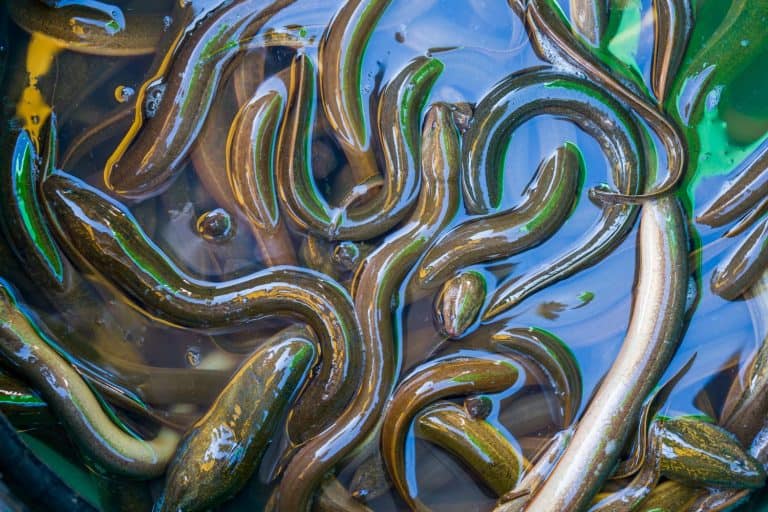
Ospreys are phenomenal hunters, but their diet is uncommon among raptors. They are piscivorous, getting 99% of their calories from fish. Additionally, they are considered generalist eaters. It typically does not matter what type, species, or size of fish it is — an osprey will eat it all.
On average, an osprey kills and eats fish that are 10–14 inches long and weigh between 5 and 11 ounces (roughly a third to two-thirds of a pound). Still, ospreys aren’t picky and will eat anything they are physically able to lift out of the water. They also hunt in freshwater and saltwater habitats.
Although most of an osprey’s diet is made up of fish, they will occasionally prey on other small animals. Most of their non-fish prey comes from small mammals, but other birds, amphibians, and reptiles are occasionally on the menu.
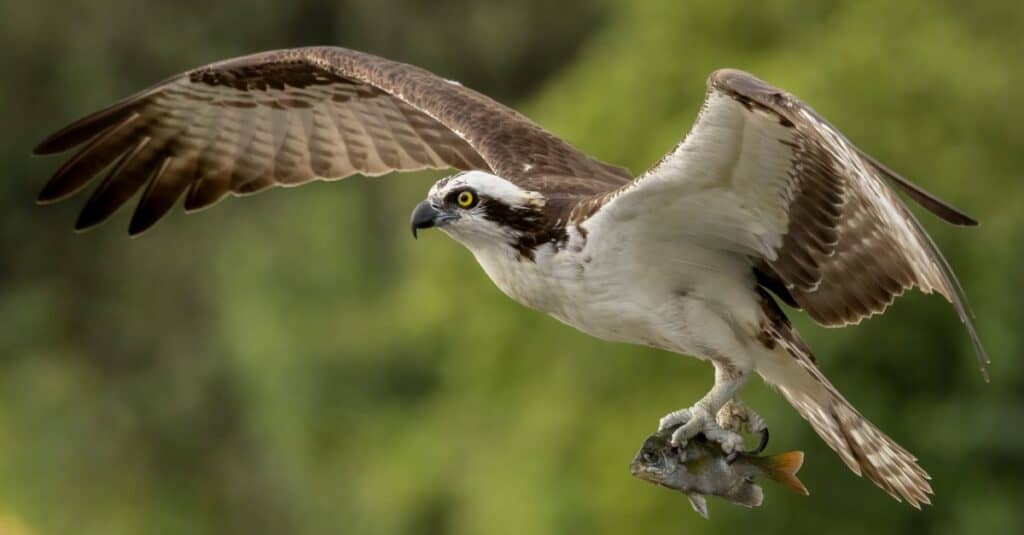
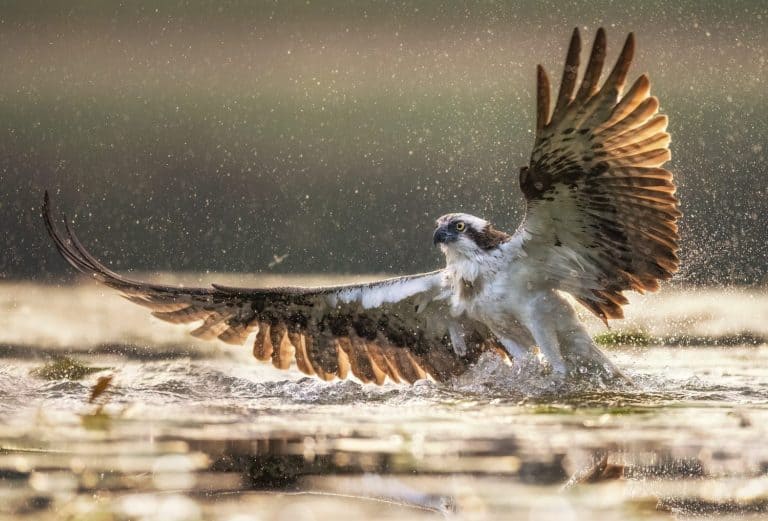
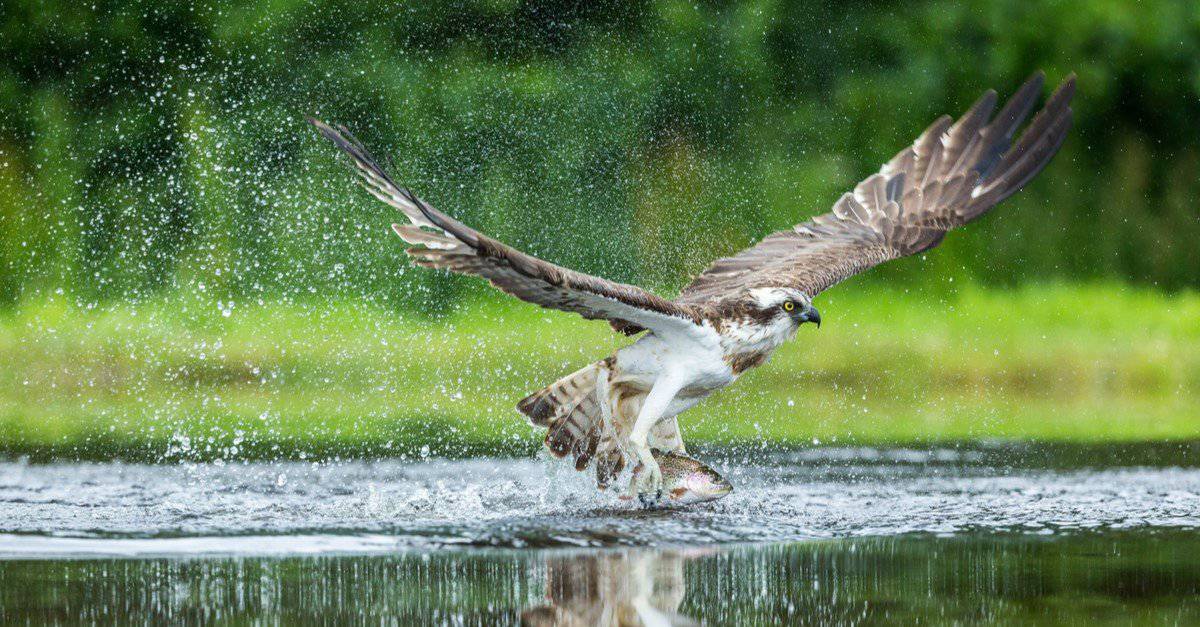
Ospreys fly over lakes and rivers and along coastlines searching for fish.
©iStock.com/Harry Collins
While there is some variation depending on their specific habitat, ospreys generally eat the following foods:
- Flounder
- Smelt
- Mullet
- Bullhead
- Spotted trout
- Sucker fish
- Gizzard shad
- Catfish
- Sunfish
- Small mammals
- Amphibians
- Reptiles
- Small birds
How Do Ospreys Hunt?
Ospreys are truly some of the best fishers in the world. They have both physical adaptations and behavioral adaptations that aid in their success. Take an in-depth look at these adaptations in the sections below.
Physical Adaptations
There are some amazing evolutionary adaptations that ospreys have developed to suit their fishy diets. One of the most helpful is their reversible outer toes. Generally, a bird of prey has four talons, three in the front and one in the back. Ospreys have developed the ability to rotate one of their toes backward, allowing them to grip with two toes in the front and two in the back. For elongated and slippery fish, this modified grip makes sure they never drop their catch. Additionally, ospreys have sharp spines and rough pads on their feet, adding extra grip. When they grab a fish, the rough pads and sharp spines lock the fish in. As a bonus adaptation, their scales are even backward-facing on their feet, giving them even more grip. It’s safe to say that once an osprey gets hold of a fish, it isn’t getting away!
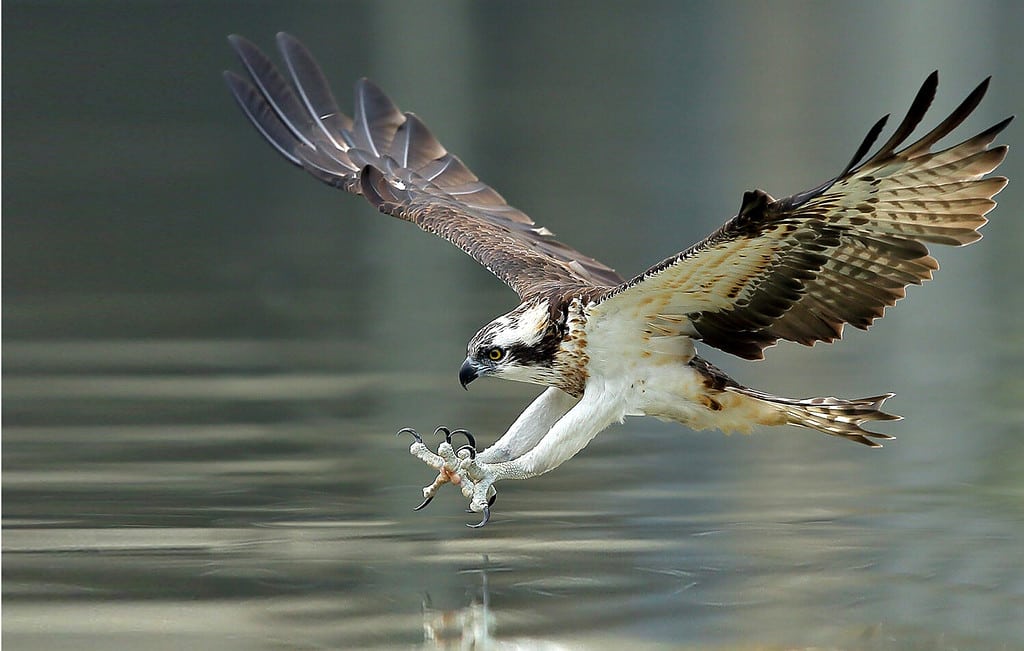
Ospreys can rotate one toe so they can grip with two toes in the front and two in the back.
©Wang LiQiang/Shutterstock.com
Outside of their claws, ospreys have closable nostrils. When they dive for their food, they drop into the water, sometimes even sinking their whole bodies. Having nostrils that can close ensures that they never breathe in water by accident. On top of that, their plumage is especially thick and oily when compared to other birds of prey. This allows them to shed water as waterfowl would so they don’t get bogged down after making a catch.
Behavioral Adaptations
Ospreys are incredibly successful when they hunt. On average, they spend 12 minutes looking for food and are generally successful, catching a fish out of every four attempts. In some places, ospreys are known to achieve success rates of up to 70%, but they can generally only catch fish within 3 feet of the surface.
The first thing ospreys do while hunting is fly above the water, roughly 30–130 feet high, and look for fish below. When it spots one, it will then hover before plunging towards the water with feet outstretched. What makes the osprey so effective is that it adjusts its flight angle as it dives to account for the water’s refraction of light around the fish. This adjustment makes them much more accurate. Once it hits the water, the osprey will close its nostrils, grab the fish, and then head to a nearby perch to eat.