Quick Take
- White pit bulls carry a hidden health risk that surprises most adopters, and it has nothing to do with temperament. See the hidden health risk →
- Breed clubs actively discourage a certain coat color in pit bulls, and there is science behind the reason why. Explore the breed club science →
- White pit bulls and albino pit bulls look similar, but confusing the two could affect how you care for your dog. Spot the key differences →
- Adopting a deaf pit bull is more manageable than most people think, provided you know one key communication trick first. Learn the key communication trick →
The term pit bull does not refer to a single specific breed. Pit bull is an umbrella term used to describe multiple breeds, including the American pit bull terrier, the American Staffordshire terrier, the Staffordshire bull terrier, the American bully, and countless mixed-breed dogs that share this general appearance. Because identification is often based purely on visual traits like a short coat, a broad, blocky head, powerful jaws, and a stocky, muscular build, many entirely unrelated breeds are frequently mislabeled as pit bulls, making the term more of a description of appearance than a strict genetic classification. However, this article focuses on the American pit bull terrier and the American Staffordshire terrier.
Are White Pit Bulls Rare?
Currently, the AKC (which recognizes the American Staffordshire terrier) permits registered AmStaffs to have white coats but discourages coats that are all-white or more than 80% white. The UKC, which recognizes the American pit bull terrier, accepts all coat colors except merle and albino.

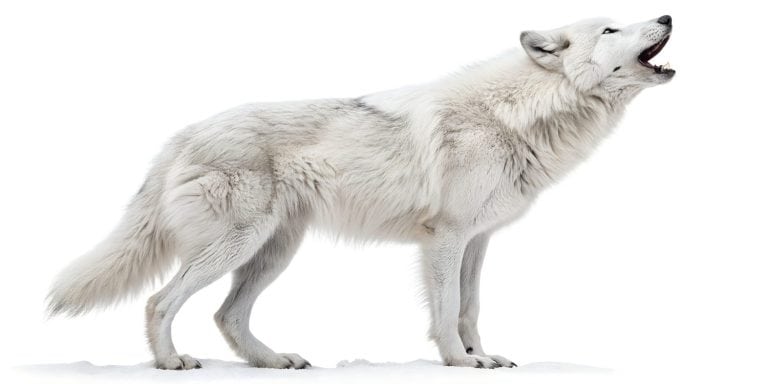
Solid white pit bulls are incredibly rare.
©Anna_Bondarenko/Shutterstock.com
The reason some clubs discourage white coats in pit bulls is that these dogs have a much greater risk of congenital deafness. The strength of this relationship between white coat color and deafness varies across breeds. Studies indicate that bull terrier breeds, along with others such as dalmatians, boxers, and Australian shepherds, are at higher risk of congenital deafness in one or both ears when their coats are all or mostly white. In the American pit bull terrier and the American Staffordshire terrier, the piebald gene is associated with an increased risk of deafness. The rate of congenital deafness in white bull terriers is estimated at 20–30%, compared to about 1% for bull terriers with colored coats or color patches.

The rate of white bull terriers born partially or fully deaf is 20%.
©Veronica Varos/Shutterstock.com
Adopting A White Pit Bull
If you are considering adopting a white pit bull, the first thing to understand is that you can perform a preliminary hearing assessment by observing how the dog responds to sound stimuli. In a noisy shelter environment, find a quiet spot to make this observation easier. If you suspect this pup may have partial or full hearing loss, you’ll need to consider the challenges involved in training a deaf dog.
What If I Want to Adopt a White Pitbull Who is Partially or Fully Deaf?
Partially and fully deaf white pit bulls can absolutely lead fulfilling, happy lives. Before adopting a deaf pit bull, research how to compassionately care for a deaf dog and support their safety and well-being, as this may require learning new ways to communicate and interact.

You can save the life of a white pit bull, hearing or deaf, by adopting from a shelter.
©Hannah Carl/Shutterstock.com
As with any dog, prioritize building a secure attachment bond so your white pit bull knows it is safe with you and that you are a consistent source of support, care, and companionship. If you do adopt, it will be important to know how to communicate with your pup most effectively, lovingly, and compassionately. Rewarding education, enrichment, a secure attachment bond, and support for your dog’s ability to safely engage and disengage are all crucial for any dog, including deaf ones.
Communication and Safety
If you do adopt a deaf white pit bull, focus on hand signals, eye contact, and other visual cues—such as lights turning on and off—to communicate. Non-coercive positive reinforcement will help your pup feel safe and excited to engage with you.
Most dogs find hand signals easier to process than verbal cues anyway. For safety purposes, some caregivers of deaf dogs use both a non-restrictive harness and a comfortable collar when outdoors. Having a fenced-in yard can also help ensure the safety of deaf pups.

Focus on facilitating rewarding education and communication with your white pit bull.
©Crystal Alba/Shutterstock.com
Are White Pit Bulls and Albino Pit Bulls the Same?
Pit bulls with white coats are not typically albino. Dogs with albinism have a significant deficiency in—or a total lack of—the pigment melanin, and may have pink eyes, light pink skin, and a pink nose. While white-coated, non-albino pit bulls may have patches of skin without melanin, they generally also display pigmented skin.

Albino pit bulls may have icy blue eyes.
©yhelfman/Shutterstock.com
For both albino and non-albino white pit bulls, it is important to take extra precautions to protect them from sunburn. Because white pit bulls often have patches of light skin, owners should apply dog-safe sunscreens, especially for pups who like to sleep on their backs in the sun.