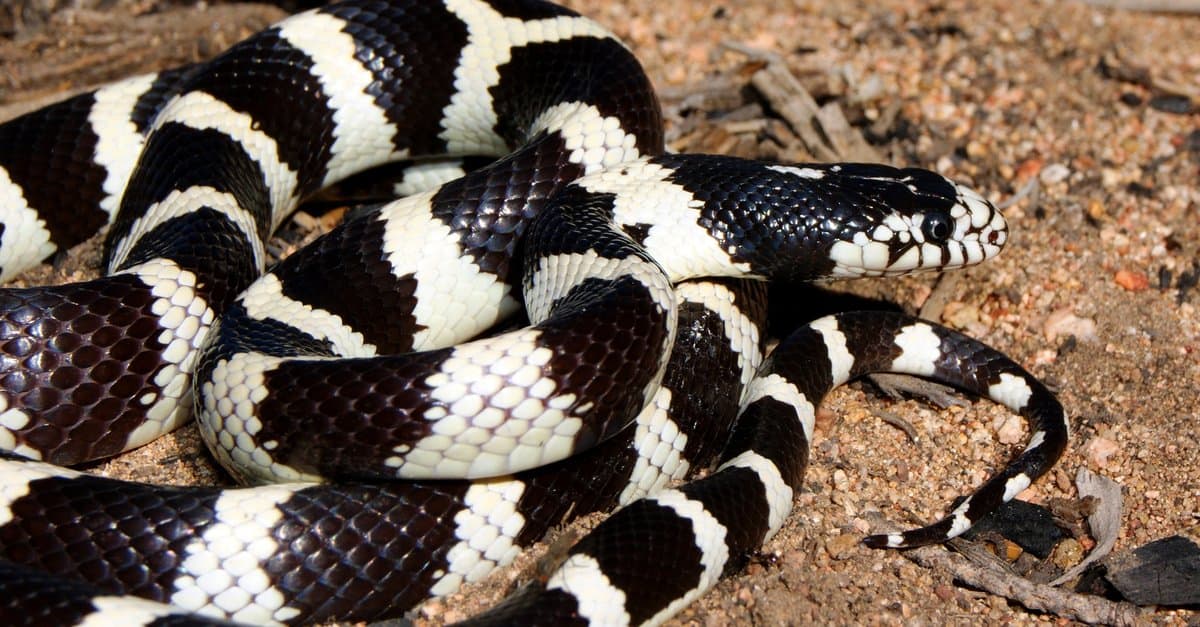

Quick Take
- One black-and-white snake's venom is drop-for-drop more powerful than most land snakes, yet it's considered nearly harmless to humans for a surprising reason. Meet the sea krait →
- A snake nicknamed the 'hoop snake' exists in six distinct species, all of which can only be found in one place on Earth. Explore the six species →
- One of these black-and-white snakes actively hunts rattlesnakes and copperheads, and it is valued for a pest control reason most people overlook. See the kingsnake's role →
- Not all striped whipsnakes are black and white, so how do you know when you're actually looking at one? Learn to identify it →
There are over 4,000 recognized species of snakes across the globe that range from massive constrictors to tiny, worm-like burrowing species. Snakes occupy nearly every continent and body of water except Antarctica. The majority of the world’s snake species are earth tones like brown, gray, and drab green for camouflage, or vibrant reds, yellows, and oranges to signal toxicity. Very few snake species are truly black and white, but some do exist. Continue reading to learn about some black and white snakes and where to find them.
Bandy-Bandy
The bandy-bandy (Vermicella) is also known as the hoop snake. Both of these common names refer to the black and white bands or hoops that wrap around the length of the snake’s body. There are six different species of bandy-bandy snakes. However, you will only find these species in Australia. They have a black-and-white banded pattern.
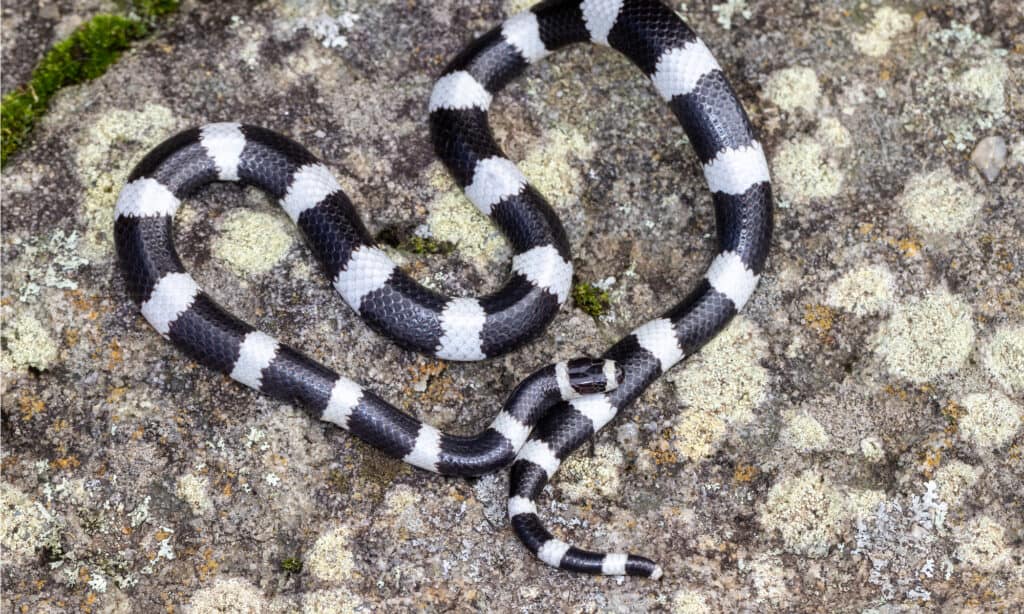
Bandy-bandy snake is native to Australia and has six different species.
©Ken Griffiths/Shutterstock.com
The Eastern bandy-bandy (Vermicella annulata) is the most common species of this black-and-white snake. They are found in the Northern and Eastern regions of Australia. Eastern bandy-bandys thrive in a variety of habitats, from coastal forests to desert sandhills.
The wide-banded Northern bandy-bandy (V. intermedia) is less common. They thrive in eucalyptus forests. It is closely related to the Northern bandy-bandy (V. multifasciata), and both species inhabit the same areas in Australia. You can distinguish them by the number of bands: the Northern bandy-bandy has over 75 bands, while the wide-banded Northern bandy-bandy has fewer than 75.
The Pilbara bandy-bandy (V. snelli) is only found in the Pilbara region of Western Australia, and the Weipa bandy-bandy (V. parscauda) is only found in the Weipa region of Australia.
Banded Sea Krait
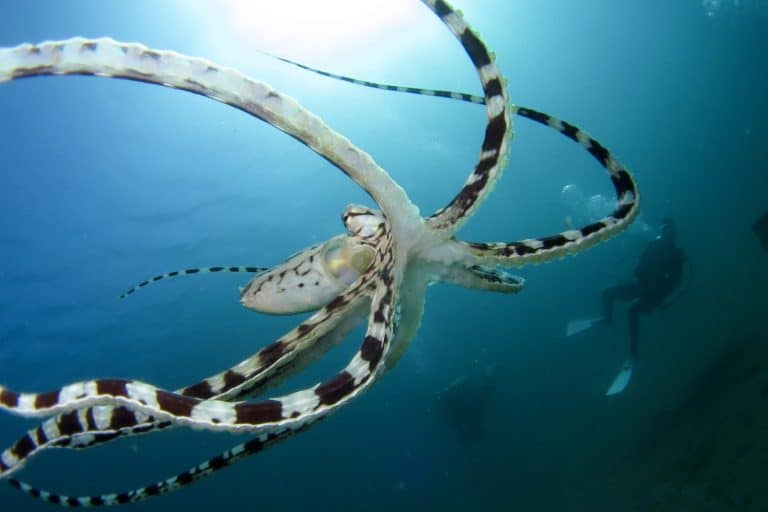
The banded sea krait (Laticauda colubrina) is a semi-aquatic marine reptile widely distributed throughout the Indo-Pacific Ocean, ranging from the Eastern coast of India and Southeast Asia to Northern Australia and the Pacific islands.
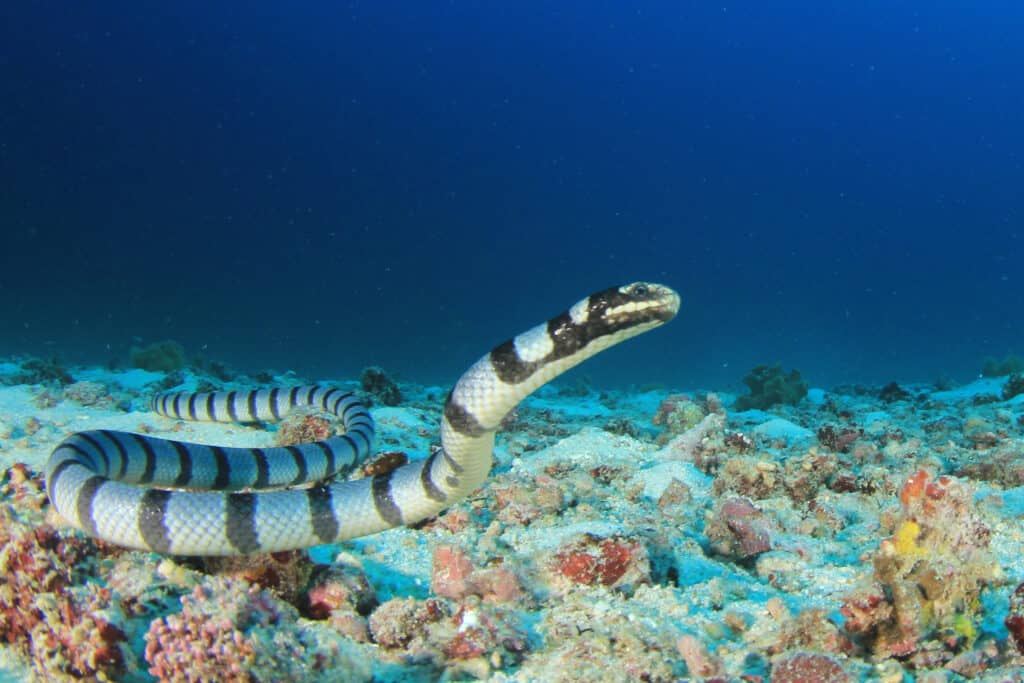
Sea kraits are known for being a venomous species, and many can be identified through their black-and-white colors.
©Rich Carey/Shutterstock.com
These snakes can grow to five feet long. The banded sea krait features a distinct pattern of alternating black and bluish-grey or white bands along the entire length of its body. This high-contrast coloration serves as a warning to potential predators that the snake is highly venomous.
Banded sea kraits use this potent neurotoxic venom to paralyze their prey, such as eels and small fish. Although its venom is, drop for drop, significantly more powerful than that of many terrestrial snakes, the banded sea krait poses a low real-world risk to humans due to its exceptionally docile, non-aggressive temperament.
Common Kingsnake
The common kingsnake (Lampropeltis getula) has several subspecies, such as the Eastern kingsnake (L. g. getula), Carolina kingsnake (L. g. floridana), and chain kingsnake (L. g. getula), each with its own range and characteristics. The common kingsnake is known for its black-and-white bands and its pest control abilities. Kingsnakes are opportunistic feeders that eat rodents and other snakes, including venomous species such as rattlesnakes and copperheads.
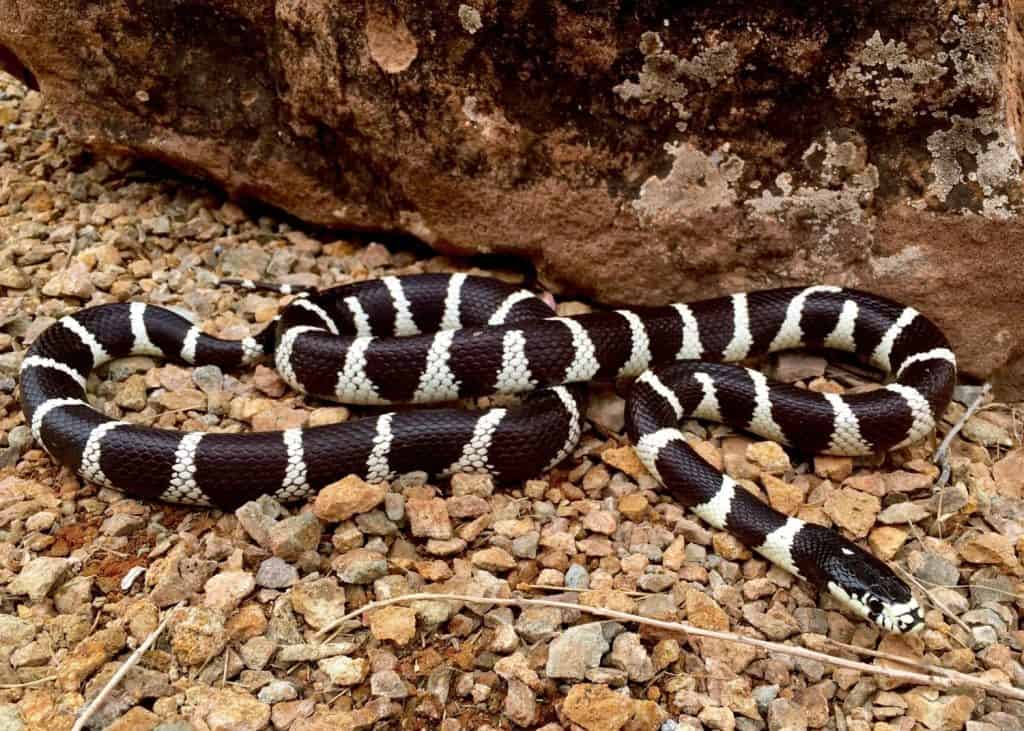
Common kingsnakes are found throughout much of the Eastern and Central United States.
©Matt Jeppson/Shutterstock.com
Butler’s Wolf Snake
The Butler’s wolf snake (Lycodon butleri) is a species of snake native to Thailand and Malaysia. This species is named after Arthur Lennox Butler, a Karachi-born British zoologist. Butler’s wolf snakes are found in montane forests, which are known for their rich and unique biodiversity, supporting species that other ecosystems cannot.
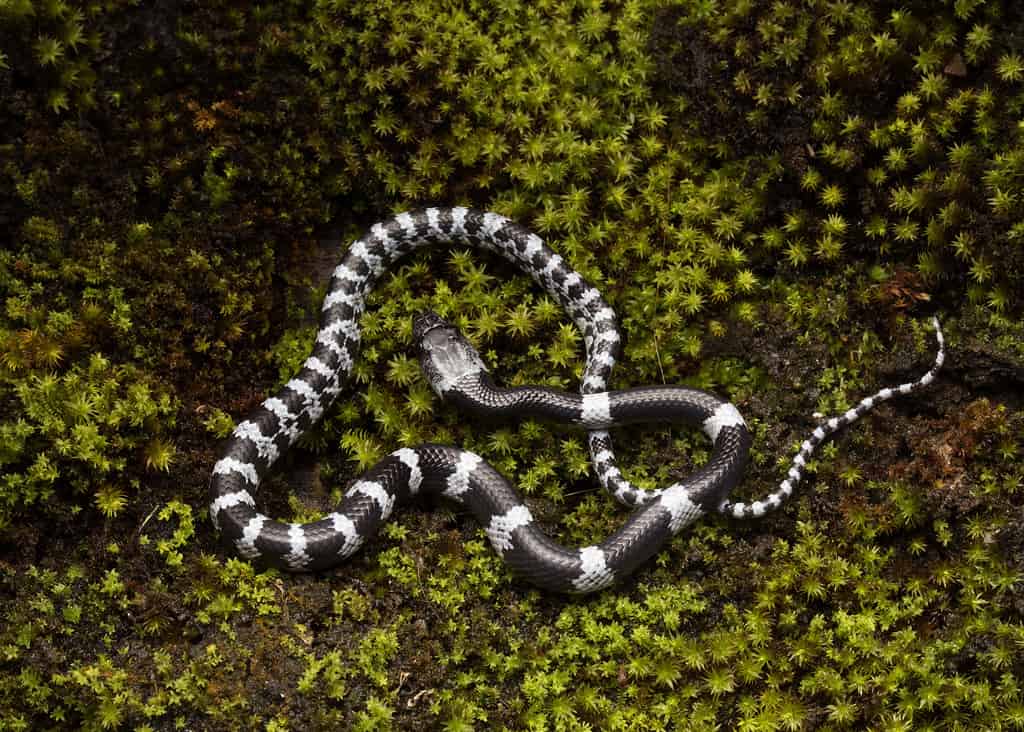
The Butler’s wolf snake lives in a habitat known as the montane forest.
©iStock.com/Vince Adam
Striped Whipsnake
The striped whipsnake (Masticophis taeniatus) is a nonvenomous species known for its dark dorsal side with two light stripes running lengthwise down its body. However, it can also come in other colors, such as brown or olive green. It is native to the Western United States and Mexico, where it can be found as far south as Michoacán.
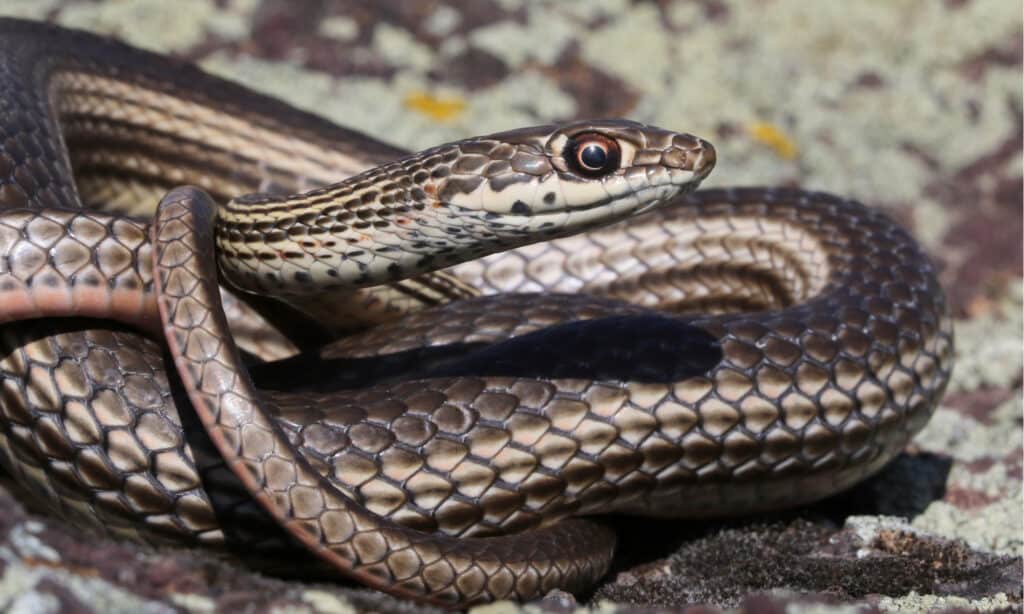
This black-and-white snake, known as the striped whipsnake, is found in the United States and Mexico.
©Randy Bjorklund/Shutterstock.com