Quick Take
- One of these snakes slithers into people's homes at night and bites them while they sleep. There is no antivenom to treat it. Meet the krait →
- A snake that hunts king cobras needs venom so extreme it produces an effect unlike anything else on this list. See its unique venom →
- One of these species looks harmless enough that even experienced handlers have been fatally fooled, and to this day no cure exists. Discover this deceptive snake →
- A zoo employee was bitten by one of these snakes in 2021, and doctors had no antivenom to give them. Read about the 2021 bite →
Imagine stepping off the trail to take a photo of a unique wildflower when you suddenly feel a prick on your ankle. You look down to see the tail end of a snake slithering away. What just bit you? If you are not sure, you should seek treatment immediately. Many major U.S. hospitals are equipped with antivenom for snakebites from rattlesnakes, copperheads, and cottonmouths. However, because coral snake bites are incredibly rare and antivenom is extraordinarily expensive, most hospitals in the U.S. do not stock it, although it can be obtained. In other parts of the world, however, some snake species have no antivenom at all. Continue reading to discover five snake species for which there is no antivenom.
Variable Bush Viper
The variable bush viper (Atheris squamigera) is a venomous snake found in the central and western countries of Africa. They are arboreal snakes, meaning they prefer to live in trees. These snakes live in tropical rainforests and rarely come into contact with humans, which is fortunate because there is no antivenom for the African bush viper. They typically grow 18 to 24 inches long and are bright green, red, orange, or yellow.
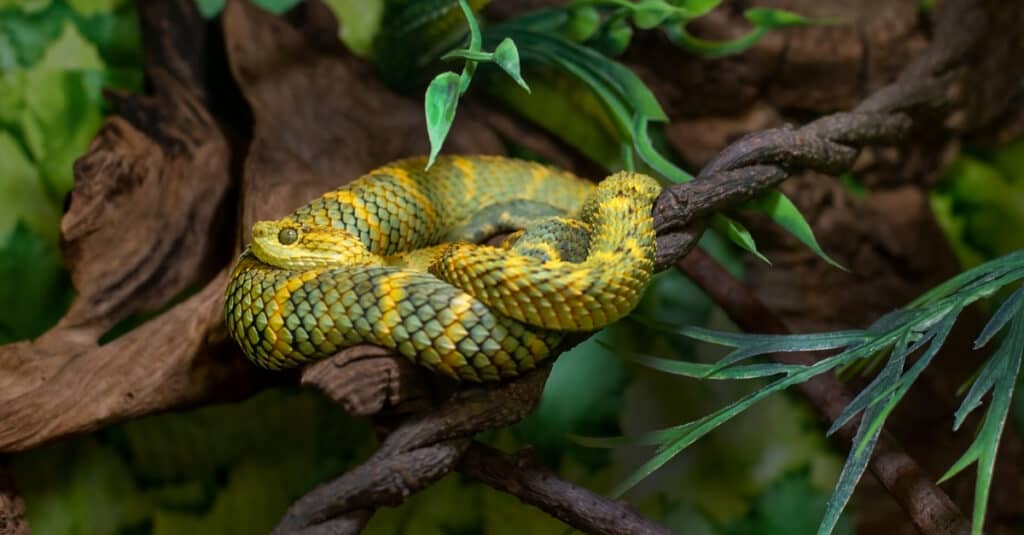
There is no antivenom for African bush vipers, including the variable bush viper.
©Marina Yesina/Shutterstock.com
In April of 2021, a zoo employee at the San Diego Zoo was bitten by a variable bush viper. The victim was rushed to the nearest hospital for evaluation and medical care. The venom of the variable bush viper is a hemotoxin, which slows blood clotting, destroys red blood cells, and can cause tissue damage and internal bleeding. A later report stated that the worker was recovering at home and should make a full recovery. The severity of a bite can depend on the snake’s age, the type of bite, and other factors.
Spiny Bush Viper
The spiny bush viper (Atheris hispida) is usually green with spiky scales that stick up. Males can grow up to about 29 inches long and live mostly in trees. They can be found in the central regions of Africa in swamps, woodlands, and tropical rainforests.

The spiny bush viper looks like a dragon.
©reptiles4all/Shutterstock.com
There is no antivenom for the spiny bush viper, and its venom is a neurotoxin that can also cause internal hemorrhaging of organs. Because the spiny bush viper lives in secluded areas, bites on humans are extremely rare.
Malayan Blue Coral Snake
The Malayan blue coral snake (Calliophis bivirgatus) is a beautifully colored snake with a bright red head, tail, and belly, a dark blue or black back, and blue or white stripes along each flank. They are medium-bodied snakes that typically grow up to about 5.9 feet (1.8 meters) in length.

The Malayan blue coral snake has a unique coloration with a bright red head and tail and a dark blue back with bright blue side stripes.
©reptiles4all/Shutterstock.com
Malayan blue coral snakes only live in Southeast Asia, and their numbers are dwindling due to habitat loss. The venom of the Malayan blue coral snake acts rapidly, immediately producing full-body spasms and paralysis. Malayan blue coral snakes possess unusually long venom glands, extending to around 25% of their body length. They need such potent venom because they eat highly venomous snakes, such as the king cobra.
Sind Krait
The Sind krait (Bungarus sindanus), which lives in Western India, is a venomous snake that belongs to the cobra family. Kraits (which rhymes with ‘bites’) comprise 18 different species of terrestrial snakes. They vary in color and can grow up to 6½ feet long. Sind kraits frequently live near humans, resulting in a high number of fatal bites.

The Sind krait’s venom is 40 times more potent than that of the common cobra.
©Arabindu Sardar/Shutterstock.com
In India and Pakistan, kraits and cobras are collectively responsible for tens of thousands of deaths per year, with India alone averaging approximately 58,000 snakebite deaths annually and Pakistan accounting for around 20,000. While common kraits (Bungarus caeruleus) cause the vast majority of krait-related deaths due to their extensive geographic range, the Sind krait is responsible for fatal bites in the northwestern regions of India. Kraits will slither into people’s homes, huts, and living quarters at night, biting them while they sleep.
Researchers have found that the Sind krait’s venom is 40 times more potent than that of the common cobra.
Savanna Twig Snake
The Savanna twig snake (Thelotornis capensis), also widely known as the Southern vine snake, is a slender, arboreal snake distributed across Eastern and Southern Africa. Exceptionally well camouflaged to mimic tree branches, these slender, rear-fanged serpents reach an average length of 3.2 feet.
Despite their highly potent, slow-acting hemotoxic venom, no antivenom exists for the savanna twig snake’s bite, primarily because human envenomations are exceedingly rare. Savanna twig snakes are responsible for virtually no human deaths, with historical fatalities limited to a few isolated cases, such as herpetologist Robert Mertens, and others involving snake handlers.

Savanna twig snakes blend into their environment by looking like a twig. They can also puff their head up if they are threatened.
©Morne Carstens/Shutterstock.com