
Quick Take
- Two of these yellow snakes are genuinely dangerous, though not necessarily the ones you would expect.
- Some of these snakes are technically venomous yet completely harmless to humans, and the reason why is stranger than you'd think. See why it's harmless →
- One species spends its entire life in the ocean and carries lethal neurotoxic venom, yet it rarely poses a real threat to beachgoers. Explore this ocean species →
- The most dramatically defensive yellow snake on this list isn't venomous at all, and its bluff is surprisingly convincing. See the convincing bluff →
Yellow appears to be the brightest color in the rainbow, and many snakes around the world sport this beautifully brilliant color. Some snakes are solid yellow, while others have yellow stripes or blotches. The vibrancy of yellow coloring is often associated with dangerous animals. However, many other dazzling yellow snakes are nonvenomous and completely harmless to humans. Keep reading to take a closer look at 10 of these charmingly yellow snakes.
Yellow Rat Snake
The yellow rat snake (Pantherophis quadrivittatus) has a mustard yellow body with thin brown or black stripes along its length. Occasionally, it may also be green or orange instead of yellow. Yellow rat snakes are not very fast, but they can climb trees quite well due to the angled scales on their bellies that help them to grip.
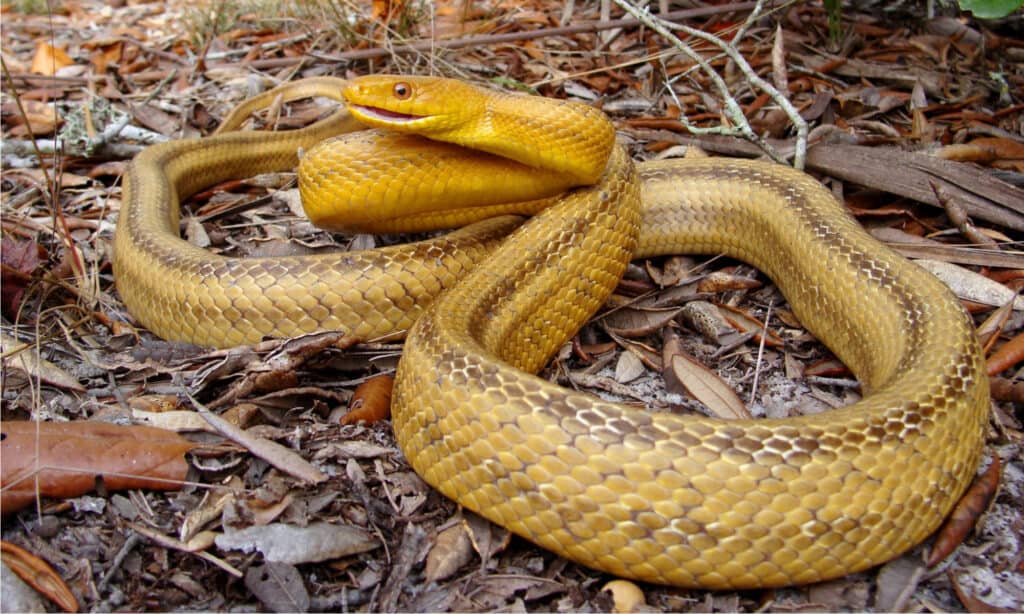
Although they are nonvenomous, yellow rat snakes can bite, but generally do not.
©Matt Jeppson/Shutterstock.com
These snakes are considered by many taxonomists to be their own species, though they have also been classified as a subspecies of the western rat snake, and live in the Southeastern United States. When threatened, a yellow rat snake may choose to freeze, play dead, vibrate its tail like a rattlesnake, or stand and fight. Although these snakes are nonvenomous, they can bite repeatedly.
Jamaican Yellow Boa
The Jamaican yellow boa (Chilabothrus subflavus) is a large, nonvenomous snake only found on the island of Jamaica in the Caribbean. This snake is yellow, orange, or red-brown with black markings. Jamaican yellow boas are 6 ½ feet long on average.
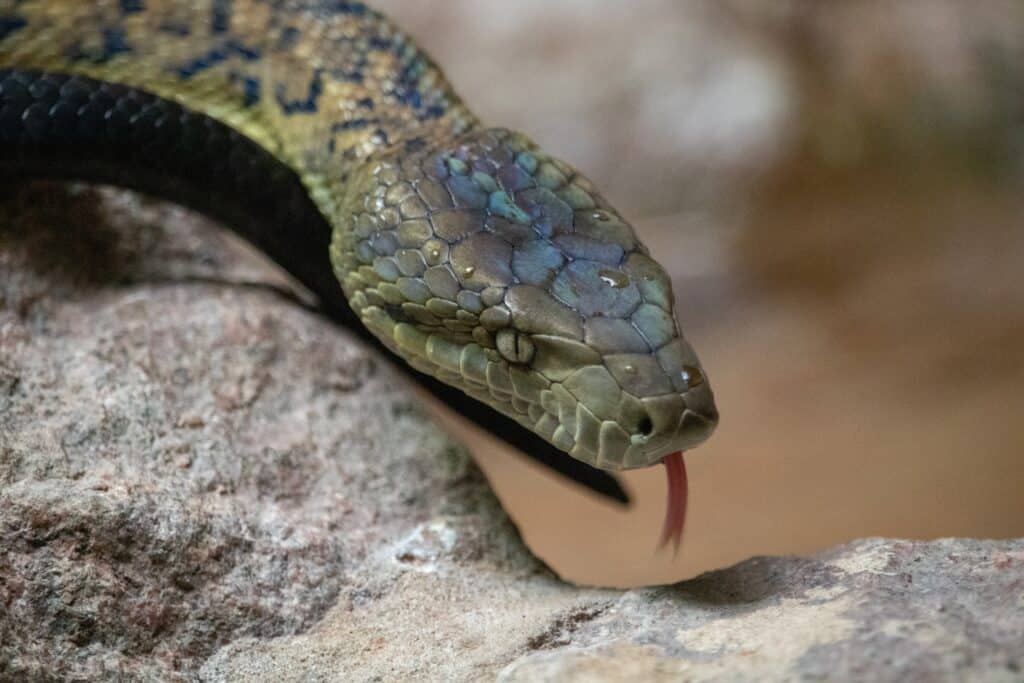
Jamaican Yellow Boas are the largest native predators in Jamaica and can grow up to 8 feet in length.
©Lauren Bilboe/Shutterstock.com
The Jamaican yellow boa is classified as a vulnerable species and its population is declining rapidly. These are harmless, beneficial snakes that spend much of their lives in trees. European colonization introduced many new predators to the Jamaican yellow boa, including cats, dogs, and pigs, while mongooses were later brought to the island in the 19th century to control rats. Presently, the Jamaican yellow boa suffers from habitat loss and human disruption.
Yellow Corn Snake
Wild Corn Snakes (Pantherophis guttatus) are typically yellow, red, or orange with blotches along their backs. These snakes are found in the Central and Southeast United States and grow between 24 and 72 inches long.
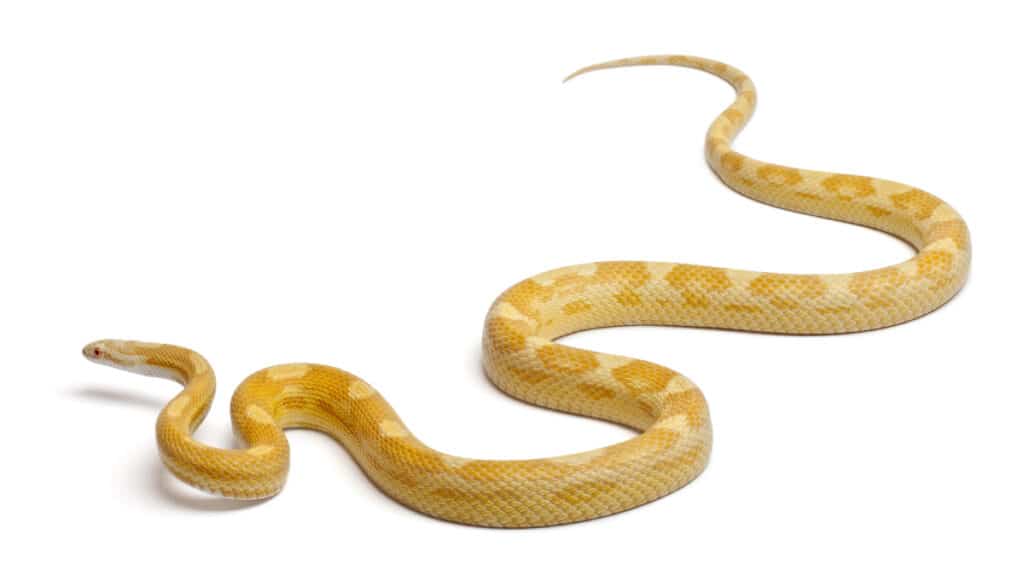
Corn Snakes are constrictors that swallow their prey whole.
©iStock.com/GlobalP
Corn snakes are very popular pets, and captive-bred snakes are selectively bred in a wide variety of color morphs. The butter corn snake, for example, is bright yellow in color, with darker yellow or brownish-orange blotches. The amber stripe corn snake is a darker golden yellow, with light amber stripes running along the length of its body. Corn snakes are nonvenomous and do not present a threat to humans or pets.
Western Hognose Snake
The Western hognose snake (Heterodon nasicus) naturally displays a sandy-brown, tan, or yellowish-olive background overlaid with darker brown or olive blotches; however, some hognose snakes have been selectively bred with specific color morphs, which make them appear yellow. This bright or muted yellow base color provides effective daytime camouflage while contrasting sharply with its dramatic jet-black belly markings.
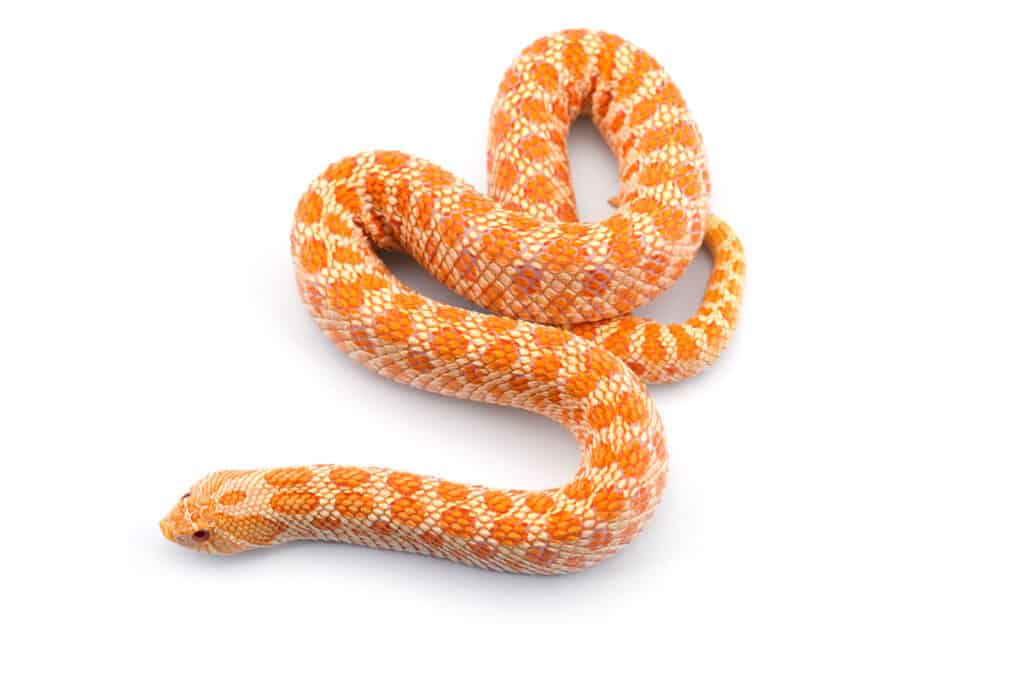
Some Western hognose snake morphs may appear very yellow.
©PetlinDmitry/Shutterstock.com
The western hognose snake is not dangerous to humans. While they are venomous, their fangs are in the back of their mouth, and their venom is extremely mild and adapted to subdue small prey like toads.
Ring-Necked Snake
Ring-necked snakes (Diadophis punctatus) typically measure between 10 and 18 inches long, though some individuals can reach up to 20 inches or more. They have smooth, glossy scales that range from slate gray to black on their back, and a vibrant yellow, orange, or red underbelly. However, the defining feature of ring-necked snakes is the golden-yellow or orange ring that wraps completely around their neck.
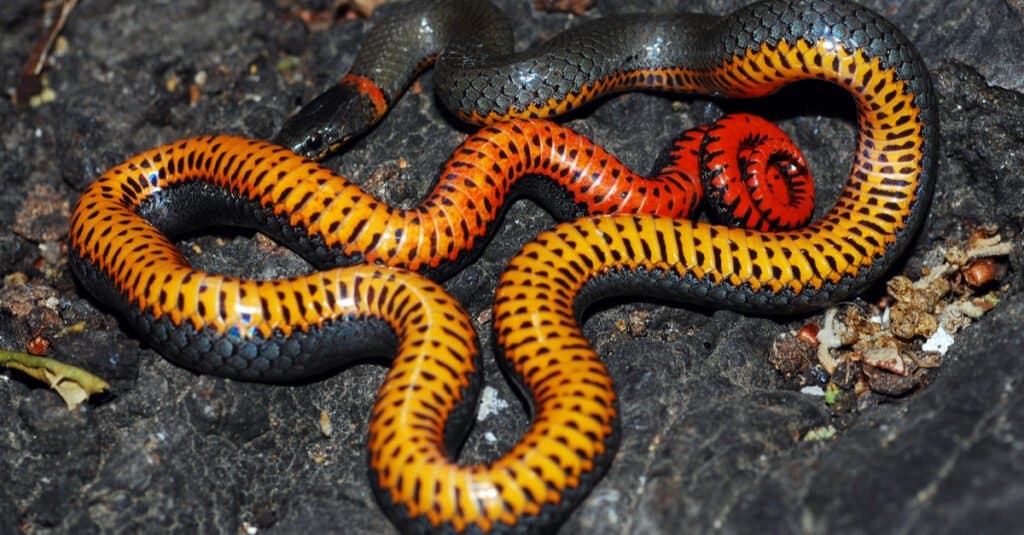
Ring-neck snakes are small and secretive, usually hiding under rocks and ground cover.
©Jason Mintzer/Shutterstock.com
Although ring-necked snakes are venomous, they deliver their venom with tiny rear fangs and use it to paralyze small prey like earthworms or salamanders. Therefore, the ring-necked snake is completely harmless to humans.
Jungle Carpet Python
The jungle carpet python (Morelia spilota cheynei) lives in the rainforests of Queensland, Australia. These beautiful snakes have a lemon yellow body with jet-black irregular banding along the length of their bodies. Jungle carpet pythons typically measure 4 to 6 feet and are protected from capture and killing in Australia.
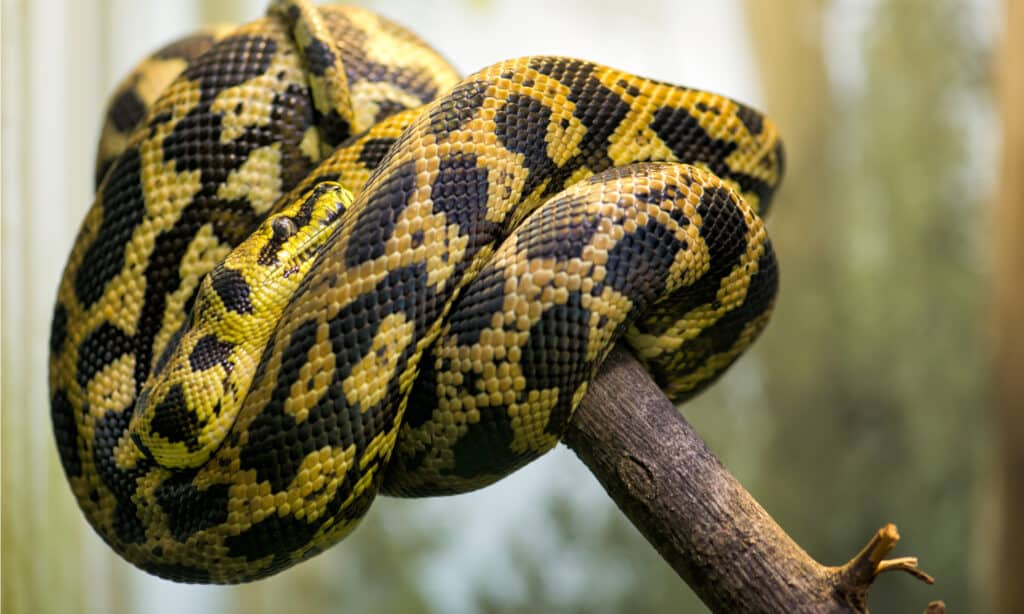
Most often, you’ll find a jungle carpet python in the trees.
©Nagel Photography/Shutterstock.com
Jungle carpet pythons are not considered a threat to human life, as they are completely non-venomous and lack the massive size required to pose a constriction hazard to adults.
Western Shovelnose Snake
The Western shovelnose snake (Chionactis occipitalis/Sonora occipitalis) is a small nonvenomous snake, measuring 11 to 17 inches long with smooth scales. These snakes are creamy or light yellow with alternating black bands and red splotches along their backs. Their snouts are flat like a shovel, helping them to burrow through loose and sandy soil.
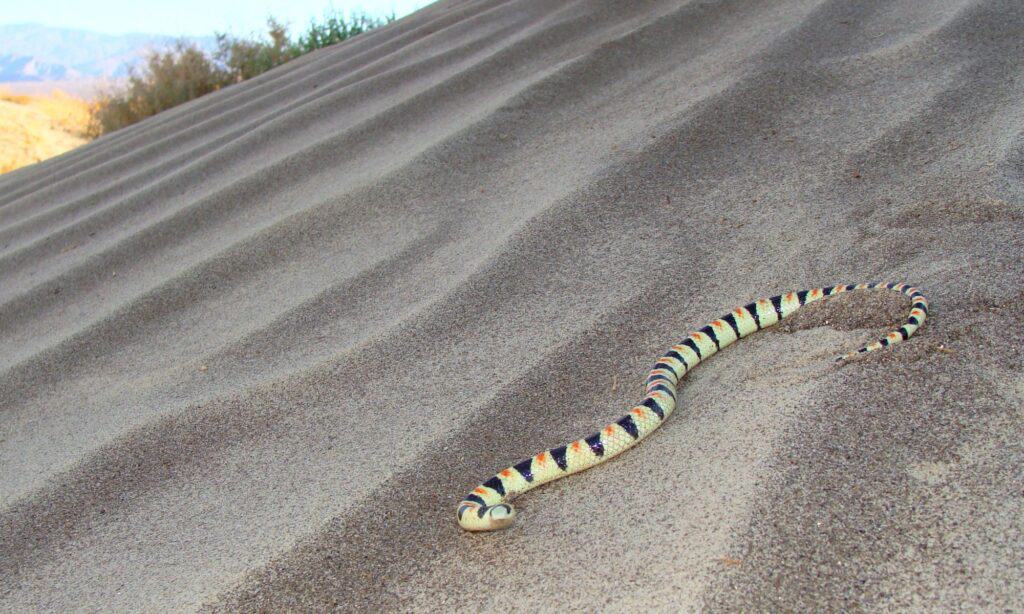
Western shovelnose snakes can move so fluidly that it looks like they are “swimming” through the sand.
©Matt Jeppson/Shutterstock.com
Western shovelnose snakes live exclusively in deserts and are found in Mexico, as well as in the Southwestern United States. However, these snakes are rarely seen since they spend the day underground or partially submerged in the soil until they come out at night to hunt. These snakes eat various types of invertebrates, like insects, scorpions, spiders, and centipedes.
the Western shovelnose snake is completely harmless to humans, as it is non-venomous and pose no medical threat.
Ball Python
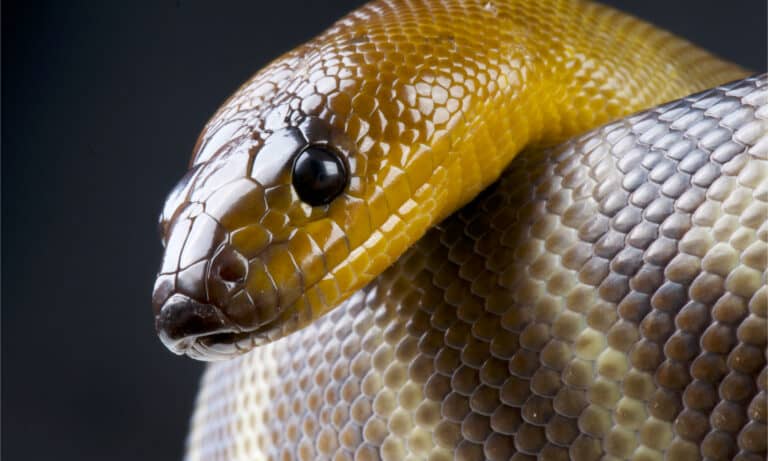
The ball python (Python regius) is a nonvenomous snake found in West and Central Africa. This snake’s name comes from its defensive strategy of rolling into a ball and tucking in its head and neck for protection.
In the wild, these snakes are dark brown or black, with large, irregular blotches of tan, gold, and light brown. However, ball pythons are popular pets, many of which are selectively bred to produce yellow morphs.
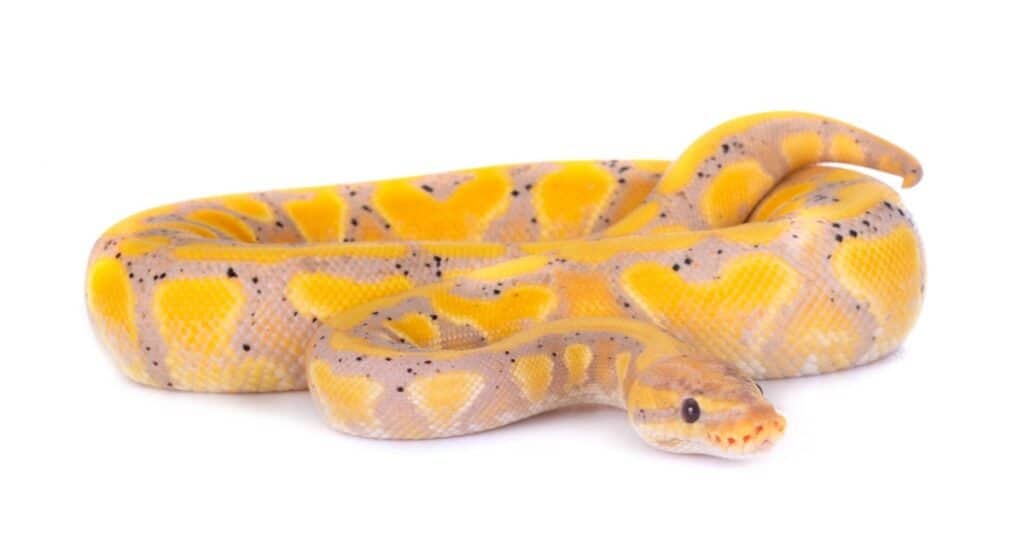
The banana ball python is easily identified by its bright yellow markings.
©iStock.com/cynoclub
Ball pythons are not dangerous to humans. They are considered one of the gentlest snake species in the world.
Unfortunately, ball pythons are a threatened species due to poachers who collect them for the exotic pet trade, their use in traditional medicine, exposure to pesticides, and habitat loss.
Yellow-Bellied Sea Snake
The yellow-bellied sea snake (Hydrophis platurus) lives in the tropical waters of the Pacific and Indian Oceans. The top half of this snake is jet black, while the bottom half is brilliant yellow. The snake’s flat, paddle-shaped tail is a lighter shade of yellow, patterned with black spots and blotches. Yellow-bellied sea snakes are typically 3.5 feet long and live their entire lives in the ocean.
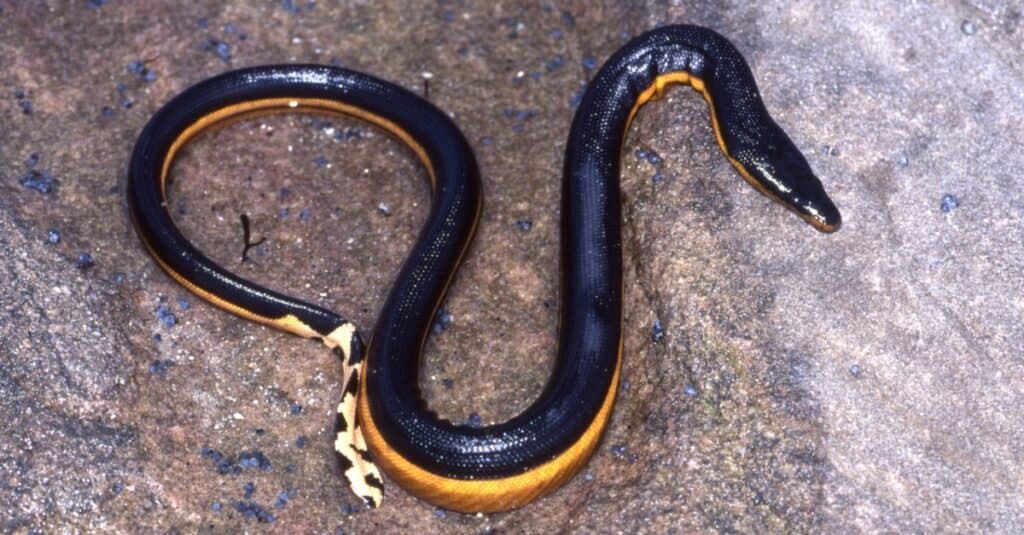
The yellow-bellied sea snake is found in all tropical oceanic waters except for the Atlantic Ocean.
©Ken Griffiths/Shutterstock.com
The yellow-bellied sea snake is extremely venomous and is one of the most widespread snakes in the world. These snakes hunt by resting along the surface of the water and hanging their heads down to capture fish as they pass below them.
A new subspecies of the yellow-bellied sea snake was discovered in 2017. The yellow sea snake (Hydrophis platurus xanthos) is a solid, golden-honey yellow color, with occasional black spots scattered throughout.
Yellow-bellied sea snakes are a potential threat to humans because they are highly venomous, but they pose a very low practical danger. Although they have lethal neurotoxic venom, encounters with beachgoers are extremely rare.
Eyelash Pit Viper
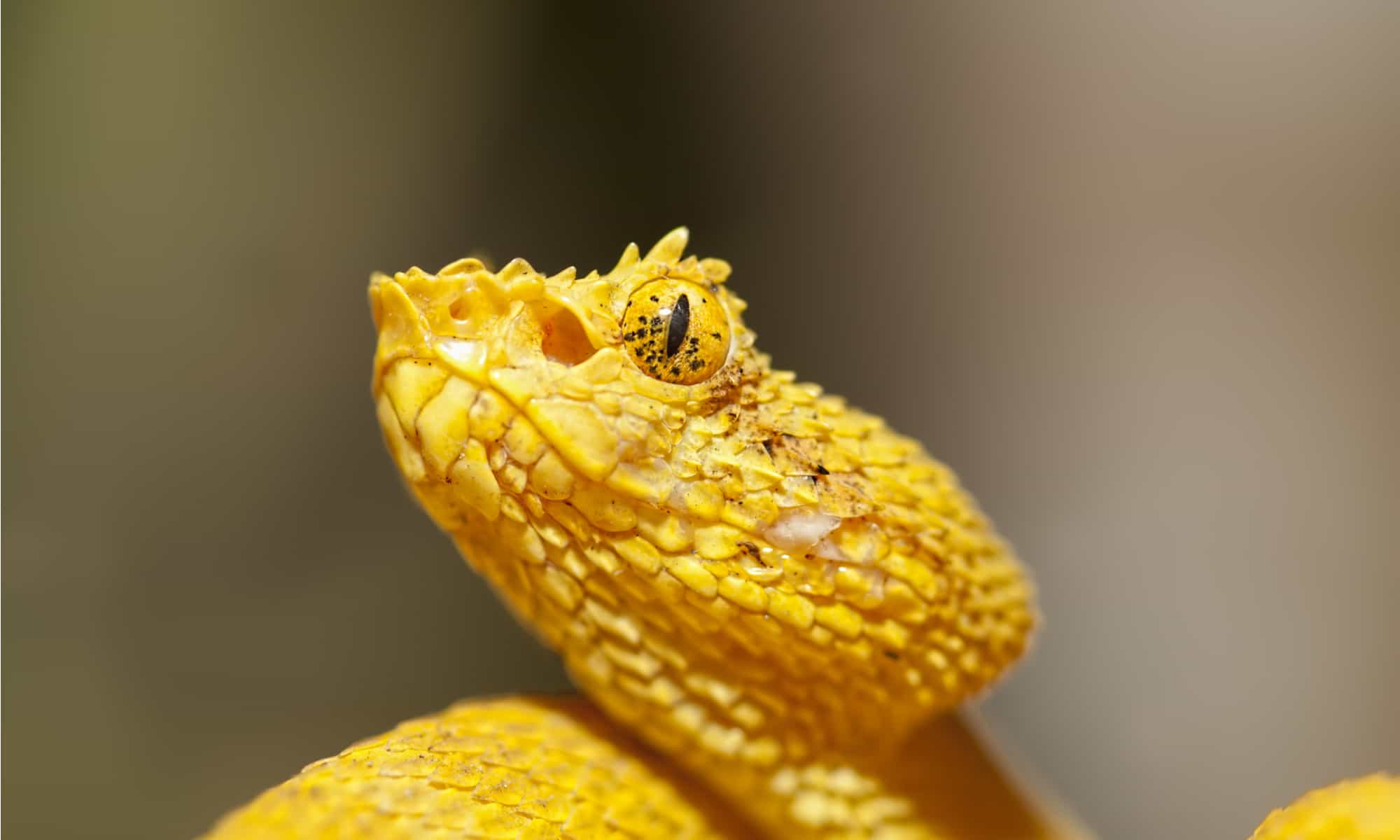
The eyelash pit viper (Bothriechis schlegelii) is a dazzling yellow snake that lives in the forests and jungles of Central and South America. These snakes are commonly yellow in color, although they have many other color variations, including red, pink, green, and brown. Eyelash pit vipers are one of the smallest venomous snakes in Central America, measuring between 22 and 32 inches long
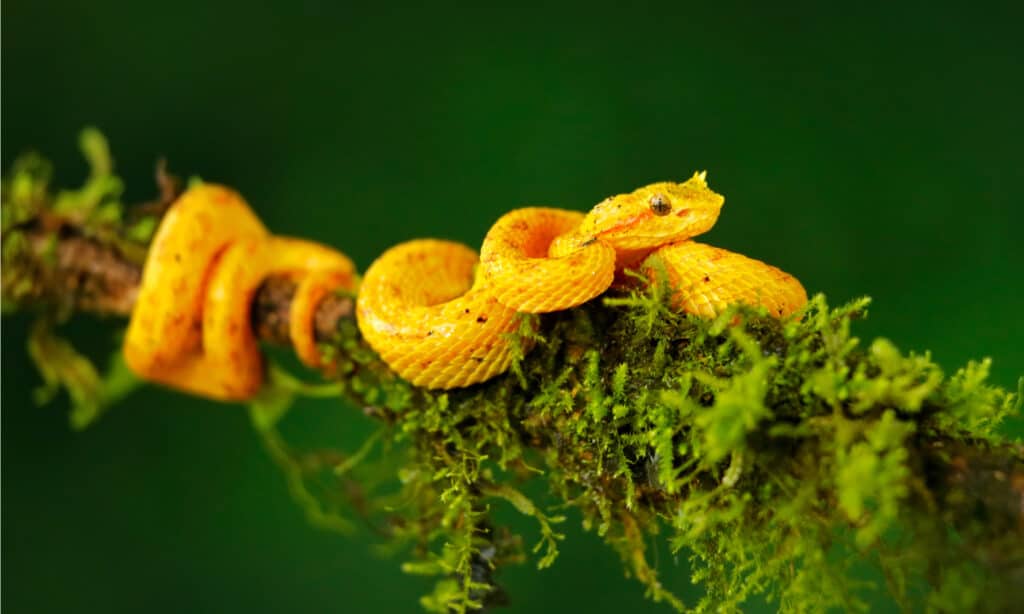
Eyelash vipers have subtle and sparse speckles of brown or black dots along their entire body.
©Ondrej Prosicky/Shutterstock.com
These snakes have large, triangular-shaped heads and sharp, keeled scales. their most distinctive feature, however, is the modified scales extending out from above their eyes like large eyelashes. Eyelash pit vipers are venomous snakes that live in trees.
Eyelash pit vipers are medically significant to humans. While they are generally docile and relatively small arboreal snakes, their bite delivers a potent toxic cocktail that requires immediate medical care.