Quick Take
- Baby black widows don't look anything like their infamous mothers, and the difference goes far beyond size. See their true colors →
- These spiderlings have a built-in superpower for escaping the nest that makes them look like they're flying. Discover ballooning behavior →
- Despite their reputation, most black widows you'll encounter around your home physically cannot hurt you. Read on to find out which ones actually can. Find out who can bite →
- The biggest threat to a mother's own offspring isn't predators but the babies themselves. Explore sibling cannibalism →
Spiders are not everyone’s cup of tea, especially when it comes to the notorious black widow. However, learning about baby black widows might alleviate a smidgen of that arachnophobia. Below, you’ll find interesting facts about these young spiders, along with photos. Hopefully, our spider-fearing readers will gain a new perspective on these arachnids.
About Black Widows
Globally, there are over 30 species of true widow spiders in the genus Latrodectus. However, there are only three black widow species native to North America. These are: the southern black widow (L. mactans), which mostly inhabits the southern half of the U.S. west to Texas, the northern black widow (L. variolus), primarily found in the eastern part of the country, and the western black widow (L. hesperus), common throughout the western U.S. west of the Great Plains.
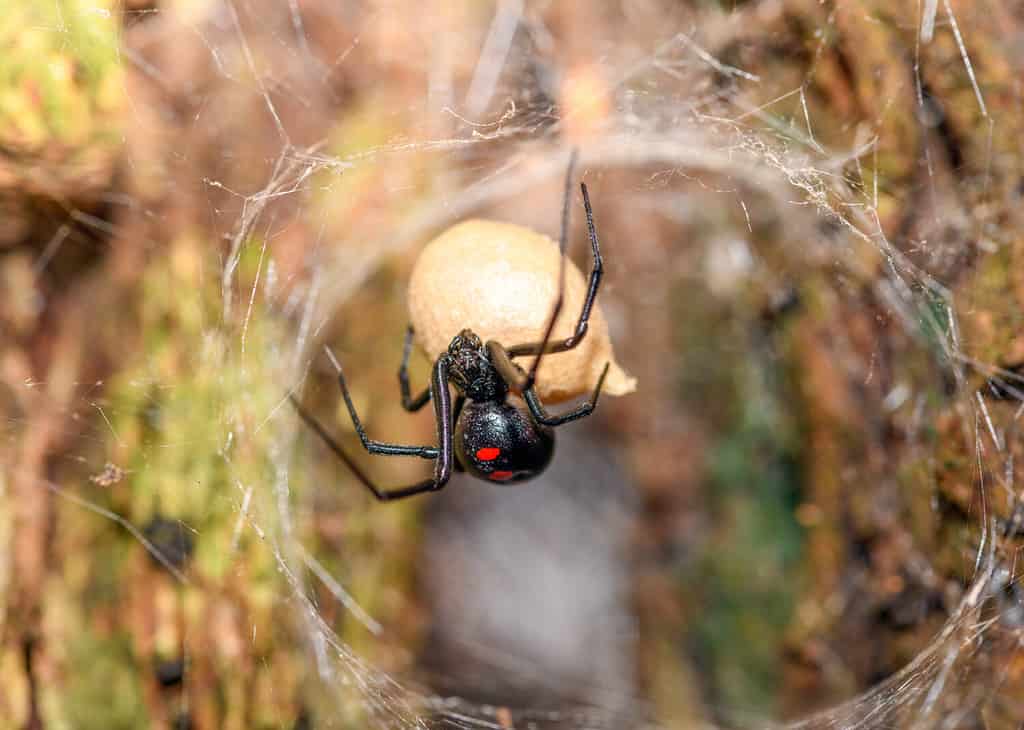
The southern black widow has a shiny black body with a solid red or reddish-orange hourglass on the underside of the abdomen. The northern black widow has a red or orange broken hourglass marking and a row of reddish spots along the top of the abdomen. Western black widows have black or brown bodies with a red, orange, or pale yellow hourglass. Females are around 1-1.5 inches including the legs.
Males of all U.S. species are generally brown, tan, or grey with yellow, white, and red bands or spots along the sides and back of the abdomen. They may also have a faint hourglass marking on their undersides and tend to have long, banded legs. Males are about half the size of the females at 0.5 to 0.75 inches including the legs.
1. Baby Black Widows Are Not Black
Young black widows have a very different color pattern than the dangerous adult females. As mentioned above, the markings of black widow spiders can vary slightly based on their species, but only mature females have a glossy black body with a red hourglass on the underside of the abdomen.
Newly hatched black widow spiders are generally white, tan, or light orange with black spots on their abdomens and a cream-colored hourglass (or none) on their undersides. They molt multiple times during their youth, darkening each time. Females can molt up to nine times before they reach their mature size and coloration. As the spiderlings transition, the abdomen becomes more olive-gray, tan, or dark brown with a longitudinal stripe down the center of the abdomen. and with diagonal stripes or spots on the sides in white, yellow, or orange. Adult males retain this juvenile coloring.
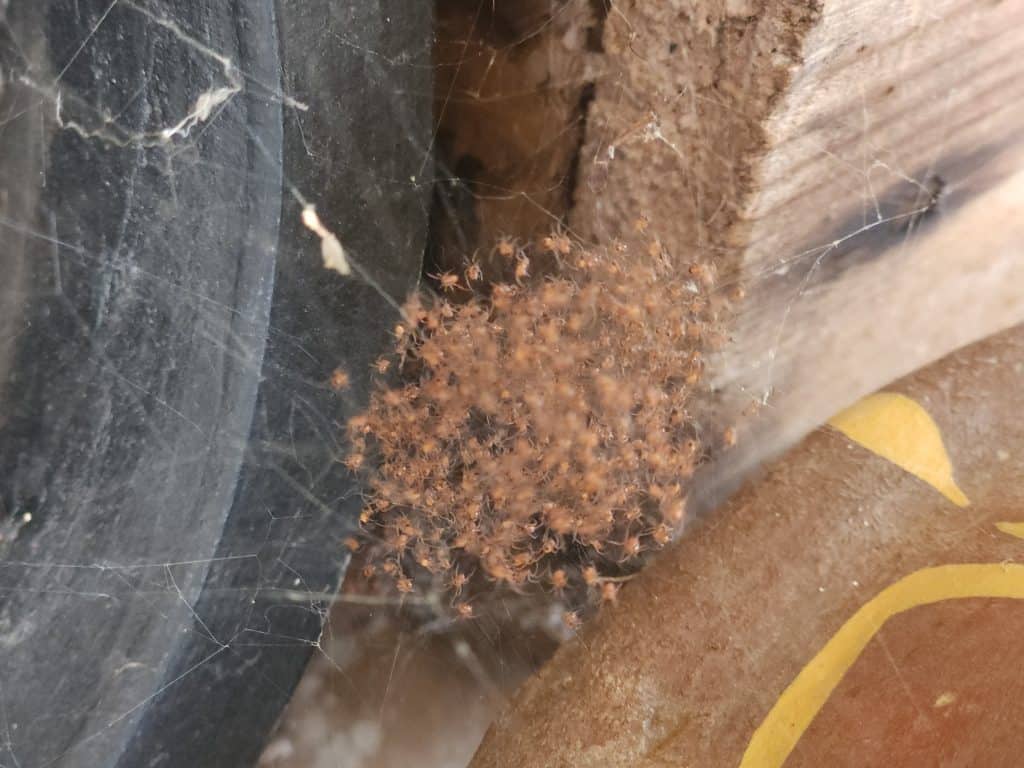
Baby black widows can be white, tan, or orange when they hatch.
2. Babies Stay in Their Cocoon for Up to One Month
Female black widows can lay up to nine egg sacs each summer. These 0.5-inch-diameter egg sacs can contain 200-800 eggs. Once a black widow lays her eggs it takes about 20 days before the spiderlings leave the egg sac. During this time, the mother spider protects the egg sac from predators and other spiders until her babies hatch. Egg sacs are usually laid in the late spring to summer months, which is when most bites occur.
After hatching, the spiderlings might linger on the web for a few days before they disperse to make their own webs. Although they’re not full-grown upon departure, they’re capable of weaving a web to trap and consume prey until they’re mature enough to mate the following spring. Adult female black widows can live up to three years, whereas adult males rarely live past one year, often dying after mating.

Female black widows protect their egg sacs aggressively.
©toddarbini/ via Getty Images
3. Spiderlings Do Something Called “Ballooning”
Hatchlings “balloon” when they’re ready to leave the nest. This involves spinning silk into the air to be carried to new locations where they can establish themselves. It’s called ballooning because spiders look like they’re attached to balloons, floating through the air. It might even look like the spiders are flying.
This process is not unique to black widows. There are quite a few other spiders that use this technique, too. Once in a new spot away from competition from siblings, the spiderlings create their web to catch food for themselves. This web is where they’ll overwinter until they finish developing by the next spring.

When baby black widows are ready to leave their mother’s web, they “balloon” to their new location.
©Frank Buchter/ via Getty Images
4. Juvenile Black Widows Are Not Dangerous
It may be unsettling to see a black widow, let alone an egg sac or dozens of black widow spiderlings. However, these spiders are not interested in humans. The most dangerous time for a human to come into contact with a black widow is when the mother is protecting her nest. Other times, any inflicted bites are accidental. For example, moving logs where a spider is hiding can startle it, forcing the spider to react.
Baby black widows and male adult black widows cannot bite humans because their fangs are too small to break human skin. The only ones capable of biting and envenomating humans are adult females, who for the most part, can be avoided. However, it’s understandable if you’re not willing to wait around for the young to mature so you can tell if they’re female or male. Experts recommend vacuuming to maintain a safe distance from the mother while also removing the spiderlings. However, this method can still be dangerous. If the spiders are not in an area where they’re bothering you, it might just be best to let them be. After all, black widows and other spiders are great for pest control.
Only adult female black widows can inflict a nasty bite, but it is hardly ever fatal to humans.
©Jeff W. Jarrett/Shutterstock.com
5. Young Black Widows Are Cannibalistic
They say female black widows eat their partners right after mating to ensure they have the required nutrients necessary for their egg laying. While this may be the norm in some widow species, in North American species it is uncommon in the wild, typically only occurring when the female is starving. However, cannibalism among the young is more common. Juveniles sometimes cannibalize their siblings for extra nutrition, especially when there is a significant size difference between siblings. Researchers believe that females may synchronize their clutches to prevent cannibalism.

©Frank Buchter/ via Getty Images