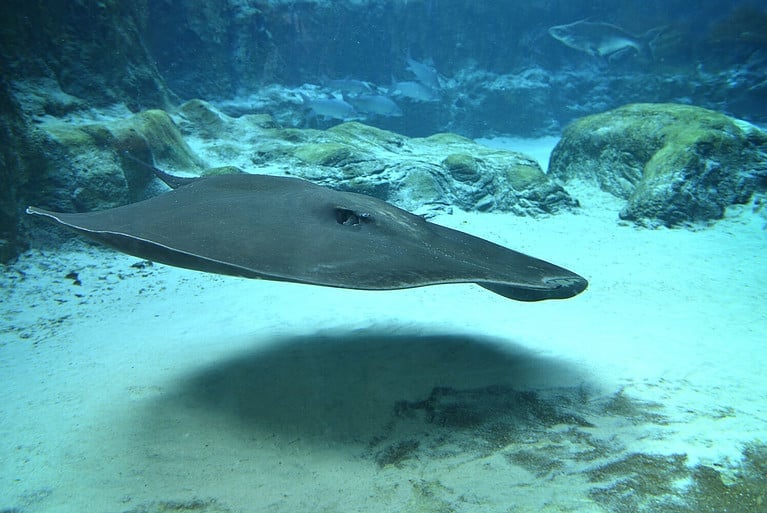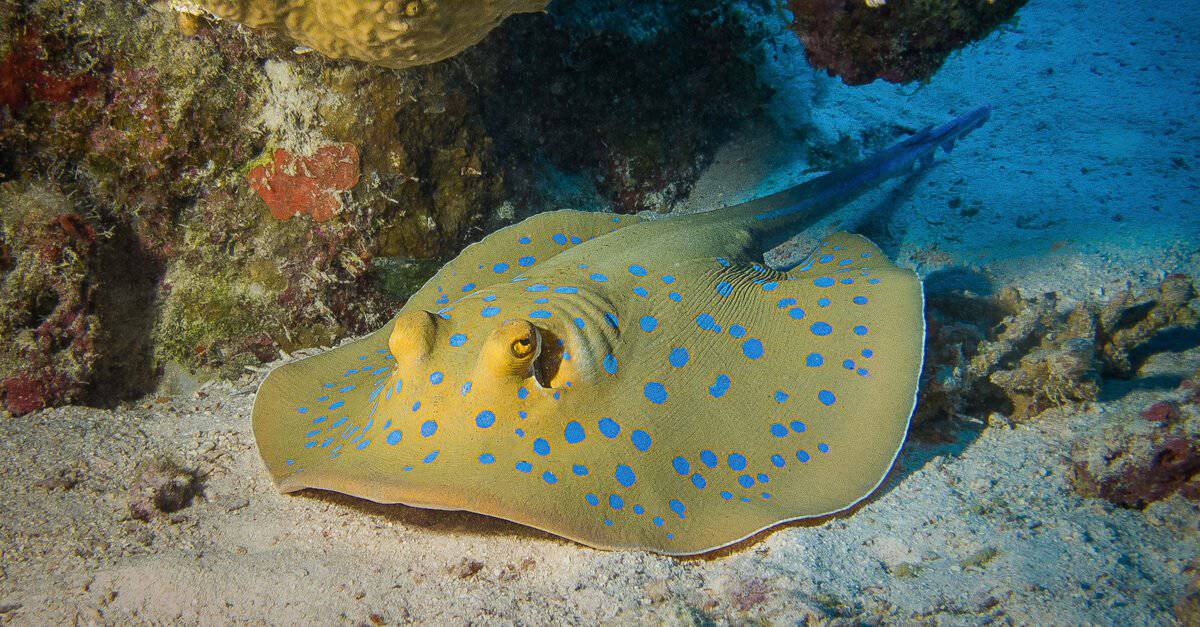

Stingrays are large, mysterious sea creatures. Often wider than long, these flat cartilaginous fish include over 200 species in 29 genera and eight families. Basic characteristics include a wide, flat body with a tail, spiracles for breathing, and a stinger with venom. Despite their docile nature, stingrays will use their tail stingers when threatened. Ranging in size from less than a foot to nearly 10 feet, let’s take a closer look at the eight largest stingrays in the world today.
How Are Stingrays Measured?
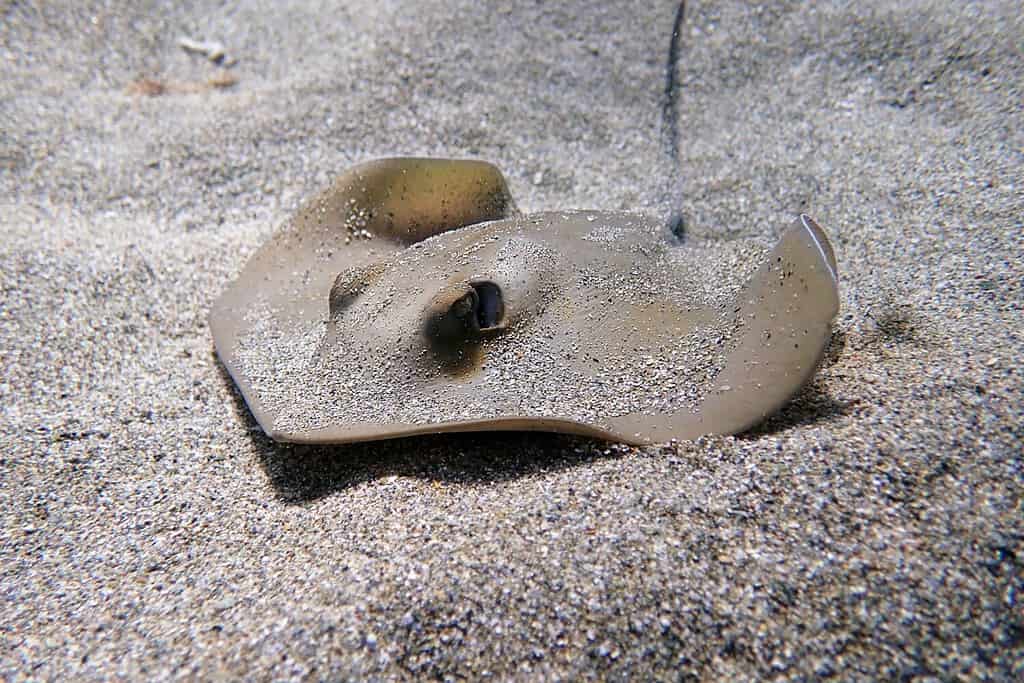
Stingrays are currently separated into eight families.
©Vojce/Shutterstock.com
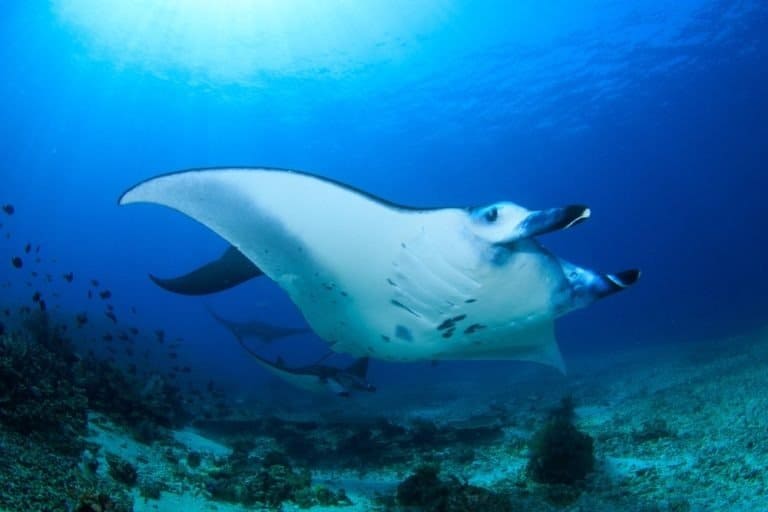
While similar in many ways, manta rays differ from stingrays because they do not have a stinger. This article will focus exclusively on stingrays. Skates are related to stingrays as well, but they belong to the order Rajiformes, while stingrays belong to the order Myliobatiformes. In some cases, comprehensive data on stingrays is unfortunately lacking. Since many stingray species have not been properly studied, the list below organizes stingrays by the largest species in each of the eight currently recognized stingray families.
There are a few ways to measure the overall size of stingrays. Due to their unique body shapes, disc width is used in combination with body length and weight. The tail lengths of stingrays vary dramatically, and tail length is sometimes included in body length. However, since the vast majority of a stingray’s mass occurs in its disc area, we chose body length as the default length measurement. Tail length and size are included where the information is available.
8. American Round Stingrays (Urotrygonidae)
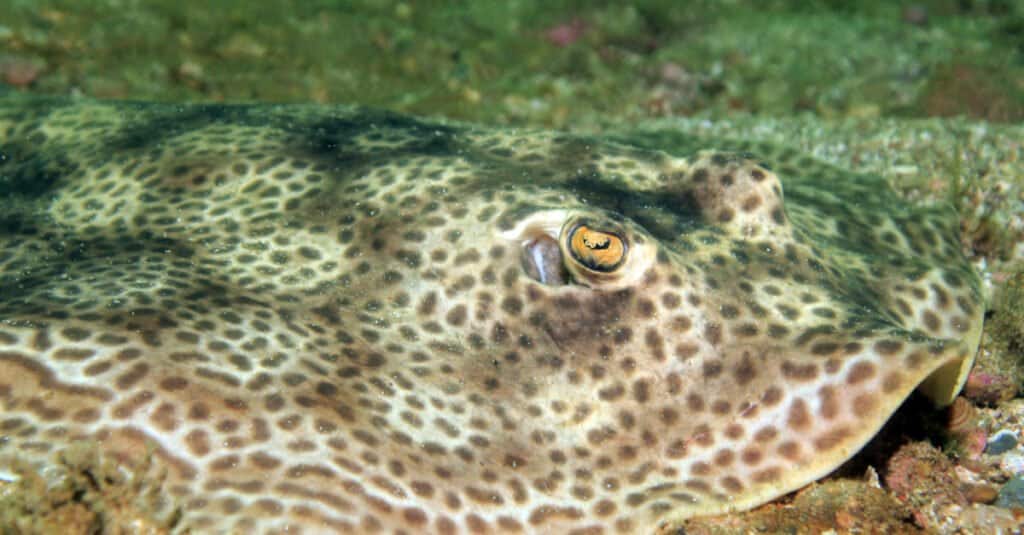
Round stingrays can be found in the waters of the western Atlantic.
©Daniel Lamborn/Shutterstock.com
- Yellow stingray (Urobatis jamaicensis)
- Body Length: 2.2 feet
- Disc Width: 1.2 feet
- Data insufficient for average weight
Generally small, these round rays live in tropical and temperate waters near the Americas. They can be found in the Atlantic Ocean from North Carolina down to Florida and into the Gulf of Mexico. They may also sometimes be seen in the Caribbean. These rays primarily consume small fish and crustaceans.
The yellow stingray is believed to be the largest of the Urotrygonidae family. The yellow stingray’s disc shape is more rounded. It has a stout tail that narrows at the end and a venomous spine just before the robust caudal fin. They have rounded pelvic fins and no dorsal fin. Their bodies are tan or yellow with darker spots. The yellow stingray currently has a conservation status of Least Concern.
7. Stingarees (Urolophidae)
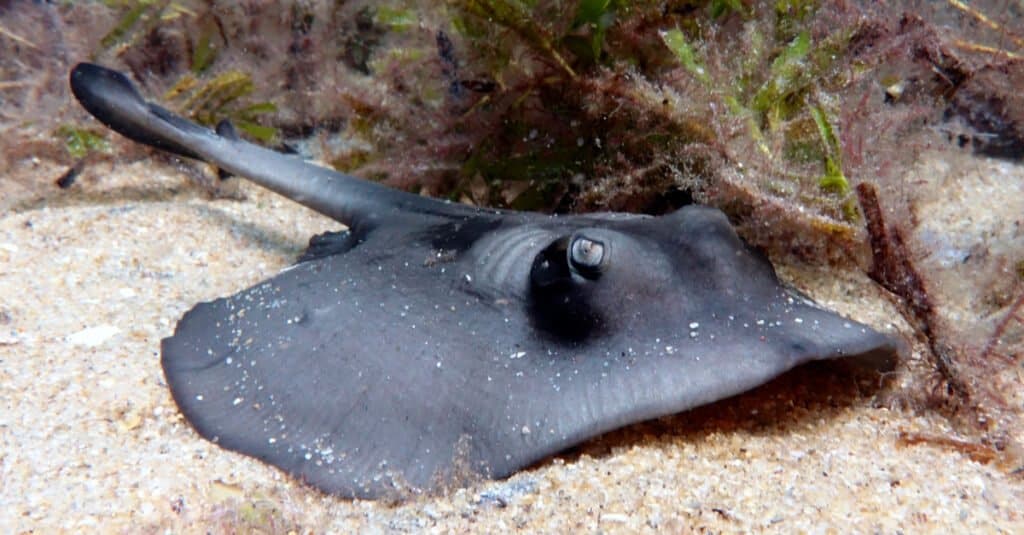
Stingarees are moderately-sized stingrays that can be found in the Indo-Pacific region.
©scott plume/Shutterstock.com
- Sandyback stingaree (Urolophus bucculentus)
- Body Length: 2.9 feet
- Disc Width: Unknown
- Weight: Over 20 pounds reported
Also known as round rays, stingarees are medium-sized stingrays prevalent in the Indo-Pacific region. The waters around Australia are a hotbed for stingarees, with dozens of species identified. Stingarees are sluggish stingrays that prefer the soft bottoms of the continental shelf. They primarily feed on crustaceans and other invertebrates found in the sediment.
Sandyback stingarees are the largest in the family. They have diamond-shaped bodies, protruding snouts, and short, flat tails with a serrated spine. As their name suggests, they are a yellowish or brownish color on the top with a white underside. Many also have small, pale spots. The IUCN currently lists the sandyback stingaree as Vulnerable.
6. Sixgill Stingrays (Hexatrygonidae)
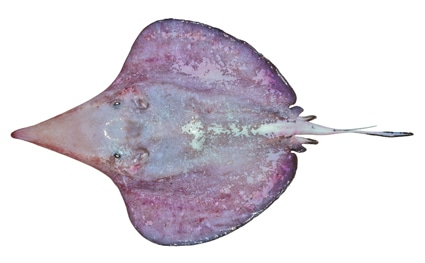
- Sixgill stingray (Hexatrygon bickelli)
- Length: Up to 5.5 feet
- Disc Width: Believed to be at least 1 foot
- Data insufficient for average weight
A relatively new species and the only species in the family Hexatrygonidae, the sixgill stingray was first observed in 1980. This is a deep-sea dweller usually found at depths from roughly 1,500 feet to over 3,600 feet. As the name suggests, this stingray can be differentiated from other stingrays due to the presence of six gills instead of the usual five. Its range extends through the Indo-Pacific region, with populations off the coast of South Africa to Japan, Australia, and isolated areas in the Pacific Ocean.
It has a flabby, rounded body and a broad, pointed snout. This stingray is a brownish-purple to reddish-brown on top and white underneath. Its caudal fin and long tail are typically dark. Like many stingrays, it consumes crustaceans, invertebrates, and other bottom-dwelling organisms. It is currently listed as a species of Least Concern by the IUCN.
5. Butterfly Rays (Gymnuridae)
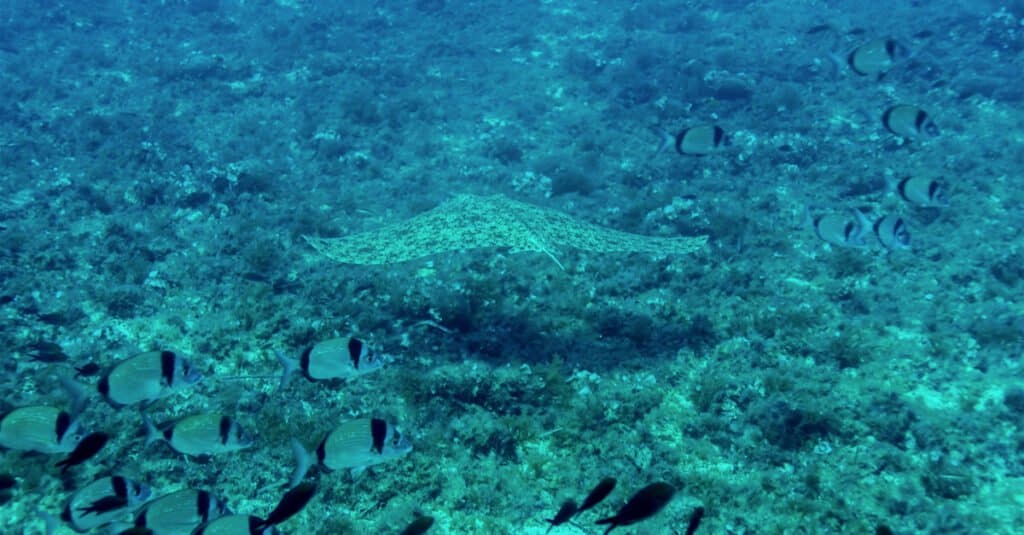
The butterfly ray can be found in the Atlantic Ocean.
©Pdrac/Shutterstock.com
- Spiny butterfly ray (Gymnura altavela)
- Length: 3-5 feet
- Disc Width: Average around 7 feet with up to 13 feet reported
- Weight: Up to 132 pounds
Butterfly rays are a large family of stingray species, with the spiny butterfly ray being the largest. These rays are found in Atlantic waters from the coast of Massachusetts down to Buenos Aires, Argentina. They are also prevalent on the eastern edges of the Atlantic. The IUCN currently lists the spiny butterfly ray as Endangered.
With a large, rhombus-shaped disc, the spiny butterfly ray is much wider than it is long. Like similar bottom-dwellers, it relies on camouflage and surprise to hunt fish and prefers sandy ocean floors or brackish waters with muddy substrates. They have protruding snouts and diamond-shaped bodies with short, spiny tails. Butterfly rays are dark brown to greyish-black with a white underside. They may also sometimes have lighter or darker spots.
4. Deepwater Stingrays (Plesiobatidae)
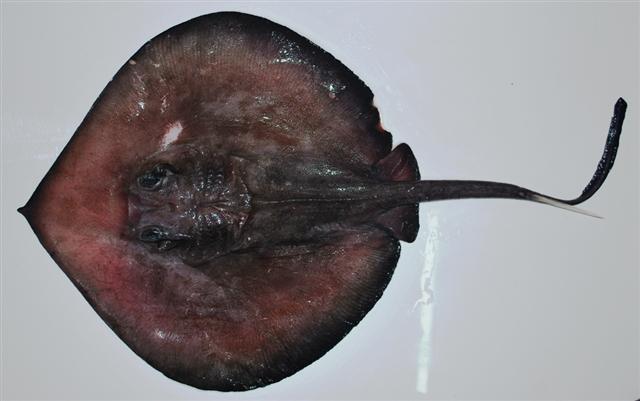
The deepwater stingray is widely distributed throughout the Indo-Pacific.
- Deepwater stingray (Plesiobatis daviesi)
- Length: Up to 8.9 feet
- Disc Width: Up to 4.9 feet
- Weight: ~260 pounds
The only species of its family, the deepwater stingray is a large, widely distributed ray in the Indo-Pacific. They prefer fine sediment habitats in the upper continental shelf. Typical among rays, it feeds on small crustaceans, cephalopods, and some bony fish, including eels.
This stingray has a round, flabby body of brownish-purple to black on its upperparts with a white underside. Its skin is covered in dermal denticles, which are an abrasive outer layer that protects it from predators. They may also reduce drag and aid in sensory perception. The deepwater stingray has a long, thin snout and small eyes. Most of the back half of the tail supports a long, leaf-shaped caudal fin and a thin sting. The IUCN currently lists the deepwater stingray as a species of Least Concern.
3. River Stingrays (Potomatrygonidae)
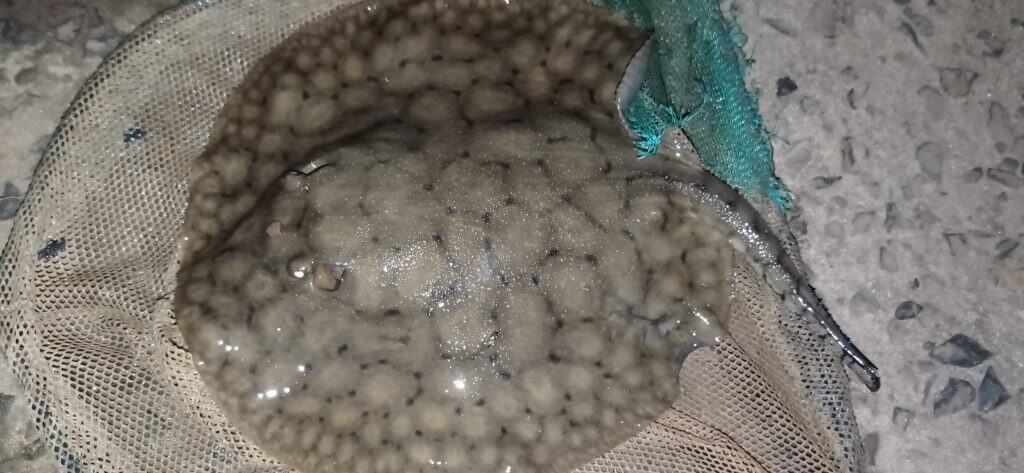
Short-tailed stingrays are endemic to the Río de la Plata River basin in South America.
- Short-tailed stingray (Potamotrygon brachyura)
- Length: Over 12 feet including the tail
- Disc Width: Up to 6.25 feet
- Weight: 490 pounds
River stingrays include some of the largest stingray species alive today. They are more circular than other types of rays, and while the vast majority of the species live in freshwater, there are a few species of river stingrays, such as the Chupare, that live in saltwater. River stingrays generally feed on crustaceans, mollusks, and fish. The biggest threats are overfishing and habitat loss.
The short-tailed stingray is the largest stingray in the Potomatrygonidae family. They primarily live in the Río de la Plata River basin in South America. These stingrays are slightly more diamond-shaped, but they have rounded pectoral fin tips. They have blunt snouts and their thick bodies are grey to greyish-brown on top and white underneath. Although its tail is shorter than its disc, the tail is very thick and muscular with venomous spines on the upper surface. They are currently classified as Data Deficient by the IUCN.
2. Eagle Rays (Myliobatidae)
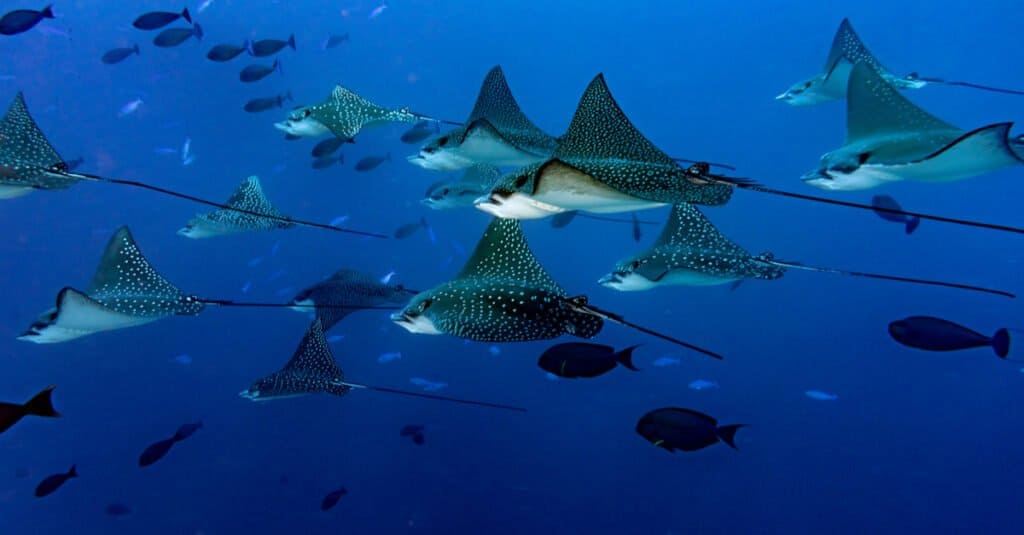
The eagle stingray can to breach the surface of the water by up to several feet.
©Andrea Izzotti/Shutterstock.com
- Spotted eagle ray (Aetobatus narinari)
- Length: 16.4 feet including the tail
- Disc Width: 9.8 feet
- Weight: 507 pounds
Eagle rays are a superb family of swimmers who can often breach the surface of the water by up to several feet. They can be found on the soft bottoms of tropical and warm waters worldwide. Like most rays, they use camouflage and stealth to prey on bottom-dwelling animals like mollusks, crustaceans, and certain fish.
The spotted eagle ray, also known as the whitespotted eagle ray, is the largest member of the Myliobatidae family. These rays have dark blue to black bodies with white spots and white undersides. They also have wing-like pectoral fins and a broad snout that is said to resemble a bird’s beak. Spotted eagle rays favor coastal areas and are often seen around coral reefs. These rays are currently listed as Endangered by the IUCN.
1. Whiptail Stingrays (Dasyatidae)
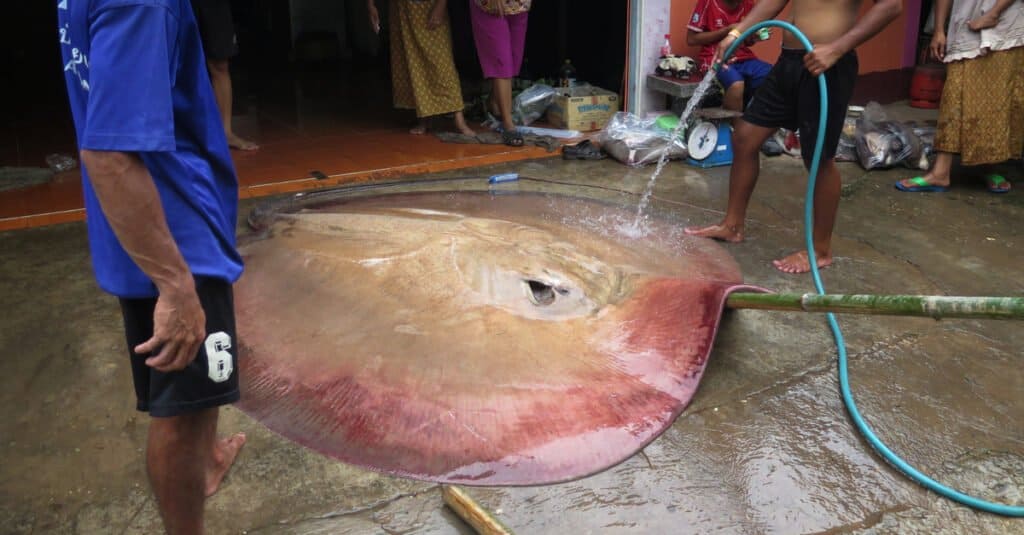
The giant freshwater stingray holds the world record for the largest freshwater fish ever recorded.
©Mekong on tour/Shutterstock.com
- Giant freshwater stingray (Urogymnus polylepis)
- Length: 13 feet including the tail, but may grow larger
- Disc Width: Up to 7.2 feet
- Weight: 661 pounds
A large family of 35 species, whiptail stingrays are common worldwide. They prefer tropical and temperate oceans as well as freshwater locations in Africa, Asia, and Australia. The largest among them is the giant freshwater stingray, which holds the world record for the largest freshwater fish ever recorded. This stingray was taken from the Mekong River in northern Cambodia. It was 13 feet long including the tail, 7.2 feet wide, and weighed 661 pounds.
It has an oval body with a thin pectoral fin and a sharp, protruding snout. Typical of whiptails, the tail of the giant freshwater stingray is whip-like with a barb at the base. The ray is grayish-brown on its upper side and white on its underside. It also has dark bands on its pelvic and pectoral fins. They eat a variety of crustaceans, mollusks, invertebrates. This ray is listed as Endangered by the IUCN due to pollution and overfishing.