
By its simplest definition, a vulture is a bird of prey that feeds on carrion, which is the meat of dead animals. The media has often portrayed vultures as harbingers of death in books and films. Much like crows and ravens, these birds have an undeserved stigma. Vultures’ unique characteristics and majestic size set them apart from almost all other birds of prey. In fact, the largest vulture species are bigger than eagles, hawks, and falcons. Let’s take a look at the top ten largest vultures alive today.
10. White-Backed Vulture
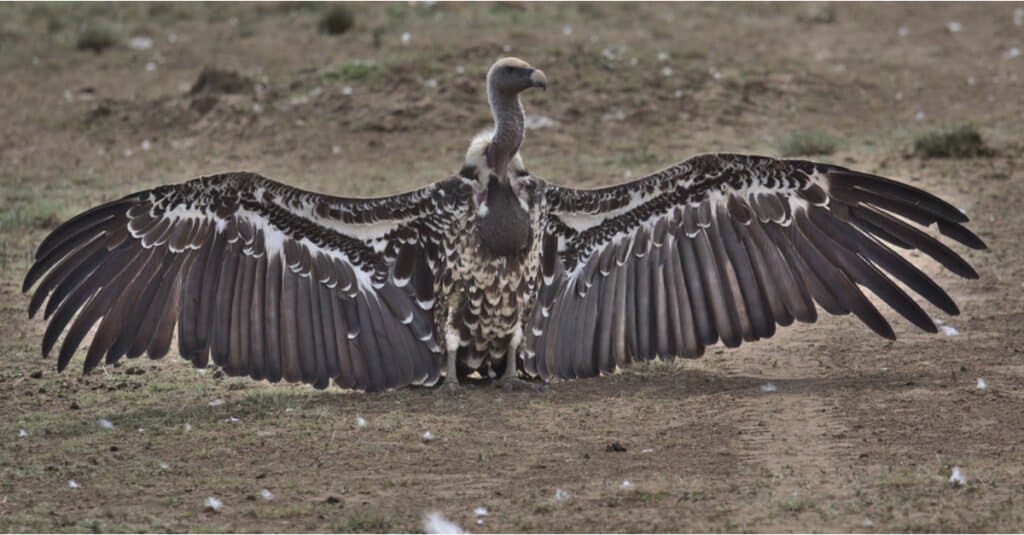
The white-backed vulture has a wingspan that can reach more than 7 feet.
©nshah86/Shutterstock.com
- Body Length: up to 3 feet 2.5 inches
- Wingspan: up to 7 feet 4.5 inches
- Weight: 9.3 to 15.9 pounds
The white-backed vulture (Gyps africanus) is an Old World vulture, as its habitat does not extend into the New World or the western hemisphere. This large bird is native to the open plains and savannas of sub-Saharan Africa. They breed in colonies and make their nests in tall trees, typically laying only one egg per year. This vulture is brown with lighter patches on its underwings. True to its name, the white-backed vulture also has white feathers along its back. It has two bare patches of skin on the backs of its neck that are believed to help it sense thermals and aid in thermoregulation.
Once considered relatively stable, the population of these vultures has dropped severely over the past few decades. The primary cause of their decline is poisoning, although habitat loss is another significant contributing factor. In an effort to protect their crops and livestock, farmers have misused poisons to kill predators. When the predators die, vultures feed on their carcasses and ingest the poison as well. Currently, the white-backed vulture is listed as critically endangered by the IUCN.
9. Indian Vulture
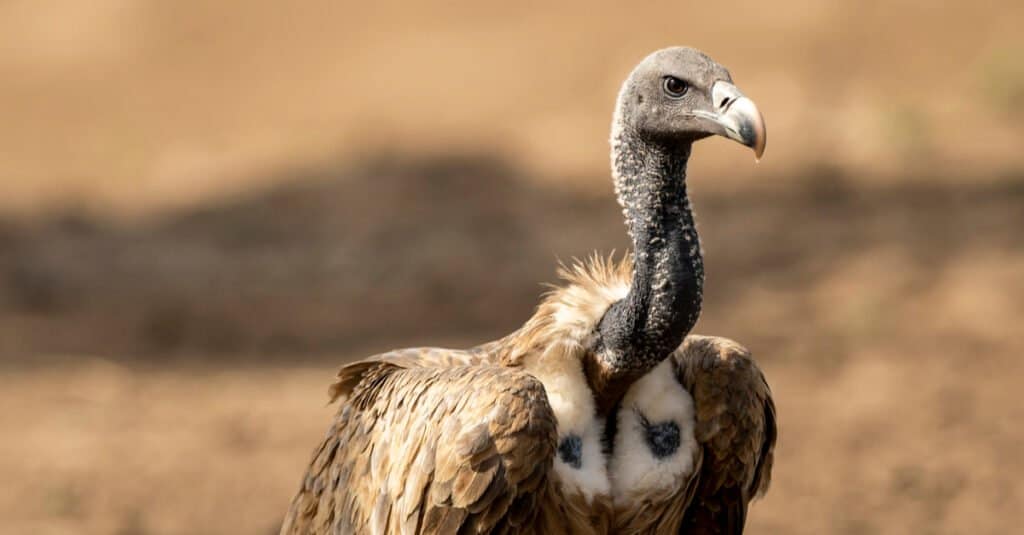
Indian vultures are listed as critically endangered.
©Sourabh Bharti/Shutterstock.com
- Body Length: Up to 3 feet 4.4 inches
- Wingspan: Up to 7 feet 4.5 inches
- Weight: 12 to 14 pounds
Native to Nepal, India, and Pakistan, the Indian vulture (Gyps indicus) has also experienced rapid population decline due to the accidental ingestion of poisons. The IUCN lists them as critically endangered, and captive breeding programs have been started to stop the decline of the species. Since vultures feed on dead animals, a decline in their population leads to increases in feral dog and rat populations, as well as a higher risk of disease. Their impact on stabilizing the local ecosystem is substantial.
Indian vultures can be found in both open and wooded areas. They primarily nest in colonies along cliffs in south-central India, though they have been known to nest in trees on occasion. An adult Indian vulture has a light brown body with white collar feathers, pale underwings, and dark flight feathers. Its head and neck are dark with a pale bill.
8. Rüppell’s Vulture
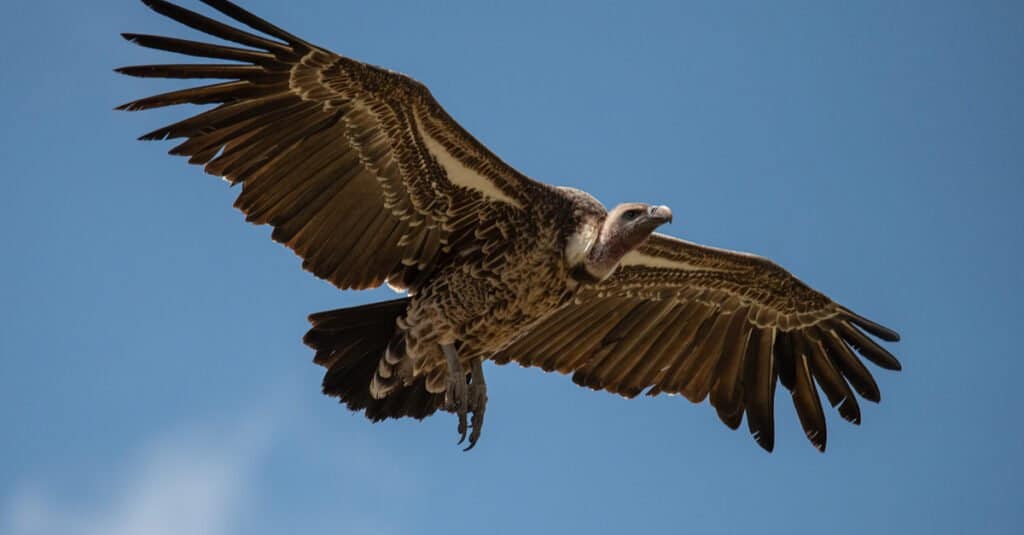
The Rüppell’s vulture can soar at altitudes as high as 37,000 feet.
©ANDRES MENA PHOTOS/Shutterstock.com
- Body Length: Up to 3 feet 4.4 inches
- Wingspan: Up to 8 feet 6 inches
- Weight: 14 to 20 pounds
Named after a German naturalist and explorer, Eduard Rüppell, the Rüppell’s vulture (Gyps rueppelli) is native to the region of Africa between the Sudanian savanna and the Sahara desert. They may not be the largest vultures, but Rüppell’s vultures hold the record for being the highest-flying birds on Earth. They can fly at altitudes up to 37,000 feet above sea level, which is higher than Mount Everest. However, they typically do not fly at such extreme heights. Scientists have discovered that Rüppell’s vultures have specialized hemoglobin that allows them to use oxygen efficiently even at extreme elevations.
The Rüppell’s vulture has a dark brown or black body, with light feather tips on its body and shoulders that look like scales. They have a paler underbelly and white collars. To help them consume animal hides and bones, these vultures have backward-facing spikes on their tongues. Like the previous two vultures, Rüppell’s vultures are critically endangered according to the IUCN. Populations have suffered great losses due to accidental poison ingestion.
7. Cape Vulture
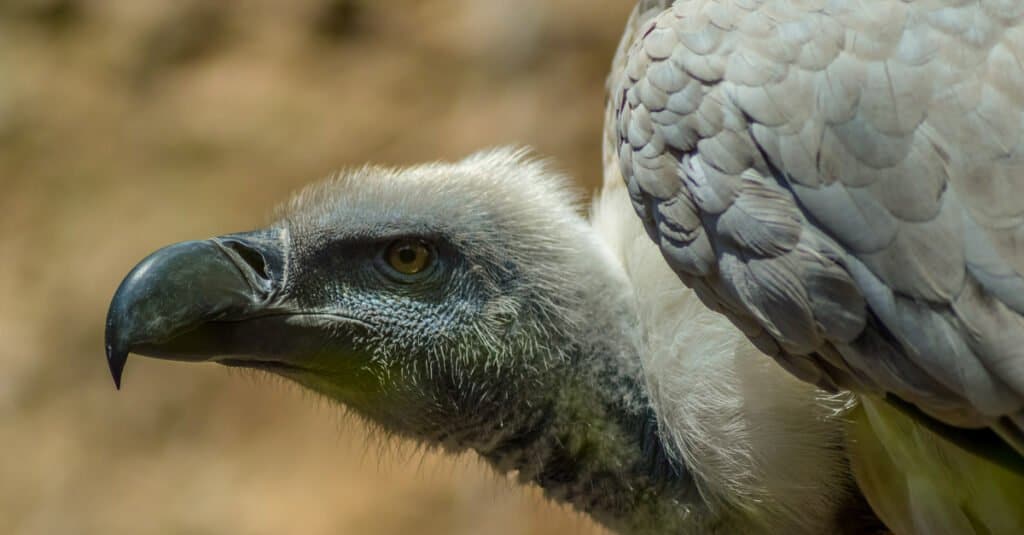
Cape vultures can often be seen soaring above open areas in search of a meal.
©Shams F Amir/Shutterstock.com
- Body Length: Up to 3 feet 9 inches
- Wingspan: Up to 8 feet 6 inches
- Weight: 15 to 24 pounds
The Cape vulture, or Cape griffon (Gyps coprotheres), another African native, makes its home in South Africa, Lesotho, Botswana, Angola, and some parts of Namibia. The Cape vulture is one of the largest birds of prey in Africa. On average, the Cape griffon is the third largest Old World vulture in the wild. They can often be found soaring over open areas and woodlands in search of food.
Like white-backed vultures, Cape vultures have two patches of bare skin at the base of the neck, which are used to detect thermals in the air and regulate their body temperature. Adults have pale bodies with dark feathers on the wings and tail. These vultures prefer to nest along cliffs and in tall trees. Like many other vultures, the Cape vulture lays only one egg per year. It is considered vulnerable by the IUCN, primarily due to poisoning and habitat loss.
6. Bearded Vulture
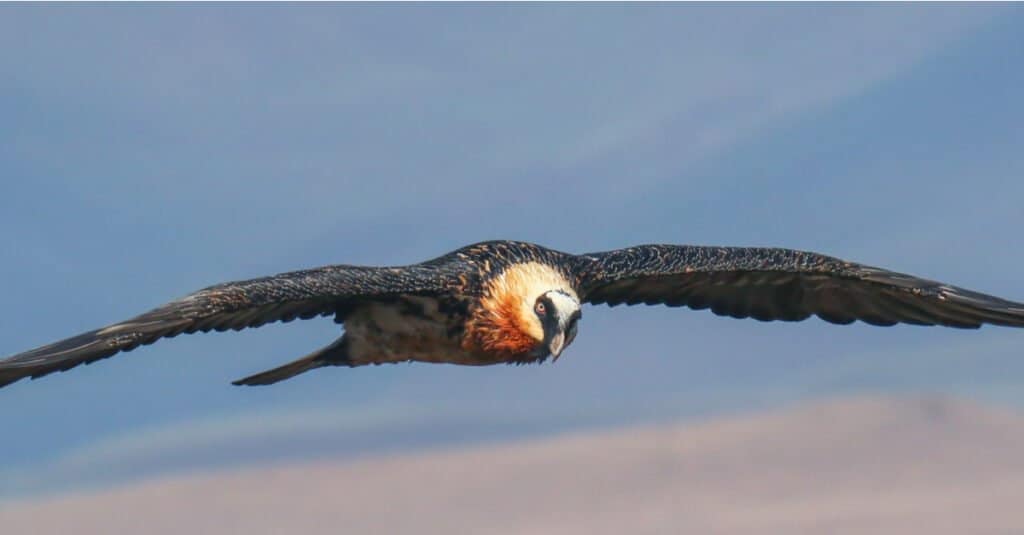
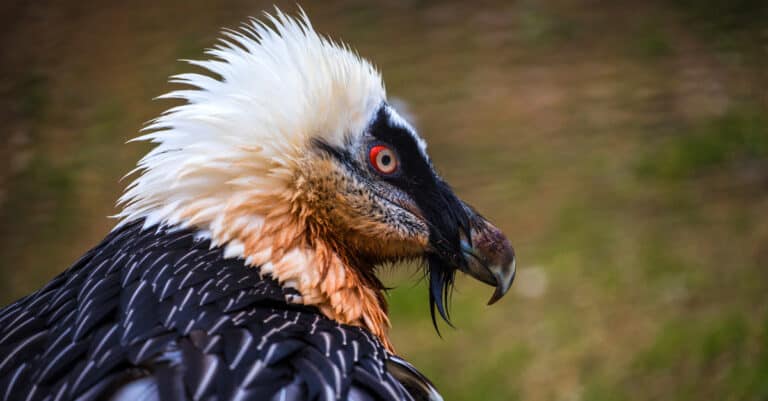
Bearded vultures primarily eat a diet of bones.
©Dr. C.J. Nortier/Shutterstock.com
- Body Length: Up to 4 feet 1 inch
- Wingspan: Up to 9 feet 3 inches
- Weight: 9.9 to 17.2 pounds
The bearded vulture (Gypaetus barbatus), also known as the lammergeier, can be found in southern Europe, Asia, and parts of Africa. Adults have either reddish-yellow or white plumage on the head and chest, with grey to black tail and wing feathers. It has a small “beard” of dark feathers at the base of its bill. They prefer high mountain ranges where they nest on cliffs or in caves. The IUCN lists them as near-threatened due to a steadily declining population caused by poisoning and loss of breeding territory.
Unlike many other vulture species, the bearded vulture does not have a bald head, likely due to its unique diet. Most vultures have bald heads, as it helps them stay cleaner while feeding on animal carcasses. However, the bearded vulture is the only known vulture with a diet consisting primarily of bones. Due to a highly specialized digestive system, the bearded vulture can swallow and digest bones up to the size of a femur. For bones that are too large to swallow, the vulture carries them to a high altitude and then drops them to crack them.
5. Eurasian Griffon Vulture
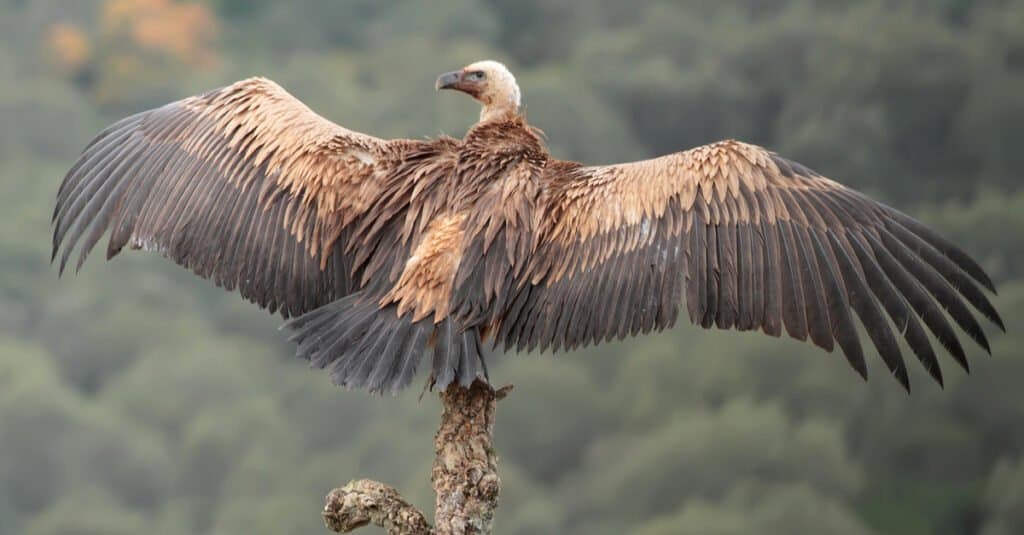
Some extremely large griffon vultures have been recorded to weigh nearly 30 pounds.
©Raul Baena/Shutterstock.com
- Body Length: Up to 4 feet
- Wingspan: Up to 9 feet 1 inch
- Weight: 14 to 23 pounds
The Eurasian griffon vulture (Gyps fulvus) is a large bird similar in size to the bearded vulture. However, some exceptionally large individuals have been recorded at nearly 30 pounds, which is substantially heavier than the bearded vulture. Unlike the bearded vulture, Eurasian griffon vultures are commonly seen flying and feeding in groups. They are among the most social vultures and live in colonies of hundreds of birds.
These vultures have pale heads and necks, light brown bodies, and dark flight feathers. Like many vultures, the griffon nests on high cliffs and lays one egg per year. These birds are common in mountainous regions of southern Europe, and in parts of Asia and North Africa. The IUCN currently lists the species as least concern.
4. Lappet-Faced Vulture
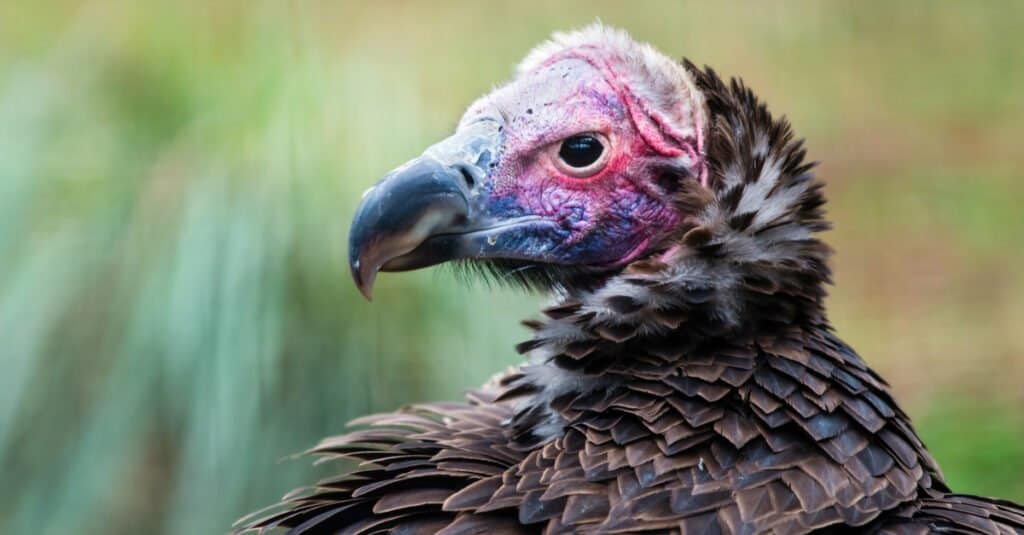
Lappet-faced vultures are found across Africa and the Arabian Peninsula.
©Rob Hainer/Shutterstock.com
- Body Length: Up to 3 feet 9 inches
- Wingspan: Up to 9 feet 6 inches
- Weight: 23 to 30 pounds
The lappet-faced vulture (Torgos tracheliotos) is a massive Old World raptor that prefers drier regions than most other vultures. They can typically be found in arid and semi-arid open habitats like savannas, deserts, and grasslands. This vulture inhabits most of Africa and the Arabian Peninsula. It has a square, bald head with reddish-pink skin, brown to black body feathers, and white feathers on the chest. It has a yellowish-blue beak and loose, wrinkled folds of skin, called lappets, on its face.
While generally solitary, large groups of more than 20 birds may feed at sites with abundant carrion. They generally nest in the forked branches of large trees. Unfortunately, the number of lappet-faced vultures is declining throughout its range, although it appears to be more stable in the Arabian Peninsula. As is the case with many vultures, their populations suffer from habitat loss and poison ingestion. The IUCN currently lists the species as endangered.
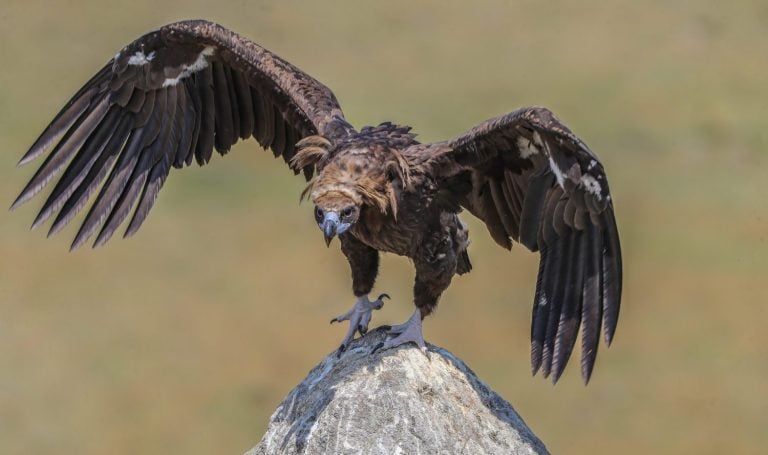
3. Cinereous Vulture
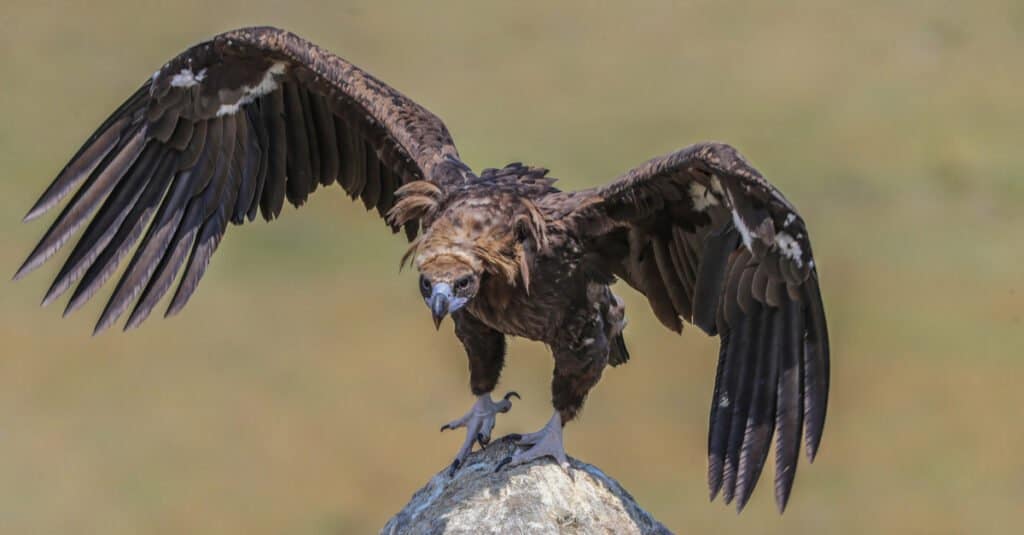
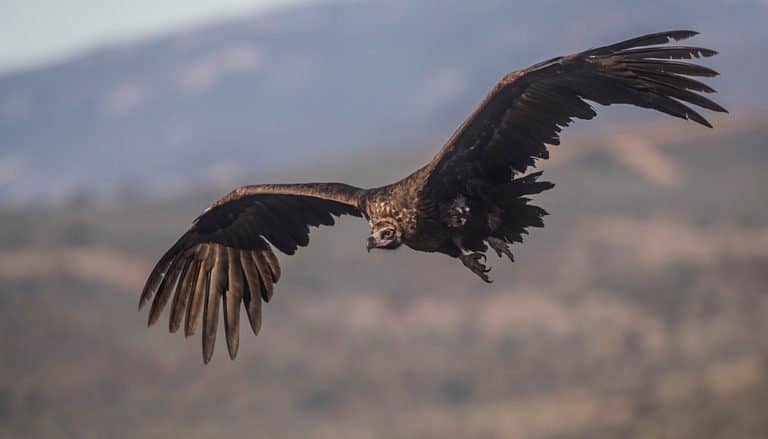
The cinereous vulture is the largest Old World vulture.
©yabaninizinde/Shutterstock.com
- Body Length: Up to 3 feet 11 inches
- Wingspan: Up to 10 feet 2 inches
- Weight: Approximately 31 pounds
Ranked third on our list, the cinereous vulture (Aegypius monachus) is the largest Old World vulture. This vulture is found in Europe and central Asia, with breeding territories in Turkmenistan, Tajikistan, northern Afghanistan, and extreme western China. The cinereous vulture prefers open, mountainous terrain, including high-elevation meadows and the Central Asian steppes. Although European populations appear to be increasing, the population in Asia is decreasing. The IUCN lists the global cinereous vulture population as near-threatened.
Unlike the colorful lappet-faced vulture, the cinereous vulture is mostly dark, with dark brown plumage and a pale, featherless head. Like Rüppell’s vulture, the cinereous vulture has special hemoglobin that allows it to fly at high elevations where oxygen is thin. This vulture has been recorded at elevations over 22,000 feet on the slopes of Mount Everest.
2. California Condor
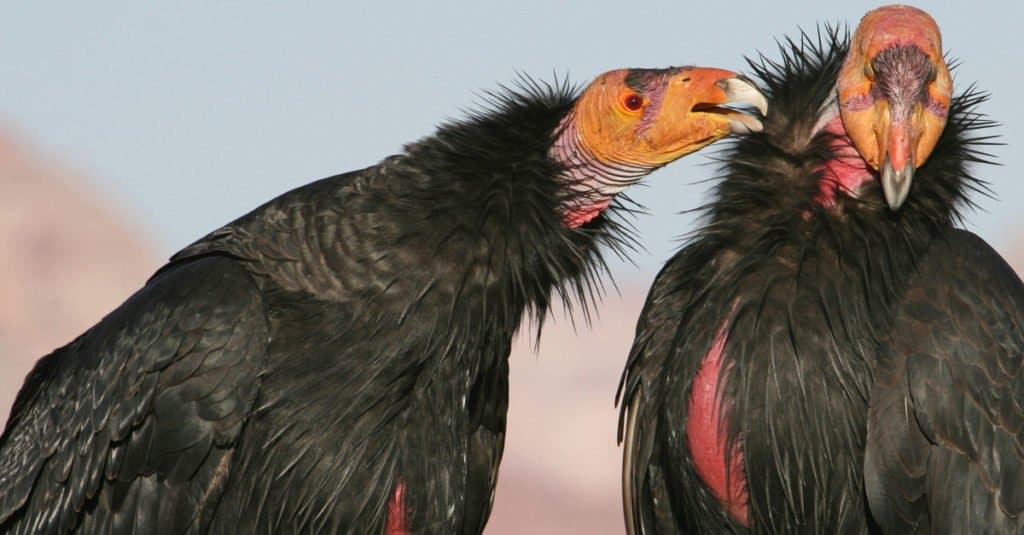
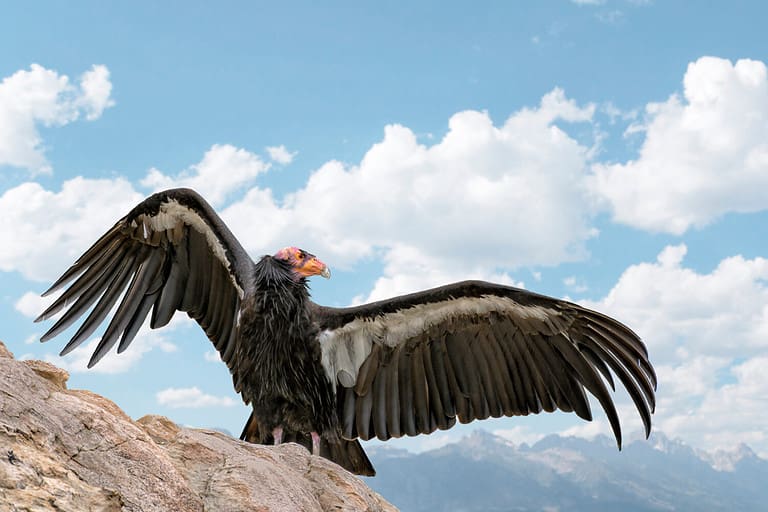
By 1987, the California Condor was nearly extinct, but ongoing efforts to save the species have proven successful.
©MTKhaled mahmud/Shutterstock.com
- Body Length: Up to 4 feet 7 inches
- Wingspan: Up to 9 feet 10 inches
- Weight: 15 to 31 pounds
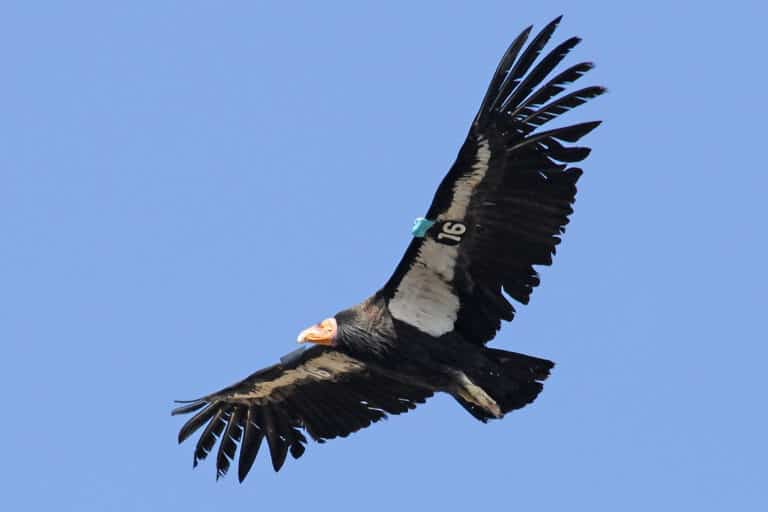
Number two on our list is the largest bird of prey in North America, the California condor (Gymnogyps californianus). By 1987, only 23 California condors remained. However, due to efforts to save the species from extinction, there are now over 560 California condors, including both captive and wild birds. The IUCN lists the California condor as critically endangered. These condors are typically located in California, Arizona, and Utah. They can be found roosting on cliffs or in large trees, and nesting in caves or on rocky ledges in mountainous areas.
The California condor is mostly black, except for a white triangle of feathers on the underside of each wing. Its featherless head can change colors depending on the condor’s mood. The skin of the California condor’s head and neck can be shades of orange, yellow, red, pink, or light blue. The skin becomes a more intense pinkish-orange during the breeding season and when the birds are excited.
1. Andean Condor
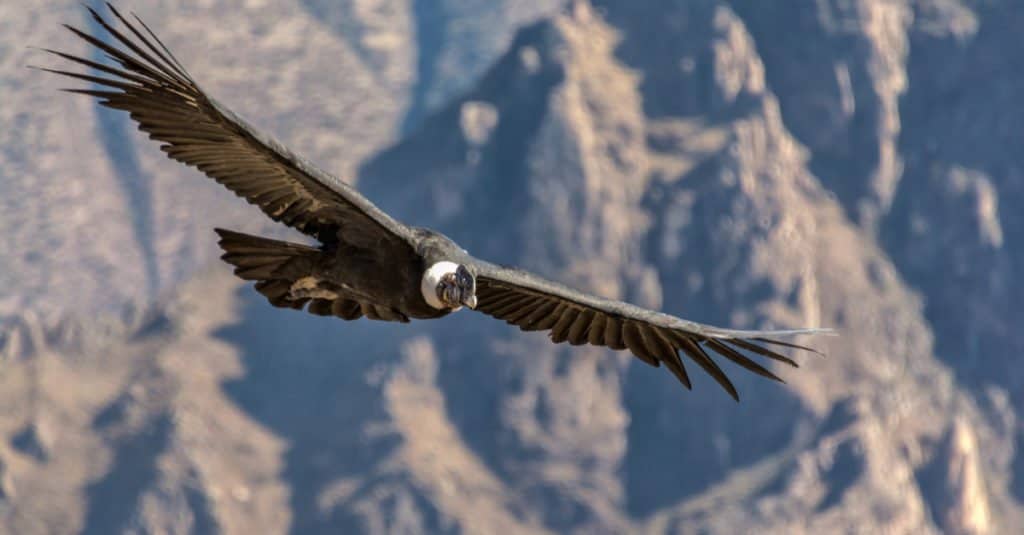
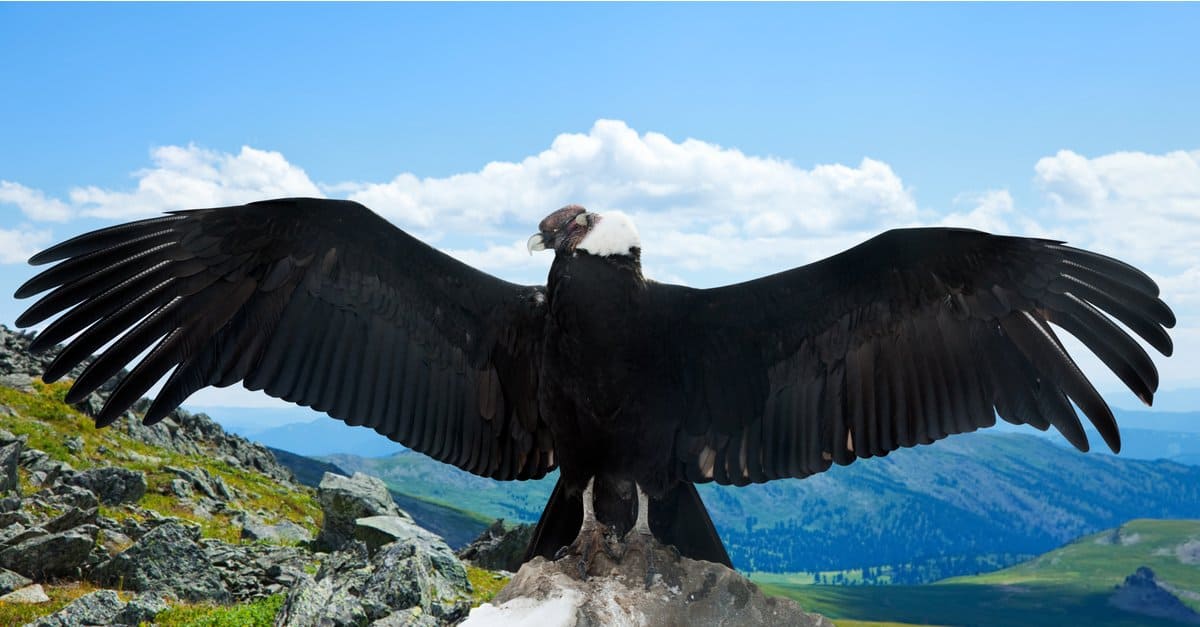
The Andean condor has a wingspan of over 10 feet.
©Gus Martinie/Shutterstock.com
- Body Length: Up to 4 feet 3 inches
- Wingspan: Up to 10 feet 5 inches
- Weight: 22 to 33 pounds
Not only is the Andean condor (Vultur gryphus) the largest vulture on Earth, it is also the largest raptor and one of the largest flying birds in existence. This enormous raptor makes its home in the Andes mountain range in South America, but it also inhabits the lowlands of southern Chile, Argentina, and Tierra del Fuego. The IUCN currently lists the bird as vulnerable. It is one of the longest-living birds on earth, with some individuals reportedly living nearly 80 years in captivity.
The Andean condor nests in remote, rocky crags and lays 1 to 2 eggs per year. It is a mostly black-feathered bird with white feathers on the upper wing and a ruff of white feathers surrounding the base of the neck. They are the only New World vultures to exhibit sexual dimorphism, with males generally being larger than females. Males also have a wattle under their beak and a comb, similar to a rooster’s, on top of their heads. Like most vultures, the head and neck of Andean condors are featherless. Their skin appears dull red, but the color can change to yellow during the breeding season.