
Quick Take
- Researchers thought they had a known species, but something tiny stopped them cold under the microscope. See the microscope discovery →
- A single anatomical detail invisible to the naked eye is all that separates this new species from thousands of known lookalikes. Explore the key distinction →
- Scientists collected only one specimen, which raises more questions than it answers. See what remains unknown →
- The closest known relative shares almost the same appearance, yet the two are far more different than they look. Compare the two species →
When a team of researchers from China and the United Kingdom was collecting insects in the trees of Dashu Mountain National Forest Park, they weren’t expecting to discover a brand new species. But that’s exactly what happened. A pale, creamy white leafhopper, the size of a grain of rice, was among the bugs in the nets.
In the field, the researchers initially thought it was a known species. But once they got back to their lab and looked at it under the microscope, they realized they had collected something previously undiscovered. Two prongs, shaped like a stag’s antlers and part of the male leafhopper’s reproductive organ, were like nothing scientists had seen before.
The new insect was eventually named Eurhadina cervina, a reference to the Latin word for “stag.” Details of the discovery were recently published in the journal ZooKeys.
What Is a Leafhopper?
Leafhoppers are part of a very large group of insects called Cicadellidae, of which leafhoppers represent more than 20,000 known species around the world. They are found everywhere except Antarctica.
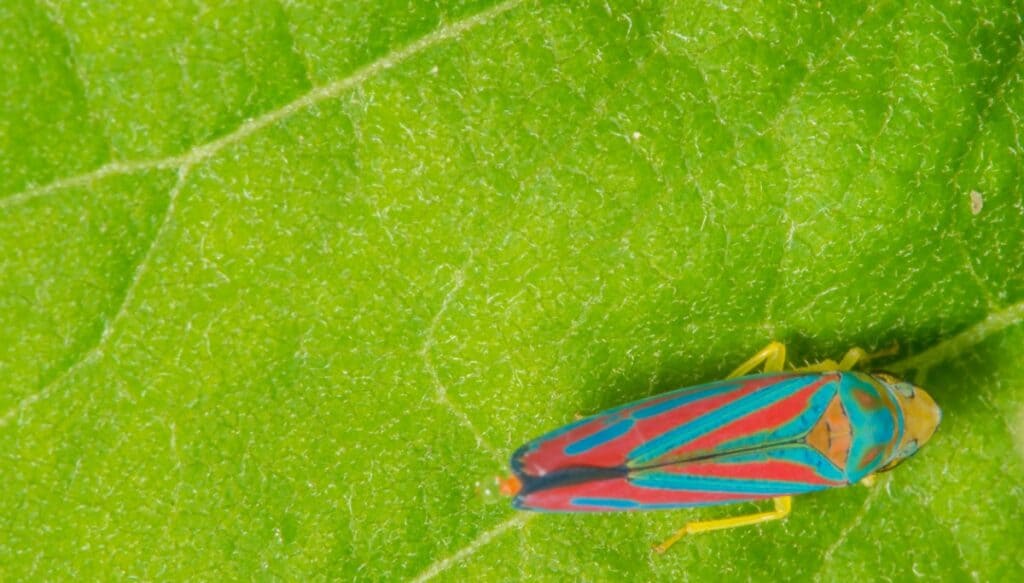
Leafhoppers belong to the family Cicadellidae and are found around the world.
©iStock.com/BobGrif
Leafhoppers are small, slender insects that typically range from 1/8 to 1/4 inch long, although some can grow up to one-half inch. The newest discovery is small even by leafhopper standards, measuring around .06 inches long.
Leafhoppers feed on sap from leaves and plants, using a straw-like mouthpart that allows them to pierce the plant’s surface and extract sap. However, not all leafhoppers feed on the same type of sap. Some focus on water, others seek out sugar, and some—like the newly discovered species—feed on the soft tissue found between the veins of a leaf.
Discover the New Species
The newly discovered species belongs to the genus Eurhadina, which now includes 99 known species worldwide. China is home to more than half of these species, with 55 found in the country. When scientists collected the new species, they managed to capture only a single male specimen; no females were found.
The specimen was collected in the Dashu Mountain National Forest Park in Hefei, Anhui Province, China. It was caught on July 8, 2024, using a sweep net at an altitude of approximately 930 feet. Researchers use sweep nets to sweep through leaves and branches, capturing the small insects that hide in these environments. After collection, the research team preserved the insects in a 90% ethanol mixture for later examination.
To date, this is the only specimen of this leafhopper species that scientists have collected. It is believed to be native to this single location.
How Scientists Could Tell It Apart
Because they are so small, many leafhopper species appear identical to the naked eye. Researchers brought the specimen to their lab and used microscopes to carefully inspect it. They focused on color and markings, body shape, and reproductive organs, the latter of which required dissection for detailed study.
It was the examination of the reproductive organs that led the scientists to realize they had found an entirely new species. When they studied the internal organs individually, they discovered the branching, antler-like shape of the male specimen’s reproductive organs. This pattern had not previously been observed in any leafhopper species.
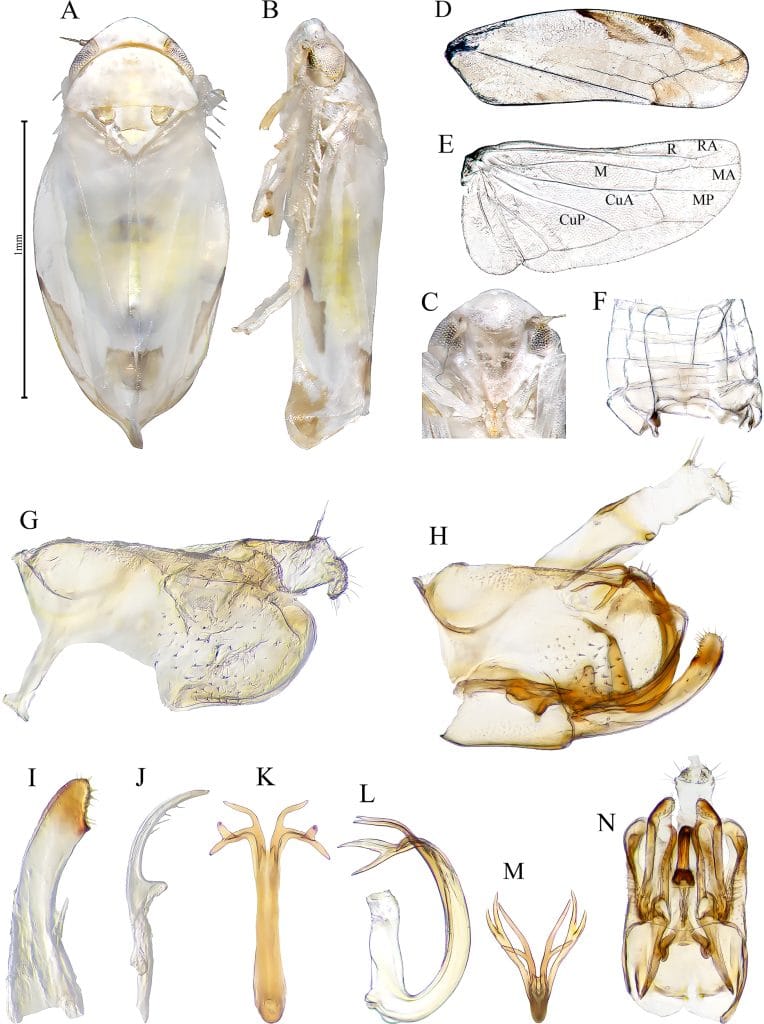
The dissected portions of the male specimen. A. Habitus, dorsal view; B. Habitus, lateral view; C. Face; D. Forewing; E. Hindwing; F. Male abdominal apodemes; G. Side of male pygofer and anal tube, lateral view; H. Male genital capsule and anal tube, lateral view; I. Subgenital plate, dorsal view; J. Style, dorsal view; K. Aedeagus, dorsal view; L. Aedeagus, lateral view; M. Apical part of aedeagus, dorsal view; N. Male genital capsule and anal tube, ventral view.
But there were other telltale signs, too. The closest known species resembling the new discovery is Eurhadina japonica, but it is about twice as long, measuring approximately 0.11 to 0.13 inches. The new species also lacks a distinctive dark spot on its forewing, which is characteristic of E. japonica. Based on this evidence, the scientists concluded they had discovered an entirely new species of Eurhadina leafhopper.
What Else Do Scientists Know?
Not much, actually. Because only a single specimen of the new species was collected—and it was part of a larger, general sweep—there is no plant data available to associate with the finding. This means scientists do not know what the species eats. Additionally, since no female specimens were collected, it is difficult for researchers to draw conclusions about other aspects of the new species.
The researchers note that they hope to collect additional specimens and conduct future studies focusing on DNA testing and host-plant information to better understand the species. They believe this will help them determine how the new species is related to its 99 other Eurhadina relatives.
The new discovery may be barely visible to the naked eye, but it adds another piece to the puzzle of insect life in China’s forests. It serves as a reminder that countless species are still awaiting discovery around the world.