
Quick Take
- The newly discovered frog species was named after someone you wouldn't expect to find in a biology paper. See who it's named after →
- What makes the Dajomes glassfrog unique is not its transparency. It has a feature no other glassfrog has. Explore the Dajomes glassfrog's unique trait →
- Researchers found far more unknown species at El Quimi than they anticipated. See the surprising species count →
Glassfrogs are tree-dwelling amphibians that can be found throughout Central and South America. There are actually about 167 different species. Now there is at least one more.
The newest glass frog species was discovered during biological surveys conducted by researchers in El Quimi Nature Reserve, located in the mountainous region of southern Ecuador. The newest species was just one of many glass frog species that had never been observed before. As it turns out, the reserve is a hotspot for amphibians. The discoveries were announced in a new study published in PLOS One on April 8, 2026.
What Are Glass Frogs?
Glass frogs are small, tree-dwelling amphibians that live in rainforests. They are typically no larger than 1.2 inches long. From above, they look like typical frogs, with bright green skin on their backs and heads. That coloration helps them blend in with the leaves to avoid detection by predators.
What makes glass frogs unique – and earns them their name – is the transparent skin that covers their undersides. The skin is so transparent that you can sometimes even see their heart and other internal organs in vivid detail.
Researchers believe at least 44 species of glass frogs live in the higher elevations of the tropical Andes Mountains, above 1,000 meters (3,280 feet) in elevation.
The Newest Glass Frog Discovery
In 2017 and 2018, research teams conducted two separate biological surveys in the El Quimi Nature Reserve. The surveys were conducted by researchers from the QCAZ Museum and focused on the sandstone tabletop plateau found on the eastern side of the Quimi River Valley within the Reserve.
It was during these expeditions that researchers discovered the new species of glass frog. To determine it was a unique species, the researchers sampled tissue from the collected glass frogs and compared it to existing specimens at various universities and museums, among them the Natural History Museum in London and the National Museum of Natural History at the Smithsonian Institution in Washington, D.C. They ran DNA comparison tests to validate that the species was unique and previously undiscovered.
The newly identified species was named after Neisi Dajomes, the first Ecuadorian woman to receive an Olympic gold medal. She won it at the Tokyo 2020 games in women’s 76 kg weightlifting.
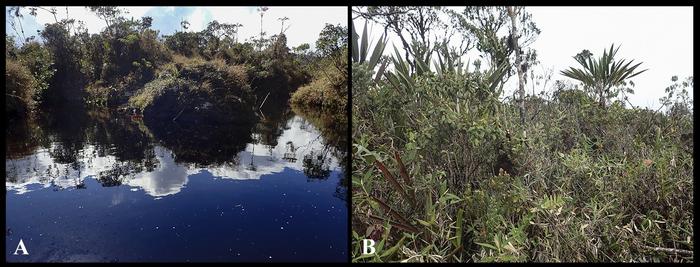
The El Quimi Nature Reserve, where the new glass frog species was discovered.
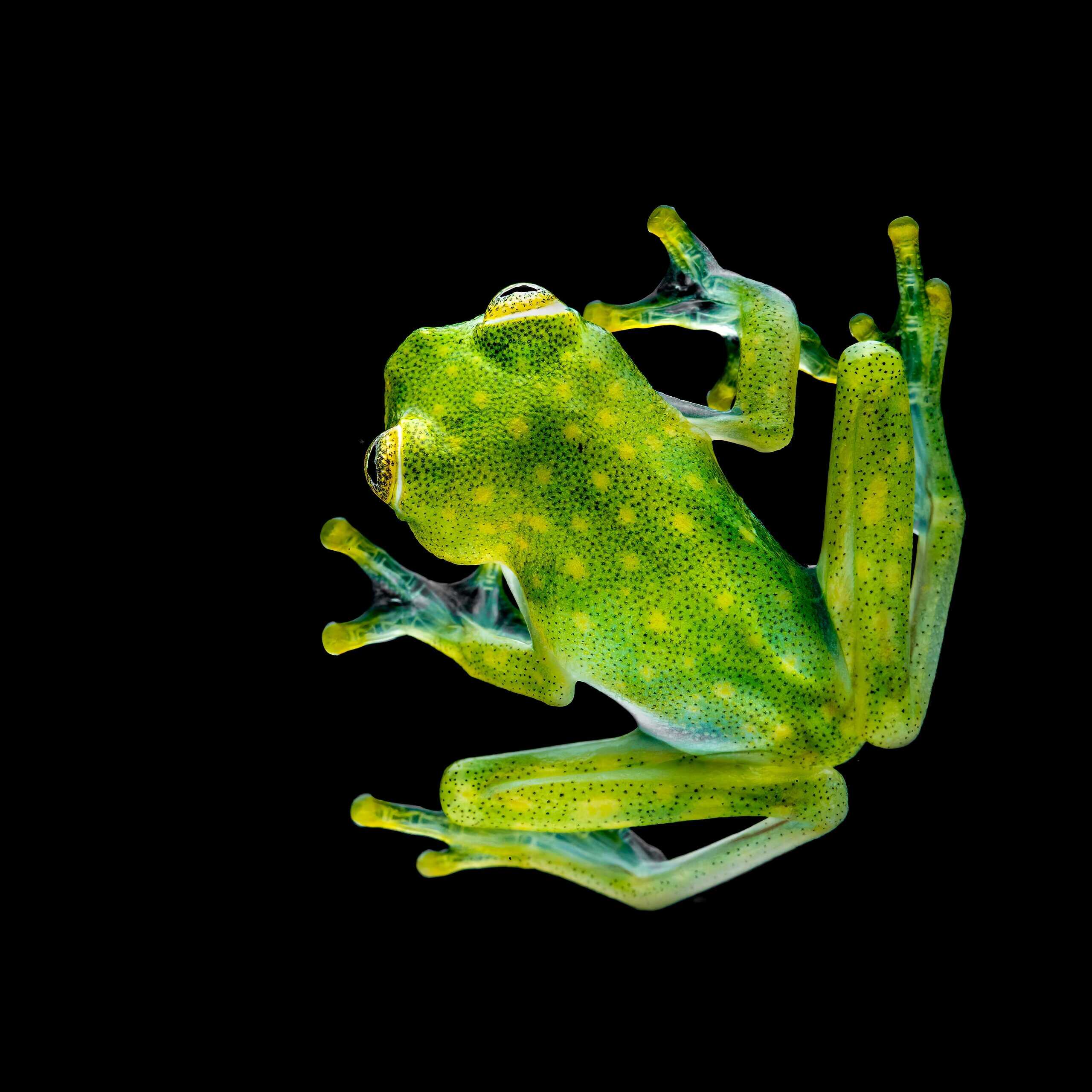
Mylena Masache, a biology student at the Pontifical Universidad Católica del Ecuador and an Ecuadorian native, described the newly discovered species in the study. The Dajomes glass frog has pebbly green skin that is uniformly colored on top. Its underside is transparent, revealing some of the frog’s internal organs. However, what makes this species unique is the white membrane that covers the frog’s heart, esophagus, stomach, and kidneys. The membrane is covered with special light-reflecting cells.
Researchers believe the Dajomes glass frog species likely originated during the Pliocene era, between 5.33 and 2.58 million years ago. They also note in the study that the Dajomes glass frog is a sister species to another undescribed species, also from southwest Ecuador.
The first Dajomes glass frog was observed just a few miles from a large-scale mining operation in an agricultural region. Mining in the area has caused an overall decline in the local amphibian population, but it is unknown how the Dajomes glass frog is impacted. It’s unclear to researchers whether the frog should be considered threatened or endangered.
What Else Did Researchers Discover?
The Dajomes glass frog species was only one of the discoveries researchers made during their two separate expeditions into the reserve. Another noteworthy discovery was just how much as yet undiscovered amphibian biodiversity there was in the region.
Researchers determined that more than 85 percent of the amphibian species they observed were previously unknown. They believe the Cordillera del Cóndor region—a Subandean mountain range separated from the Eastern Cordillera of the Andes in Ecuador by the Nangaritza-Bomboiza-Zamora River Valley—could contain amphibian communities that are hidden worlds, ready for biological exploration. The Cordillera region is extremely remote and has complex geology and geography, which, according to researchers, explains why so many species remain undiscovered.
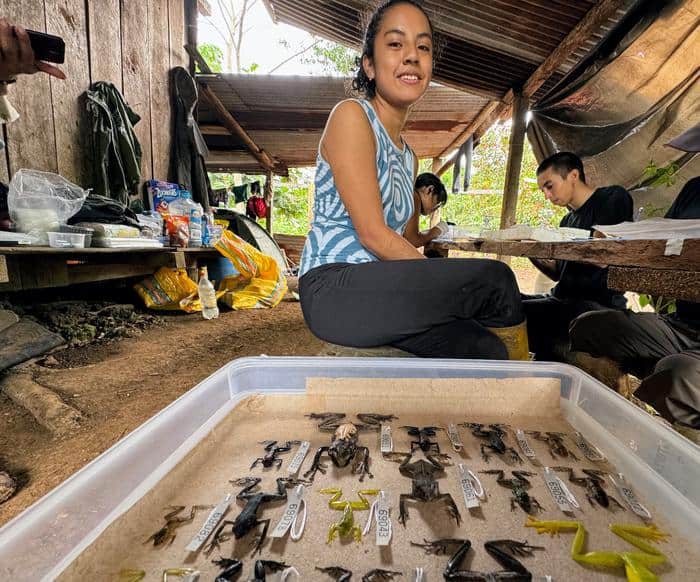
Student researchers sort through a variety of amphibians collected during the biodiversity surveys.
The study’s authors said in a recent press release, “We were astonished by the high number of new species found at the site. Few places in the tropical Andes harbor amphibian assemblages as novel as the one found at El Quimi.”
The researchers involved in the study advocate for additional biodiversity surveys to be conducted throughout southeastern Ecuador and neighboring northeastern Peru.
Regarding the discovery of the new Dajomes glass frog species, the researchers are proud that its discovery was led by an Ecuadorian native. Study author Dr. Diego Cisneros said in the press release, “It is especially meaningful that this discovery is led by a young woman scientist and honours an Ecuadorian Olympic champion – this species becomes a symbol of how science and society can recognize and celebrate women shaping the future.”