Quick Take
- A newly discovered ocean worm may hold clues to treating two devastating brain diseases, and it was found in one of the last places scientists expected. Meet the ribbon worm →
- Scientists found a new species somewhere recreational scuba divers visit regularly, a discovery that raises a question about how much we're missing in plain sight. See the sea cave shrimp →
- Discovering a species doesn't protect it. A structural bottleneck means a newly found animal could vanish before science officially admits it exists. Understand the 13.5-year gap →
- One of this year's most significant discoveries is not a flashy creature. It is a digital platform quietly racing to outrun extinction. Explore the NOVA platform →
Earth’s oceans cover more than 70 percent of our planet’s surface. That is a lot of room for species to exist, often without ever being detected by humans. Those species have had nearly 3.7 billion years to evolve, and today more than 90 percent of them remain undiscovered.
One group of scientists is working together to change that statistic. They’re doing it through the Nippon Foundation-Nekton Ocean Census and are making meaningful progress toward their goal. In a single year, the research teams discovered 1,121 marine species. It marks a significant step forward for the project and marine conservation.
What is the Ocean Census?
Ocean Census is the product of a collaboration among more than 650 marine institutes, museums, and universities working toward a common goal, collectively called the Ocean Census Science Network. The Census project’s mission is to “accelerate the discovery of ocean life to advance fundamental science, empower conservation, and fuel innovation for the future of our planet.”

One of the research vessels involved in the Ocean Census project.
©The Nippon Foundation-Nekton Ocean Census – Original / License
The work is supported by governments, philanthropists, and businesses and represents the largest marine bio discovery program ever undertaken. While the census itself is the deliverable, it is the Ocean Census Alliance that unites the diverse participants and powers the research needed to discover new marine species.
To do that, census partners fund, design, and oversee individual research programs that take place around the world. The Nippon Foundation and Nekton are the co-founders of the Ocean Census. The census program is endorsed by the Program of the UN Ocean Decade.
The program was launched in April 2023. Its stated goal is to discover 100,000 new marine species by 2030.
What the Ocean Census has Achieved
Now in its third year, the Ocean Census just released its Year 3 Impact Report, covering April 2025 to March 2026. During that timeframe, researchers on 13 separate, coordinated expeditions were able to identify 1,121 previously unknown marine species.
This marks a 54 percent increase in the number of new discoveries. In the previous reporting year, the Census identified 866 new species.
The Most Captivating Finds
This year’s findings include very diverse new species. Here are a few.
Ghost Shark (Chimaera SP.1)

This new species of Chimaera was one of the discoveries during an Ocean Census expedition.
©The Nippon Foundation-Nekton Ocean Census – Original / License
The ghost shark was one of more than 110 new species identified during CSIRO expeditions. From a conservation standpoint, it is an important find. One-third of sharks, rays, and chimaeras are considered vulnerable to extinction.
‘Life in a Glass Castle’ Symbiotic Worm (Dalhousiella yabuki)

This newly discovered species of worm lives inside a glass sponge.
©The Nippon Foundation-Nekton Ocean Census – Original / License
This polychaete worm lives inside the tiny chambers of a glass sponge, a creature that gets its name from the crystalline silica that makes up its skeleton. The worm and the glass sponge have a symbiotic relationship, each benefitting from the other. The discovery was made during the 2025 Ocean Census JAMSTEC-Shinkai Japan expedition.
The worm was discovered on a volcanic seamount in Japan’s Shichiyo Seamount Chain at a depth of 791 meters. The worm is named after Dr. Akinori Kabuki, the mission’s principal investigator.
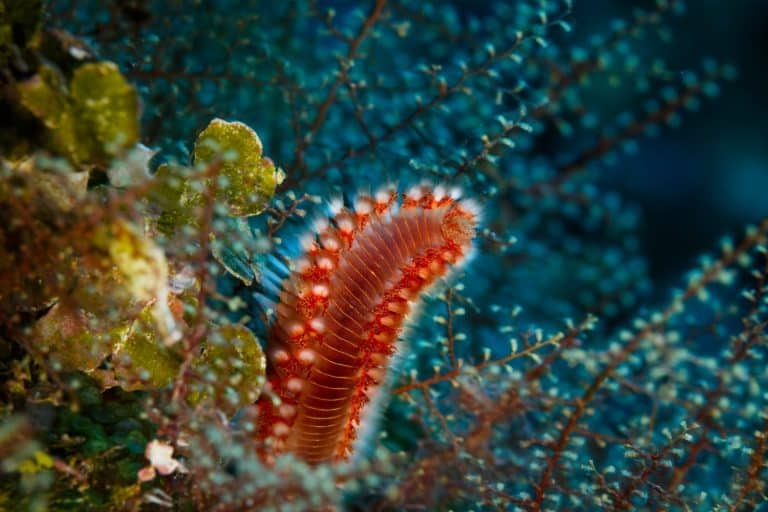
Ribbon Worm (Drepanophoridae SP.1)

Ribbon worms emit a toxic chemical when threatened.
©The Nippon Foundation-Nekton Ocean Census – Original / License
Ribbon worms are predators of the sea, using their eye-catching color combinations as a visual warning to other predators to leave them alone. The ribbon worm’s defense system is a potent chemical it can emit when threatened. Found in Timor Leste at a depth of between one and five meters, this new species of ribbon worm, less than three centimeters long, was discovered by Dr. Svetlana Maslakova.
One notable finding is that the unique toxins of ribbon worms may be helpful as potential treatments for Alzheimer’s and schizophrenia.
Mediterranean Shrimp (Caridion SP.1)

This new species of shrimp was found in the shallows of the Mediterranean Sea.
©The Nippon Foundation-Nekton Ocean Census – Original / License
Tucked away in a sea cave off the coast of Marseille, France, this new shrimp species sports a striking orange stripe pattern and detailed appendages. It was found at a relatively shallow depth of between 15 and 35 meters in the Mediterranean. This is proof that even in areas frequented by scuba divers, species remain undiscovered.
The discovery was made by taxonomist Dr. Hossein Ashrafi. It adds to the data helping conservationists in the area protect the inhabitants of the Mediterranean Sea.
The Race Against Time
Historically, the average time between a new species being discovered and its official scientific description in published literature is 13 and one-half years. For many species, this time lag means the species could go extinct before it is officially recognized.
A shortage of taxonomists, strict paperwork requirements, and a lack of shared digital infrastructure are primary factors in the decade-plus bottleneck. However, Ocean Census is committed to speeding up the process.
The Platform That is Speeding Things Up
During its three-year existence, Ocean Census has been building the networks, infrastructure, and systems that will help discoveries be recognized faster and at scale. Their global network and open-access digital platform is called NOVA.
The platform allows data to be available globally within days and draws on a network of more than 1,400 taxonomists and scientists from 85 countries and more than 660 institutions. It has been proven to work with the discoveries made to date.

Researchers worked from a variety of vessels to collect the newly discovered species.
©The Nippon Foundation-Nekton Ocean Census @JAMSTEC – Original / License
The data from NOVA can also be used to support policy decisions made by entities like the UN’s High Seas Treaty and the Kunming-Montreal Global Biodiversity Framework. The latter is responsible for the international ’30 by 30′ conservation agreement.
What Ocean Census wants to do next is scale the platform. To do that, it needs additional funding.
What Happens Next?
Ocean Census co-founder Nekton is currently seeking $100 million in capital to match $75 million already pledged by partner organizations. Once Nekton obtains the funding, the full $175 million will be available to scale NOVA to help newly discovered marine species be officially recognized faster.
Faster recognition means marine conservation can focus on these vulnerable species more quickly.
According to Oliver Steeds, Director of Ocean Census, as stated in the press release announcing the findings, it is money well spent. “We spend billions searching for life on Mars or going to the dark side of the moon. Discovering the majority of life on our own planet–in our own ocean–costs a fraction of that. The question is not whether we can afford to do this. It is whether we can afford not to.”