
Quick Take
- Contrary to appearance, reflex bleeding is a voluntary defense rather than a lethal injury.
- The Texas horned lizard can shoot, on average, 2% of their body mass in blood.
- These lizards’ diets play a role in why the blood is so off-putting for predators.
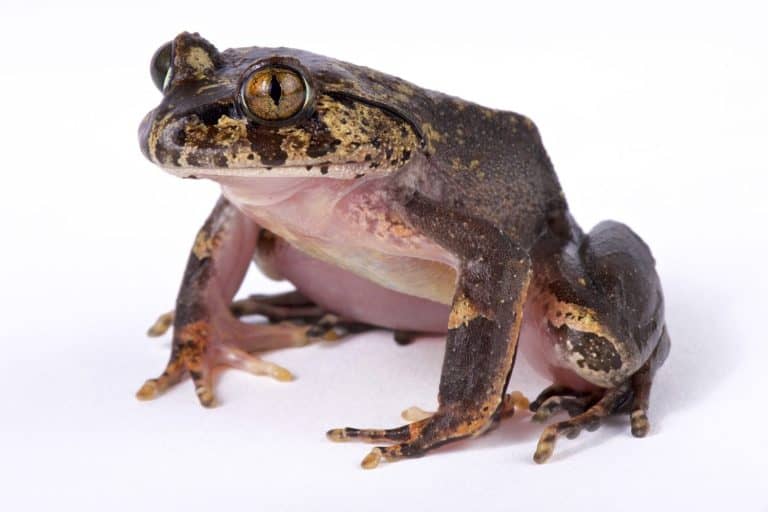
In the animal kingdom, surviving often means adapting. Animals must, over time, adapt not only to climate changes, habitat alterations, and changes in food sources, but also to how they protect themselves from danger. There’s certainly no shortage of odd defense mechanisms within nature. Bombardier beetles, for example, direct a stream of caustic liquid reaching up to 212 degrees Fahrenheit at their attackers. Hairy frogs can break their bones and force them through the skin, a tactic that makes them more challenging to fight and eat. But perhaps one of the most alarming and dramatic defense tactics around belongs to the Texas horned lizard (Phrynosoma cornutum).
If you’re squeamish around blood, you probably want to stay away from these lizards. Or, at the very least, you’ll want to make sure you don’t spook them. In an effort to protect themselves from being eaten, Texas horned lizards can spray terrible-tasting blood from their eyes. While this process, known as reflex bleeding, may sound gross to us, it could just save these lizards’ lives.
What are Texas Horned Lizards?
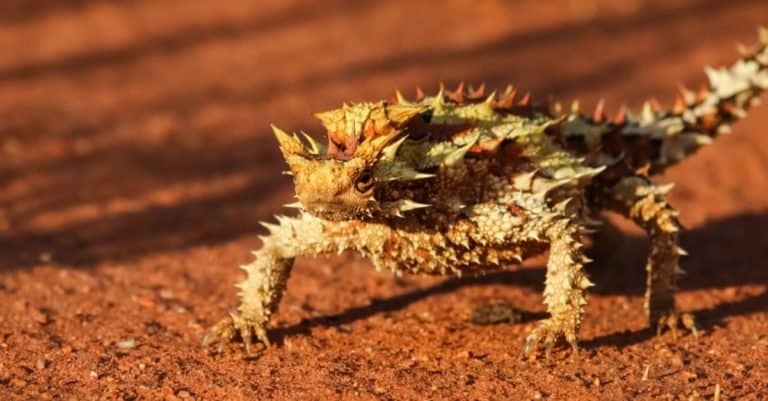
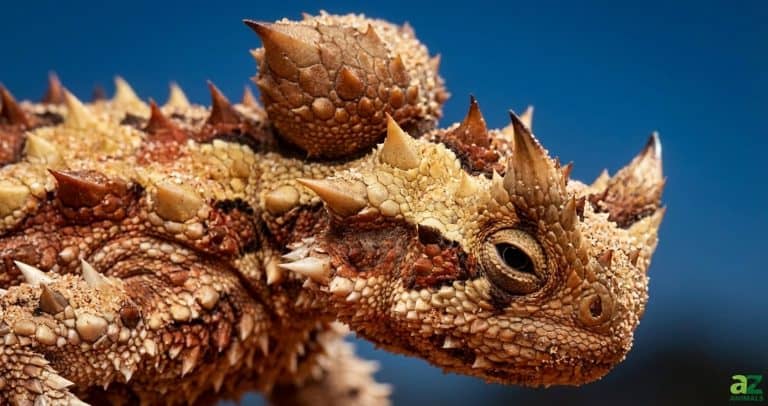
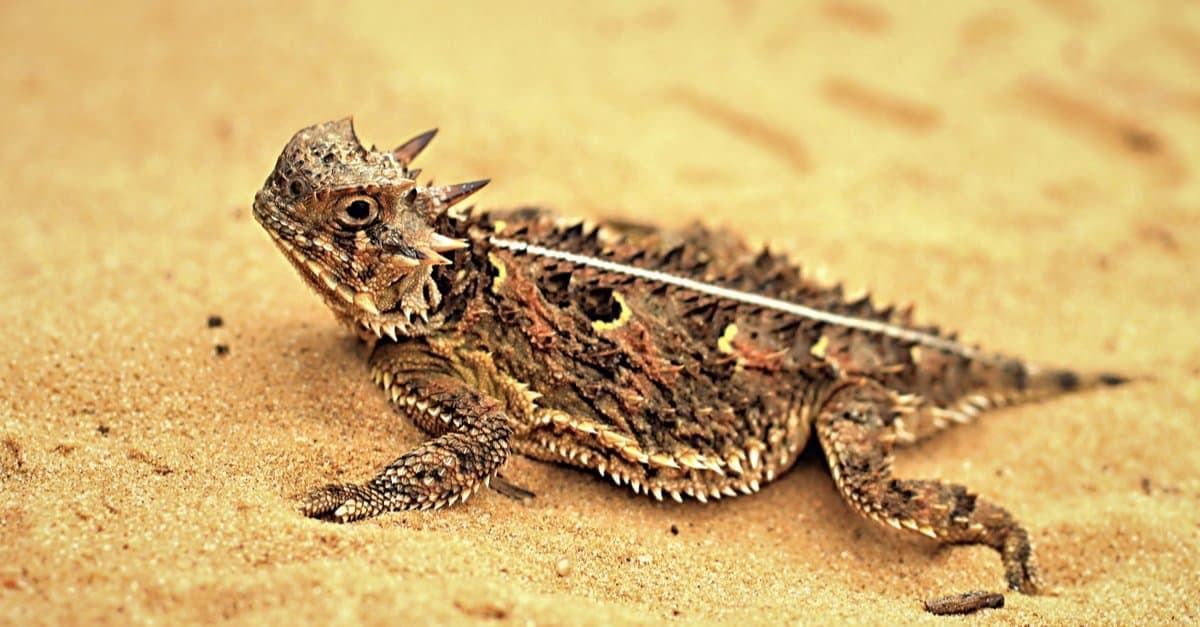
Texas horned lizards are short, relatively flat reptiles found throughout Texas, Oklahoma, Kansas, and New Mexico, and at some points in the southwestern corner of Missouri. Also known as “horny toads” due to their squat, stocky bodies, Texas horned lizards are covered in spikes, including two prominent horns on the back of their heads. Depending on where they’re found, these lizards might be gray, brown, or yellow. They also have a white line down their back, and large dark spots.

Texas horned lizards typically grow to around 5 inches long.
©Matt Jeppson/Shutterstock.com
If you want to find a Texas horned lizard, you should look in warm, sandy habitats. These lizards may bury themselves underground for nesting and hibernation. In many cases, Texas horned lizards also live near anthills, since harvester ants make up approximately 70% of their diet.
Currently, Texas horned lizards are not federally endangered, but they are considered “threatened” in Texas. Texas horned lizards face population losses due to habitat destruction and the pet trade. However, there are also several issues with their food sources. For example, homeowners may spray ant mounds with pesticides, not realizing the ecological ripple effects. Additionally, red imported fire ants, an invasive species, have been devastating harvester ant populations. Red imported fire ants provide no nutritional benefits for Texas horned lizards. These aggressive ants may also kill juvenile Texas horned lizards. To protect the health and well-being of Texas horned lizards, it’s important to consider potential ways to better control fire ants.
Which Animals Eat Texas Horned Lizards?
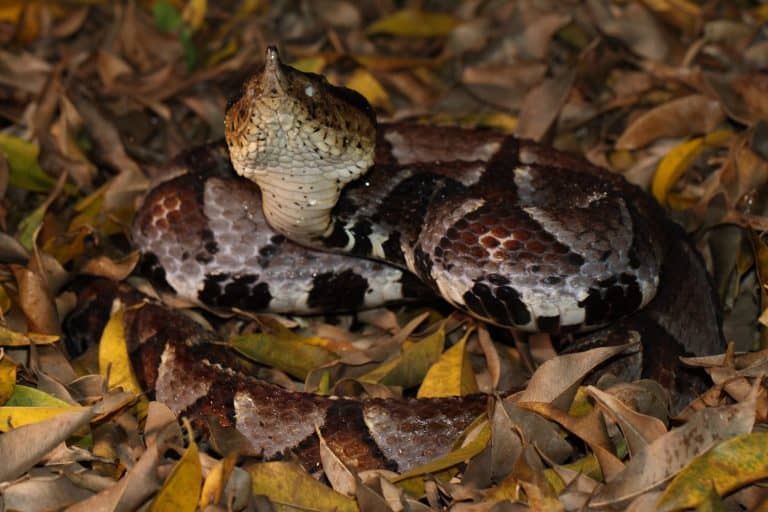
While Texas horned lizards have a limited insectivorous diet, they are actually prey for a number of predators. Hawks, owls, feral dogs and cats, roadrunners, snakes, bobcats, wolves, coyotes, and foxes will all snack on Texas horned lizards if given the chance.
To protect themselves against predators, Texas horned lizards have a few distinct defense mechanisms. They’ve adapted coloring that blends into the landscape, camouflaging them. If they’re still spotted, the San Antonio River Authority explains that Texas horned lizards will puff up their bodies to attempt to look larger than they are.
Now, let’s say the predator is not dissuaded. At this point, the Texas horned lizard lets its most surprising defense mechanism loose: reflex bleeding.
Understanding the Physiology Behind Reflex Bleeding
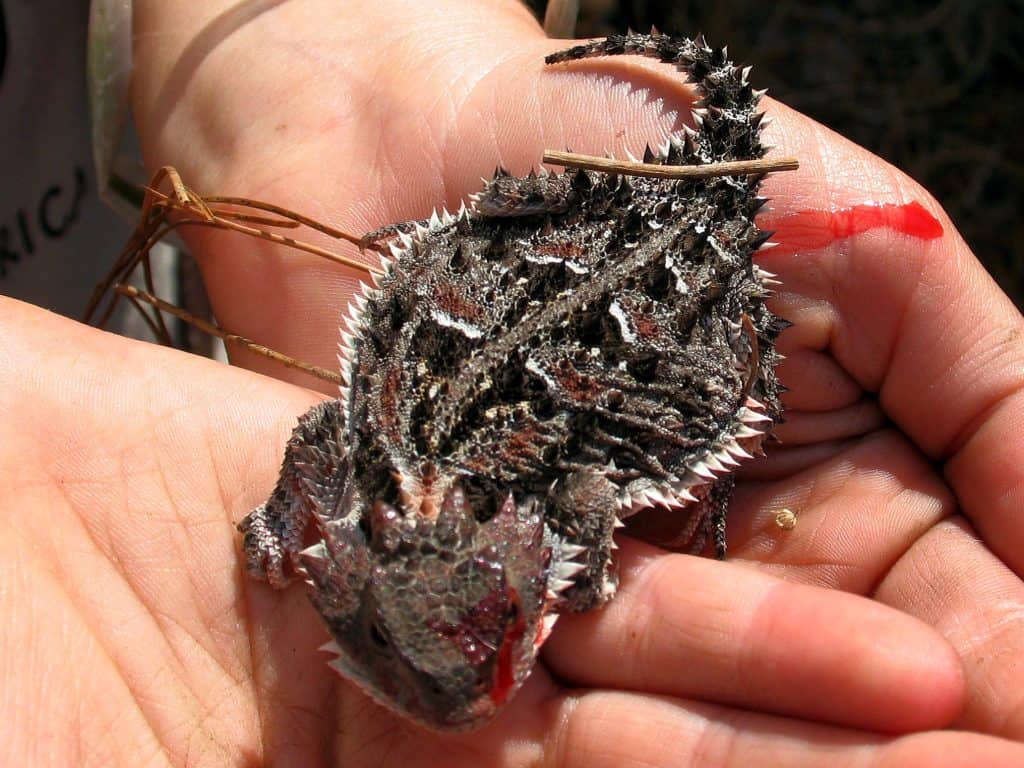
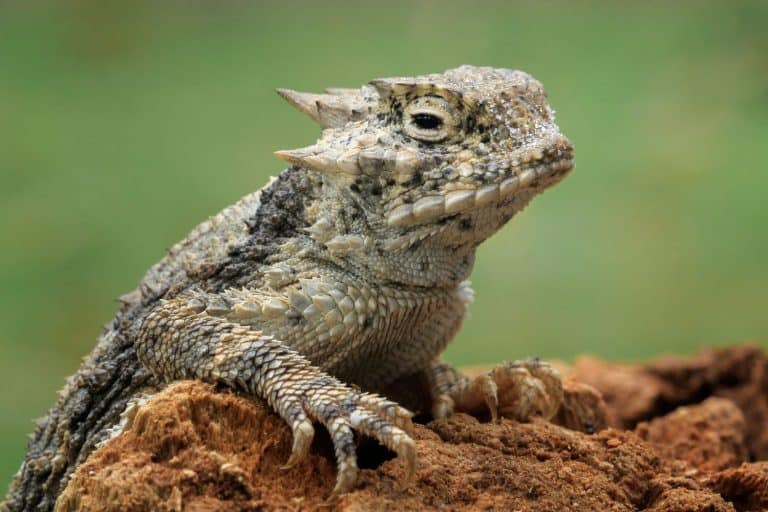
Similarly to its close cousin the Mexican Plateau horned lizard (pictured), the Texas horned lizard may shoot blood from its eyes when threatened.
©Waditalipetit / CC BY-SA 3.0 via Wikimedia Commons – Original / License
Reflex bleeding is also known by its more scientific name: autohemorrhaging. Autohemorrhaging refers to the ability to voluntarily release or eject blood. Several animals and insects use autohemorrhaging as a defense mechanism, but not all of them eject blood from the eyes like Texas horned lizards. Other creatures may instead bleed from the mouth, membranes, or other areas of the body.
When it comes to Texas horned lizards, you might be wondering how autohemorrhaging works. Dr. Karl Shuker, a world-renowned cryptozoologist, explains in his book The Hidden Power of Animals that the autohemorrhaging process begins when lizards constrict the muscles around their eyes. This prevents blood from flowing back to the heart. Instead, blood (which continues pumping to the head) fills the sinuses in the eye sockets, causing pressure to build higher and higher. By rapidly re-constricting the muscles, and rupturing the sinus membranes, Texas horned lizards can then shoot blood from the eyes.
Interestingly, Texas horned lizards are remarkably accurate with their shots. The blood squirts can travel up to five feet and are often specifically shot at either the predator’s eyes or mouth. According to a 2001 study published in Copeia, Texas horned lizards can shoot an average of 2% of their body mass in blood, though the study also cites lizards shooting up to a stunning 6.8% of body mass.
How Bitter Blood Begins
Another remarkable element of this gruesome defense mechanism is the taste of the blood. Harvester ants are particularly venomous. But Texas horned lizards have a component in their saliva that neutralizes the venom. Because of their high-ant diet, Texas horned lizards build up high levels of formic acid in their blood. Now, this is important for the lizards, since formic acid keeps them healthy. But for predators, the formic acid ruins the meal.
I like to think of it like this: imagine you’ve got a meal in front of you that you’re really looking forward to, whether that’s a juicy hamburger or a veggie quinoa bowl. You’ve eaten it many times before, so you know exactly what to look forward to. But when you take a bite, your mouth is suddenly flooded with bitterness.
That’s similar to what happens when Texas horned lizards autohemorrhaging. Their blood, high in chemical compounds and formic acid from their ant-heavy diet, is noxious and bitter.
How Do Predators React?
We know the answer (at least partially) thanks to a 2005 study which examined coyotes’ sensory reactions. Researchers found that coyotes typically reacted when they smelled or tasted the blood, versus when they simply came in contact with the blood, indicating that the blood tasted or smelled worse than it felt. Additionally, the research team observed headshaking, opening and closing the mouth, or even recoiling completely and leaving the lizard alone. When fed dead lizard carcasses, coyotes also showed signs of gastric discomfort and even vomiting.
Ultimately, this could actually be a long-term benefit for Texas horned lizards. It’s likely that some predation will always occur. After all, if Texas horned lizards are in an environment where food sources are lacking or competition is high, predators may be willing to tolerate a poorly tasting meal just to get some calories. However, younger generations of coyotes or foxes, especially those who are squirted with blood once, may develop a learned aversion to these lizards.