Quick Take
- Cleveland’s famous sea monster, Dunkleosteus terrelli, was recently discovered to have a more typical jaw size than originally thought.
- It was also found to be of a more normal size compared to other similar fishes of the time.
- Its jaw went through a similar evolutionary process to that of mammals, including humans.
For generations, Dunkleosteus terrelli, also known as Ohio’s state fossil fish, has been a familiar figure for those in the Cleveland area, regarded as one of prehistory’s great sea monsters. This 14-foot armored fish sliced through ancient seas with bone blades instead of teeth. School children and museum visitors in the Cleveland area stare at its skull in awe. Artists paint it as a deep-sea terror built unlike any creature before or since.
But what if the real Dunkleosteus wasn’t actually the impossibly strange creature Cleveland has known for 150 years? What if it was…surprisingly normal?
That’s the story emerging from new research led by Dr. Russell Engelman of Case Western Reserve University. Engelman and his team peeled back 360 million years of mystery to analyze Dunkleosteus as never before, and the findings recast this Devonian superstar in unexpected and fascinating ways.
“I think the single biggest way this changes our understanding of Dunkleosteus is that it makes it much less of an outlier relative to the general arrangement of jaw anatomy in early jawed fishes,” Engelman tells A-Z Animals.
For an animal long portrayed as a total evolutionary mystery, that’s a big deal.
Myth vs. Reality: The “Alien” Fish That Wasn’t
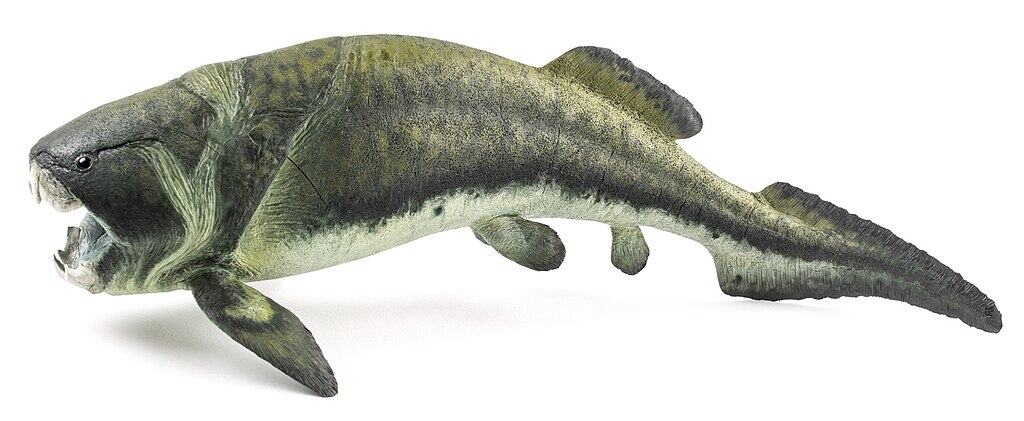
An illustration of Cleveland’s beloved sea monster Dunkleosteus terrelli
So how did Dunkleosteus get its strange reputation?
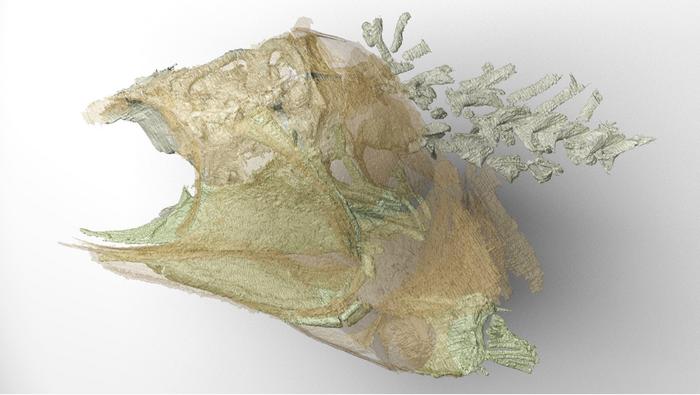
Much of it comes from the fossils themselves. The species is often found flattened; its internal anatomy is rarely preserved; and for nearly a century, no one had revisited its structure with modern tools. As Engelman explains, early scientists didn’t have enough data to interpret its bones confidently. In his words, “Dunkleosteus had sometimes been proposed to have wildly unique and alien jaw anatomy compared to other fishes, which was largely due to difficulties in interpreting how the bones went back together.”
The challenge can be described as trying to reassemble a crushed 1930s car from blueprints for a motorcycle. A strange creature is almost guaranteed.
But with new comparative data from other armored fishes around the world—and especially from superbly preserved fossils in Australia—researchers can finally see which parts of Dunkleosteus are extraordinary and which are actually fairly standard for early jawed vertebrates.
One example? Those terrifying shearing jaws.
Engelman reveals that the lower jaw of Dunkleosteus followed the same evolutionary pathway as ours: “It looks like the lower jaw was originally composed of a single undifferentiated cartilage, and then it gradually became ossified into several distinct bones. This is exactly the same way that our jaws went from being entirely cartilage… to entirely bone,” he notes.
Rather than a bizarre one-off, Dunkleosteus now appears to follow the exact basic blueprint used by sharks, early fish, and eventually mammals, including us.
Even the shark-like facial muscle the team identified seems to have deeper evolutionary roots. Engelman says that while it resembles modern sharks and rays, “a broader survey suggests a similar muscle may have been present in most early fishes and was simply lost or modified in the lineage leading to modern bony fishes.”
Far from being an anatomical outcast, Dunkleosteus may actually help scientists understand what the earliest jawed fish were really like.
Not toothless…after all?
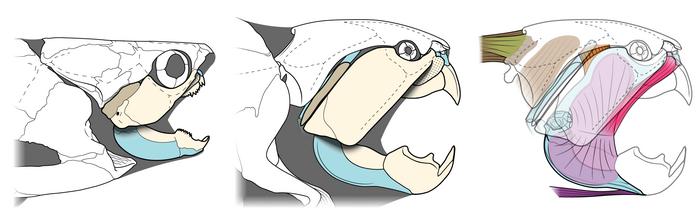
The muscle and jaw anatomy of Dunkleosteus terrelli (center), compared to other prehistoric fish.
©Russell Engelman/Case Western Reserve University – Original / License
One of the most distinctive features of Dunkleosteus is its lack of true teeth. Instead, it sported enormous, sharpened bone blades which were perfect for slicing other armored fish into manageable chunks.
This striking anatomy has often been framed as “primitive,” as if Dunkleosteus lived before real teeth evolved. But Engelman cautions against that common misconception: “The lack of teeth in Dunkleosteus is often framed as ‘this fish is so ancient it existed before teeth evolved’ but in fact what we are seeing is that Dunkleosteus is part of a broader group of fish that have teeth but have simply lost them in certain lineages.”
In other words, Dunkleosteus didn’t predate the evolution of teeth; it opted out of them.
Even more surprising, its iconic bone blades aren’t as unique as they seem. As Engelman explains: “The bone blades of Dunkleosteus are often framed as completely unlike anything that has existed for the last 360 million years, but… the system of growth and wear in Dunkleosteus is similar (but less extreme) to that seen in modern chameleons and an extinct group of reptiles known as rhynchosaurs.”
Yes, a chameleon and a reptile that lived alongside the first dinosaurs share a curious connection with the Devonian’s top predator.
The evolutionary logic behind those blades is now more apparent as well. Whenever certain armored fish specialized in eating other large fish, Engelman says the same thing happened: “Bone blades are a feature that independently develops in these armored fishes whenever they start specializing on eating other large fishes… these bone blades are very good at cutting digestible chunks out of very large animals.”
To put it simply: when it comes to hunting big prey with bony jaws, nature tends to reinvent the same tools.
Dunkleosteus had sometimes been proposed to have wildly unique and alien jaw anatomy compared to other fishes, which was largely due to difficulties in interpreting how the bones went back together.
Dr. Russell Engelman of Case Western Reserve University
Still an apex predator?

A fossil of Dunkleosteus from Cleveland shale
Even with a more grounded anatomy, Dunkleosteus remains an apex predator, but now scientists have a clearer picture of how it fed, moved, and grew.
One longstanding misconception? Its size.
For decades, popular books and museum signage often cited enormous estimates: 30 feet or more. Engelman discovered something surprising when he reevaluated the fossils: “For 80 or more years it was considered ‘common knowledge’ that this fish reached lengths of 8–10 m [24-30 feet], but… there was no way for the fish to be this big given the proportions seen in most reconstructions,” he says.
Even worse, oversized depictions became self-reinforcing as “reconstructions of Dunkleosteus that are 5–6+ meters long imply animals that are more than twice the size of the largest known fossils,” Engelman adds.
In reality, most individuals likely topped out around 14–20 feet long, still massive, but not the skyscraper-sized monster beloved by internet listicles.
A new reputation for Cleveland’s beloved sea monster
So what image should the public carry forward?
Engelman hopes readers will understand Dunkleosteus as both extraordinary and familiar: a sleek, heavily armored pursuit predator shaped by the same evolutionary rules that guided countless other fish lineages. “A lot of what is considered common knowledge about Dunkleosteus is actually speculative or based on limited knowledge,” he says.
With its anatomy freshly interpreted—from cartilage-rich skull to shark-like muscles to bone-blade jaws—we can finally imagine a creature that isn’t a mythic aberration, but a powerful, well-adapted product of its time.
It was fast. It was formidable. It was the apex predator of the Devonian seas.
But it was also part of a larger evolutionary story, one that includes sharks, early vertebrates, reptiles, mammals, and yes, even us.
If anything, that makes Dunkleosteus more remarkable, not less.