
Quick Take
- King eiders are circumpolar sea ducks that normally winter near sea-ice edges but are now being seen along the U.S. Atlantic coast.
- Their appearance is tied to shifting ice, prey, and ocean temperatures, signaling broader changes in Arctic and offshore ecosystems.
- Cape Cod Canal is a hotspot; use a scope to spot the male’s orange bill knob and blue crown.
If you’ve been scanning the East coast flocks this winter, you may have noticed an uncommon and utterly dazzling visitor: the king eider. These striking sea ducks are showing up in larger-than-usual numbers along the U.S. Atlantic coast, from Maine to New Jersey and islands like Nantucket and Block Island. For birders this is a rare treat indeed. King eiders are normally Arctic specialists in winter, so seeing them off our coastlines is exciting, but it’s also a useful indicator of broader ocean-change processes. Keep reading to learn where to look for these beautiful ducks, why they may be arriving in force, and what scientists think this tells us about shifting ocean conditions.
Who are the King Eiders?

The male king eider stands out immediately within a flock of ducks.
©Manakin/iStock via Getty Images
King eiders are circumpolar sea ducks, meaning they occur across the entire Arctic region: Alaska, northern Canada, Greenland, Svalbard, and the Russian Arctic. They breed on Arctic tundra but spend much of the non-breeding season at sea. Males are unmistakable when in full plumage. They sport a large bright-orange bill knob, a pale ice-blue crown, a vivid green cheek patch, and bold black-and-white body contrast. Their uniquely rounded head shape and striking colors make them stand out instantly in any sea-duck flock. Females are a more basic brown and streaked, so they’re easily overlooked in mixed flocks of common eiders. In eastern North America, these birds traditionally winter in marine waters from eastern Canada down toward the mid-Atlantic but mostly remaining well north of the continental shelf edge, preferring sea-ice edges or open-water areas within ice called polynyas.
Until recently…
Where Birders are Seeing Them Now and Why
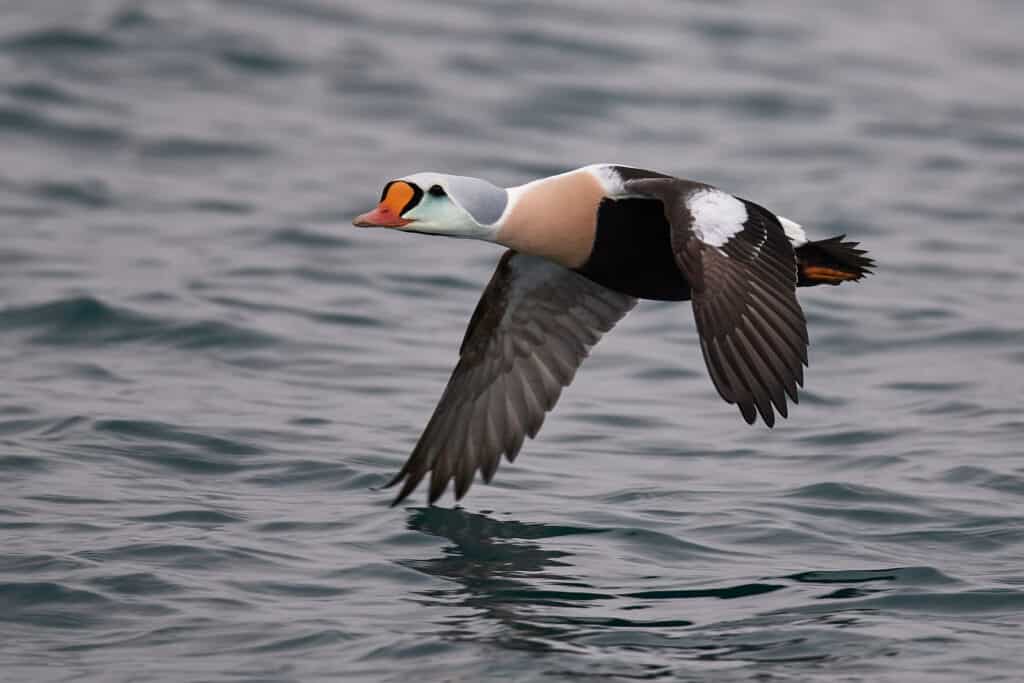
Changes in sea ice as a result of rising global temperatures has the kind eider seeking prey in new places, much to the benefit of birders.
©Bildagentur Zoonar GmbH/Shutterstock.com
Recent sighting reports and local birding roundups show king eiders appearing at several familiar coastal watchpoints where sea ducks typically gather. In Massachusetts, birders have spotted them in the Cape Cod Canal, at Scusset Beach, and off Race Point in Provincetown. Farther south, scattered records have come from Long Island, New Jersey sites such as Island Beach State Park and Cape May, and from Delaware Bay and Cape Henlopen.
There isn’t a single simple explanation for why this influx is occurring, but the pattern lines up with what scientists expect when sea ice, prey availability, and ocean temperatures shift. King eiders’ winter distribution has long been tied to sea-ice edges and productive polynyas, where they dive for benthic invertebrates. Recent analyses show the Arctic is warming rapidly and sea-ice cover has fallen to some of the lowest levels on record; NOAA’s Arctic Report Card and the National Snow and Ice Data Center both document continued declines in multi-year ice. In short, the Arctic ocean environment that historically structured where king eiders fed and rested is changing quickly.
Research on sea ducks, including king eiders, shows that changes in ice cover can alter winter site fidelity and movement patterns. When traditional open-water feeding areas shift, birds move to find alternative patches of suitable habitat, sometimes farther south or into different oceanographic features than usual. Studies using telemetry, dietary analysis, and long-term monitoring indicate that both abrupt weather events and longer-term trends in sea-ice and ocean conditions can cause years with unusually high numbers of sea ducks in places where they’re normally scarce. That means coastal sightings can be a visible signal of deeper ecological shifts offshore.
How to look for king eiders

King eiders are easily spooked, so watching from a distance with a scope of binoculars is your best approach.
©Agami Photo Agency/Shutterstock.com
Sightings have been reported from the New England coastline down to the mid-Atlantic, but the Cape Cod Canal seems to be a particular hotspot. If you’re hoping to spot one, start by scanning mixed flocks of sea ducks from a sturdy jetty, headland, or beach overlook. These birds often travel with common eiders, scoters, and long-tailed ducks, so a good spotting scope or binoculars really helps. Look for the male’s unique color pattern or, for females, a slightly different head shape and warmer brown tones. Calm mornings with good light are best, and watching from shore keeps the birds relaxed while giving you the best chance to pick out that unmistakable king eider in the crowd.
A Regal Opportunity… But also, a Scientific Signal

©Heikki Huhtinen/Shutterstock.com
The sudden appearance of king eiders along the Atlantic coast is more than just a thrill for birders—it’s a reminder of how shifting ocean conditions can affect wildlife. These ducks usually spend winter in icy northern waters, yet this year they’re venturing farther south, likely following changes in sea ice, prey distribution, and ocean temperatures. While each sighting is exciting on its own, taken together they form a visible signal of deeper ecological changes taking place far offshore. For now, their presence offers a rare opportunity for coastal birders to watch one of the Arctic’s most striking sea ducks without traveling thousands of miles. Whether you’re standing on a Cape Cod jetty, a New Jersey beach, or anywhere in between, keep your scope steady and your eyes sharp and you just might get to experience the joy of spotting a truly spectacular bird.