
Quick Take
- An anglerfish's glowing lure may be used for more than hunting. Researchers now suspect it serves a second, completely different biological purpose. Explore the mating hypothesis →
- Anglerfish don't actually power their own glow. Something else entirely is responsible for the light. See how bacteria power the glow →
- Male anglerfish lack lures entirely, which means they have to do something else to survive. See why males lack lures →
- Anglerfish lures are 72 million years old, but it took another 35 million years and one big change to start glowing. Trace the lure's evolution →
I’ve always been fascinated by marine animals. But it wasn’t until I was watching Finding Nemo that I learned about some of the seemingly terrifying creatures that lurk in the ocean’s depths. If you haven’t seen the film, the anglerfish uses its glowing lure to entice Nemo and his friend Dory into following it into deeper, darker water. Nemo and Dory escape. But the scene stuck with me. I’ll admit that I was a little afraid of the fish’s enormous jaws and razor-sharp teeth. But I also wanted to understand the anglerfish’s unique body and how it uses its lure.
In March 2026, researchers answered my question in a study published in Ichthyology & Herpetology. PhD student Alex Maile, alongside evolutionary biologist Matthew P. Davis, explored the evolutionary history of anglerfish lure development. Their findings highlight exactly how morphological changes in the lure have made anglerfish such incredible predators. But more than that, Maile and Davis posit that the glowing lures may have a secondary purpose of helping anglerfish find mates.
The Anatomy of Anglerfish Lures
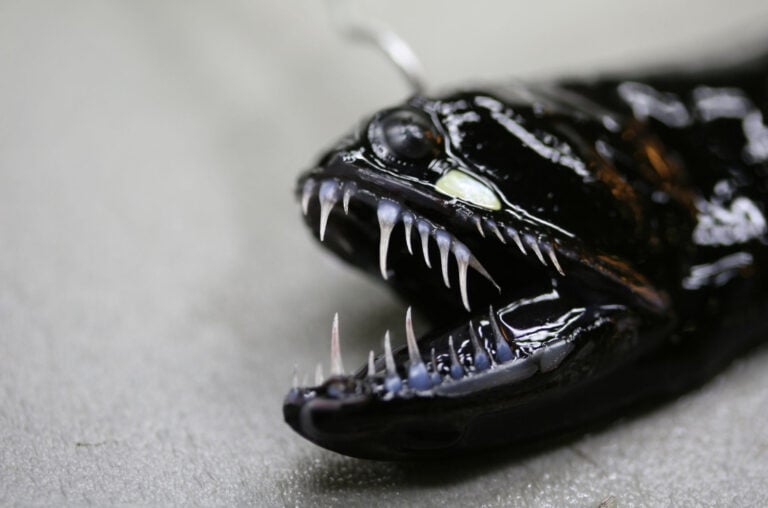
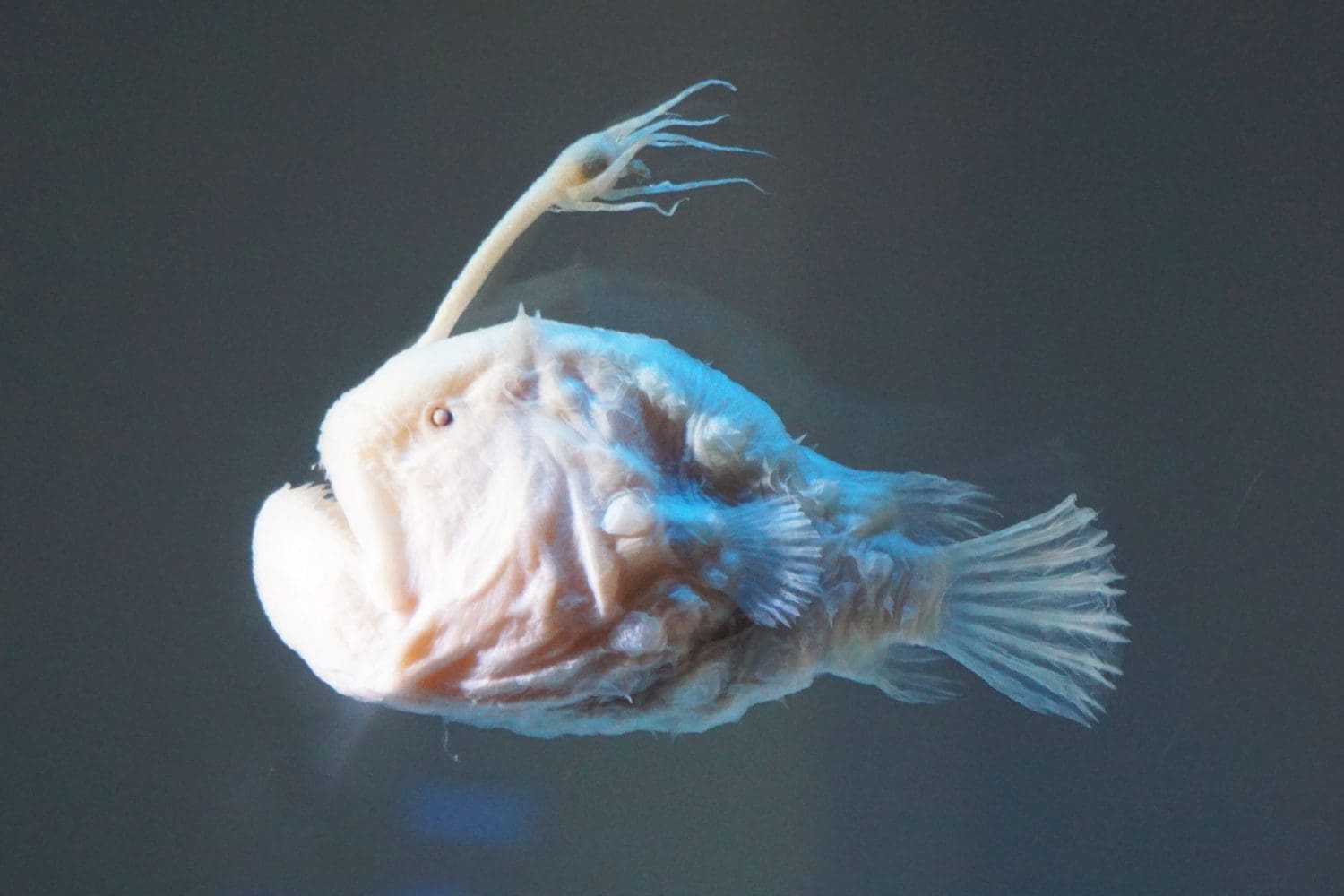
Anglerfish lures look like fishing poles protruding from the top of the fish’s heads. These three-part organs are quite interesting: they consist of a supporting base, from which extends the illicium—a long, flexible spine. At the tip of the illicium is the esca, which serves as the lure.
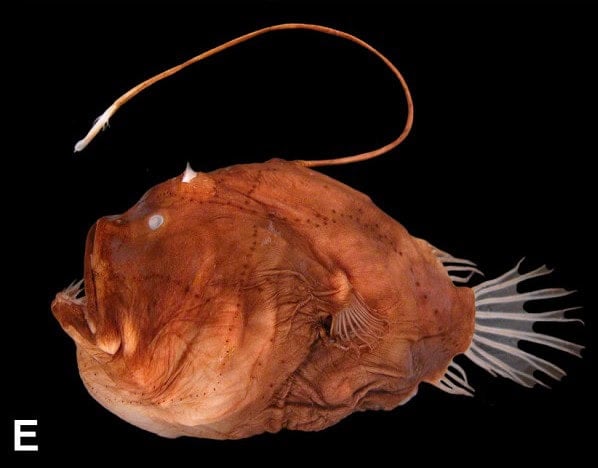
Only female anglerfish have bioluminescent lures, while male anglerfish lack any type of lure.
Maile’s research found that anglerfish began developing lures about 72 million years ago. At the time, however, the lures did not glow. Instead, anglerfish had small balls of tissue that they would wiggle to attract prey. Interestingly, several species of shallow-water anglerfish still do not have bioluminescent lures.
However, anglerfish species that moved deeper into the sea around 34 to 23 million years ago evolved to have glowing lures. But it’s not actually the fish themselves that power the lures. Bioluminescent bacteria gather in the lures, causing them to glow. As a result, the bacteria and the anglerfish have developed a symbiotic relationship.
Deep-sea anglerfish usually live between 1,000 and 4,000 meters underwater. Little light penetrates their habitat. As a result, many fish are drawn to the source of light they see in the anglerfish’s bioluminescent lure. Once a fish gets too close, the anglerfish attacks. Its specialized jaw with its needle-like teeth then prevents prey from escaping.
How Could Lures Attract a Mate?
Compared to other members of the animal kingdom, deep-sea anglerfish have an extremely unusual method of breeding known as sexual parasitism. Male anglerfish are significantly smaller than their female counterparts. They also lack a proper digestive system and cannot feed as females can. So, rather than try to hunt, male anglerfish use their sensitive smell to detect female pheromones in the water. Once a male finds his intended mate, he bites her. He then releases an enzyme that fuses the male’s body to the female’s. Their circulatory systems combine, and the male loses features like his eyes and fins. He still has his testes, so he can produce sperm and fertilize the female’s eggs. Other than that, the male anglerfish spends the rest of its life attached to the female, feeding on her.
In the past, researchers thought pheromones were the male anglerfish’s best way to identify females. But Maile and Davis had another idea. They note in their work that male anglerfish also have extremely large eyes, which could be used to spot bioluminescence in the water. Since male anglerfish don’t have these glowing lures, they automatically know the fish they’re seeing are female. They can then approach their potential mates and, if successful, latch on for life.
Challenging to Prove
That being said, researchers don’t know for a fact that anglerfish use their lures to find mates. Anglerfish are notoriously difficult to study since they live so deep underwater. The water at those depths is both extremely dark and under extremely high pressure. Taking anglerfish out of that pressurized environment can easily kill them. That’s one of the reasons why you’ll probably never see a deep-sea anglerfish in any aquarium you visit. This makes it much harder to learn about anglerfish and their behavior.
In the case of deep-sea anglerfish, Maile’s study hypothesizes that females could have developed these lures to improve sexual communication and help males find mates. The study also questions whether male anglerfish evolved over time to become more driven by sensory input or if males and females evolved in tandem with each other. Although we can’t say for certain, it’s an intriguing possibility to consider.