
Quick Take
- A single arm bone sat misidentified in a museum collection for nearly 20 years, and what it turned out to be rewrites the fossil record of an entire region. See the misidentification story →
- From a single fragment, researchers reconstructed the size, wingspan, and hunting behavior of this creature, and their conclusions are surprisingly specific. See how size was estimated →
- The bone pellets scattered across the dig site puzzled scientists for years, but this discovery finally made the answer obvious. Discover the bone pellet clue →
- Hundreds of bird fossils were found at the site, but only one of this predator was among them. The reason why is stranger than you'd expect. Explore the fossil rarity reason →
Thanks to Jurassic Park, velociraptors are the best-known of the bird dinosaurs, known as dromaeosaurs. However, a new member of the dromaeosaur family has been discovered that is far larger than its famous cousin. It may be time for the velociraptor to step aside for its larger cousin. Meet the massive four-winged glider that hunted Earth’s earliest birds.
Jian changmaensis Is a Cousin of the Velociraptor
For the last two decades, researchers have collected fossils from the Changma Basin in China. It was believed that the fossils belonged to prehistoric birds that called the region home during the Early Cretaceous period. Researchers only recently realized that what they had in their collection was not a bird at all, but rather a cousin of the velociraptor.
According to a new study published in the Annals of the Carnegie Museum, researchers have discovered a new species of microraptor. A typical microraptor is about the size of a modern-day crow. The new species, Jian changmaensis, is believed to be larger—perhaps about the size of an owl.
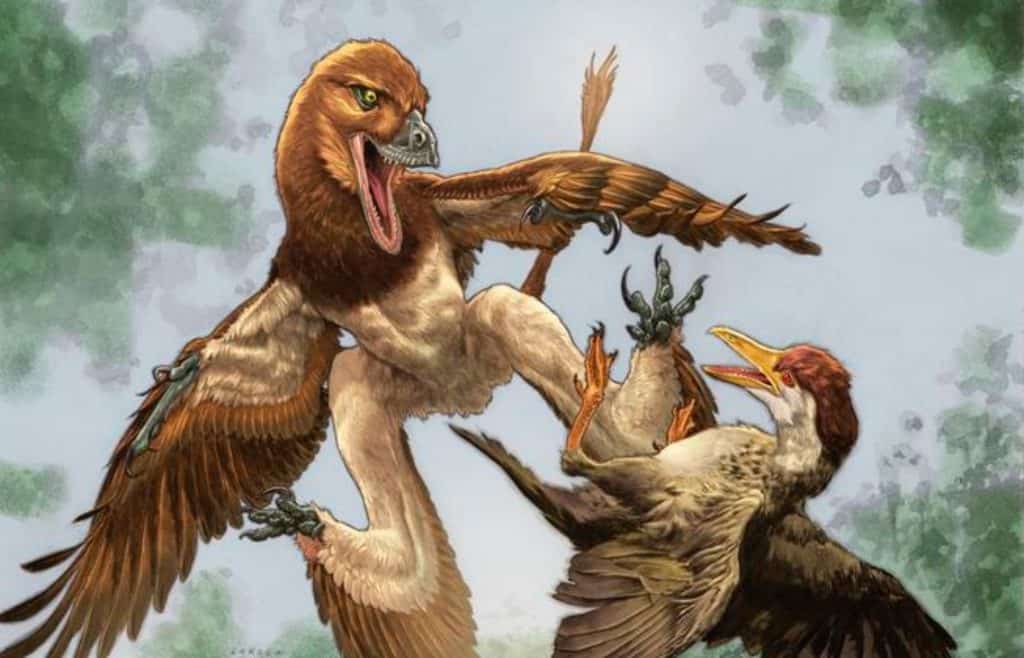
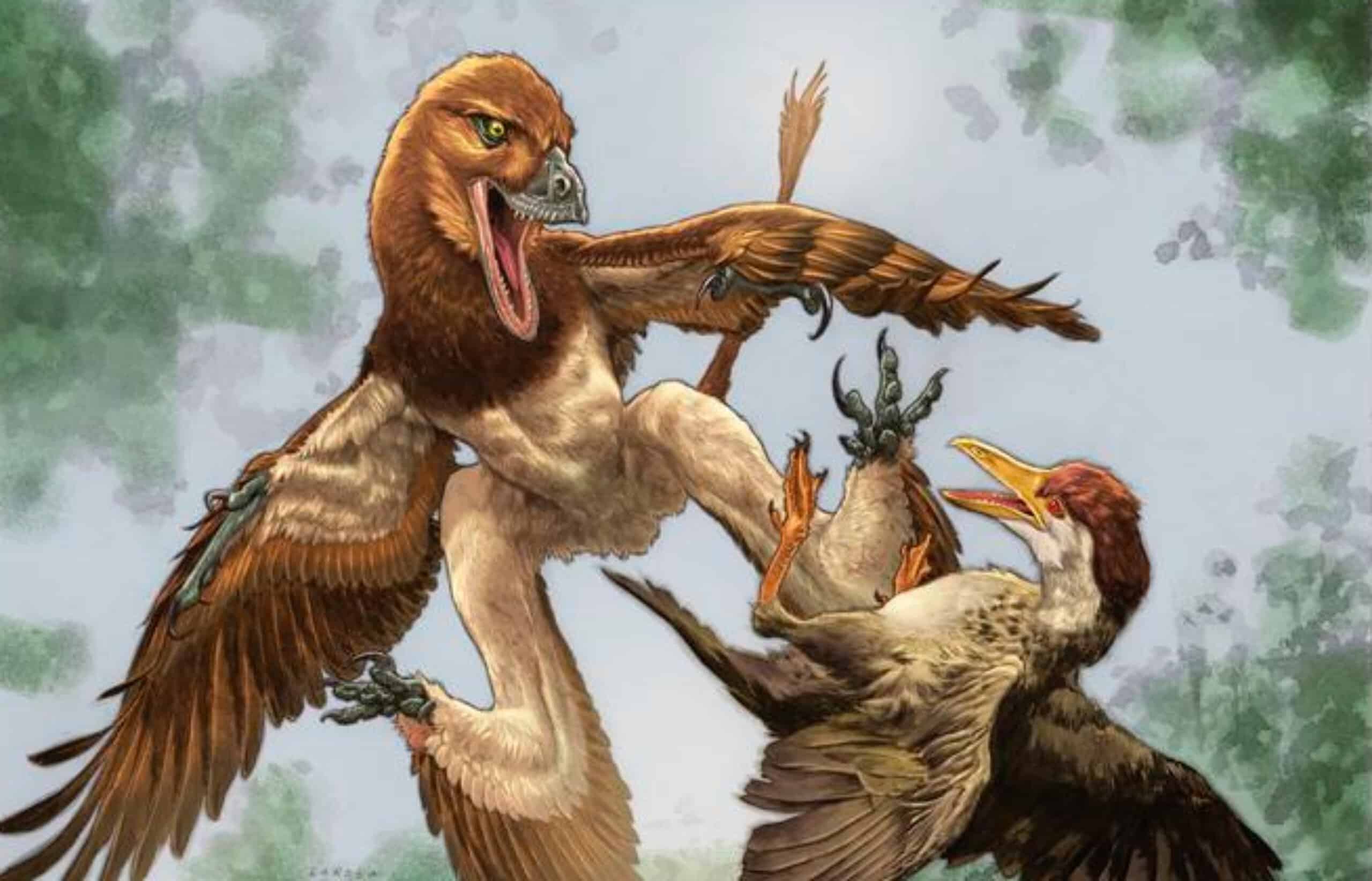
Jian changmaensis, left, is the newest microraptor species discovered, believed to be the predator that preyed on birds in the Changma Basin.
© Illustration by Lewis LaRosa, colorized by Jão Canola / EurekAlert – Original / License
The new microraptor’s name was an ode to both Chinese mythology and the location where the fossil was found. In Chinese mythology, Jian is a “winged creature,” and Changma Basin was the discovery site of the fossil.
The fossil discovered was embedded in a rock. It is Jian’s upper arm bone, believed to be between 124 million and 120 million years old. No other bones from microraptors have been located at Changma Basin.
In addition to the bones of prehistoric birds and Jian, bone pellets were discovered at the dig site. Thanks to Jian’s identification, the bone pellets now make sense. It is believed to be the remains of the prehistoric birds Jian consumed and then coughed up, akin to what owls do today.
How Jian changmaensis Was Discovered
According to the study, Jian changmaensis was first discovered in 2008 in the Xiagou Formation, part of the Changma Basin. However, the arm bone was not initially seen as significant. It was not until recently that researchers discovered what they had in their collection of over 100 aviary bones.
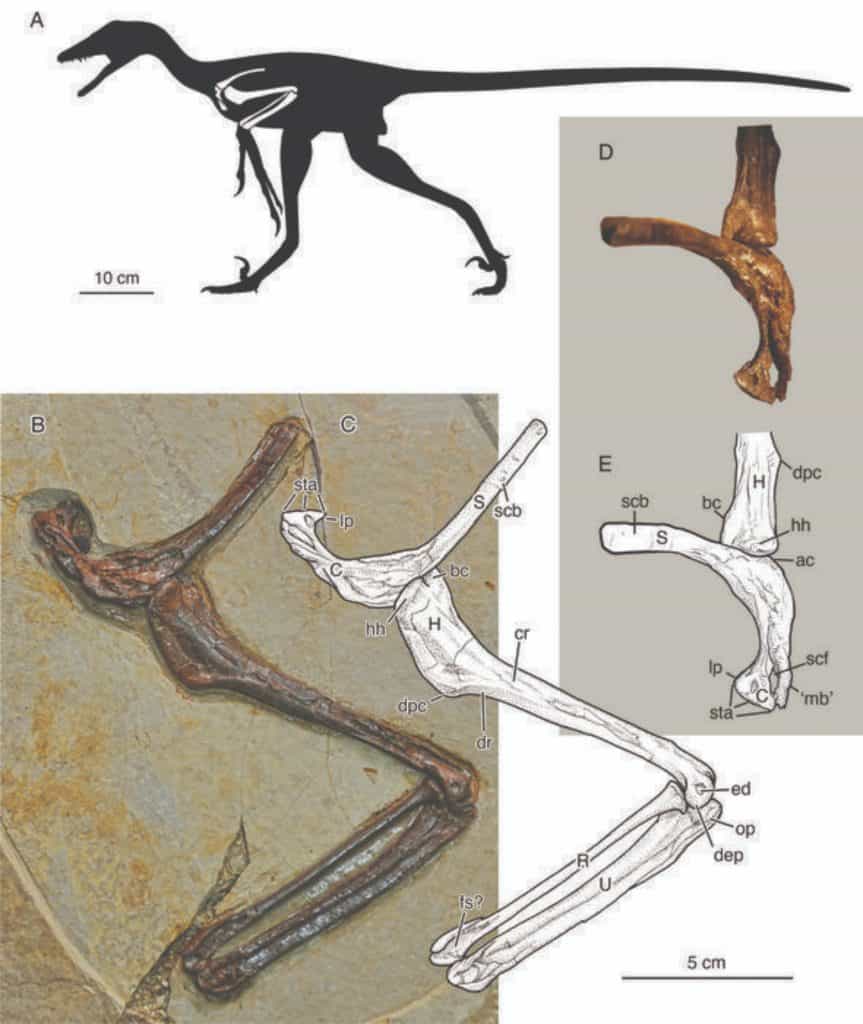
Jian’s upper arm bone has been housed in a museum since its discovery in 2008.
Since the early 2000s, the Changma Basin has provided insight into the birds that lived in the region. Among the dozens of bone fragments collected—some with feathers and skin—it was not immediately apparent that one was the upper arm of a microraptor.
It was not until the fossil received a closer look and an in-depth analysis in 2026 that it became clear it did not belong to an ancient bird. Instead, researchers had found the first non-avian dinosaur in the Changma Basin, likely responsible for the bone-pellet debris found in the region.
How Did Researchers Piece Together What Jian changmaensis Looked Like?
To date, researchers have only been able to identify Jian changmaensis‘ arm. Yet, they have been able to come up with a concept of what Jian looked like. How is this possible?
First, the size of the arm helps researchers such as Jingmai O’Connor, senior author and associate curator of fossil reptiles at the Field Museum in Chicago, determine Jian’s size.
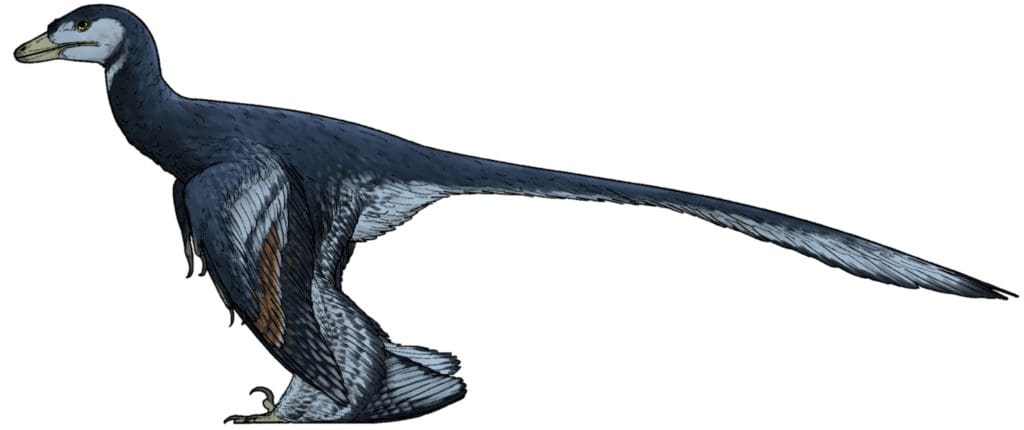
Jian changmaensis was believed to have a four-foot wingspan and be the size of a barn owl.
©Connor Ashbridge, CC BY 4.0 / Wikimedia Commons – Original / License
“Jian is one of the biggest microraptor specimens that has ever been found,” O’Connor explained in a press release. “The piece of its upper arm bone that we have is about 4 inches long, so the entire dinosaur probably had something like a four-foot wingspan, around the size of a barn owl.”
Additionally, researchers use what they have learned about the appearance of microraptors to deduce what Jian would have looked like. It is believed that, like other microraptors, Jian had long feathers on both its arms and legs, giving it the appearance of having four wings.
O’Connor said, “Jian and the other microraptors probably weren’t capable of true, powered flight, but they could probably glide like a flying squirrel.”
Why More Microraptors Have Not Been Located in Changma Basin
Since the Changma Basin is rich in prehistoric bird fossils, it would seem logical to find more microraptors in the region, as they preyed on these birds. However, according to Lamanna, the lack of microraptor fossils may be due to the habitat in which the microraptors lived.
“If you could take a time machine back 120 million years ago, you’d be on the shore of a vast lake with vegetation surrounding it,” Lamanna explained to CNN. “It stands to reason that maybe if you’re looking in a lake, you might find the animals that are living there more than you would find the animals that are living around the margins.”
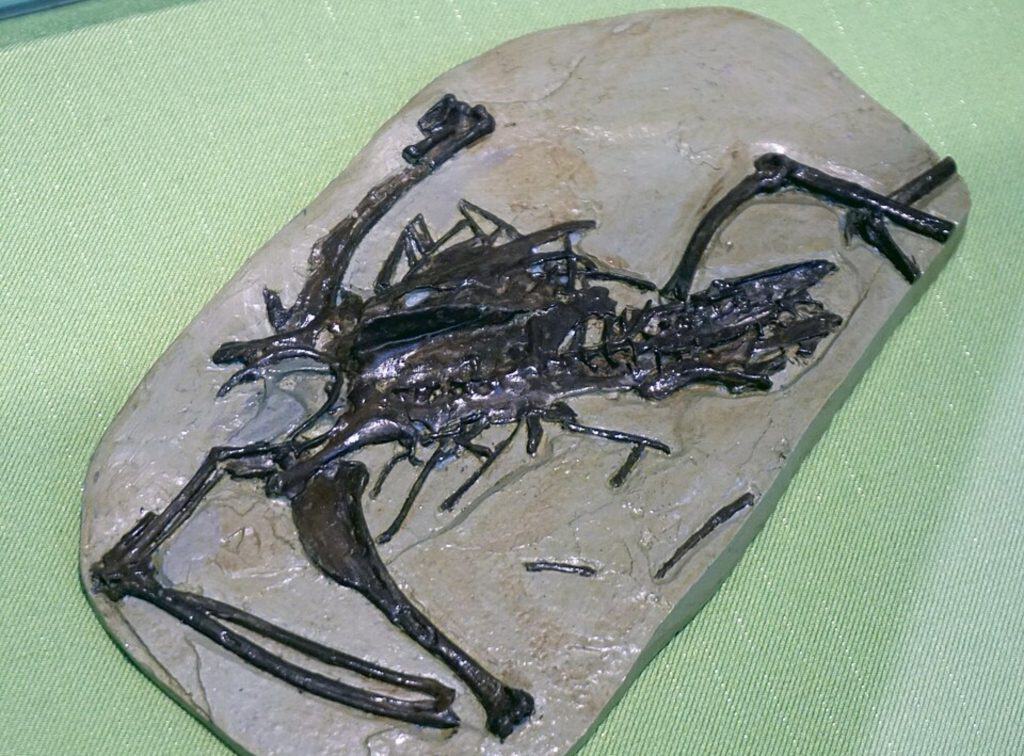
Gansus yumenensis far outnumbered Jian changmaensis in the Changma Basin, as the duck-like animals lived there, whereas the microraptor hunted there.
©三猎, CC BY-SA 4.0, via Wikimedia Commons – Original / License
It was once believed that microraptors and duck-like ornithuromorphs did not coexist. The presence of the Jian changmaensis fossils at Changma Basin complicates this theory. Now, there is evidence that these creatures lived at the same time, with ornithuromorphs serving as their prey.
“Jian changmaensis reveals that non-avian dinosaurs lived in what is now the Changma Basin, an area famous for its fossil birds,” Lamanna said in a press release. “Our team has recovered more than a hundred bird fossils at Changma, but only this single non-avian dinosaur specimen. Jian provides critical new insight into the biological history of the Changma region and the ecological context of the ancestors of today’s birds.”
There is no question that birds are the most successful land-dwelling creatures today. By studying the past, researchers hope to learn what enabled the ancestors of modern birds to survive, while many other species did not, during the last mass extinction event.