
Quick Take
- This spider destroys something it spent hours building, and that destruction is key to its survival. See the web destruction →
- One unusual feature of its body makes its camouflage physically possible, and the feature in question is not what you would expect. Discover the concave body →
- It doesn't hide behind anything. Instead, it becomes part of the thing you're about to touch. See how it blends in →
- Its venom sounds alarming, but the real story is far less threatening than you'd think. Check the venom details →
Imagine grabbing hold of a branch only to discover that it’s not just a branch—it’s a spider wrapped around a branch! You would have encountered one of the best-camouflaged spiders on the planet. Take a look at this Instagram post—you’ll probably need to spend a few moments staring before you can spot the spider. Here’s what else we know about wrap-around spiders.
What Are Wrap-Around Spiders?
Wrap-around spiders are members of the Dolophones genus and a type of orb-weaver spider. There are 17 different species, and they all live in Australia. The spiders are more active at night, when they weave their web, which is usually around 15 inches across and shaped like wheels. They use it to catch flying insects, small flies, and moths. These spiders are very small. The females are only around 0.4 inches, and the males are even smaller at around 0.2 inches. They can produce venom, which they use to subdue their prey. However, the venom is not powerful enough or produced in large enough quantities to be a problem for humans. These spiders do not want to harm you; they have evolved to hide away and are very good at it!
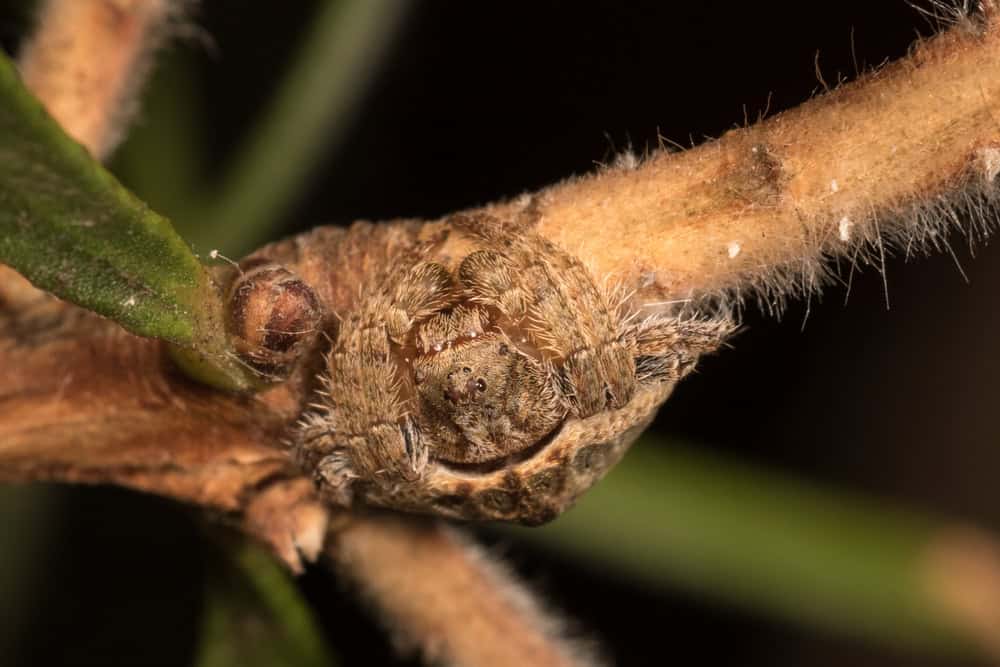
Wrap-around spiders blend in perfectly with bark.
©Katarina Christenson/Shutterstock.com
How Do Wrap-Around Spiders Camouflage Themselves?
Wrap-around spiders are hunted by birds. So, to stay safe during the day, they start by destroying their web because this advertises to birds that there is a spider around. Then they find a suitable twig and literally wrap themselves around it.
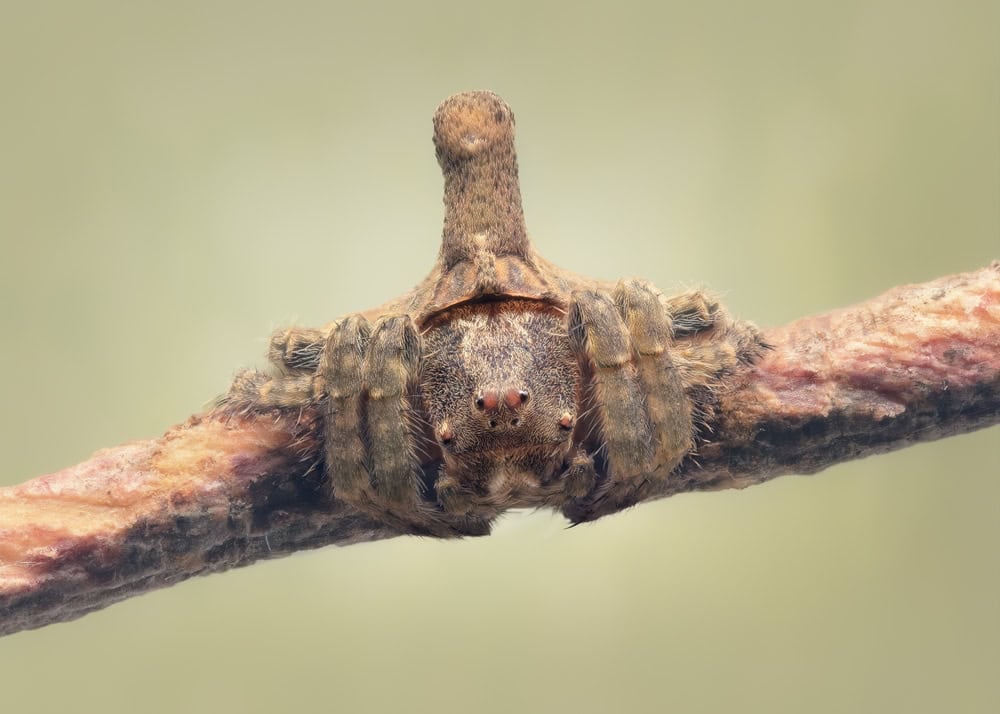
Not only does their coloring blend perfectly with the twig, but they can also wrap their body and legs around the twig. They resemble a nodule where shoots and leaves might grow. These spiders are able to do this because the underside of their bodies is concave.
This means that they can press closely against the twig. No one can spot them unless they make a move. This type of camouflage is called masquerade or crypsis and is highly effective. They likely evolved this amazing adaptation in Western Australia to evade high levels of predation from birds.