Most people’s “drive home from work” stories don’t end with a career pivot into rattlesnake wrangling. But Danielle Wall isn’t most people. What started as a roadside rescue mission (armed with a stick and sheer instinct) has evolved into a full-time calling — relocating rattlesnakes in California’s High Desert, busting myths, and proving that a five-foot-two woman with a snake hook can handle business just fine, thank you very much.
Danielle shares what it’s really like to be the High Desert’s go-to rattlesnake relocator. Spoiler alert: it involves a lot of hiking, a surprising amount of Tupperware, and zero patience for “Sit down, Little Girl” energy.

Meet Rattlesnake Wrangler, Danielle Wall. “I studied forensic entomology in college; I was the weird bug lady my whole life.”
©Richard Stow – Original
How did you get into rattlesnake wrangling? Was there a moment or an experience that made you realize it was your calling?
I was on my way home from work in the desert and almost ran over a rattlesnake. It was one of those areas where there’s no shoulder to pull off on, no phone service, none of that. I got the snake between the tires, and then pulled over and ran back.
I was terrified. I was a little city girl. I poked it with a stick, it took off, and I said, “Well, that’s not what Hollywood made it sound like.” It was instinctive; I didn’t want something to die in the road.
Then, I did research on what people do out here when this happens. What if this shows up at a house? The general consensus was murder, so I reached out to a couple of people in the snake world. I’ve always done animal rescue, whether going to the shelters or fostering. And I found out no one really did that — the government, the state, whatever.
There have been a couple of volunteers here and there over the years, but no one did it 24/7 for free. And I thought, How freaking hard could it be? No one was willing to teach me. I got turned down — one person in particular (he has apologized since), told me, “Sit down, Little Girl, you’re gonna get hurt.”
Then it became a double mission.
I just thought I’d have a couple of calls here and there. But I was ignorant of the need. As it developed, I pivoted my life.

“A lot of people assumed I was this rich kid. I’m just a kid who needs a purpose. Now this is what I do.”
©Danielle Wall – Original
What does a typical call look like for you?
I would say that 80% of the time, it is really cut and dry. I get a phone call and ask for a photo, if safely possible. Some people are too freaked out, and if they can’t get a photo, I’m not stressing it. That’s more because I want to know if it’s venomous or non-venomous.
If it’s not venomous, then I do everything in my power to convince people to leave it alone unless the snake itself is in danger. If it’s in a dog run, and the dog’s using it as a chew toy, that’s a different story. But people will just call me and say, “Hey, I’ve got a snake in the yard.” And then I go move it.
There’s a lot of science, too — like the farther you move any kind of critter, the less likely it is that it will thrive in that new ecosystem environment. So, I always move it to the closest legal distance I can. On average, it’s an hour to two hours per call, between getting the snake, relocating, and getting back home. And I do anywhere from one to 13 a day.
What would people be most surprised to learn about your work?
Probably the amount of physical hiking I have to do! I’m just trying to get .7 miles away, but sometimes I have to go three miles out of my way to the other side of the mountain and then climb up there because of accessibility and private property.
The relocation portion is really the majority of the work. I think when people see me drive away, that’s it for them; their job is done. But mine’s just starting. I have done thousands of dollars’ worth of damage to my vehicles.
A couple of years in, I had an upgrade. I sold my house in town and bought a truck. That was a game-changer. Instead of having to hike halfway up a mountain, I could take the off-road route with my four-by-four.
The goal is always for no one to see the snake again. So, even if I can take a trail or an off-road path, I’m still hiking the snake to a zone where the average person isn’t going to be walking up. I’m just trying to get them to the closest legal spot with the same ecosystem, same terrain, and same elevation. But that part gets really freaking hard and exhausting.
Once you’re there, do you just let it go?
It’s species-specific, and also depends on availability. If it’s a speckled rattlesnake or any of the rock-dwelling snakes, when you go up into these rock formations, you can see pack rat nests. You’ll see a rock formation, and then sticks and crap are pouring out of the rocks, because it’s a rodent nest. They form these massive nests in these rock piles. There’s the strategy of always trying to release the snake within a food source.
I’m parroting off studies done by Loma Linda and other universities with relocation data — the main reason they end up dying if you move them significantly is because they have to re-acclimate to the new area. That means more movement, which means their camouflage won’t work as well. And then they get eaten. I figure if I put them in a pack rat nest, they don’t have to move for food. All they have to do is sit and wait.
I put them in little Tupperware bins when I move them, so I can pour water in. And 75% of them just gulp that water down, because dehydration is a big portion of them surviving or not. With all that extra movement and energy, dehydration can play a factor — especially out here in the desert.
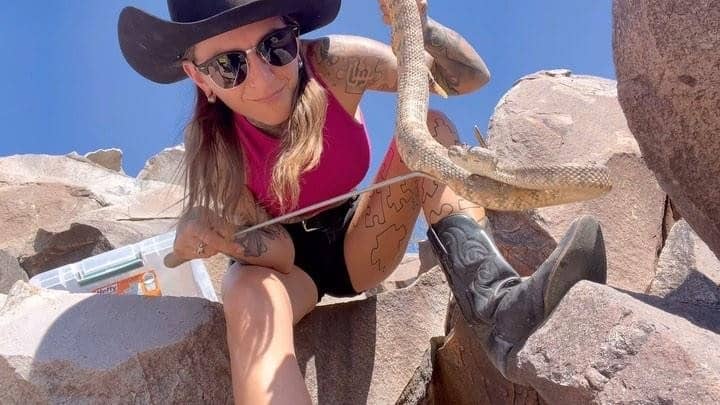
“I try to put them in the most optimal place possible, where I feel like they’re not going to have to move for survivable resources.”
©Danielle Wall – Original
There’s a lot of fear and misinformation surrounding rattlesnakes. What do you think is the biggest misconception?
I’ll give you the top two. Number one is that people think the babies are more deadly than the adults. The myth is that they can release all the venom. It’s not a faucet! It’s a little baby snake with teeny, little venom glands. Who’s going to have more spit, a newborn baby or a full-grown adult? It’s the same thing — a venom gland and a salivary gland. The bigger the gland, the more venom, and the more deadly the snake.
The biggest factor is how much venom is in your system. A baby can bite you 10 times, and it’s still not going to produce the amount of venom as one fang from one full-grown rattlesnake. But I still hear that to this day — practically every week!
The second myth is that everyone thinks the snake’s going to come back. These snakes don’t have GPS! They’re getting a lot of credit where credit is not due. Rattlesnakes essentially move the least amount possible to survive, especially out in the desert ecosystem. So when one is found in a home, it means it has found food, water, shelter, sex — everything it needs. And it’ll never leave that tiny, little zone, because why would it?
Out here, a half mile in snake world might as well be 10 miles. Rattlesnakes just don’t move as much as people think. It’s a camouflage ambush predator, so it just sits still and waits most of its life. They don’t go back to the same location; they’re just going to stop at the next point of survivable resource.
People will have this odd relief or sense of safety when I take the snake, and I tell them, “Realistically, you already have two or three more on the property at any given time, no matter how many I take.”
Danielle Wall, rattlesnake wrangler
Are there any particularly memorable rescues that you can share?
My favorites are the ones where I’m crawling under homes. I do a lot of crawl spaces, and those are definitely the most exciting, because it’s something different. I got to go under Cheech Marin’s house. They had a plumbing issue, so the plumber had to go under there. He saw a snake and came running out.
I remember knocking on the door, and Cheech answered. I grew up watching Cheech and Chong with my dad, so that was a fun little moment. It ended up just being a gopher snake, and those are harmless.
There are some gruesome ones I hold in my mind; they’re not all happy ending stories. A couple of weeks ago, someone called me; their dog was using a rattlesnake as a rope toy, and the dog wasn’t looking good. Let me tell you, the snake didn’t look that good either. Unfortunately, I do have those calls where the snake cannot be saved, and it’s got to be humanely euthanized. That was part of my service that I didn’t really anticipate … and it never gets easier.
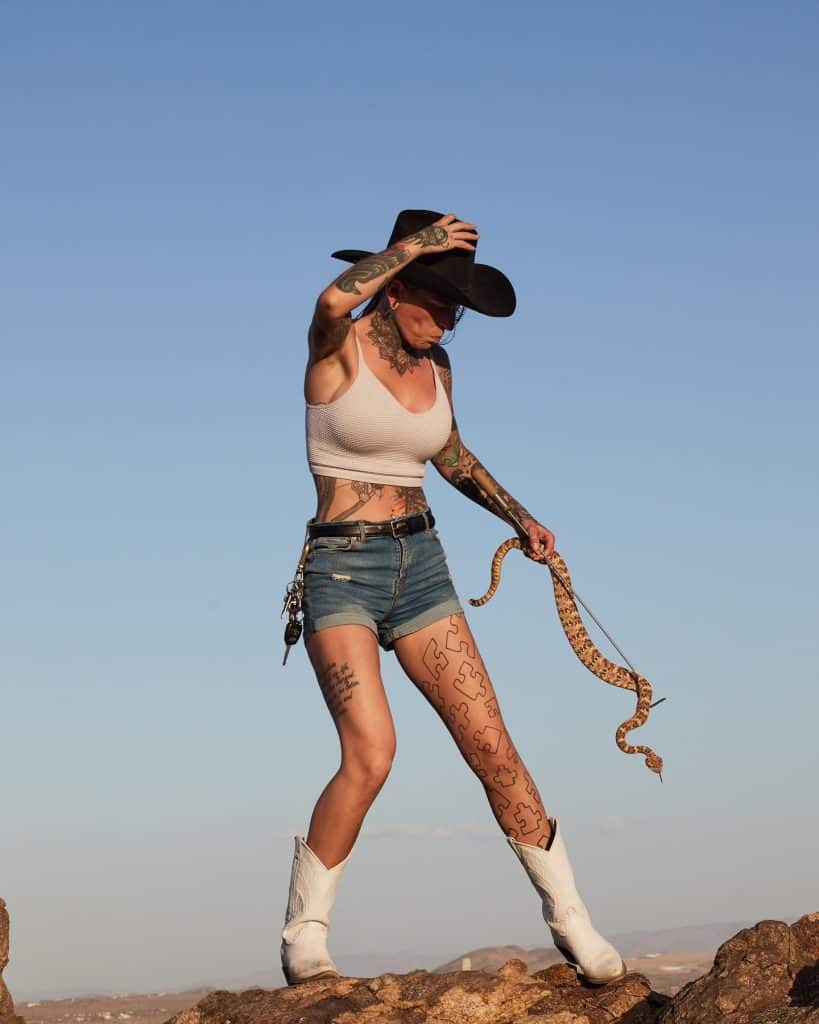
“I may be a little lady, but I was raised by a crazy Italian, so I know how to stand up for myself. My mom was a very vocal woman. She gave me that toughness and thick skin.”
©Shaughn & John – Original
How do you stay safe during a wrangling job? What tools or strategies are essential?
The only thing I have to do is wear boots because the boots prevent those accidental bites when I’m walking past what I don’t see. Otherwise, I’m just not putting myself in that position. I use a snake hook and a snake grabber.
If I get stuck out there, I have a satellite walkie-talkie with my grandfather, who used to run the search and rescue out here back in the day. It’s more about protecting myself from humans and nature, because nature is pretty brutal out here. I had a moment where I almost succumbed to heat stroke. I’ve learned a couple of things and pushed some limits.
The one rattlesnake you see is not the danger; on average, we see less than 1% of the rattlesnakes we pass by. They’re just sitting still. They’re in a bush. They’re in a rock pile. We can look right at them, and our eyeballs and brain just won’t register it as an animal. People freak out over the one snake they see, and then I get to that house and look at their backyard, and it’s 10 acres of rocks.
People will have this odd relief or sense of safety when I take the snake, and I tell them, “Realistically, you already have two or three more on the property at any given time, no matter how many I take.” They’re shocked when I tell them that, and I try to put it in perspective of how sweet the animals actually are. It’s like Steve Irwin said, “They don’t pretend to be your friend first before trying to hurt you.” They’re just trying to survive.
What advice would you give someone who finds a rattlesnake on their property? What should they do and not do?
The dos and don’ts are just like they are with any animal: if you don’t have the experience, just don’t do it. On average, 75% to 80% of all venomous snake bites across the U.S. are on men 18 to 35 years old, below the elbow. And 15% to 20% of those men are legally intoxicated in some way. When I’ve watched presentations on snake safety, it’s like, “Hey, silly young drunk guys…”
For the average person who sees a rattlesnake, if they don’t mess with it, there’s no danger. Evaluate your situation. Get any dogs or cats away from it that could be perceived as immediate danger, and then call your nearest rattlesnake wrangler volunteer — not Animal Control, because Animal Control still comes out and just kills them.
Is there a scenario where people should leave it be?
It depends. A rattlesnake will adapt to human activity. So, if no one’s available to help you, try to scare the snake, because then it’ll still be afraid of people. But if a rattlesnake sees us 300 times — sees that we’ve never touched or bothered it, it’s not afraid of us. You want to “make physical contact” without making physical contact.
Out here, it’s easy to grab a handful of sand (something soft like that) and throw it at them — where you’re creating safe physical contact, but the snake’s not harmed in any way. Then the snake realizes it’s seen, and there’s a threat. That’ll at least discourage it from staying in that immediate zone … potentially. I always throw that “potentially” out there.
If you have a water source out here … It’s like the poor gazelles that have one watering hole, and it’s filled with crocodiles. If they leave the one watering hole, it’s certain death. But if they drink out of the watering hole, it’s death for only a few of them. It’s hit or miss out here.
You still want to make sure it’s afraid of people, but the catch-22 of that is that the snake is like, “Well, what am I going to do, go out to the abyss or stick around this potential threat because I know the water’s here?” More often than not, it’s going to take the water option, because it’s just so dang hot.

“The truth is that people think, ‘Oh, let’s just pick one thing out that’s dangerous, and it won’t screw up the entire chain.’ Every rodent eaten means more fleas, ticks, and disease are eaten. The birds get more prey. I wish people understood that we need them.”
©Danielle Wall – Original
As a woman working in a field that’s often seen as rugged and male-dominated, have you faced any challenges or unexpected support? What has it been like to carve out space in this arena?
In the beginning, it was kind of a hindrance; a lot of people were doubting me because I’m a five-foot-two, 100-pound woman. But then that kind of ended up being the endearing part. This tiny little lady will come with a smile and move the snake, and there’s no “Fear Factor” crap or embellishment on how hard it is. I try to keep everyone’s nervous system nice and calm … including the snake’s! When a lady calls me at 11 o’clock because there’s a snake, there’s no worry for her.
And over time, all the firemen and the police officers started calling me instead of waiting hours for animal control. Eventually, that egotistical, machismo stuff got put aside. We all know our skills, and we’re going to be proud, confident, and supportive of that.