
Quick Take
- The blackchin guitarfish is a type of shovelnose ray that looks like half shark and half ray.
- They mainly live in marine and brackish waters over sandy or muddy substrates.
- The species is classed as Critically Endangered and threatened by commercial and subsistence fishing.
The blackchin guitarfish has a name that is only marginally more intriguing than its physiology. At first glance, it looks like a child’s drawing of a half-shark, half-ray creature. Its numbers are also in decline, and conservationists have their work cut out to protect it. Read on to find out more about this extraordinary animal.
Blackchin Guitarfish – The Essentials
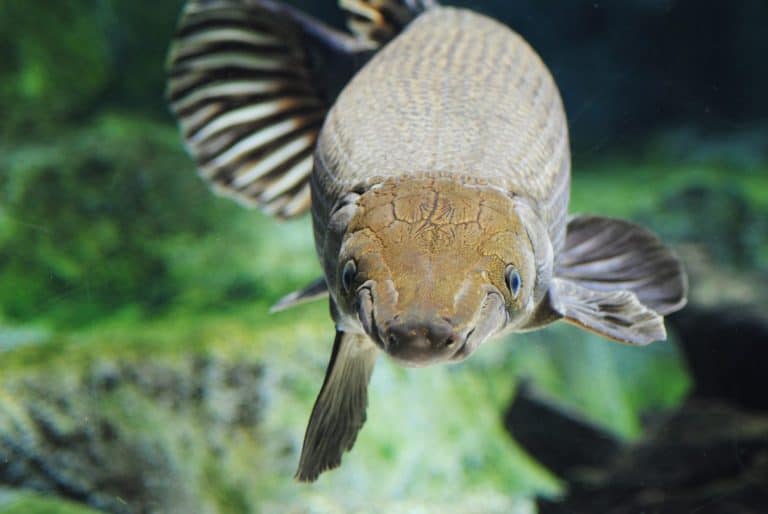
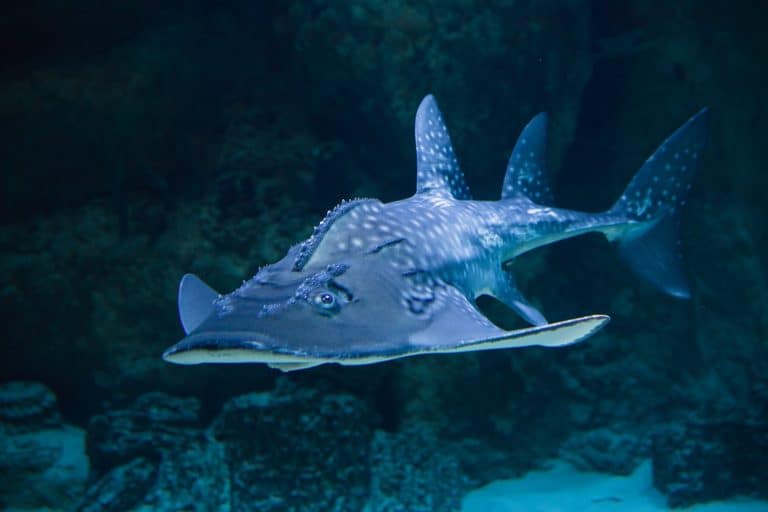
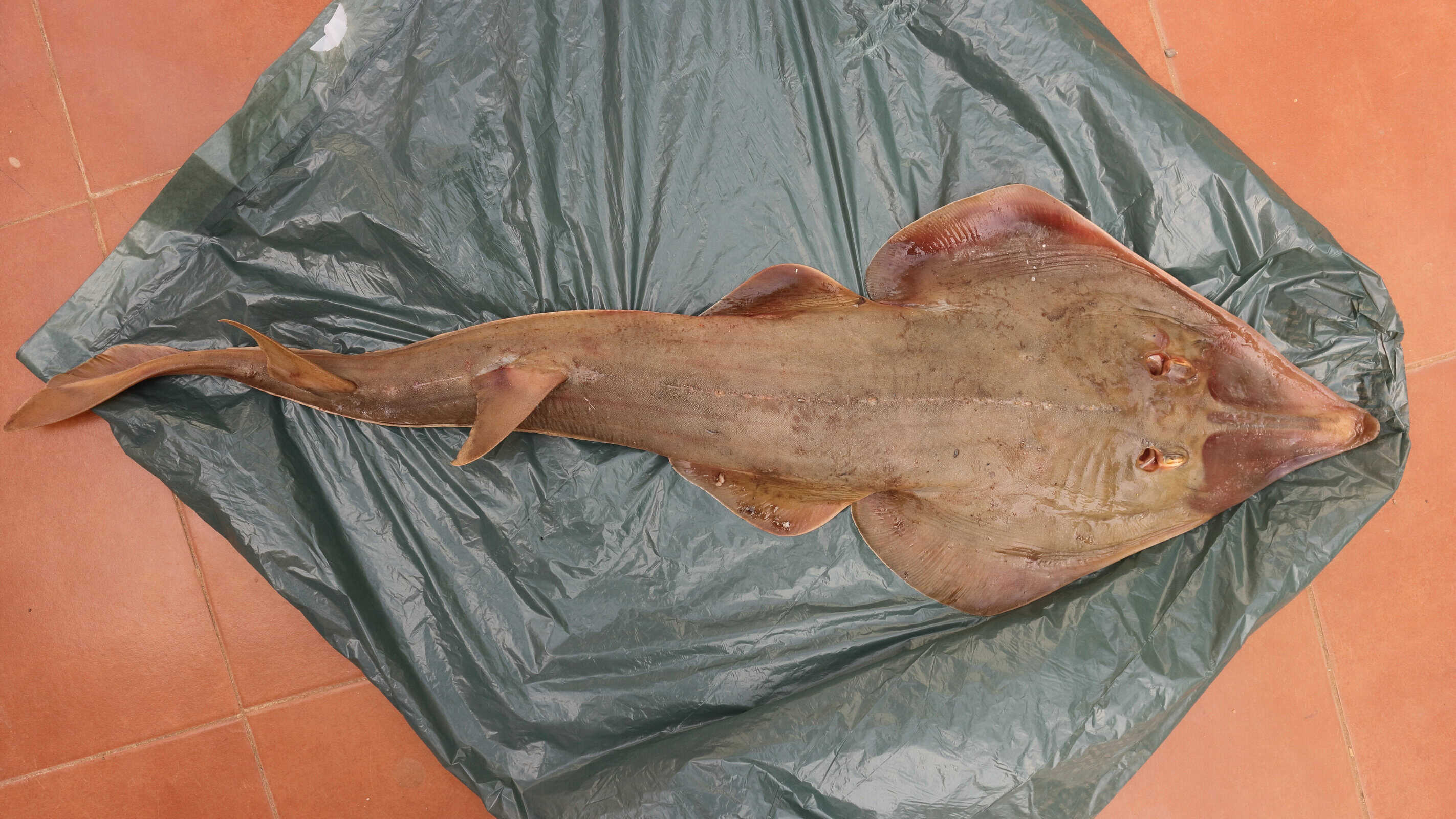
The blackchin guitarfish (Rhinobatos cemiculus) is a type of shovelnose ray in the Elasmobranchii subclass of cartilaginous fish. They can weigh up to 57 pounds and grow up to 8 feet in length. The name ‘blackchin’ comes from the dark spot on their flattened, wedge-shaped snout. This is most obvious when they are younger. The rest of their body is brown, but they are paler underneath. Their body is also flattened but elongated in a shark-like shape with two equal, well-developed, and well-separated dorsal fins and a long, finned tail. Small thorn-like projections cover their entire body.
These fish mainly live in marine and brackish waters over sandy or muddy substrates. You will spot them in shallow waters and in depths up to 300 feet or so. They either bury themselves in the sand or swim slowly over the top of it. Here, they eat invertebrates such as shrimp and other crustaceans.
What Is the Conservation Status of the Blackchin Guitarfish?
The blackchin guitarfish can be mistaken for the common guitarfish and the Brazilian guitarfish, which have similar body shapes. Their historic range included the shallow waters throughout the Mediterranean Sea and eastern Atlantic Ocean, from Portugal to Angola. Now, however, its Atlantic range is from northern Portugal to Angola. In the Mediterranean, it is found primarily along the North African shore and the Eastern basin.

Shallow waters throughout the Mediterranean Sea were once home to the blackchin guitarfish.
©ChameleonsEye/Shutterstock.com
The species is classed as Critically Endangered by the IUCN, and its population trend is classed as declining. It is also listed under the Convention on International Trade in Endangered Species of Wild Fauna and Flora. The main threat to its survival is presented by commercial and subsistence fishing. They are targeted for their fins, which are prized in eastern and southeastern Asia. Coastal populations in several countries also target them for meat.