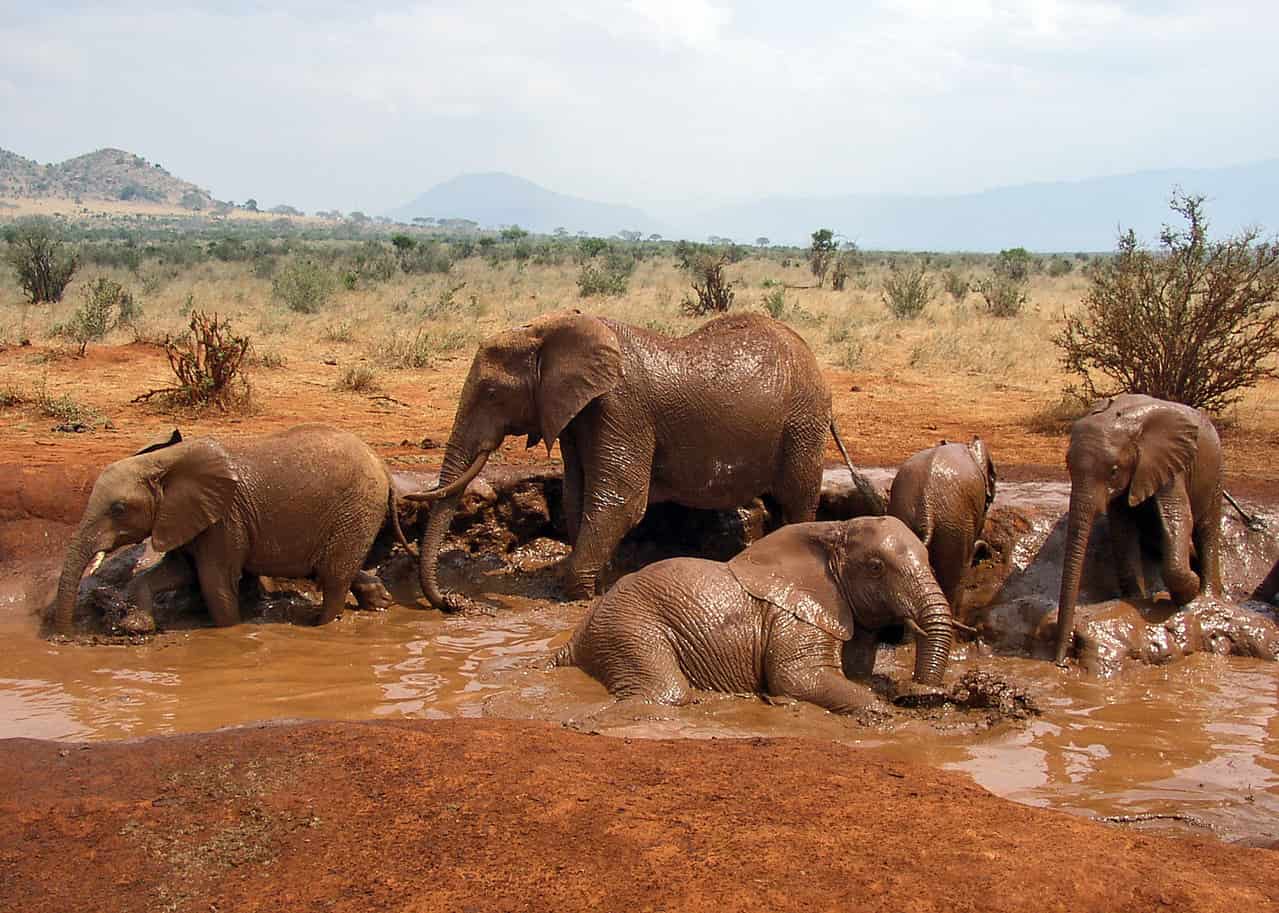

Quick Take
- Colorado State University achieved vocal label identification, proving elephants utilize abstract names for social communication.
- Infrasonic sounds create sub-audible frequencies that mask vocal differences from human observation.
- Elephants avoid vocal imitation, unlike the mimicry used by parrots and dolphins.
- The playback stage was necessary to determine if elephants distinguish 101 unique vocal callers.
The idea that animals have their own forms of language has been explored, shared, and expounded upon by scientists for hundreds of years. Even without much scientific knowledge, it’s hard to deny that songbirds seem to be communicating with each other. Those sounds simply seem too complex, nuanced, and context-dependent to be a form of information sharing. Perhaps it is our own hearing that is limited in scope. Advancements in artificial intelligence and machine learning have given scientists a new perspective on animal language. Indeed, they have identified name-like components in elephant communication.
Researchers from Colorado State University, in collaboration with Save the Elephants and ElephantVoices, have confirmed the existence of individual names among at least several elephants, per a new study published in Nature Ecology and Evolution. They selected intended elephant recipients, played back recorded calls, and observed that certain elephants responded affirmatively to their name sounds. Plus, recorded calls meant for other elephants received less of a reaction.
Lingua Franca
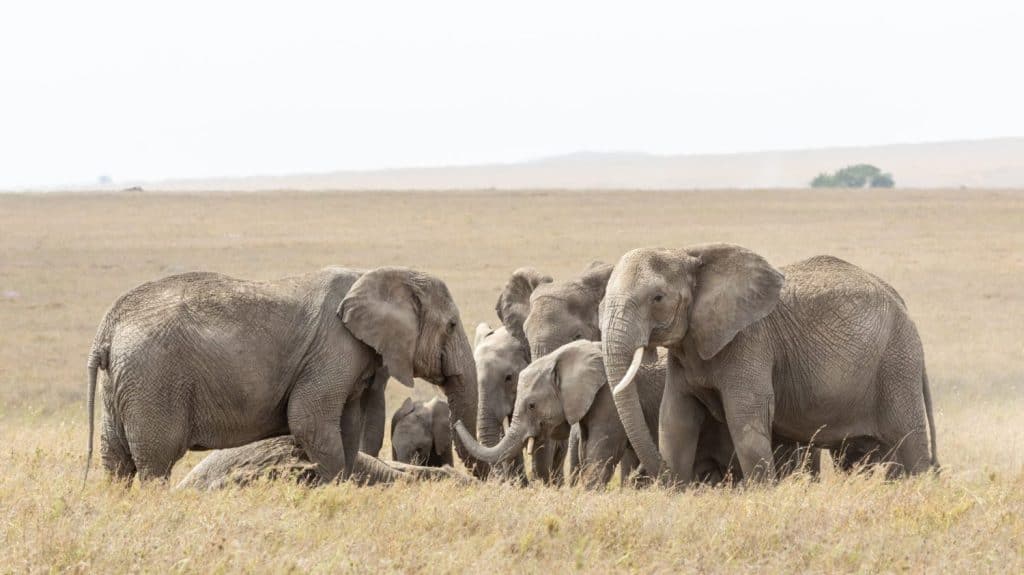
While animals communicate with each other, the longstanding scientific consensus was that they could not create novel sounds and sound combinations.
©Stu Porter/Shutterstock.com
Lie in a park for an hour, and you will likely hear a symphony of successive bird calls. There are whoops and tweets, all expressed in patterns that seem to imply purpose. Many forms of communication between non-human animals show similarities to human language. There are signs and movements exchanged between animals of the same species that seem to be produced intentionally.
However, the general academic consensus is that animal communication systems are primitive. They seem to be missing key aspects that would make them as complex or dynamic as human languages. One of those is the fact that humans can create new patterns of vocal signs depending on the circumstances. This has led some researchers, such as linguist Charles Hockett, to argue that human and animal languages are so different that they are unrelated. However, the study from Colorado State University challenges aspects of the widespread scientific consensus about animal communication.
Say My Name
It can be argued that language is a socially necessary technology. It is born of the need for individuals to communicate within ordered, complex social groups. While elephants and humans diverged evolutionarily tens of millions of years ago, both species remain highly social and communicative. Like humans, elephants live in family units that themselves belong to social groups and larger clan structures.
Managing these relationships, factions, and interactions likely drove the development of arbitrary vocal labels. George Wittemyer, co-author of the new paper and a professor at Colorado State University’s Warner College of Natural Resources, believes such needs drove the novelty of names. He said in a news release, “It’s probably a case where we have similar pressures, largely from complex social interactions. That’s one of the exciting things about this study: it gives us some insight into possible drivers of why we evolved these abilities.”
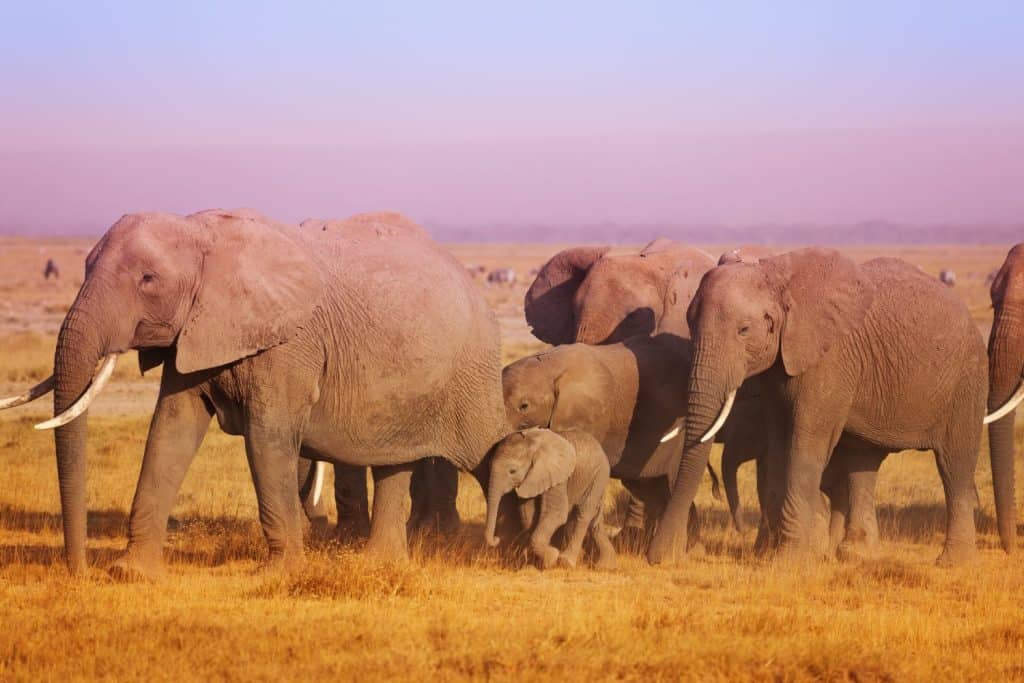
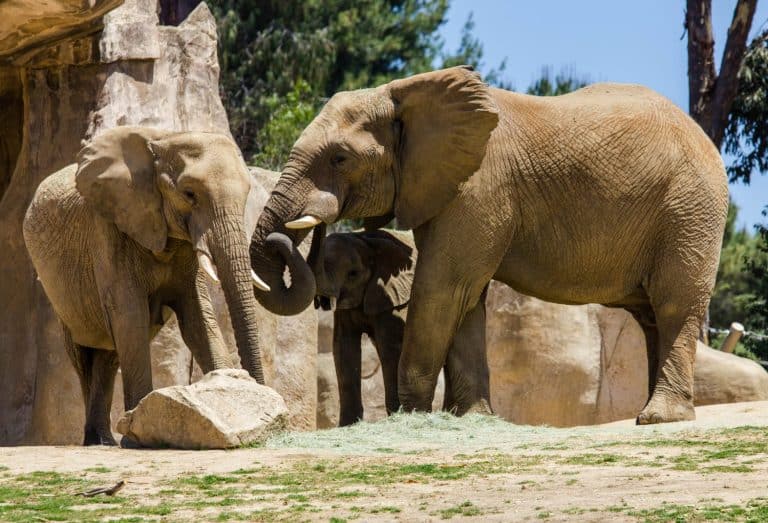
Elephant vocalizations range from blistering, trumpet-like loud noises to almost imperceptible, infrasonic sounds.
©Sergey Novikov/Shutterstock.com
Hang around a group of elephants long enough, and you will see just how chatty they can be. Elephants communicate constantly, whether through blustering trumpet-like calls or in more subtle mediums of sight, scent, and touch. Their vocalizations span a wide frequency spectrum, including infrasonic sounds that are inaudible to humans.
We Have the Technology
To figure out exactly what elephants are saying to each other, scientists had to develop the tools to decode their language. Kurt Fristrup, a research scientist at Colorado State University’s Walter Scott, Jr. College of Engineering, took on the task. He created a new signal processing technique to detect subtle differences in vocalization structure. Then, Fristrup and lead author Michael Pardo trained a machine-learning model to correctly identify elephant calls based on their unique acoustic features.
The researchers were surprised by the results. Other animals can address each other as individuals, but they typically do so by imitating the signature call of the addressee. That’s how dolphins and parrots do it. The researchers’ findings, however, showed that elephants do not imitate to address others. As Pardo said in the release, “Our data suggest that elephants do not rely on imitation of the receiver’s calls to address one another, which is more similar to the way in which human names work.”
The complexity of a language depends on the ability to create new sounds. This ability is uncommon for animals, but required for identifying individuals by name. This level of abstraction—using sounds to represent an idea without direct imitation—is a form of arbitrary communication that elephants seem to possess. As Fristrup said, “Our finding that elephants are not simply mimicking the sound associated with the individual they are calling was the most intriguing. The capacity to utilize arbitrary sonic labels for other individuals suggests that other kinds of labels or descriptors may exist in elephant calls.”
Tenacious Translation
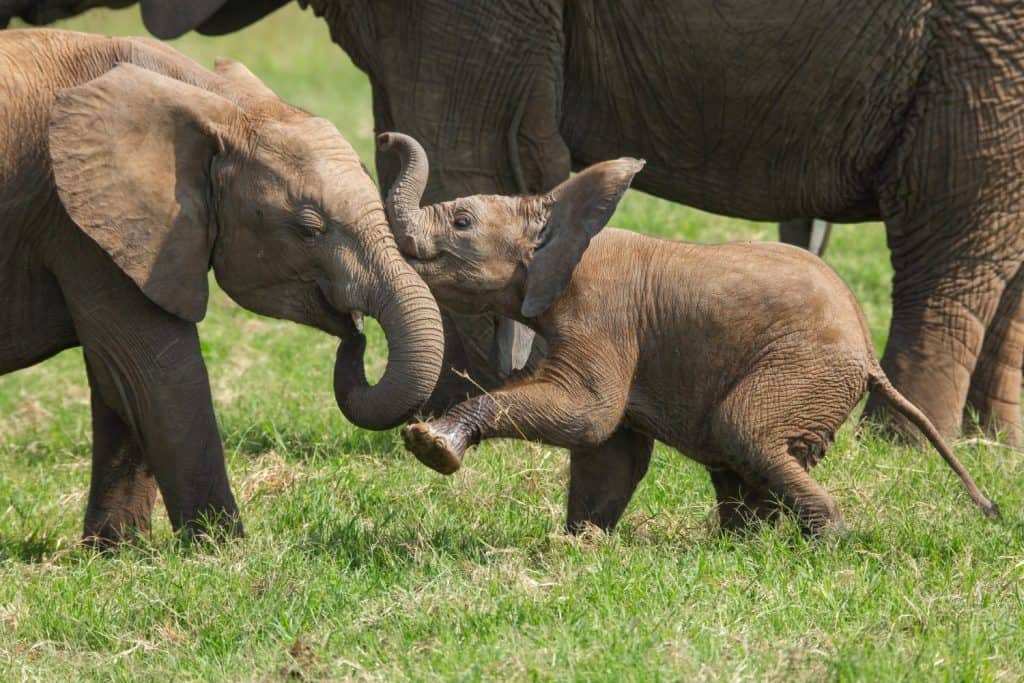
Researchers found that elephants addressing each other by name was a practice mostly reserved for communication over long distances or between adults and calves.
©Chedko/Shutterstock.com
Achieving such novel results required significant legwork. Researchers spent four years, including 14 months of intensive fieldwork in Kenya, to record the elephants and make their findings. They captured about 470 distinct elephant calls. These came from 101 unique callers, corresponding to 117 unique recipients in Samburu National Reserve and Amboseli National Park.
Once the researchers obtained quality recordings, they played back samples to the herd. Elephants would respond positively and animatedly to recordings “of their friends and family members calling to them, but did not react enthusiastically or move toward calls directed to others.” This demonstrated that elephants could, at least to some extent, recognize their names.
Researchers also found that name-calling wasn’t useful for elephants when they were near each other. Like people, elephants don’t use each other’s names as often during direct conversation. Instead, such name-calling seems to occur more often at a distance or when adults are communicating with calves. People have long considered elephants to be intelligent, wise, and even spiritual animals. Many point to elephants’ tendency to mourn their dead as just one indication of their inner lives. These findings greatly expand our understanding of elephant intelligence.
Future Implications
The researchers from Colorado State University are confident that elephants know each other’s names. Understanding their language systems beyond that, however, will require more research and technology. The researchers stated that much more data is needed to isolate the names within the calls and to determine whether elephants name other things they interact with, such as locations, food, and water.

Elephants are considered an endangered species due to extensive poaching and habitat loss. Being able to communicate with these creatures, even on a basic level, could be a game-changer when it comes to protecting them.
©binoymarickal/Shutterstock.com
There are also challenges to gathering that data. As George Wittemyer said, “Unfortunately, we can’t have them speak into microphones.” However, the novel techniques developed by Kurt Fristrup and his colleagues have provided a glimpse into a world most people didn’t know existed. As such, the team’s findings have significant implications for both our understanding of animals and for conservation efforts.
Elephants are classified as endangered due to extensive poaching for their ivory tusks and habitat loss caused by human development. Their large size and strength can also lead to serious conflicts where elephant habitats and human settlements overlap. The researchers hope that their new insights into elephant intelligence and communication could help strengthen the case for conservation. As Wittemyer explained, communicating with elephants may be a distant dream, but it would be a game-changer. He said, “It’s tough to live with elephants when you’re trying to share a landscape, and they’re eating crops. I’d like to be able to warn them, ‘Do not come here. You’re going to be killed if you come here.'”