Quick Take
- Larger, more tolerant chimpanzee groups manage shared resources more effectively and exhibit less aggressive competition than smaller, more competitive groups.
- Tolerance functions as a group-level strategy, allowing individuals to coordinate, read social cues, and avoid unnecessary conflict.
- Chimpanzees follow informal leaders whose behavior improves group cooperation, suggesting leadership and social influence have deep evolutionary roots, not solely based on dominance.
From school to work to everyday life, you’ve likely been part of groups that work together smoothly and others that quickly devolve into squabbling factions. But have you ever stopped to ask yourself why some groups cooperate while others fall into conflict? Scientists have been asking versions of that question for decades, often by looking to our closest living relatives for clues. A new study published in Behavioral Biology adds an important piece to that puzzle by examining how chimpanzees handle what researchers call a “resource dilemma.” The results suggest that group size and social tolerance play a major role in determining whether cooperation or conflict prevails, and the findings may help explain the evolutionary roots of human cooperation.
The study shows that chimpanzees living in larger, more tolerant groups are better at sharing limited resources and more willing to follow leaders than those in smaller, more competitive groups. While this might seem obvious, scientifically demonstrating it in animals as complex and socially sophisticated as chimpanzees is a significant achievement. The research offers insights into how peaceful cooperation can emerge and persist, even when resources are scarce—insights that extend beyond the field of primatology.
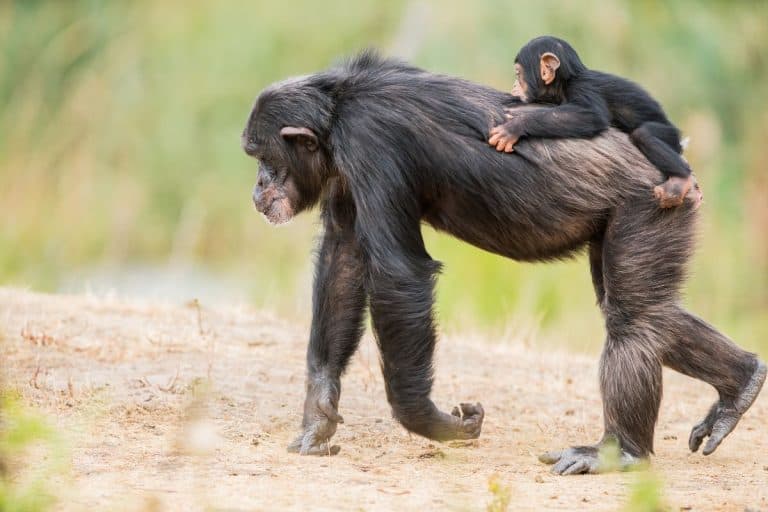
Chimpanzees face real-world resource dilemmas similar to humans, needing to balance individual gain with group cooperation to avoid conflict over limited food.
©Patrick Rolands/Shutterstock.com
What Is a “Resource Dilemma”?
The concept of a resource dilemma comes from social science and economics. It describes a situation in which individuals must choose between acting in their own immediate self-interest and cooperating for the benefit of the group. For example, a group of people lost in the desert comes across a barrel of water. If everyone scrambles to grab as much as they can, the resource will quickly be depleted, and conflict will likely erupt. Some individuals will end up much better hydrated than others. But if individuals restrain themselves and cooperate, the group as a whole can do better.
Humans face real-world resource dilemmas all the time, from managing fisheries and forests to deciding how to share office snacks. What makes this study compelling is that it shows chimpanzees, who split from the human lineage millions of years ago, face and resolve similar challenges in surprisingly sophisticated ways.
How the Study Was Conducted
The researchers observed multiple groups of chimpanzees under controlled conditions designed to mimic a shared resource problem. Researchers ensured the study was safe, but the setup required chimpanzees to choose between competing aggressively for food or tolerating others and following group strategies that allowed more individuals to benefit.
The researchers compared groups that differed in size and social temperament. Some groups were relatively small and prone to competition, while others were larger and known for more tolerant social interactions. By observing how each group behaved when faced with the same dilemma, the scientists could identify which factors were most important.
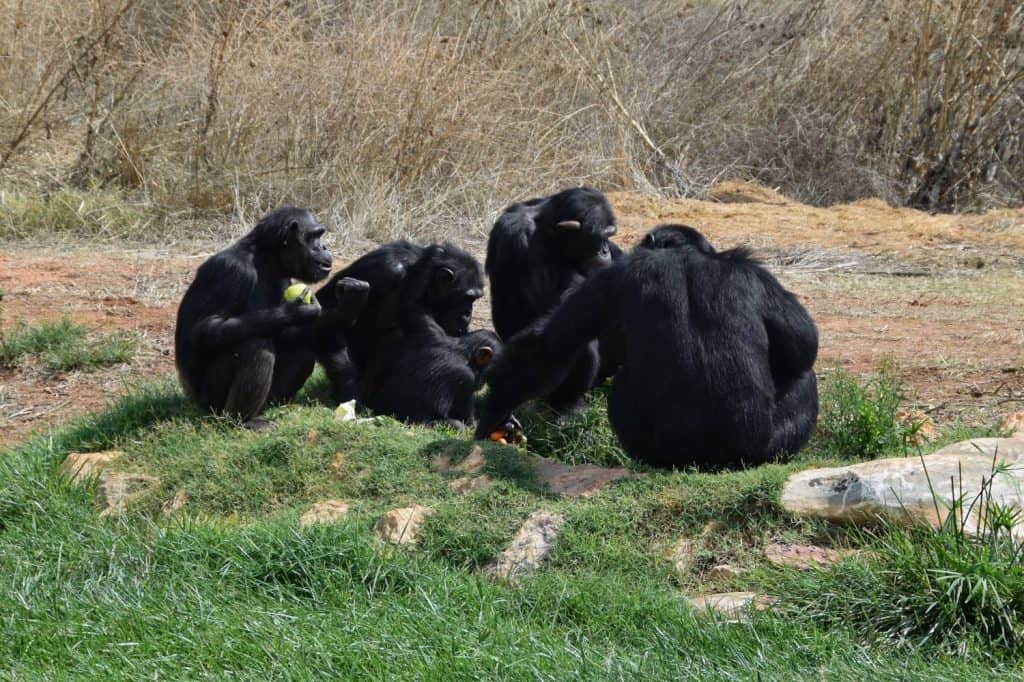
In larger chimpanzee groups, individuals restrained aggressive impulses, allowing better resource sharing and smoother group coordination.
©dimitris_k/Shutterstock.com
Larger Groups, Less Fighting
One of the clearest findings was that larger groups tended to manage the shared resource more successfully. Rather than descending into chaos, these groups displayed higher levels of tolerance, allowing individuals to access the resource without constant aggression.
This might seem counterintuitive. More individuals could mean more competition and more opportunities for conflict. Instead, the study found the opposite. In larger groups, chimpanzees appeared more willing to restrain themselves, perhaps because outright fighting would be costly and disruptive when many individuals are involved.
In contrast, competitive behavior was more likely to dominate in smaller groups. Individuals in these groups often attempted to monopolize the resource, leading to more conflict and less overall sharing.
The Role of Tolerance
Tolerance turned out to be a key ingredient, but not in the soft, feel-good sense the word often implies. In this study, tolerance meant something much more practical: a willingness to allow others close access to valuable resources without immediately responding with threats or force.
What mattered wasn’t simply that these groups were more tolerant, but how that restraint changed the group’s behavior. In more tolerant groups, chimpanzees spent less time jockeying for position and more time coordinating their actions. They were more likely to wait briefly rather than rush in, read social signals from nearby individuals, and avoid confrontations that could disrupt access for everyone. The result was a smoother flow of activity and a more efficient use of the shared resource.
Crucially, this tolerance wasn’t just a collection of individual personalities. Some groups consistently behaved this way, while others didn’t, even when the individuals themselves varied. This suggests that tolerance is a group-level strategy shaped by past interactions, social relationships, and environmental pressures. In other words, tolerance appears to be something groups develop because it works, not simply a trait a few particularly nice chimpanzees happen to possess.
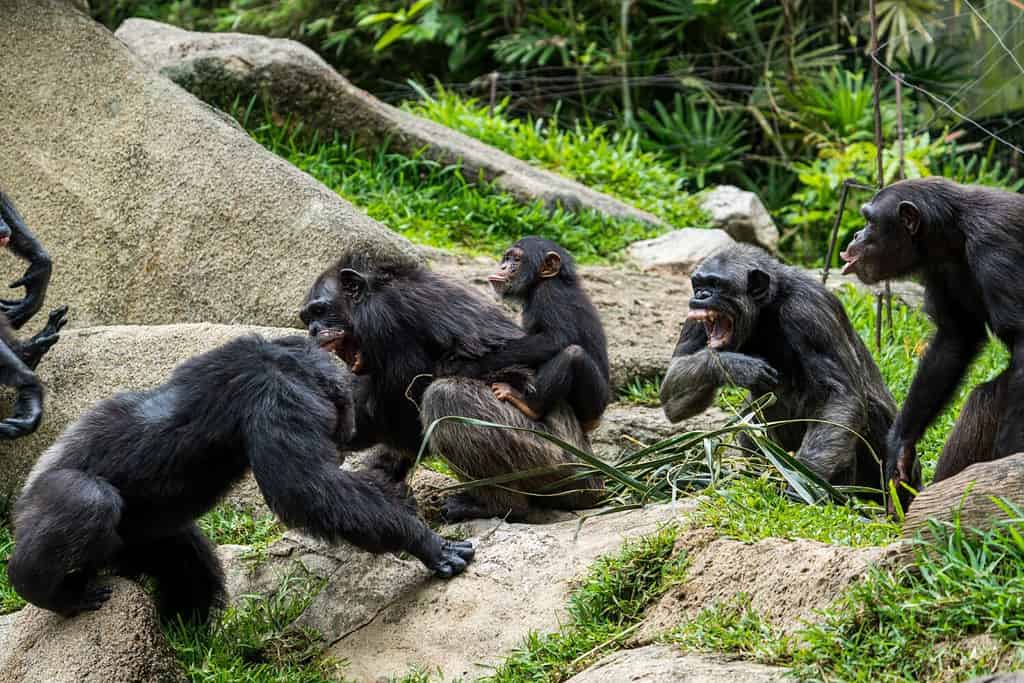
When tolerance was low, chimpanzees were more likely to compete aggressively for resources, a pattern that disrupted coordination and limited how many individuals could benefit.
©Hit1912/Shutterstock.com
Following Leaders When It Counts
Another intriguing finding involved leadership. In larger, more tolerant groups, chimpanzees were more likely to follow the actions of certain individuals who effectively guided the group’s behavior. These were not leaders in the human sense of issuing commands or enforcing rules, but individuals whose actions others observed and imitated.
Following these informal leaders helped the group coordinate its behavior and avoid destructive competition. In smaller, more competitive groups, this kind of leadership was less effective or broke down entirely, as individuals were more focused on their own immediate gains.
This aspect of the study hints at deep evolutionary roots for leadership and social influence. The chimpanzees weren’t simply deferring to an “alpha” individual out of habit or fear. Instead, they appeared more likely to follow individuals whose behavior helped the group function more smoothly in that moment. When a chimp’s actions reduced conflict or made the shared resource easier to access, others tended to fall in line. This suggests that the ability to recognize and follow effective leadership, especially when cooperation is beneficial, may not be uniquely human.
What Can Humans Learn From This?
Chimpanzees are our closest living relatives, so their behavior offers clues about the origins of human social instincts. This study suggests that cooperation, tolerance, and context-dependent leadership did not suddenly appear in human societies, but likely evolved from strategies already present in our common ancestors.
Environmental conditions also matter. When resources cannot easily be monopolized and fighting is costly, tolerance and cooperation become the most effective strategies. Over time, these pressures can shape social systems that reduce conflict and promote group success. This insight has clear parallels in human history: as communities grew larger and more interconnected, new norms regarding sharing, fairness, and leadership became necessary for societies to function.
Importantly, cooperation isn’t fragile. In the chimpanzee groups studied, peace did not result from coercion—it emerged because cooperation was more effective than conflict. Conflict still occurred, but it did not dominate or prevent groups from accessing shared resources, demonstrating that tolerance and cooperation can be stable strategies under the right circumstances.
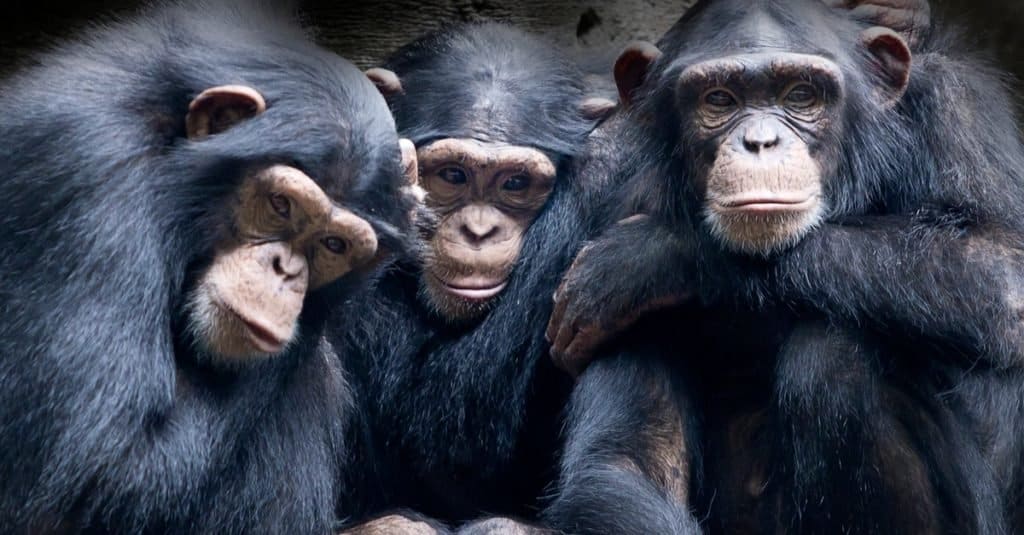
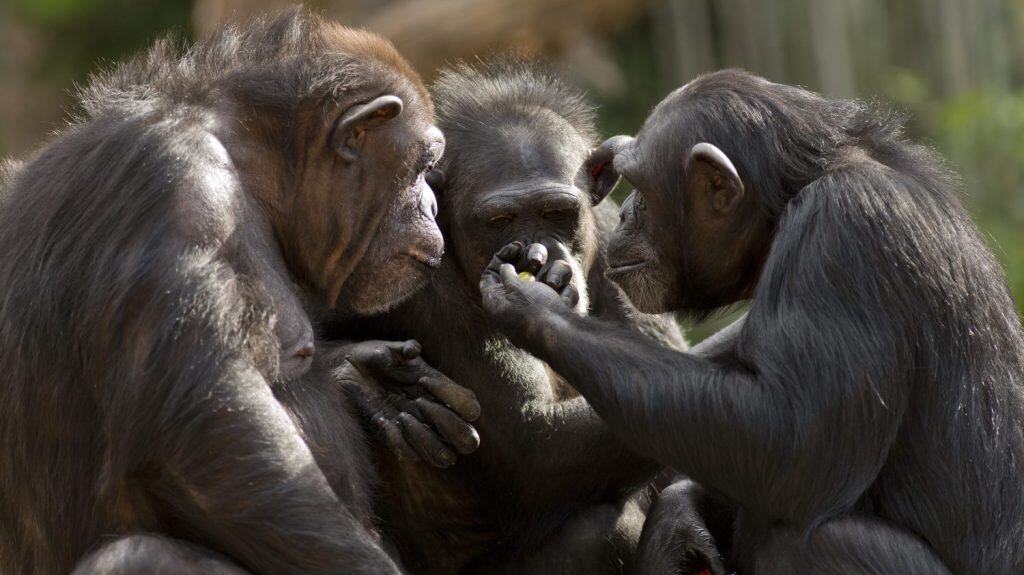
Understanding chimpanzee social dynamics helps explain human cooperation, illustrating how shared resources, group size, and leadership shape collective behavior.
©Lili Aini/Shutterstock.com
Beyond Primatology
These findings have broad implications for human societies. Understanding how group size, social tolerance, and leadership interact could inform research in psychology, sociology, and political science, especially when it comes to managing shared resources. The study highlights that cooperation is rooted in evolution and can emerge even without language, laws, or formal institutions.
Ultimately, this research shows that our ability to cooperate is not just cultural—it is part of a long lineage of social strategies shaped by living together in a finite world. By studying chimpanzees, we can better understand the conditions that make peace and cooperation possible, across the animal kingdom and in our own species.