
Quick Take
- These Saharan ants reach speeds of up to 0.855 meters per second on sand that can reach up to 70 degrees Celsius (158°F).
- A 10-minute window restricts foraging activity before lethal thermal thresholds force the ants to retreat underground to avoid fatal overheating.
- Relying on the sun as a navigation tool proves counterintuitive for surviving extreme surface radiation.
- Specific path integration methods allow for a direct return after complex scouting routes across shifting dunes.
Imagine sprinting barefoot across a searing hot parking lot in midsummer. The ground blazes. The light dazzles and blinds your eyes. Shade is a distant memory. And you want to move as fast as you can with as little contact with the ground as possible. Now scale that scene down to insect-level, and you’ll have a glimpse of the world of the Saharan silver ant, a desert scavenger that moves when most animals quit. Dashing across sand that can reach up to 190°F, it has minutes to be in the open, not hours. If it hesitates, it’s toast. Literally.
It doesn’t rely on luck, but rather on an instinct for timing, anatomy, astronomy, and math. It waits until midday, when predators retreat. Then it races out to find insects that have collapsed from the heat and quickly returns before it risks overheating itself. The ant spends little time outside, grabs food fast, and bolts home. And it does so at a speed that, if scaled up to human size, would be nearly twice as fast as a Formula 1 race car.
Broiled From Above, Baked From Below
In the Sahara, extreme heat comes from both the sky and the ground, creating one of the most punishing environments on Earth. Midday air temperatures can climb above 110°F, but the sand surface often becomes far hotter, reaching 160 to 190°F under direct sunlight.
That means an animal moving across the dunes is not only blasted by solar radiation from above, but also exposed to intense heat radiating upward from the ground. The surface can act like a giant hot plate, making even brief contact dangerous. This double-layered heat is why survival in the open desert depends on narrow margins, and why creatures there have evolved specialized adaptations to avoid being cooked from both directions.
An Ant That Looks Like a Race Car
One of these is the Saharan silver ant, Cataglyphis bombycina, a small insect less than half an inch long with unusually large eyes that help it navigate across the featureless North African desert. It gets its name from its striking metallic sheen. Its body is covered in dense, pale hairs that make it look almost like a tiny race car shimmering across the dunes. But those hairs are not just for show. They play a critical role in survival, helping the ant reflect harsh sunlight and release heat through radiation—an essential advantage when the desert sand can become far hotter than the air above it.
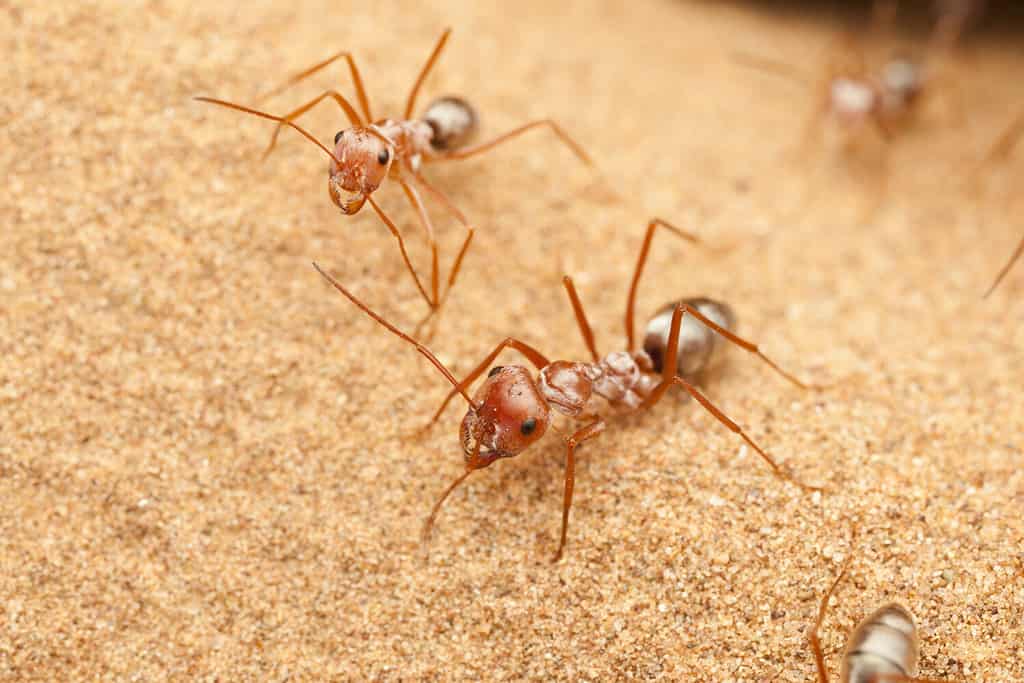
The Saharan silver ant’s pale sheen and long legs help it survive extreme heat on desert sand.
©Pavel Krasensky/Shutterstock.com
The ant’s silvery coat reflects both visible and near-infrared light, reducing how much solar energy its body absorbs. Researchers have also found that the unique structure of these hairs supports heat loss through thermal radiation, especially in mid-infrared wavelengths. Under the open desert sky, this allows the ant to shed excess heat more efficiently, preventing dangerous overheating during its brief foraging runs.
The Desert’s Daily Schedule
This ant does not roam all day. It works inside a narrow time window. It often comes out near the hottest part of the day, when many predators stop moving. That timing flips the normal food race. Other scavengers hide, and heat-stunned insects become easy pickings. The ant turns a brutal climate into a competitive edge.
Colonies stay mostly underground. Workers handle brood care, nest upkeep, and food processing below the surface. Above ground, the foragers act like short-burst sprinters. They leave, search, collect, and return quickly. In some field observations, their above-ground activity is typically limited to about ten minutes per day. That is not laziness; that is physics forcing a schedule.
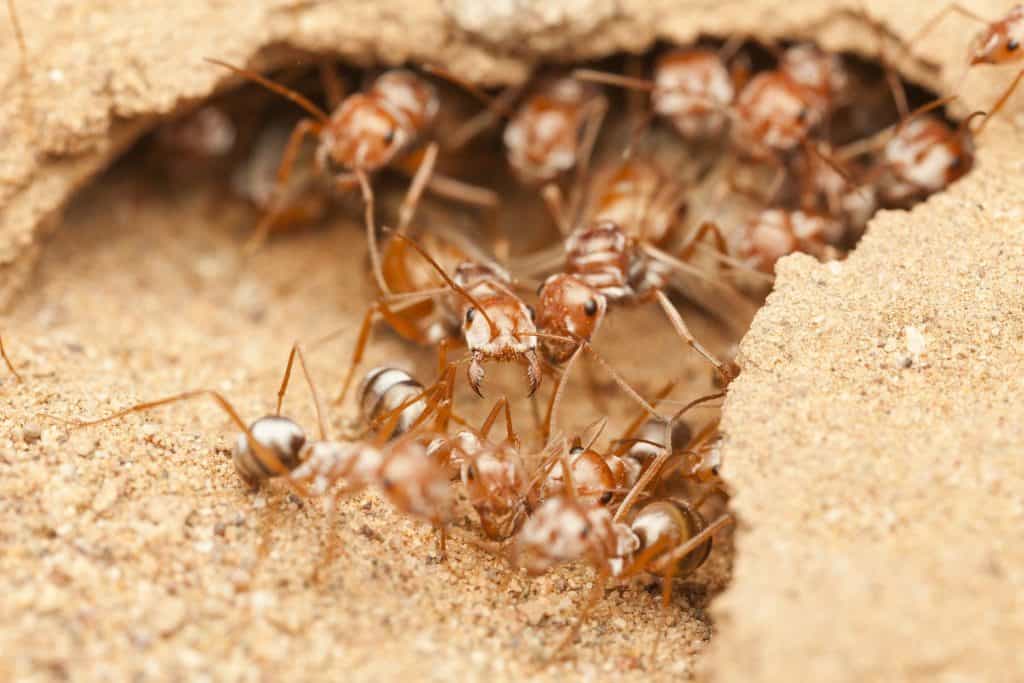
Saharan silver ant colonies spend most of their time underground.
©Pavel Krasensky/Shutterstock.com
Fried Food on the Griddle
The Saharan silver ant survives by exploiting a dangerous window of time when few other animals can remain active. During the hottest midday hours, extreme heat kills or disables many small desert insects, and the silver ant takes advantage of this. It often scavenges the bodies of heat-stricken arthropods that collapse on the sand surface. These can include other ants from less heat-tolerant species, flies, small wasps, and beetles that become overwhelmed by the temperature.
In particular, many insects that forage earlier in the morning or late in the day may be caught off guard if the heat rises quickly, leaving their remains available as food. By specializing as a rapid scavenger of animals that cannot withstand the Sahara’s midday sun, the silver ant turns one of the harshest conditions on Earth into a reliable feeding opportunity.
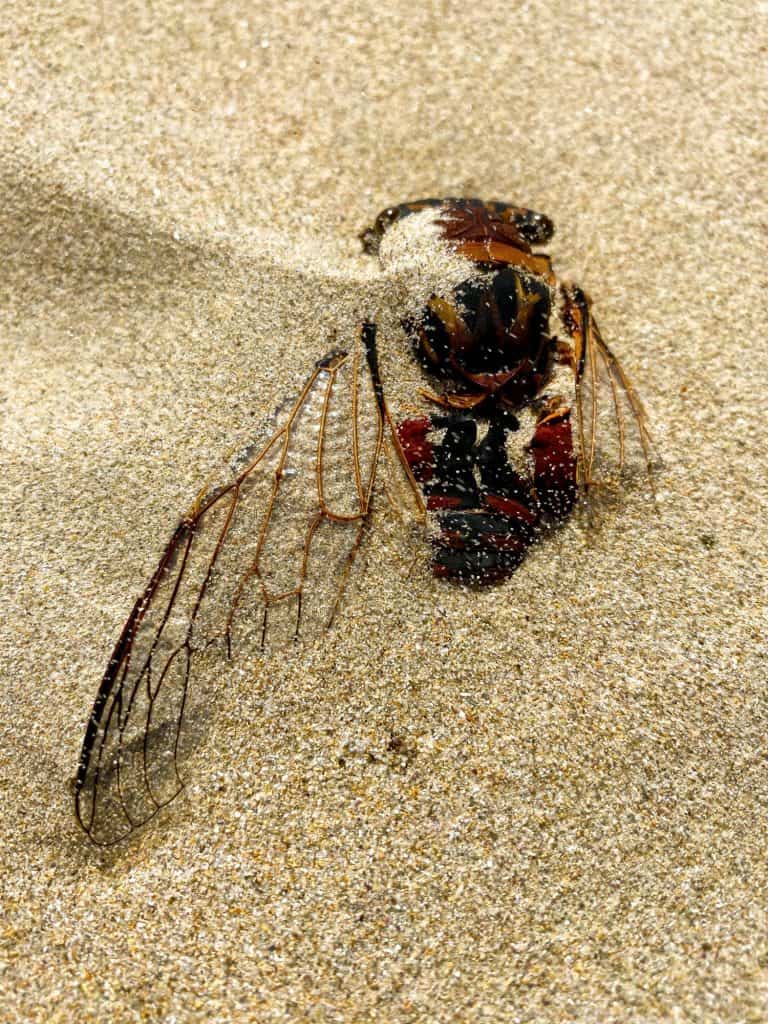
A cicada overwhelmed by heat can be a substantial food source for a Saharan silver ant colony.
©LachWHD/Shutterstock.com
A Need for Speed
To take advantage of this daily bonanza, the ant’s gait helps it run at insane speeds. It has a pattern to put the fewest number of legs in contact with the ground at once. That reduces heat transfer and supports rapid stride cycling. And that makes it the world’s speed record holder among ants. Researchers have measured top speeds around 3 feet per second, which is about 2mph.
But to put that in perspective, for the ant, this is 108 body lengths per second. If a human could move at the same relative speed, a person about 6 feet tall would be running roughly 440 miles per hour—faster than a Formula 1 car. The Boston Marathon world record is 2 hours, 3 minutes, and 2 seconds. But if a human could run at the relative speed of the Saharan silver ant, they would shave that down to 3 minutes and 34 seconds!
Speed helps in two ways. It shortens exposure time, which protects the ant from overheating. It also expands the search range, which raises the odds of finding food before time runs out. So it would be accurate to say these ants truly have a need for speed.
Legs and Strategies for Fire-Walking
The ant’s anatomy and behavior are adapted to the hot surface on which it moves. Long legs lift the ant’s body into cooler air. Measurements and summaries of field work often cite a clearance of around 4 millimeters. At that height, the air temperature can drop several degrees compared to the surface. That difference can slow overheating. This can also reduce the heat load on the abdomen and thorax.
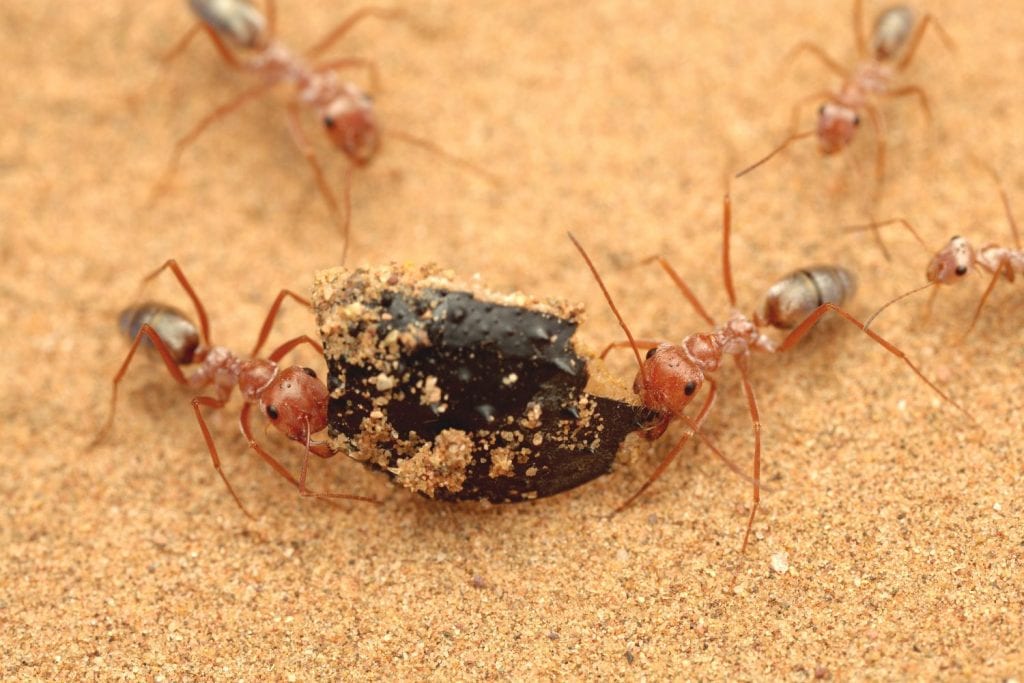
The unusually long legs of the Saharan silver ant help it move quickly and with the least amount of contact with the scalding hot sand as possible.
©Pavel Krasensky/Shutterstock.com
The legs also provide stability at speed. The ant makes rapid, high-frequency steps. It needs precise coordination to avoid wiping out and rolling around on scorching sand. Its body plan supports that. A lighter body and long limbs help it maintain momentum. The result looks like a tiny, frantic sprint, but the motion is tightly controlled.
Behavior matters too. Ants do not run nonstop in a straight line if the heat climbs too high. They can pause briefly and raise their body up off the sand to increase airflow. They can also seek micro-shade from small stones. These seem like small wins, but because these ants are constantly within minutes of being scorched alive, every little bit counts.
A Heat Shield From Predators
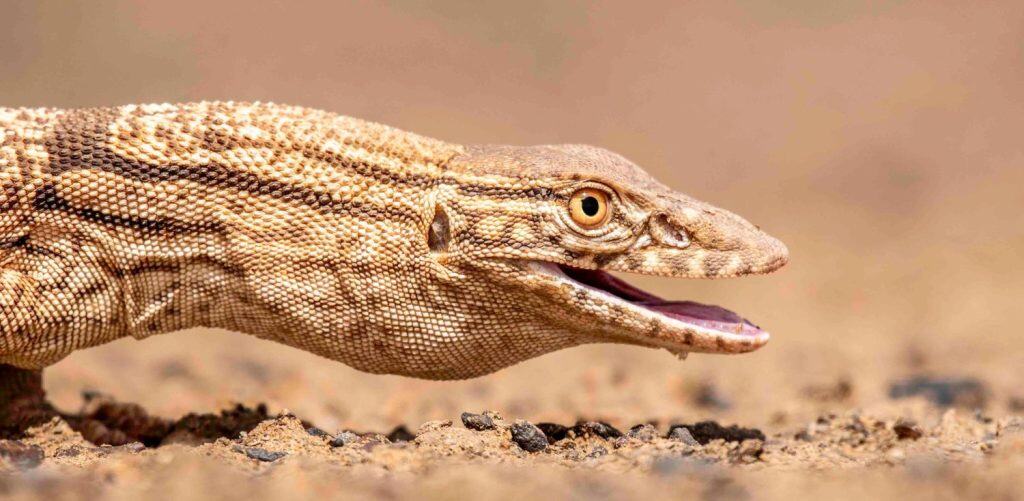
Reptiles like the desert monitor (Varanus griseus) prey on ants in the Sahara.
©Bouhayek/Shutterstock.com
The Saharan silver ant uses desert heat as a shield from predators by foraging during the hottest midday hours when many predators retreat to shade from the extreme temperatures. Ants face threats from a range of desert predators. In the Sahara, insectivorous birds and ground-dwelling spiders, scorpions, and lizards may snatch workers on their errands. Competing desert ants may attack foragers or raid colonies as well. That’s why these ants have developed a strategy of coming out only when the risk of predation is lowest.
Counting Its Daily Steps
The silver ant doesn’t depend on scent trails the way many ants do, because heat and wind can erase chemical signals quickly in the desert. Instead, it relies on a navigation system that combines internal tracking with sky-based cues. Scientists call the core process “path integration.” As the ant runs, it continuously keeps track of its own movements—how far it has gone and in what direction—by counting steps and sensing turns.
We know this step-counting system is real because researchers have tested it directly: in classic experiments, ants were trained to travel a set distance to food, and then scientists altered their leg lengths. Ants with artificially lengthened legs walked too far past the nest, while ants with shortened legs stopped too soon. Since stride length was the only variable changed, the results showed the ants were estimating distance by counting steps.
Navigating By the Sun
The ant also tracks direction by sensing its turns through internal body feedback and by using celestial information. Desert ants can detect patterns of polarized light in the sky, along with the sun’s position and brightness gradients, which act like a compass.
In experiments, researchers manipulated polarized light patterns or shifted the apparent compass cues, and the ants adjusted their homeward paths in predictable ways. This demonstrates that they actively treat the sky as a navigational reference. Together, step counting, turn sensing, and sky-based orientation allow the silver ant to return home accurately even when landmarks are scarce and the desert terrain looks nearly identical in every direction.
An Inspiration for Technology
The Saharan silver ant has become a powerful source of inspiration for technology because it solves problems that engineers struggle with: staying cool, moving efficiently, and navigating reliably in extreme environments. These applications are useful not only on Earth, but also have vast potential for informing the design of rovers that traverse the landscapes of other planets in our solar system and beyond.
Researchers have pointed to this ant as an example of passive cooling materials that could help buildings, vehicles, or wearable gear stay cooler without using extra energy. Its long legs and rapid gait also inspire ideas in robotics, especially for machines that need to travel across hot or unstable terrain while minimizing contact with the ground.
Its silvery hairs reflect sunlight and enhance heat loss through radiation, offering a natural model for designing reflective coatings for vehicles, machinery, and buildings, or clothing fabrics that reduce overheating. Even its navigation system—combining internal movement tracking with sky-based compass cues—has relevance for autonomous drones or desert robots that must operate where landmarks are scarce, and GPS may be unreliable. By turning deadly desert conditions into an advantage, the Saharan silver ant shows how biology can guide new approaches to heat management, mobility, and resilient design.